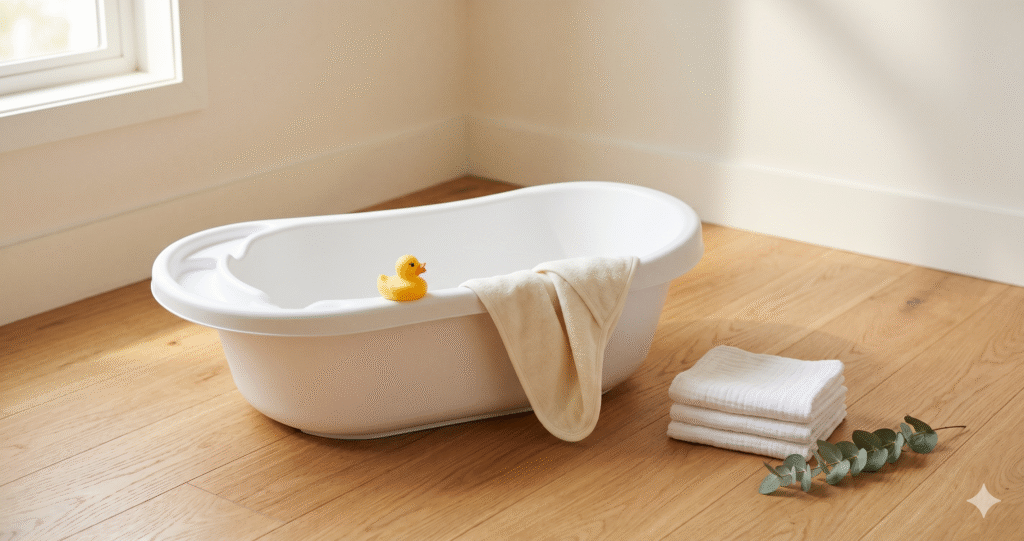
Modern white baby bathtub on hardwood floor with cream baby towel and rubber duck — best baby bathtubs 2026 guide

Best Baby Bathtubs 2026: 7 Tested Picks from a Mom of 3 (Recall-Aware Guide)

This post contains affiliate links. As an Amazon Associate, I earn from qualifying purchases. If you buy through our links, we may earn a small commission at no extra cost to you. All products are independently researched and recommended based on real parent needs — never sponsored.

My daughter’s first bath at home was a disaster. My husband held her under the arms like she might shatter, I was trying to pour warm water from a measuring cup, and the “infant tub” we’d been gifted had a mesh sling that already smelled funny after one use. She cried. I cried a little. The dog watched us like we were insane.

That was almost seven years ago. Since then I’ve bathed three babies: that same daughter (now 6), my older son (now 3), and my youngest son (19 months and still in the splash-chaos phase). We’ve owned more baby bathtubs than I’d like to admit. Some were brilliant. Some molded within a month. One nearly got recalled.

If you’re sitting here trying to figure out which one to buy in 2026, I want to save you the trial and error. This guide covers the seven bathtubs worth your money this year, plus a few you should steer clear of. The baby bath market got noticeably messier in the last 18 months, and most roundup articles haven’t caught up.

⚠️ What Changed in Baby Bathtub Safety in 2025–2026

This section isn’t fluff, so please don’t skip it. A lot of “best of” lists haven’t been updated to reflect what happened recently.

Between late 2024 and early 2026, the U.S. Consumer Product Safety Commission (CPSC) issued at least six separate recalls involving baby bath products sold on Amazon. Four of them were tipping-hazard bath seats from Amazon third-party sellers (YCXXKJ, NFSVLB, Trankerloop, and BenTalk). Another was Bebamour. The most recent was the Napei Collapsible Baby Bathtub in early 2026, pulled because the button-cell battery in its built-in thermometer was accessible to small children, a potentially fatal ingestion risk.

None of the tubs on my list below are affected. But the pattern matters. Collapsible bathtubs with built-in LCD thermometers are flooding Amazon right now, usually $25–40, usually from brands you’ve never heard of. Many are sold under different names but look suspiciously identical. The Napei recall is likely not the last one in that category.

My rule for 2026: I won’t buy a bathtub with an electronic thermometer built into it, and I won’t buy a suction-cup “bath seat” from an unknown Amazon brand. A $5 standalone bath thermometer (or honestly, your wrist) works just fine.

Quick Comparison: All 7 Picks

Bathtub Best For Age Price Why I Picked It
Skip Hop Moby 3-Stage Best Overall 0–25 lbs ~$40 Industry standard, grows with baby
First Years 4-in-1 Reclining Best Budget (No Sling) 0–24m ~$30–40 Patented recline replaces the moldy sling
Boon SOAK 3-Stage Best Sink-Friendly Basin 0–18m ~$40 No sling to mold, fits double sinks
Frida 4-in-1 Grow-with-Me Best for 1–3 Year Olds 0–3y ~$45 Roomy for toddlers, adjusts for longevity
Angelcare Soft Touch Bath Support Best for Newborns (0–6m) 0–20 lbs ~$20 Drain-through mesh, genuinely mold-resistant
Puj Tub Best for Tiny Apartments 0–17 lbs ~$45 Folds flat, sink-only, space saver
Stokke Flexi Bath X-Large Bundle Best Foldable (0–6 yrs) 0–46 lbs ~$99 Longest lifespan, includes newborn support

How I Chose (and Tested) These

By the time my third baby arrived, I had very little patience for products that look good in photos and fall apart in real life. For this guide I pulled in everything I owned, everything I’d borrowed from my sister-in-law, and everything my mom group wouldn’t stop talking about. Then I cross-checked the contenders against CPSC’s recall database, the American Academy of Pediatrics’ current bathing guidance, and a pile of Amazon reviews (specifically the 3-star ones, where the real information lives).

A few things I refused to compromise on:

  • Mold resistance. If a tub grows mold within 3 months of normal use, it’s disqualified. I don’t want to scrub bleach into my baby’s bath every week.
  • No electronic thermometer. For reasons I explained above.
  • A stable, non-slip base. No tipping. No surprises.
  • Honest age ratings. Some “0–24 month” tubs are really 0–9 month tubs if your baby is on the bigger side, and I’ll flag that where it applies.

The 7 Best Baby Bathtubs of 2026

1. Skip Hop Moby 3-Stage — Best Overall

Ages: 0–25 lbs (birth through ~2 years) · Price: ~$40 · Amazon rating: 4.5+ stars

The Skip Hop Moby is the tub you see recommended everywhere for a reason. It’s whale-shaped (which my daughter loved), has a smart sling that locks into two positions — higher for tiny newborns, lower for wobbly sitters — and the sling comes out entirely once your baby can sit upright, which gives you a roomy tub until they’re nearly two.

We used this one from my daughter’s first week home until she was over a year old. It fits across our adult bathtub, has a hook for hanging it to dry, and is light enough (3.6 lbs) to move around one-handed. The non-slip interior texture actually works.

Here’s where I need to be honest, because nobody else seems to mention this: the mesh sling will eventually mold. Mine did, around the 4-month mark, even though I rinsed and hung it after every bath. It’s a mesh-in-a-humid-tub design flaw, and the replacement slings aren’t sold separately. Most people end up either scrubbing it with vinegar weekly, or switching off the sling earlier than intended.

The other small gripe: there are warning stickers inside the tub that are nearly impossible to fully remove, and they eventually start deteriorating and shedding tiny paper flakes into the water. Peel them off before first use.

✓ ProsRoomy and durable · Smart sling grows with baby · Fits most adult bathtubs · Easy drain plug · Hangs to dry
✗ ConsSling will mold (plan to replace or retire it by 4–6 months) · Interior stickers disintegrate · Too big for most kitchen sinks

Best for: First-time parents who want the industry standard and will be bathing baby in the adult tub. Check price on Amazon →

2. First Years Sure Comfort 4-in-1 Reclining — Best Budget (and No Sling)

Ages: 0–24 months (up to 25 lbs) · Price: ~$30–40

This one’s a newer release (2024) and it’s my pick for anyone who wants the grow-with-baby concept without the mold-prone mesh sling. The patented recline adjusts in seconds between four positions: a near-flat newborn cradle, a mid recline for 3–6 months, an upright back support for first-time sitters, and a full toddler bath on the opposite side.

Because there’s no fabric or mesh anywhere, there’s nothing to mold. That alone makes it worth the price. It’s essentially the Skip Hop Moby experience, minus the part I complain about above.

I’ll be upfront: this model is too new for me to have personal long-term use data. I’m recommending it based on the design (which is genuinely clever), the established reputation of the First Years brand (their original Sure Comfort tub has been a budget staple for 20 years), and early reviews that are almost entirely positive. If the recline mechanism holds up long-term, this becomes my top budget pick.

✓ ProsNo sling, no mold · 4 positions adjust in seconds · Budget-friendly · Works in adult tub or as a kitchen-counter tub for small babies
✗ ConsNewer product, long-term durability of the recline mechanism still being validated · Smaller review pool than the classics

Best for: Budget-conscious parents who want grow-with-baby features without the mold headache. Check price on Amazon →

3. Boon SOAK 3-Stage — Best Sink-Friendly Basin

Ages: 0–18 months · Price: ~$40

The Boon SOAK is what I used with my daughter after we retired the Skip Hop sling. It’s a sleek, no-frills basin with an adjustable bump at the bottom and a contoured back for reclining. No sling. No mesh. Nothing to grow mold on.

The footprint is small enough to fit inside most double kitchen sinks, which saved my back for months. Once my daughter was too big for the sink, we moved it into the adult tub. The non-slip foam on the back held her steady through the sitting-up phase.

Two things to flag. First, the color-changing drain plug (it’s supposed to turn white when the water is above 100°F) is hit or miss. Mine stopped working within a few weeks. Use a real thermometer or your wrist. Second, the tub runs small. My daughter was a chunky 9-month-old and she was visibly crowded by then. If your baby is on the larger side, plan to transition out closer to 6 months than 18.

There’s also been a cluster of reviews about the foam backrest being torn or damaged on arrival. Not a dealbreaker, but worth inspecting when it shows up.

✓ ProsFits double sinks · No sling means no mold · Adjustable bump for growing baby · Simple, durable plastic construction
✗ ConsRuns small (plan to outgrow earlier than the 18m rating) · Color-changing plug unreliable · Inspect foam backrest on arrival

Best for: Parents who want to bathe baby in the kitchen sink for the first few months, then transition to the adult tub. Check price on Amazon →

4. Frida Baby 4-in-1 Grow-with-Me — Best for 1–3 Year Olds

Ages: marketed 0–3 years, but I use it as a 1+ tub · Price: ~$45 · Amazon rating: 4.1 (1,300+ reviews)

This is the tub my youngest son uses right now. And I want to be careful about how I recommend it, because the Frida 4-in-1 is marketed as a newborn-to-toddler tub and I genuinely don’t think it’s ideal for newborns.

The issue: in the newborn sling position, the seat angle pushes baby’s chin toward their chest in a way that isn’t comfortable for small infants. Multiple parents in the review section mention the same thing. I wouldn’t use it for the first 3–4 months.

But for a 1–3 year old? It’s genuinely great. My 19-month-old has room to splash, the bum bumper keeps him from sliding, and the removable sling (when we still used it) was machine-washable, which the Skip Hop sling is not. The drying hook, the easy-release drain plugs, and the no-slip feet all work as advertised.

One warning: the drain plugs leak. Not enough that the tub is unusable, but enough that Frida’s own customer support (in Amazon Q&A threads) tells buyers to place it inside the adult bathtub, not directly on a counter, because some water will escape. Also, the four little blue anti-slip stoppers on the bottom can trap water and mildew if you don’t remove and clean them periodically. The instructions don’t tell you to do this.

✓ ProsRoomy for older babies and toddlers · Machine-washable sling (rare feature) · Attractive modern design · Frida customer service is excellent
✗ ConsNot ideal for newborns (seat angle issue) · Drain plugs leak · Blue bottom stoppers trap mildew if not cleaned

Best for: Parents who want a tub that’ll take their toddler through preschool-age baths. Skip it for newborns. Check price on Amazon →

5. Angelcare Soft Touch Bath Support — Best Newborn Helper (0–6 Months)

Ages: 0–6 months (up to 20 lbs / 9 kg) · Price: ~$20

Before I get into why I love this one, a terminology clarification that’s going to come up again in the “what to avoid” section: the Angelcare is a bath support, not a bath seat. It doesn’t have suction cups. It doesn’t stand alone. You place it inside your regular adult bathtub and fill the tub with a few inches of water. Your baby reclines on the support, with water draining through the mesh.

This distinction matters because the “bath seats” getting recalled on Amazon are the suction-cup upright-seat kind. The Angelcare is a completely different category and is not part of that trend.

It’s also the one product on this list that I’ve genuinely never had a mold complaint about. The soft-touch mesh is made of TPE (thermoplastic elastomer), water drains straight through it, and there’s a built-in hook so you hang it up to air-dry between baths. It dries in about 30 minutes. After four years and two babies bathed on ours, it still looks new.

The only real caveats: it’s bulky to store (doesn’t fold), and it’s genuinely a 0–6 month product. Once your baby can sit up independently, you need something else. But for that specific window when you have a floppy newborn who’s impossible to hold one-handed, it’s a godsend.

✓ ProsDrain-through mesh genuinely resists mold · Leaves both hands free · Hook for easy storage · BPA/phthalate-free · Budget price
✗ ConsOnly usable inside a full-size adult bathtub (no independent water-holding) · Doesn’t fold · You’ll outgrow it around 6 months

Best for: New parents who want something simple, safe, and genuinely mold-proof for the first six months. Pair it with a regular bathtub. Check price on Amazon →

6. Puj Tub — Best for Tiny Apartments

Ages: 0–6 months (up to 17 lbs) · Price: ~$45

The Puj Tub is the baby-gear equivalent of a product you either love obsessively or can’t make work at all. It’s a piece of soft closed-cell foam, held in place with magnets, that conforms to your bathroom sink. No basin, no water-holding. You fill your sink with a few inches of warm water and your little one rests on the foam.

When it works, it’s magical. It folds flat to about an inch thick, hangs on a hook behind your bathroom door, weighs almost nothing, and the material is closed-cell foam so it doesn’t absorb water or grow mold. For a truly tiny apartment, it’s the best sink-insert option on the market.

When it doesn’t work, it really doesn’t. The Puj only fits sinks that are roughly 12–15 inches across and 6.5–9 inches deep. If your sink is too big, the tub slides around. Too small, your baby’s head will be wedged against the faucet. Measure your sink carefully before buying.

Two other things: your little one will outgrow the Puj quickly. Most babies have outgrown it by 3–4 months, not the advertised 6. And there are scattered reports of the holding magnets coming apart mid-bath. Not enough to tip baby into the sink, but enough to be jarring.

✓ ProsTakes up almost zero storage space · Closed-cell foam is truly mold-resistant · BPA/PVC free · Travel-friendly · Soft and comfortable for tiny babies
✗ ConsStrict sink size requirements · Short lifespan (plan on 3–4 months of use, not 6) · Magnets occasionally release · Small water volume means constant top-ups

Best for: Parents in studios, tiny apartments, or homes with no adult bathtub. Measure your sink first. Check price on Amazon →

7. Stokke Flexi Bath X-Large Bundle — Best Foldable and Longest Lifespan

Ages: 0–6 years (up to 46 lbs) · Newborn Support included (0–8m / 17.6 lbs) · Price: ~$99

The Stokke Flexi Bath is the premium pick, and it’s earned that title. It’s a full-size foldable bathtub made of BPA-free polypropylene and a flexible TPE joint system that lets it collapse flat for storage. The X-Large version is 31.5 inches long and rated to hold children up to 46 pounds. Unlike almost every other tub on this list, it’ll take your kiddo from newborn through preschool.

I want to flag an important update: until recently, the Newborn Support (the little infant insert that makes this tub newborn-safe) had to be purchased separately for around $20 extra. Stokke now sells Bundle versions that include both. If you’re buying it, buy the Bundle. The tub on its own is not ergonomic for a floppy newborn.

We’ve used ours mostly for travel. It folds down to fit in a large suitcase, and we’ve used it everywhere from my in-laws’ walk-in shower to a vacation rental with no bathtub. The heat-sensitive drain plug changes color if the water is too warm (and unlike Boon’s, Stokke’s still works after years of use). My husband, who is the designated “temperature checker” in our house, was weirdly delighted by it. Importantly, there’s no button-cell battery in the plug. It’s a thermochromic material change, not an electronic sensor. So it sidesteps the exact issue that triggered the Napei recall.

What drops it from a perfect score: the plug is genuinely hard to insert one-handed, which is a problem when your toddler pulls it out mid-bath. And while the tub itself is durable, I’ve seen reports from parents who used theirs for 3+ years of the silicone flex joints eventually developing small splits. Not a safety issue, but worth knowing.

It’s also JPMA certified and meets ASTM safety standards, which I mention only because almost no other tub in this price range bothers to get either.

✓ ProsLongest lifespan on this list (0–6 years) · Folds flat for storage and travel · Bundle includes Newborn Support · No electronic parts · JPMA + ASTM certified · Works for siblings sharing a bath
✗ ConsMost expensive option here · Plug is two-handed to operate · Long-term (3+ years) users report occasional silicone cracking at fold joints · Requires a flat surface to fully open

Best for: Parents who travel often, live in small homes, want one tub to last the whole baby-to-preschool window, or just want the premium option. Check price on Amazon →

What to Avoid in 2026

I don’t usually include “avoid” sections in my roundups, but the baby bath category has genuinely shifted in the last year and some warnings are worth making explicit.

🚫 Collapsible bathtubs with built-in LCD thermometers. This is the category that Napei got recalled from (button-cell batteries accessible to children). Amazon is full of visually similar listings, many from brands you’ve never heard of, priced $25–40. Even the ones that aren’t currently recalled are from the same design generation. A $5 standalone bath thermometer is safer and easier to replace.
🚫 Amazon “bath seats” with suction cups and arm restraints. Five different small brands of these (YCXXKJ, NFSVLB, Trankerloop, Bebamour, BenTalk) have been recalled since 2024 for tipping over. They fail the federal stability standard for infant bath seats. If you want a seat-style option for a 6+ month old, stick to major brands with long track records, and understand that the American Academy of Pediatrics is not enthusiastic about any bath seat. They create a false sense of security.
🚫 Terry cloth “lotus flower” sink inserts in humid climates. Products like the Blooming Baby Bath are adorable and soft, but the fabric petals hold moisture and can develop mold or bacterial issues if not dried aggressively (think putting them in the clothes dryer) after every use. If you’re in a humid climate or you’re not the aggressive-drying type, skip this category entirely.

Bath Seat vs. Bath Support vs. Bathtub — the confusion that matters

This distinction trips up almost every new parent shopping for a bathtub, and it’s exactly the confusion that leads to the wrong (and sometimes dangerous) purchase.

  • Bathtub = an actual tub that holds water. Skip Hop Moby, Boon SOAK, Frida, First Years, Stokke, Puj, etc. These are what most babies use for most of infancy.
  • Bath support = a mesh or foam cradle that goes inside your adult bathtub. No suction cups, no seat belt. Angelcare is the archetype. Safe and useful.
  • Bath seat = a plastic seat with suction cups and arm restraints, meant to sit in the big tub with an older baby. This is the category with the recall issues. The AAP recommends against these entirely because parents sometimes step away thinking the suction cups will hold. They don’t always.

When someone tells you about their “baby bath seat,” ask which of the three they actually mean.

The 4 Types of Baby Bathtubs, Explained

If you’re still overwhelmed, here’s the simplest way to think about categories:

Basin tubs are the most common and versatile. You fill them with a few inches of water, and they sit either in your adult bathtub, in a double kitchen sink, or on a counter. Skip Hop Moby, Boon SOAK, First Years, and Frida all fall here. If you’re not sure where to start, start here.

Sink inserts (like the Puj Tub) don’t hold water themselves. They cradle your little one in your sink while the sink holds the water. Great for small spaces, short lifespan, picky about sink dimensions.

Bath supports (like Angelcare) are inserts for your adult bathtub. No independent water-holding, no sink required. Brilliant for the newborn-to-sitting phase if you have a full bathtub at home.

Foldable/travel tubs (like Stokke Flexi Bath) are full-size basin tubs that collapse flat. More expensive, longer lifespan, great for travel or small storage spaces.

Bath Time Safety: The Non-Negotiables

I’m going to be brief here because every baby care book in the world covers this, but the AAP guidelines are worth repeating because I forgot half of them with my first baby.

  • Never leave baby alone in the bath. Not for a phone call. Not for a towel. Not for the door. Bring baby with you, wet and all. Drowning can happen in less than an inch of water, in under 30 seconds, with no splashing or sound.
  • Water temperature should be around 100°F (37–38°C). Check with your inner wrist or elbow — it should feel pleasantly warm, not hot. Set your home water heater to no higher than 120°F as a permanent safeguard.
  • Fill only 1–2 inches of water for newborns and small infants. The AAP is very specific about this, and my pediatrician reinforced it at every well visit for the first six months.
  • Non-slip surfaces everywhere. Inside the baby tub, yes. Also on the floor where you’re kneeling. Also on the big adult bathtub once baby graduates.
  • Skip the bath additives until baby is older. No bubbles, no oils, no colored things until you’re well past the newborn phase. Plain water is the safest first few months.
One thing nobody tells you: most newborns only need a full bath 2–3 times a week. Daily baths can actually dry out their skin. Sponge baths between full baths are completely fine. This saved my sanity with my daughter. (If you’re wondering what products you actually need to stock up on beyond the tub itself, I put together a separate baby bath essentials checklist covering gentle washes, hooded towels, and the toys we actually kept.)

When to Transition to the Regular Tub

The honest answer: when your baby can sit up independently without wobbling, usually somewhere between 6 and 9 months.

Signs your baby is ready:

  • They can sit unassisted for several minutes at a time.
  • They’ve clearly outgrown the baby tub (feet touching the ends, sides touching the walls).
  • They’re cramped enough that baths are getting harder, not easier.

When you transition, add a non-slip bathtub mat (the suction-cup full-tub kind), a soft spout cover to protect against head bonks, and a few bath toys for distraction. Keep water shallow — maybe 4–5 inches max — and stay within arm’s reach the entire time.

Frequently Asked Questions

Do I really need a baby bathtub?

Honestly? Not strictly. Plenty of parents do sponge baths in a towel on the counter for the first few weeks, then transition straight to the adult tub with a bath support like the Angelcare. But a dedicated baby bathtub makes the first six months much easier, especially for first-time parents, and the good ones are $20–40. Worth it in my opinion.

Can I use my kitchen sink instead?

Yes, especially for the first 2–3 months. A clean, disinfected kitchen sink with a soft towel or a sink insert (like the Puj Tub) is perfectly safe. Some parents do this exclusively and skip buying a tub entirely. Just make sure nobody in the house has prepared raw meat in that sink recently, and give it a full clean before bath time.

How often should I replace the mesh sling on a bathtub?

If the sling is developing visible mold or mildew that doesn’t come out with vinegar, replace the whole tub (since Skip Hop and First Years don’t sell replacement slings separately). Most slings last 4–8 months of daily use before they need retiring. You can extend their life by hanging them on a hook to air-dry completely between baths. Don’t fold them wet into a drawer.

Which bathtubs are actually mold-proof?

From this list: Angelcare (drain-through mesh), Puj Tub (closed-cell foam), Boon SOAK (no fabric at all), and First Years 4-in-1 Reclining (no fabric at all). Any tub with a removable cloth or mesh sling will eventually have mold potential, no matter how diligent you are about drying.

How do I check if the bathtub I already own has been recalled?

Go to cpsc.gov/Recalls and search the brand name. You can also sign up for CPSC’s email alerts. I recommend doing this for anyone who shops baby gear on Amazon, where small-brand recalls happen frequently.

What’s the difference between a bath seat and a bath support?

A bath seat is an upright suction-cup chair for older babies, and it’s the category that’s had multiple recalls recently. A bath support is a mesh cradle that reclines a newborn in your adult bathtub, like the Angelcare. They are not the same product, and the AAP has very different safety guidance for each. I generally recommend avoiding bath seats entirely.

Is the Skip Hop Moby worth it if it’s going to mold anyway?

Yes, with eyes open. Plan to use the sling for 4–6 months, then remove it and keep using the tub as a basin for the next year. Or buy the First Years 4-in-1 Reclining instead if the sling issue is a dealbreaker for you.

A Final Note

If I could only pick one tub to recommend to a new parent who didn’t want to think about this for more than 30 seconds, it would be the Skip Hop Moby 3-Stage, with the understanding that the sling is a 4-month consumable, not a forever part. If you want to sidestep the mold conversation entirely, go with the First Years 4-in-1 Reclining. And if you’re already dreaming about bath time through the toddler years, just bite the bullet and get the Stokke Flexi Bath X-Large Bundle. You won’t need another tub.

Bringing baby home this week?

Grab the free Newborn First Week Guide — day-by-day schedule, feeding tracker, and when-to-call-the-doctor checklist.