Updated July 30, 2026
A reusable food bag can make the snack drawer calmer and the freezer easier to scan. It can also become one more damp thing balanced over a bottle beside the sink. The difference usually has less to do with the prettiest color set and more to do with the food, the closure, and how much washing your household will actually tolerate.
For this guide, I narrowed the list to two options with distinct jobs. Stasher is the stronger all-purpose choice for families who want smaller snack and sandwich sizes plus one larger bag. Lerine is the lower-cost, gallon-size option I would reserve for flat, solid freezer prep. Neither replaces a rigid container for delicate crackers, berries, soup, or anything that would make a serious mess if a seam failed.
Quick answer: Choose the Stasher 4-Pack if you want a premium starter set for snacks, sandwiches, refrigerator storage, and modest freezer portions. Choose the Lerine 6-Pack only if your priority is budget-friendly gallon bags for solid foods such as bread, vegetables, frozen fruit, or wrapped portions. If a child must open the bag alone, test the closure before packing it for school—both options can be tight.
Our Reusable Food Storage Bag Picks at a Glance
| Reusable bag | Best for | Material and sizes | Heat use | Main watch-out |
|---|---|---|---|---|
| Stasher Premium Reusable Silicone Food Storage Bags, 4-Pack | Family snacks and mixed everyday use | Platinum silicone; one 64-fl-oz Half Gallon, two 28-fl-oz Sandwich, one 12-fl-oz Snack | Manufacturer permits freezer, microwave, dishwasher, and oven use up to 425°F when its directions are followed | Premium price; thick bags take attention to clean, open, and dry |
| Lerine 6-Pack Reusable Gallon Freezer Bags | Flat, solid freezer prep on a budget | PEVA; six 1-gallon bags, each about 11 × 11 inches | Freezer-safe; not microwave-safe; handwashing is my conservative care choice | Seam, warping, and hard-to-open reports make this a narrow-use pick |
Price tiers are relative to this two-product shortlist and may change. Confirm the exact size, color, pack count, seller, care instructions, and current price before ordering.
Match the Container to the Food, Not the Trend
A soft-sided bag is useful because it flexes and stores flat. That same flexibility offers almost no protection from a lunch box pressing against a ripe berry or a cracker. Start with the consequence of a bad match: a bruised snack is annoying, while broth leaking through a tote is a much bigger problem.
| Food or family job | Start with | Why |
|---|---|---|
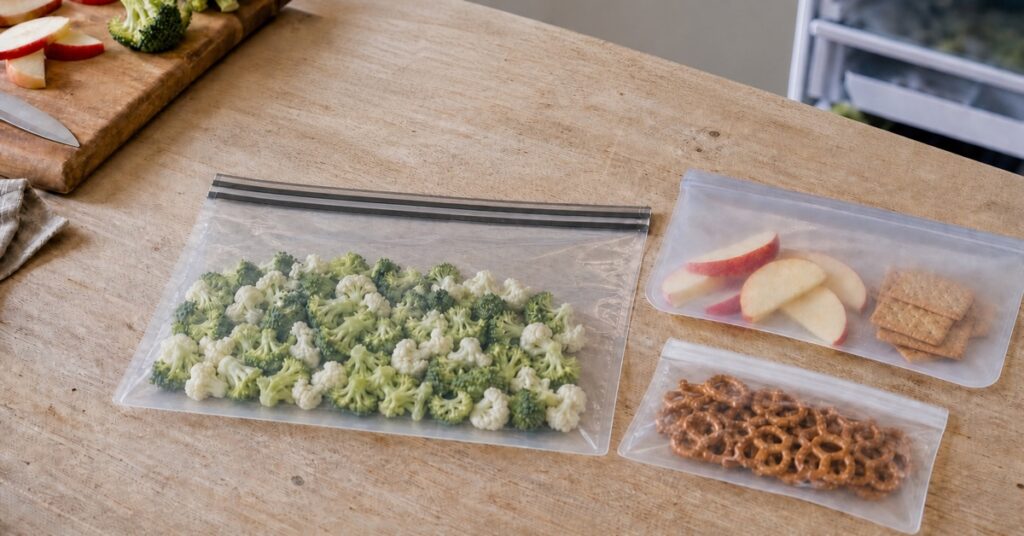
| Nuts, pretzels, apple slices, or a sandwich | Stasher Snack or Sandwich bag | The smaller sizes suit daily portions, and the product family has stronger care and testing support |
| Bread, frozen fruit, vegetables, pasta, or wrapped solid portions | Lerine gallon bag | The broad, flat shape suits solid batch-prep foods without paying a premium per bag |
| Soft berries, delicate cookies, or crushable crackers | Rigid snack box | Hard walls protect food from pressure |
| Soup, broth, thin sauce, or a juicy marinade in transit | Locking rigid container | A secure box gives you more margin for a closure or seam mistake |
| Long-term bulk freezer storage | Vacuum-sealer system | Removing more air addresses a different freezer job than a hand-closed zipper bag |
| A child must open the container independently | Closure test first, then bag or an easier box | A good seal is not useful at school if small or sore hands cannot open it |
If most of your leftovers are wet, saucy, or stackable, reusable bags may not be the right center of your system. A set of glass food storage containers for family meal prep can handle those jobs while bags cover dry snacks and flatter freezer foods.
Best Reusable Food Storage Bags for Families
These are not interchangeable winners. One has better documentation and a versatile size mix; the other earns a limited place because six gallon bags can make solid-food freezer prep more affordable. The practical question is which limitation you would rather manage.
Stasher Premium Reusable Silicone Food Storage Bags, 4-Pack — Best Multipurpose Set for Family Snacks and Mixed Use
Best for: a family wanting one well-supported starter set for snacks, sandwiches, refrigerator storage, and small freezer portions
Exact pack: one 64-fl-oz Half Gallon, two 28-fl-oz Sandwich bags, and one 12-fl-oz Snack bag · Material: platinum silicone · Price tier: premium
Stasher is the easier recommendation when you want reusable food storage bags to do several jobs instead of filling a freezer with one size. Two sandwich bags can rotate through lunches and leftovers, the snack bag handles smaller portions, and the Half Gallon gives you room for produce, a larger snack, or a flat freezer portion.
The evidence behind the product family is also unusually useful. Consumer Reports included Stasher in its silicone-bag testing and found its thick construction and seal helpful for freezer protection, though another brand was its top overall choice. Good Housekeeping selected Stasher as its silicone option while noting that soft sides do not protect delicate food and tomato sauce can stain. Those caveats match the realities of the format better than a blanket “best for everything” label.
Stasher’s Pinch-Loc seal needs to be pressed all the way across. The thick silicone can feel bulky, and some owners find it hard to open—especially with wet hands or limited grip. Cleaning and drying are the other tax. Food or detergent odors can linger, pigmented sauces may leave color behind, and the bag needs to stay propped open until the interior and seal are completely dry.
Skip it if: a young child or adult with limited hand strength must open it without help; you dislike cleaning corners or drying thick bags; you need many gallon bags at the lowest cost; or the food is easily crushed.
Watch-outs: Do not turn a Stasher bag inside out, because the manufacturer says this may damage the bonded edges. Avoid sharp objects. Follow Stasher’s exact venting and temperature instructions before microwave or oven use rather than assuming every silicone bag has the same limits. For strong-smelling foods, consider assigning one bag to that job.
Lerine 6-Pack Reusable Gallon Freezer Bags — Best Budget Option for Flat, Solid Freezer Prep
Best for: bread, frozen produce, pasta, cereal, and individually wrapped solid portions stored flat
Exact pack: six gray 1-gallon bags, about 11 × 11 inches each · Material: PEVA, not silicone · Price tier: budget
Lerine’s useful feature is straightforward: you get six broad gallon bags that can lie flat and divide a batch into visible portions. That can be more practical than buying premium silicone when your main job is separating bread, frozen fruit, vegetables, pasta, or already wrapped solid portions.
The narrow recommendation matters. Current owner feedback includes bags that work well for solid freezer foods, but it also includes seam holes, bottom leaks, zipper wear, and closures that become very hard to open when frozen. Some owners report warping or weaker seals after dishwashing. Because this exact model lacks the depth of independent professional testing available for Stasher, I would not use it as a budget substitute for every task.
Although the manufacturer permits top-rack dishwasher cleaning within its stated temperature limit, I would handwash these bags and air dry them. That takes longer, but it avoids adding heat to a construction that has mixed dishwasher feedback. Inspect the bottom and side seams before filling, and stop using a bag for food if it warps, cracks, separates, or will no longer close evenly.
Skip it if: you are carrying soup, broth, thin sauce, or free liquid; the bag will ride sideways in a backpack or tote; a child or person with arthritis or reduced grip needs to open it; you rely on the dishwasher; or you want to heat food in the bag.
Watch-outs: This product is PEVA despite “silicone” appearing in parts of its marketplace wording. It is not microwave-safe. Test each empty bag and closure over the sink, then use it for a low-consequence solid food first. Leave enough headspace to close the double zipper without forcing it, and never treat the word “leakproof” as permission to carry liquids without a backup container.
When a Reusable Bag Is the Wrong Container
Buying a reusable version does not make the bag shape right for every food. A rigid container is the calmer choice for crushable snacks, tall layered foods, and anything runny enough to escape through a small gap. It is also easier to stack when you need a predictable refrigerator system.
For long freezer storage, a hand-closed bag may leave more air around the food than you expect. Pressing out excess air helps, but it is not the same as vacuum sealing. If bulk meat, family-size meal components, or seasonal produce make up most of your freezer, compare a vacuum sealer for family freezer prep before buying a large reusable-bag collection.
And for a school snack, consider the whole trip. A soft bag that looks tidy on the counter may be squeezed beneath a bottle, book, and ice pack. Match the container to the pressure it will meet, not just the food it holds.
Do the Washing-and-Drying Friction Audit
The real cost of a reusable bag is often counter space and attention. Before choosing a large set, walk through one normal day and answer five questions:
- Who empties it? A bag returned with crumbs and fruit residue needs to reach the sink, not disappear in a backpack.
- Who washes it? Narrow corners, thick seals, and oily foods add time even when a bag is technically dishwasher-safe.
- Where will it dry? The interior has to stay open. A rack, cup, bottle, or bag-drying stand needs a regular home.
- How long does drying take in your kitchen? A bag still damp at breakfast is not part of that day’s usable inventory.
- Which foods get a dedicated bag? Tomato sauce, curry, onion, cheese, and other strong foods may leave stains or odors. Assigning rather than discarding can keep a sound bag in service.
A practical minimum: bags in use today + dirty bags waiting to be washed + clean bags still drying. If your household regularly packs three bagged snacks and two freezer portions, buying exactly five bags may still leave you short whenever yesterday’s batch is drying.
Start with a small set and watch the rotation for a week. If the bags keep reaching the sink, getting fully dry, and returning to the drawer, add only the size that keeps running out. If they collect beside the faucet, the answer may be fewer bag jobs—not more bags.
How to Use Reusable Bags for Freezer Prep
- Cool cooked food first. Follow safe cooling practices before it goes into a storage bag.
- Choose a low-mess food. Especially with a new bag, begin with bread, fruit, vegetables, or a wrapped solid portion rather than thin liquid.
- Leave closure room. Keep food below the zipper so crumbs, grease, and frost do not interrupt the seal.
- Press out excess air. Do this gently when the food shape allows, then close and check the full seal.
- Label the food and date. A clear bag shows what is inside, but it does not tell you when it was frozen.
- Freeze flat when practical. Once solid, file the bag upright only if that does not put pressure on the closure.
- Thaw safely. Use the refrigerator, cold water, or microwave as appropriate—not the counter.
FoodSafety.gov says food kept continuously frozen at 0°F (-18°C) or below can remain safe indefinitely, while published freezer times are about quality. USDA FSIS explains that suitable packaging and less air exposure help preserve quality; freezer burn is a quality issue, not by itself a food-safety issue.
For perishable packed lunches: USDA FSIS recommends at least two cold sources, such as two frozen gel packs or one pack plus a frozen drink. A reusable bag does not replace temperature control. See our guide to ice packs for kids’ lunch boxes when planning the whole lunch setup.
Snack ideas still need to match the child’s age, chewing skills, and any allergy plan. If you are filling smaller bags, these high-protein toddler snack ideas offer a starting point; modify shapes and textures for the child in front of you.
Silicone vs. PEVA: Which Material Should You Choose?
Material names are not a shortcut to a universal “safer” or “better” answer. Construction, closure design, intended temperature range, care, and the specific food job all matter.
Silicone is the thick, heat-tolerant choice in this shortlist. Stasher permits specific freezer, dishwasher, microwave, and oven uses, but those permissions belong to that product and its instructions. They do not transfer automatically to every silicone bag.
PEVA makes Lerine’s gallon bags thinner and less expensive, but the exact model is not microwave-safe. Follow the product’s stated use rather than heating packaging because its material sounds familiar. USDA FSIS likewise advises heating food packaging only when that use is specified.
Whichever material you choose, retire a bag from food use if it has a split seam, cut, crack, warped closure, persistent residue you cannot remove, or a seal that no longer closes consistently.
Frequently Asked Questions
Are reusable food storage bags good for the freezer?
They can be useful for appropriately sized solid foods when the exact product is freezer-safe. Leave a clean zipper area, remove excess air when practical, close the full seal, label the date, and keep the freezer at 0°F (-18°C) or below. No hand-closed bag can promise to prevent all freezer burn.
Can children open reusable snack bags by themselves?
Some can, but closure force varies by bag and by child. Fill the exact bag, chill it if that is how it will be used, and ask the child to open and close it without coaching. If the seal is frustrating or incomplete, use an easier container rather than sacrificing independence or food containment.
Can reusable bags go in the dishwasher?
Check the exact model. Stasher permits dishwasher use and says not to turn its bags inside out. Lerine permits top-rack cleaning within its stated limit, but because current owners report some warping and seal problems after dishwashing, handwashing and air drying are the more conservative routine for that pick.
How do you dry reusable food storage bags completely?
Shake out excess water, keep the opening spread apart, and prop the bag over a drying rack, cup, bottle, or dedicated stand without folding the bottom onto itself. Feel the corners and closure before storing. If moisture remains, give it more time rather than sealing the bag in a drawer.
Do reusable silicone bags stain or hold odors?
They can. Pigmented sauces may stain, and strong foods or scented detergent can leave an odor. A cosmetic stain does not necessarily mean a bag has failed, but follow the manufacturer’s cleaning guidance and retire the bag from food use if residue or odor cannot be resolved to your comfort.
The Bottom Line
Stasher’s 4-Pack is the better multipurpose starting point if you want reusable food storage bags for snacks, sandwiches, leftovers, and some freezer prep—and you are comfortable paying more and giving thick silicone time to dry. Lerine’s 6-Pack is the budget choice for a narrower job: flat, solid gallon-size freezer storage with handwashing and regular seam checks.
Keep rigid containers for liquids and delicate foods, and test any school bag with the child who will open it. The most sustainable-feeling system is not the one with the largest matching set. It is the one your family can wash, dry, refill, and use without creating a new daily problem.