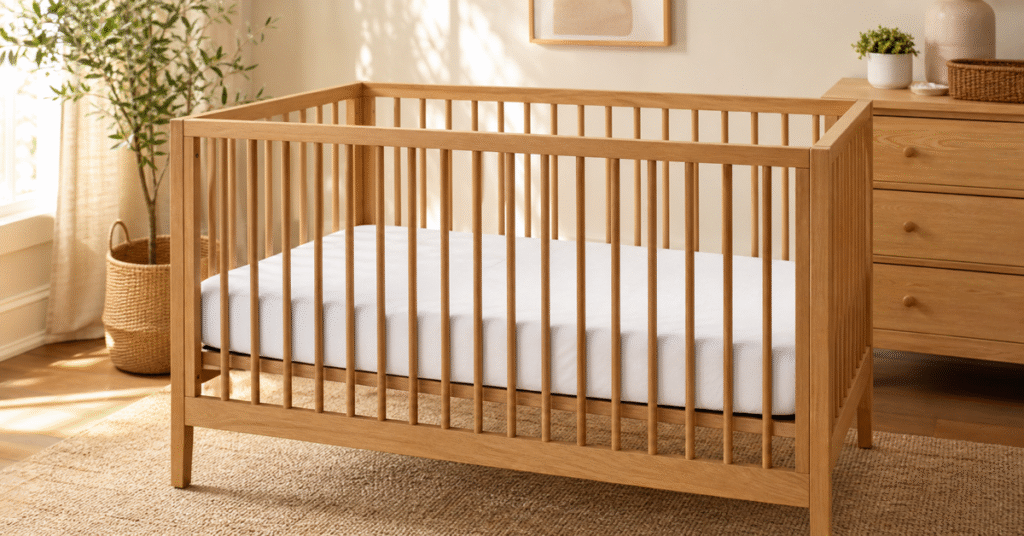
A crib mattress protector sounds like one of the easy nursery purchases. Then you see quilted pads, “breathable” covers, waterproof sheets, deep-pocket protectors, and enough fabric claims to make a 2 a.m. sheet change feel like the simple part.
My rule is much less exciting: for a baby’s crib, the protector should be thin, snug, flat, and the exact size of the mattress. Its job is to keep a leak from becoming a mattress-cleaning project—not to make the sleep surface softer.
Only two protectors made my short list. One has stronger material certifications and a higher price. The other is a simpler budget option with more trade-offs. Both are thin and fitted, but neither is a promise against every possible leak.
Best overall: Naturepedic Organic Waterproof Baby Crib Protector Pad. Choose it if you want a very thin fitted protector with organic cotton, a TPU barrier, and GOTS and MADE SAFE documentation that covers this product.
Best budget option: SafeRest Waterproof Crib Size Mattress Protector. Choose it if you want a non-quilted cotton-blend terry surface and can follow cold-wash, low-heat care carefully.
I kept this list to two on purpose. Several popular alternatives were padded, could not be matched cleanly to the manufacturer’s specifications, or raised leak and durability concerns that were too central to ignore. A longer list would not make the decision better.
The 60-second safety and fit check
Before comparing fabric or price, check the protector against the sleep surface you already own. The American Academy of Pediatrics says that if a mattress cover is used to protect against wetness, it should be tightly fitting and thin. The mattress should still feel firm and remain flat.
- Confirm the mattress type. Standard crib, mini crib, bassinet, and play yard sizes are not interchangeable.
- Look past the word “pad.” A thin protector may be called a pad, but plush fill or added cushioning is a different product.
- Check the finished surface. Put the protector on, add one fitted sheet, and run your hand across the whole mattress. There should be no bunching, loose corners, raised edges, or soft pockets.
- Read the mattress maker’s instructions. A washable or airflow-focused mattress may have its own approved cover, age guidance, or restrictions.
- Recheck after laundry day. Elastic can relax, fabric can shrink, and a waterproof layer can be damaged by excess heat.
For babies under 1: keep the crib bare except for the firm, flat mattress and a fitted sheet. A protector belongs underneath that sheet and should not add softness or looseness. See the AAP’s parent guidance and the CPSC safe-sleep guidance for the full setup.
Do you actually need a waterproof crib mattress protector?
Maybe. First check the mattress label and care instructions.
If the mattress already has a waterproof, wipe-clean outer cover, an extra protector may be more laundry than benefit. Keeping the setup simple also means one fewer layer that can wrinkle or shift.
If the mattress is not waterproof and cannot be washed, a thin fitted protector can save it from diaper leaks, spit-up, and the mysterious damp patch no tired parent wants to investigate before sunrise. That is the clearest use case.
A fully washable or airflow-focused mattress needs a little more thought. A waterproof membrane may change the airflow or washing benefit you paid for. Do not assume a universal protector preserves those features. Check the mattress manufacturer’s current instructions and use a dedicated accessory when one is required.
For mini cribs, bassinets, and play yards, use only the exact size and follow the product maker’s instructions. Do not trim a standard crib protector, force it around a smaller mattress, or add an aftermarket mattress or topper to make the fit work.
If you are still choosing the mattress itself, start with our crib mattress guide. For the rest of the nursery sleep setup, this baby sleep essentials list can help you separate the essentials from the extras.
How many crib mattress protectors do you need?
Two is practical for most families: one on the mattress and one clean, completely dry backup. That gives you a fast reset after a leak without asking a dryer to perform miracles in the middle of the night.
I would not make the popular protector-sheet-protector-sheet stack the default for a baby. Extra layers can make it harder to see whether everything is still tight and flat. Store the spare nearby instead.
For a toddler bed during potty training, two protectors may also reduce laundry pressure. But a toddler-sized flood is a different job from catching an everyday diaper leak. If heavy overnight wetting is your main concern, prioritize a product designed for that level of liquid and keep checking the mattress rather than assuming any thin crib protector is invincible.
The best waterproof crib mattress protectors
1. Naturepedic Organic Waterproof Baby Crib Protector Pad — Best overall
Best for: Families who want the best-documented low-profile option and do not mind paying more for it.
Product ID: Fitted crib protector, SKU PC63W, ASIN B001DDMFI8.
Fit: 28 × 52 × 6 inches.
Construction: Organic cotton with a thin TPU waterproof barrier and a fitted organic-cotton skirt.
Care: Machine washable and dryable; use a mild detergent, avoid bleach, and let it dry completely before reuse.
Skip it if: Your mattress is already waterproof, or you want a thick, absorbent pad rather than a barely-there protector.
Naturepedic earns the top spot because it adds almost no bulk. The brand describes it as low-profile, with a flexible TPU waterproof layer rather than added padding. That is a better match for an infant crib than a pillowy cover marketed around softness.
Its material story is also unusually clear. The fitted protector is covered by GOTS documentation, and the current product appears on MADE SAFE’s certified product list. Those certifications do not prove that it will never leak, and they are not safe-sleep endorsements. They do give you better product-level documentation than vague “organic” language on a marketplace image.
The catch is right there in the design: this protector is very thin. Some owners expected a cushioned pad and were surprised to receive something closer to a waterproof fitted sheet. I see that thinness as appropriate here, but you should know what you are buying. Older owner feedback also mentions bunching, a loose-feeling fit on some mattresses, and slow drying.
After every wash, make sure the protector is fully dry and smooth it over the mattress before adding the fitted sheet. If the corners pull, the surface ripples, or the fabric no longer lies flat, stop using it until you can correct the fit. Organic cotton and certifications are secondary to a flat sleep surface.
Naturepedic is the better choice for a family that values exact product documentation and wants as little extra bulk as possible. It is harder to justify if your crib mattress already has an easy-to-clean waterproof shell.
2. SafeRest Waterproof Crib Size Mattress Protector — Best budget option
SafeRest makes more sense when you want a basic fitted barrier and would rather keep the nursery budget for the mattress itself. Its crib-size model uses an 80% cotton and 20% polyester terry surface over a polyurethane laminate. There is no quilted fill, so it avoids the puffiness found on many inexpensive crib pads.
Best for: Everyday diaper leaks and small spills on a standard crib mattress.
Product ID: Pure White crib size, model SRT-HOK-CRBMTRPTR, ASIN B0C2FTV6JX.
Fit: 52 × 28 × 6 inches.
Construction: Cotton-polyester terry surface, PU laminate, and a polyester fitted skirt.
Care: Wash cold and tumble dry low; avoid bleach and high heat, and follow the sewn-in label if it differs.
Skip it if: You need product-level organic certification, expect heavy overnight accidents, or are very sensitive to plastic-like rustling.
The low price and unpadded build are the appeal. The trade-off is less reassurance about long-term waterproof performance. Some crib-size owners report a plastic-like feel or noise when the sleeper moves. There are also reports of leaking after repeated washing and during a heavy potty-training accident.
Those reports do not tell us how often either problem happens, but they do set a useful boundary. I would reserve SafeRest for routine nursery messes, not heavy overnight wetting. I would also be strict about laundry care. Waterproof laminates can fail early when exposed to high dryer heat, and a budget protector is not a bargain if the barrier is already peeling or letting moisture through.
Every few washes, inspect the underside in good light. Replace the protector if you see cracking, bubbling, separation, stretched corners, or any repeat leak. If you want to check the barrier, remove it from the crib and place a small amount of water on the top while it rests over a dry towel. Never wait for the next overnight accident to be the test.
SafeRest is my budget pick because it is thin, fitted, and easy to identify in the crib size—not because it is noiseless or indestructible. Those stronger promises are not supported well enough.
Why only two made the list
Crib protectors are inexpensive, and that can make a long roundup look harmless. But waterproofing is the whole job. Repeated leak complaints, uncertain current-model details, or extra quilted fill are not small differences I want to bury under a pros-and-cons list.
I also left out products designed for mini cribs, play yards, adult incontinence, and six-sided mattress encasement. They solve different problems and can create a poor fit when treated as substitutes for a standard fitted crib protector.
Neither winner is flawless. Naturepedic costs more and can feel almost surprisingly thin. SafeRest has more uncertainty around noise and durability. Those are real trade-offs you can choose between. A protector that does not fit the mattress or cannot reliably do its basic job is not.
Compatibility matrix: match the protector to your mattress
| Your mattress | What usually makes sense | What to avoid |
|---|---|---|
| Waterproof, wipe-clean crib mattress | Use the mattress as directed; add a protector only if the maker allows it and the laundry benefit matters to you. | Adding padding just to make the mattress feel softer. |
| Standard mattress that is not washable | Choose a thin, fitted, machine-washable waterproof protector in the exact size. | Loose flat pads, very deep pockets that bunch, and plush fill. |
| Fully washable or airflow-focused mattress | Read the mattress maker’s accessory and age guidance before covering it. | Assuming any waterproof membrane preserves the original airflow claim. |
| Mini crib, bassinet, or play yard | Use the exact size or a manufacturer-approved accessory. | Folding, trimming, or forcing a standard crib protector to fit. |
| Toddler bed during potty training | Prioritize repeat washing and enough backup bedding for your routine. | Assuming an infant-focused thin protector can handle every heavy overnight accident. |
Laundry mistakes that can ruin waterproofing
The waterproof layer is usually the least forgiving part of the protector. Treating it like a bath towel can shorten its useful life.
- Do not guess at dryer heat. Follow the product label. SafeRest calls for low heat; Naturepedic allows machine drying but still needs to be completely dry before use.
- Skip bleach when the instructions say to. Both picks tell owners to avoid it.
- Do not put a damp protector back on the mattress. Trapped moisture can create odor and makes it harder to tell whether the barrier is working.
- Inspect, do not just rotate. Look for cracks, bubbles, separation, loose elastic, or a fit that changed after washing.
- Retire a repeat leaker. Laundry technique cannot rescue a waterproof layer that has already failed.
Keep the second protector clean and dry rather than layered under the first. That simple rotation is easier to inspect and easier to trust.
Frequently asked questions
Are waterproof crib mattress protectors safe for babies?
A thin, tightly fitting protector can be used underneath a fitted sheet when it does not soften, tilt, bunch, or loosen the sleep surface. Follow the crib mattress maker’s instructions and current AAP/CPSC safe-sleep guidance. No protector prevents SIDS or makes an otherwise unsafe sleep setup safe.
Can a waterproof protector make a breathable crib mattress less breathable?
It may change how air moves through the mattress. “Breathable” is not one universal test or promise, and a waterproof membrane works by blocking liquid. Check the mattress brand’s current accessory guidance rather than assuming a generic protector preserves the mattress’s original feature.
Do I need a protector if the crib mattress is already waterproof?
Not necessarily. A wipe-clean waterproof cover may already protect the mattress core. An extra protector can still make laundry easier, but only if it fits flat and the manufacturer allows it.
How many crib mattress protectors should I own?
Two is a useful number for most families: one in use and one clean, fully dry spare. Families with frequent leaks may want another backup, but only one protector and one fitted sheet need to be on the mattress at a time.
Can I layer two protectors and two fitted sheets?
I would not use that as the default for an infant. More layers can make fit and flatness harder to judge. Keep the spare folded nearby for a quick change instead.
Is a crib mattress pad the same as a topper?
Not always. Retailers use “pad” for both thin protectors and cushioned products. Read the construction, not just the title. A topper is meant to add softness or thickness and does not belong on an infant’s firm sleep surface.
Can I use a standard crib protector on a mini crib or play yard?
No. Use the exact size and follow the mini crib or play yard manufacturer’s instructions. Do not fold or modify a standard protector to make it fit.
My final take
The label on the package matters less than four boring questions: Is it the exact size? Does it lie flat? Is it thin? Can you wash it without damaging the barrier?
Choose Naturepedic if you want the clearest material documentation and a very low-profile fit. Choose SafeRest if price matters more and you can accept a little more uncertainty about sound and long-term durability. Skip both if your mattress already has a washable waterproof surface and the extra layer does not solve a real problem.
Then keep one protector on the mattress, one clean backup nearby, and the rest of the crib simple. For another sleep layer that needs its own fit check, see our baby sleep sack guide.
Product details and safety guidance were checked on August 2, 2026. Always compare the sewn-in care label and your crib mattress manufacturer’s current instructions before use.