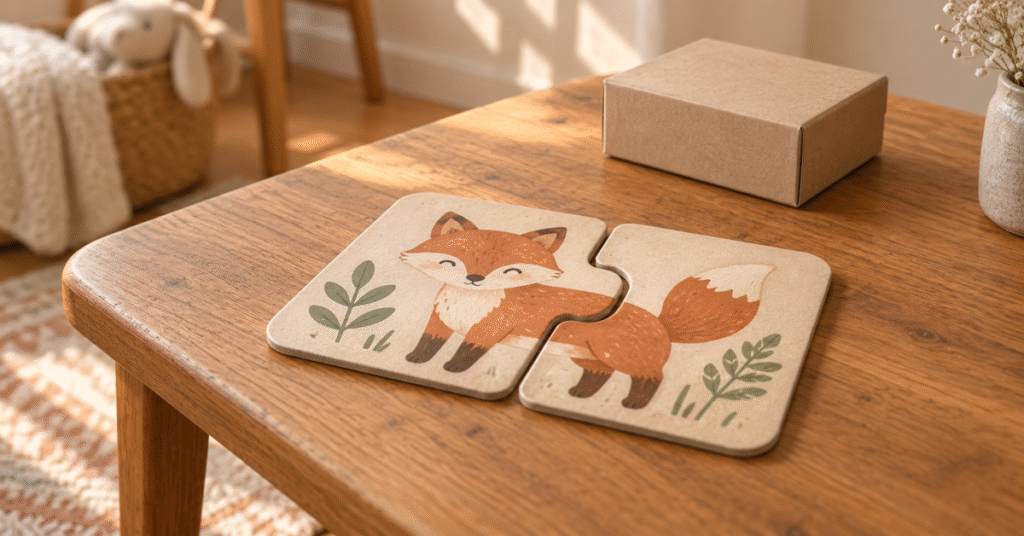
You tip a small puzzle onto the table. There are only a few pieces, but your child keeps turning them around while you wonder whether you bought the wrong box.
Before choosing another puzzle, look at the one your child already enjoys. Putting a whole wooden animal back into its outline is different from joining separate pieces to make an animal. Both can be enjoyable, but the number printed on the box doesn’t tell you which of those things your child has been doing.
For a beginner around ages 2–4, I’d check the age label, then choose by the kind of play that interests them now. One suitable box is enough. If a puzzle at home still gets pulled off the shelf and its pieces are intact, keep using it.
The age label comes first. Mudpuppy My First Animals and The Learning Journey Farm are labeled for ages 2 and up. Ravensburger On Safari is labeled for 18 months and up, though the choices here are for children around 2–4. Those labels don’t tell you how many pieces your child should be able to finish. Follow the warnings on the actual product, and postpone these cardboard puzzles if your child still frequently chews toys. Sitting beside them doesn’t cancel an age restriction.
| What you want now | A box to consider | Skip it when |
|---|---|---|
| Repeating two-piece pictures | Mudpuppy My First Animals 2 Piece Match-up | You want several piece counts in one box. |
| Increasing the count one piece at a time | Ravensburger On Safari 07301, with 2, 3, 4 and 5 pieces | Your child already enjoys simple jigsaws and you want a bigger challenge. |
| Having higher counts in the same box | The Learning Journey My First 4-In-A-Box Farm 627419, with 2, 4, 6 and 8 pieces | Two-piece matching is all you want right now. |
Repeating two-piece pictures
If you want to repeat the same kind of two-piece task, I’d start with Mudpuppy My First Animals 2 Piece Match-up. Each picture has two pieces, so you can take out one animal and leave the rest in the box. Choosing another picture lets you offer the same piece count again without turning the next attempt into a bigger puzzle.
That makes sense when joining two parts is what your child is interested in trying. Choose a different box if you want several piece counts together. Long-term owner feedback on this newer My First Animals version is still limited, so I can’t recommend it on durability. My reason for choosing it is the two-piece format. Check the My First Animals name when ordering; the older Happy Animals box isn’t the same version.
Adding one piece at a time
Ravensburger My First Puzzle On Safari 07301 is the box I’d consider when you want the piece count to change in small steps. It contains four pictures with 2, 3, 4 and 5 pieces. You can put one picture on the table and keep the others aside, then offer another when your child wants something different. There’s no need to get through all four in one sitting.
The cuts and pictures matter, too. Older owner reviews from outside the US describe vertical strips, similar-looking pictures and matching patterns on the backs. When everything has been tipped into one pile, you may need to separate the pictures before your child begins.
Those reviews also describe the strip-style puzzles becoming too simple for a child with some experience. I’d skip this box if you’re looking for a bigger challenge than the simple jigsaws your child already enjoys. The 2-to-5 sequence gives you smaller changes in piece count; it doesn’t promise four evenly spaced levels of difficulty or four pictures your child can finish alone.
Keeping higher piece counts in the box
The Learning Journey My First 4-In-A-Box Farm 627419 includes 2-, 4-, 6- and 8-piece pictures. I’d consider it if you want those higher counts in the same box. The pictures are a pig, a horse, a cow and a farm scene, so you can begin with the two-piece pig while the others stay put.
I wouldn’t buy it just to have an eight-piece puzzle waiting. If repeating two-piece pictures is all you want right now, the extra counts may have little use. And eight pieces doesn’t tell you how long a child will stay interested, how much help they’ll need, or whether that picture will feel harder than a different puzzle with fewer pieces.
Farm deserves a closer look as soon as it arrives. Older owner reports include missing or duplicate pieces, joins that feel too tight or too loose, and a report of a piece breaking. That could mean helping your child with a tight join or reconnecting pieces that keep coming apart. I wouldn’t choose it expecting your child to manage every join alone.
Before putting it away for a birthday or handing it over, assemble each picture yourself on a flat surface. Check that the right pieces are there and that the joins work. If a picture is incomplete or a piece is damaged, set it aside and contact the retailer rather than trying to make do with it. A broken piece needs to come out of play.
When ordering, look for Farm, model 627419. This is the ordinary cardboard puzzle set, not the singing Old MacDonald version.
Putting out the first picture
After checking the pieces and trying the joins yourself, separate one complete picture before inviting your child over. Leave the other pieces in the box. With a two-piece picture, put the two parts on the table where you can both reach them. You can show how they meet or hold one steady while your child tries the other. Offer the help that’s needed; finishing without help doesn’t have to be the point.
If a piece won’t go in, try the join yourself instead of asking your child to push harder. A tight fit or an awkward angle can turn a small puzzle into a frustrating few minutes. Showing one connection, returning to a familiar picture, or putting the puzzle away are all reasonable things to try. These are practical starting suggestions, with no deadline for finishing a particular number of pieces.
Check the cardboard when you take it out and as you put it away. Stop using pieces that are wet and softened, peeling into layers or broken, and pick up any fragments. Keep loose pieces and fragments away from younger siblings. A large finished picture doesn’t remove the need to check the condition of its parts.
Once a puzzle is familiar, you might include it among quiet-time activities. A new beginner puzzle still deserves your attention and whatever help your child needs; buying it doesn’t buy a stretch of independent play.
For now, clear a space for one intact picture and sit down together. See whether your child wants to join the pieces with you. You can help, repeat the same picture, or put it away for another time. The other pieces can stay in the box.