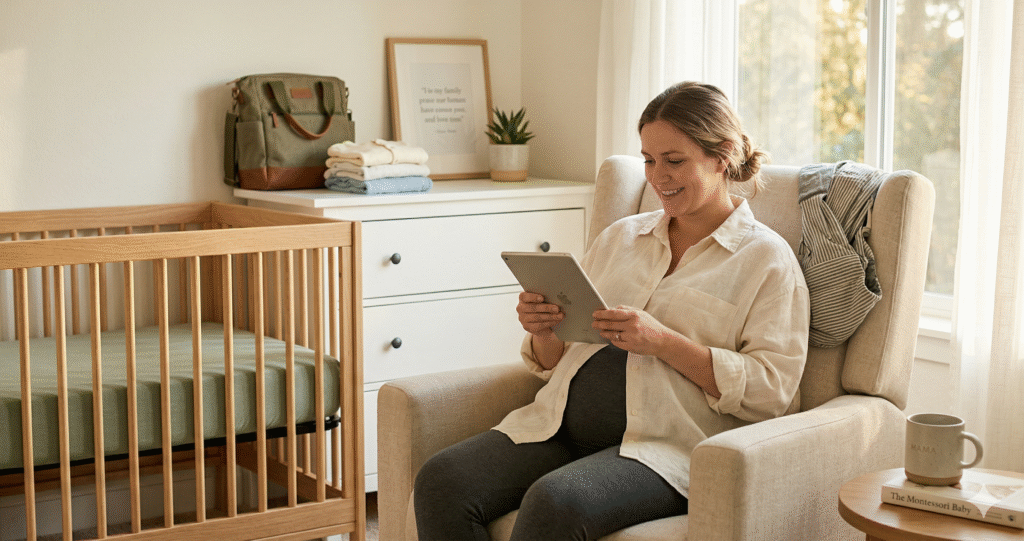
This baby registry checklist is the one I wish I’d had before my first baby. After three kids, I know exactly what gets used daily, what collects dust, and what you can borrow or skip entirely. No fluff, no “nice to have” padding — just the stuff that actually matters.
I’ve organized this by category so you can work through it section by section. Each category links to our detailed review where I compare specific products — this checklist is your overview, those guides are your deep dives.
Feeding (Breast, Bottle, or Both)
This category trips up most first-time parents because you don’t know yet whether you’ll breastfeed, bottle-feed, or combo-feed. My advice: prepare for both. I started exclusively breastfeeding my daughter and still needed bottles by week three when I went back to pumping.
★ Essentials
- Baby bottles (4-6) — Start with 4 oz for newborns. Even breastfeeding moms need bottles for pumped milk. See our tested picks →
- Bottle brush & drying rack — You’ll clean bottles 8-10 times a day. A good brush matters more than you think.
- Breast pump — Check if your insurance covers one before buying. See our breast pump guide →
- Nursing pillow — Saves your back and shoulders from day one, whether nursing or bottle-feeding.
- Burp cloths (8-10) — Buy more than you think. You’ll go through several a day.
Nice to Have
- Bottle warmer — Convenient but not essential. A bowl of warm water works fine.
- Nursing bras (2-3) — Get the pull-aside kind with no clips. You’ll live in these. Full breastfeeding gear list →
- Haakaa silicone pump — Catches letdown on the opposite side. Easiest $15 you’ll spend.
- Nursing pads — Disposable or reusable, you’ll leak. Especially at night.
- Formula dispenser (for combo-feeding) — Only if you know you’ll combo-feed.
Sleep
Safe sleep is non-negotiable. The AAP recommends a flat, firm surface with no loose bedding for at least the first year. Everything beyond that — the sound machines, the sleep sacks, the blackout curtains — is about survival for you, not safety for them.
★ Essentials
- Crib or bassinet — A bassinet for the first 4-5 months, then a full crib. Make sure it meets current CPSC standards.
- Firm crib mattress — If the crib doesn’t come with one, get a firm, flat mattress that fits snugly with no gaps.
- Fitted crib sheets (2-3) — You’ll need backups for middle-of-the-night blowouts.
- Sleep sacks (2-3) — Replace loose blankets. TOG rating matters: 1.0 for most rooms, 0.5 for summer. See our sleep essentials list →
- Baby monitor — Audio-only is fine for most families. Video is nice but not necessary. See our monitor guide →
Nice to Have
- White noise machine — A game-changer for naps and nighttime. We used ours for all three kids.
- Blackout curtains — Especially helpful for early morning wake-ups and summer naps.
- Swaddles (2-3) — Velcro swaddles like the Halo are easier than blanket swaddles. Stop swaddling when baby starts rolling.
- Night light — Red or amber light won’t disrupt sleep hormones. Skip anything blue or white.
Diapering
You will change roughly 10-12 diapers a day in the newborn stage. That number drops to 6-8 by month three, but it never feels like it. Set up a changing station on each floor of your home if you can — it saves countless trips up and down stairs.
★ Essentials
- Diapers (newborn + size 1) — Don’t stockpile one size. Babies grow out of newborn size fast — some skip it entirely.
- Wipes (fragrance-free) — Water-based, fragrance-free. WaterWipes are great for sensitive newborn skin.
- Diaper cream — Desitin or Aquaphor. Apply at every change for prevention, not just treatment.
- Changing pad with washable covers (2-3) — Waterproof cover is a must. You’ll wash these constantly.
- Diaper bag — Backpack style keeps your hands free. See our diaper bag picks →
Nice to Have
- Diaper pail — Ubbi steel pail uses regular trash bags (no refill cartridges). Worth it if the nursery is upstairs.
- Portable changing pad — A thin fold-up pad for the diaper bag. You’ll use it in restaurant restrooms, at friends’ houses, in the car.
Getting Around
Car seat and stroller are two of your biggest purchases, and they need to work together. Test the car seat installation before your due date — many car seats are installed incorrectly according to the NHTSA. Most fire stations will check yours for free.
★ Essentials
- Infant car seat — Rear-facing is legally required and should continue until at least age 2 (or until your child outgrows the seat’s limits). Choose a seat that fits your car, not just one with good reviews.
- Stroller — Your lifestyle determines the right pick: jogger for runners, lightweight for city, travel system for convenience. See our stroller guide →
- Baby carrier or wrap — Hands-free and keeps baby close. Essential for grocery runs, household chores, and fussy evenings. See our carrier picks →
Nice to Have
- Stroller organizer — Clips onto the handlebar for your phone, keys, coffee. Cheap and useful.
- Car seat mirror — Lets you see a rear-facing baby without turning around. Peace of mind on drives.
- Car window shades — Keeps sun off baby during drives. Especially important in summer.
Bath & Grooming
Newborns only need baths 2-3 times a week — daily baths dry out their skin. But when bath time comes, having the right setup makes it a calm, enjoyable routine instead of a slippery wrestling match. My youngest son went from screaming during every bath to actually splashing and laughing once we switched to a better tub.
★ Essentials
- Baby bathtub — A simple one with a sling insert for newborns. Transitions to sit-up bathing around 5-6 months. See our bath essentials list →
- Gentle baby wash (fragrance-free) — One bottle for hair and body. Less is more.
- Soft washcloths (4-6) — Softer than adult washcloths. Also useful for wiping faces and hands all day.
- Hooded towels (2-3) — Wrap them up immediately after the bath. Newborns lose body heat fast.
- Baby nail clippers or file — Newborn nails grow shockingly fast. Clip while they sleep.
Nice to Have
- Bath thermometer — Water should be around 98-100°F (37-38°C). Your elbow works too, but a thermometer removes the guesswork.
- Baby lotion (fragrance-free) — For dry skin only. Most newborns don’t need lotion.
Clothing
Babies grow through sizes faster than you can blink. My daughter skipped newborn size entirely — she was born at 8 lbs and went straight into 0-3 month clothes. Don’t overbuy any single size, especially newborn.
★ Essentials
- Footed sleepers/onesies (6-8) — Zip-up, not snaps. At 3 AM you will thank yourself for choosing zippers.
- Bodysuits (5-7) — Short-sleeve for layering. These are the base layer for every outfit.
- Scratch mittens (2-3 pairs) — Newborn nails are tiny razors. Mittens prevent face scratches.
- Hats (2-3) — Newborns lose heat through their heads. One warm hat, one sun hat.
- Socks or booties (4-5 pairs) — They fall off constantly. Buy extras.
Nice to Have
- Going-home outfit — For hospital photos. Keep it simple and weather-appropriate.
- Seasonal layers — A light jacket or fleece bunting for colder months. No puffy coats in car seats.
Play & Development
Newborns don’t need much — your face is their favorite toy for the first few weeks. But by month two, a few well-chosen items start earning their keep. The key is open-ended toys that grow with your baby instead of single-purpose gadgets they’ll outgrow in a month.
★ Essentials
- Play mat or activity gym — Tummy time and reaching practice from month one.
- High-contrast cards or board books — Black and white patterns are all they can see clearly in the first 8 weeks.
- Rattle or soft toy — Something light enough for tiny hands to hold.
Nice to Have (Add Later)
- Stacking cups, shape sorters — Great from 6 months onward.
- Push walker — The most-used toy from 10-18 months. See our toddler toy guide →
- Sensory toys — Crinkle books, textured balls, water mats. See sensory toy picks →
Nursery Furniture
★ Essentials
- Crib — Convertible cribs that become toddler beds are worth the investment. Check for current CPSC certification.
- Dresser/changing table combo — A regular dresser with a changing pad on top saves space and money vs. a dedicated changing table.
- Glider or rocker — You’ll spend hours here. Test before you buy — comfort matters more than style.
Nice to Have
- Bookshelf — Forward-facing book display encourages reading from early on.
- Closet organizers — Baby clothes are tiny. Dividers and bins keep things findable.
Health & Safety
★ Essentials
- Baby first aid kit — Infant Tylenol (for 2+ months), saline drops, bulb syringe, digital thermometer (rectal is most accurate for infants).
- Outlet covers & cabinet locks — You won’t need these for months, but register now so they’re ready when your baby starts crawling.
- Furniture anchors — Anchor every bookshelf, dresser, and TV stand. This is not optional once your baby is mobile.
Nice to Have
- NoseFrida nasal aspirator — More effective than the bulb syringe. Gross concept, life-saving results.
- Humidifier — Helpful for dry winter air and stuffy noses. Cool mist only.
- Baby gates — For stairs and off-limits rooms. Hardware-mounted for top of stairs, pressure-mounted elsewhere.
For Postpartum Recovery (Don’t Forget Yourself)
Your registry isn’t just for the baby. Recovery gear made a bigger difference in my quality of life than half the baby gadgets on the market. By my third baby, the postpartum kit was the first thing I ordered.
★ Essentials
- Peri bottle — The Frida Mom angled version is a huge upgrade over the hospital one.
- Witch hazel pads + pain relief spray — Tucks pads and Dermoplast blue can. You will use these every single bathroom trip for the first two weeks.
- High-absorbency underwear — Always Discreet is better than hospital mesh underwear.
- Stool softener — Start before you leave the hospital. Trust me.
- Large water bottle — Keep one at every feeding station. Hydration is everything during recovery and breastfeeding.
For the complete recovery kit with specific products and prices, see our Postpartum Recovery Essentials Checklist.
What to Skip (Save Your Money)
After three babies, here’s what I’d cut from every registry:
- Wipe warmer — Takes up counter space, dries out wipes, and your baby doesn’t care about cold wipes after week two.
- Shoes for pre-walkers — Babies who can’t walk don’t need shoes. Socks or soft booties are fine.
- Newborn-size everything — Most babies outgrow newborn in 2-4 weeks. Some skip it entirely.
- Bottle sterilizer — Dishwasher or boiling water works. For healthy, full-term babies with access to clean tap water, the AAP says sterilizing after the first use isn’t necessary.
- Baby food maker — A regular blender or fork does the same job in 6+ months.
- Fancy nursery decor — Your baby can’t see it and won’t care. Spend on sleep and feeding gear instead.
For a deeper dive into what’s worth skipping, read our Baby Registry Reality Check: What You Don’t Need.
The Total Budget
Cost Summary
- Feeding: $150-$350
- Sleep: $200-$600
- Diapering: $60-$120/month
- Getting Around: $250-$700
- Bath & Grooming: $40-$80
- Clothing: $80-$200
- Play & Development: $40-$100
- Nursery Furniture: $400-$1,200
- Health & Safety: $50-$150
- Postpartum Recovery: $70-$190
Registry Tips From a Third-Time Mom
- Create your registry early (around 20 weeks). You don’t have to share it right away, but start building it while you have the energy.
- Add a mix of price points. Include $10-$20 items alongside bigger ones so everyone can contribute.
- Enable group gifting for big items like the stroller and car seat.
- Add a few “for mom” items. A nice water bottle, postpartum recovery gear, a gift card for meal delivery — your future self will thank you.
- Ask your partner to review it together. They might think of things you missed, and it’s a good way to start talking about your parenting setup.
- Don’t register at more than 2 stores. Amazon + Target covers pretty much everything. Keep it simple.
The Bottom Line
The best baby registry checklist is one that’s built around your actual life — not someone else’s Instagram nursery. Start with the starred essentials, add from the “nice to have” list as you go, and give yourself permission to figure some of it out after your baby arrives. Nobody gets this perfect on the first try, and your baby won’t notice either way.
You’ve got this.
Building your registry and want specifics? Here are the detailed guides:
- Best Baby Bottles 2026
- Best Breast Pumps 2026
- Best Strollers 2026
- Best Baby Carriers 2026
- Best Baby Monitors 2026
- Best Diaper Bags 2026
- Best High Chairs for BLW
This article is for informational purposes only and is not a substitute for personalized advice from your pediatrician or healthcare provider. Product prices are approximate and may vary.
Bringing baby home this week?
Grab the free Newborn First Week Guide — day-by-day schedule, feeding tracker, and when-to-call-the-doctor checklist.