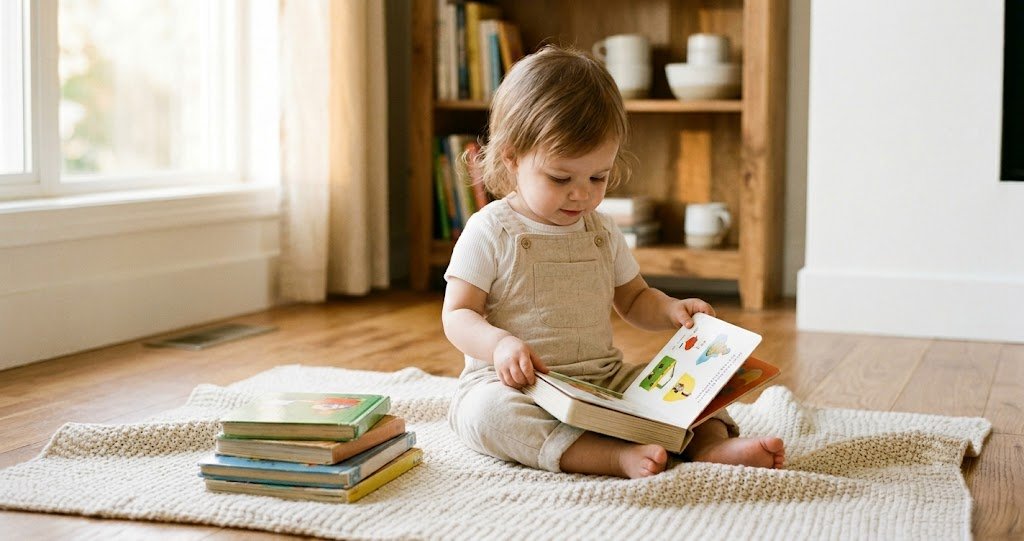
If you’ve spent any amount of time around a one-year-old and a book, you already know the routine. They chew the corner. They point at a picture of a duck and yell something that might be “duck.” They shove the book at you because they want it read again. Right now. Again. For the seventh time.
This is the age. The age when books move from “thing my baby chews” to “thing my baby will sit still for, sometimes, if I’m lucky.” And the right books make all the difference between a kid who flings books across the room and a kid who already has a favorite.
I’m a mom of three. My daughter is almost six, my older son just turned three, and my youngest is in the middle of the one-year stretch right now. Picking books for one-year-olds is something I’ve thought about across three different kids and a decade of trial and error. The eight on this list aren’t ones I’m guessing about. They’re the ones that show up on every serious expert list, that parents in review threads come back to year after year, and that real librarians keep handing to nervous new parents looking for a first-birthday gift. I’ll tell you exactly which ones to start with, and what each is genuinely good for.
If You Only Buy Three, Get These
You don’t want eight books on your registry. You want the three that genuinely matter for a one-year-old. After researching this list across multiple expert sources and weighing what parents actually report using, these are the three I’d build a starter shelf around:
- Goodnight Moon, for the bedtime routine you’re about to build (or rebuild after the toddler sleep regression).
- Brown Bear, Brown Bear, What Do You See?, for the moment your one-year-old chimes in with the last word of each line. Parents describe it as one of the first real language milestones they get to witness.
- Indestructibles: Baby Peekaboo, because at this age, a book that survives the bathtub, the dog’s water bowl, and a full afternoon of teething is a book you’ll actually read.
The other five each fill a specific gap: lift-the-flap, first vocabulary, food and counting, animal sounds, body parts. Build out from the core three as your kid develops interests.
Why These Eight (And How I Chose Them)
One-year-olds aren’t a single audience. A twelve-month-old who just learned to sit up and look at pictures is different from an eighteen-month-old who’s pointing, naming, and demanding the same book seventeen times in a row. A good one-year-old book list has to work across that whole stretch.
My criteria, refined over three kids:
- Board book format only. One-year-olds are still in the oral exploration phase. Hardcover and paperback editions get torn, drooled on, and chewed. Buy the board book, every time.
- Short. Twelve to thirty pages. Attention spans at this age are measured in minutes, not chapters.
- Rhythm, repetition, or interactivity. One-year-olds latch onto patterns. The books they request again and again are the ones with predictable structure or something to do (lift a flap, point to an object, make an animal sound).
- Vetted across multiple sources. Every book here shows up on at least three of the major expert lists I checked: Carnegie Library’s annual Best Books for Babies, School Library Journal, the NYT 50 Great Board Books, and Brightly’s parent-facing recommendations. Each one also has a long, mostly-positive track record in parent reviews — the kind of multi-year, multi-thousand-review pattern that’s hard to fake.
- Honest trade-offs. No book is perfect. For each one I’ll tell you the catch: the flap that tears too easily, the page that’s a little too dim, the gimmick that wears thin by read number fifty.
For more on what one-year-olds are actually doing developmentally, my guide to 12–24 month milestones walks through what to expect month by month. It’s useful context for picking books that match where your kid actually is.
The 8 Best Books for 1 Year Olds in 2026
1. Goodnight Moon — by Margaret Wise Brown, illustrated by Clement Hurd
The original. First published in 1947, still the bedtime book against which every other bedtime book is measured. A little bunny says goodnight to every object in his moonlit room: the red balloon, the picture of the cow jumping over the moon, the quiet old lady whispering hush. The text rolls along like a lullaby. The illustrations grow dimmer page by page as the room actually darkens.
Part of what makes it work for one-year-olds is that there’s a mouse hidden in a different spot on every spread. Babies who can’t yet follow the story can still play “find the mouse” with you. By around fifteen months, many kids start anticipating the moon page and saying “moon” before you turn to it. That’s the small, specific kind of language milestone this book is built to produce.
The honest gripe: The book alternates between bright colored spreads and small monochrome detail pages. Some babies find the gray pages less engaging and want you to skip ahead. The “goodnight nobody” page (a blank page) confuses adults more than kids. Push through. The rhythm is the point.
Check current price on Amazon →
2. Brown Bear, Brown Bear, What Do You See? — by Bill Martin Jr., illustrated by Eric Carle
“Brown bear, brown bear, what do you see? I see a red bird looking at me.” Each page introduces a new animal in a new color, and each animal hands off to the next one in a chain. The structure is so predictable that by the third or fourth read, a one-year-old will start filling in the last word of every line. Parents call it one of the first true reading-aloud milestones they get to witness, and it’s one of the most common stories you’ll find in the book’s reviews.
Carle’s signature collage illustrations carry the visual weight: bold, flat, instantly recognizable shapes that a one-year-old’s still-developing eyesight can lock onto. Twenty million copies sold over fifty years tells you most of what you need to know.
The catch: It’s not a story so much as a list of animals in colors. If you’re hoping for a narrative arc, look elsewhere. The magic is the rhythm and the call-and-response, not the plot.
Check current price on Amazon →
3. The Very Hungry Caterpillar — by Eric Carle
A caterpillar eats his way through one apple on Monday, two pears on Tuesday, three plums on Wednesday. Carle cut actual holes in the pages where the caterpillar bit, so you can poke your finger through. That’s the whole hook for a one-year-old: holes you can stick a finger into. Each die-cut hole is a tiny touch toy embedded in the page, and most one-year-olds spend more time on the food spreads (apples, oranges, pickle, salami, lollipop, cherry pie) than on the actual caterpillar pages.
The book is also doing real cognitive work: days of the week, counting one through five, the concept of metamorphosis at the end when the caterpillar emerges as a butterfly. It works at age one as a touch-and-name book, and again at age three as a story, and again at age five as a science lesson. The book has sold over 41 million copies in more than 60 languages — staying power that’s earned.
What you should know: The die-cut holes are durability’s weak point. A determined toddler can tear the page around a hole faster than around a regular board book edge. The food pages tend to show their age first.
Check current price on Amazon →
4. Moo, Baa, La La La! — by Sandra Boynton
Three pigs say “la la la.” That’s the joke. Forty years on, it still kills, with both toddlers and the parents stuck reading it eighty times a week. Sandra Boynton has sold something like 85 million books on the strength of her ability to be genuinely funny for both audiences at once.
This is the kind of book one-year-olds reach for once they’re starting to learn animal sounds. The structure invites a back-and-forth: you read the cow page, your kid moos. You read the sheep page, they baa. The pigs’ la-la-la moment lands every time. Twelve pages, four minutes, almost always gets a real laugh. It’s a bedtime add-on, not a main course, and that’s fine. Some of the best books for this age are.
Check current price on Amazon →
5. Where Is Baby’s Belly Button? — by Karen Katz
One-year-olds are biologically programmed to find peekaboo hilarious. Karen Katz built her career on that fact. “Where are baby’s hands? Lift the flap. Under the bubbles!” Each page asks where a baby’s body part is, and your kid lifts a flap to find it. The babies inside are illustrated with a beautiful range of skin tones, which is rarer in board books than it should be.
The book works because it pairs concrete vocabulary (eyes, hands, toes, belly button) with a physical action (lift the flap) and an immediate body reference (your kid’s own belly button is right there). That tight loop between word, action, and body is hard to engineer with any other format, which is why this book has been a baby-shower standard for over twenty years and accumulated more than 14,000 reviews on its way to a 4.8-star average.
Not perfect, and parents complain (loudly): The flaps tear. They are not built to survive an enthusiastic one-year-old’s grip. This is the most common complaint in the book’s reviews, and it’s earned. Karen Katz flaps are made of paper, not extra board. Read this one with your child for the first few months, not as a leave-them-alone-with-it book. If you want a flap book your toddler can wreck on their own, see number six.
Check current price on Amazon →
6. Dear Zoo: A Lift-the-Flap Book — by Rod Campbell
A child writes to the zoo asking for a pet. The zoo sends an elephant (too big), a giraffe (too tall), a lion (too fierce), and a parade of other unsuitable candidates, each hidden behind a flap that reveals the rejection reason. Eventually the right pet arrives. I won’t spoil it, but it’s the one your kid will yell at the page every time.
And here’s the thing about Dear Zoo versus Where Is Baby’s Belly Button?: the flaps are made of real cardstock. They are dramatically more durable. Parent reviews independently and repeatedly note that Dear Zoo is one of the only lift-the-flap books in their house that survived their toddler intact. Over two million copies sold globally and a third-of-a-century in continuous print suggests they’re not wrong.
It’s also a real story, with a beginning, a problem, attempts at solutions, and a satisfying ending. That’s surprisingly hard to find at this reading level.
The trade-off: The text is sparse to the point of bare. Five to eight words per page. You’ll need to ham up the animal voices to fill out a read-aloud. Honestly, that’s part of the fun.
Check current price on Amazon →
7. First 100 Words — by Roger Priddy
One hundred photographs of real objects (apple, ball, banana, dog, cup, spoon, sock), each with a single word label underneath. Grouped by category: mealtime, home, things to wear, things on wheels. The padded cover means a one-year-old can drop it on their toes and not cry about it.
This is the book to reach for when your kid is in the “pointing at everything and looking at you expectantly” phase. You name what they point to. They try to repeat it. Over the course of months, vocabulary builds. Eight million copies sold tells you a lot of families have used it exactly this way. It’s not a book to read straight through, though. There’s no story. If you’re hoping for a bedtime narrative, this isn’t the one. Treat it as a reference book for pointing and naming, not a sit-down read.
Check current price on Amazon →
8. Indestructibles: Baby Peekaboo — by Amy Pixton and Kate Merritt
This is not a board book. It’s printed on something that feels like a hybrid of paper and fabric (Tyvek, the same material as those forever-stamps mailing envelopes). It is genuinely indestructible. You can throw it in the washing machine. You can let a baby chew it for an hour straight. It will crinkle a little over time, and that is the worst that will happen to it.
The Peekaboo title is the right one for a one-year-old because peekaboo is the exact cognitive game a baby’s brain is doing at this age: figuring out that things continue to exist when they’re out of sight (psychologists call it object permanence). Every page hides someone or something. Mom is behind the curtains. Puppy is behind the toys. Baby is under the covers. The format reinforces the concept the book is teaching.
This is the book to keep in your diaper bag. When a toddler gets restless in a restaurant, this is what comes out. It survives apple juice spills, getting sat on, and being dragged across the parking lot. No regular board book does that.
What you should know: It does not feel like a “real” book. Some grandparents will give you a look when this is what comes out at story time. The page-turn experience is different, softer, more like cloth than cardboard. If that matters to you, get it as a supplement to your real board books, not as a replacement.
Check current price on Amazon →
What to Look for in Books for 1 Year Olds
A few quick rules worth knowing before you spend money on beautiful hardcover picture books at a first birthday and watch them get shredded within a month:
- Format is everything at this age. Board books, period. The one exception is Indestructibles-type tear-proof books, which are even better for the wet-and-chewy phase.
- Page count should be low. Twelve to thirty pages is the sweet spot. Fifty-page picture books are for three- and four-year-olds.
- Look for repetition or interactivity. A one-year-old will sit through a book that has rhythm (like Brown Bear) or something to do (like a flap or a hole) far longer than they’ll sit through prose.
- Bright, high-contrast illustrations beat soft watercolors. Carle and Boynton both nail this. Many traditional picture books don’t.
- Diverse representation matters even at this age. Karen Katz, Sandra Boynton, and the Indestructibles series all include babies and characters of different skin tones. It’s a small thing that matters.
How to Actually Read with a 1 Year Old
You don’t need to read for thirty minutes. You don’t even need to finish a book. You don’t need to read in a special voice (although it helps). Here’s what actually works at this age:
- Keep sessions short and stack them. Two to five minutes, several times a day, beats one long sit-down. Read at breakfast. Read after the bath. Read before nap. Read in the car (well, while parked).
- Let them touch and point. Pause after every page. Ask “Where’s the duck?” Wait for them to point. This is where language acquisition happens, not in your perfect uninterrupted recitation.
- Sing it. Boynton and Bill Martin both write in singable rhythm for a reason. If you make Brown Bear into a little tune, your toddler will request it twice as often.
- Rotate, don’t shelf. Keep six to eight books out at a time and put the rest away. Swap weekly. Familiarity is good for one-year-olds, but so is novelty.
- Let them “read” alone too. Even at one, kids will flip through books on their own once they associate them with positive time. That self-directed flipping is real literacy practice. Don’t interrupt it.
- Bonus tip: daycare crossover. Most daycare classrooms read these exact classics in circle time. Reading the same books at home means your kid hears the same rhythms and language patterns in both places, which helps them settle in faster wherever they are.
The Reach Out and Read program, endorsed by the American Academy of Pediatrics, has been encouraging pediatricians to put books in the hands of one-year-olds at well visits for over thirty years. The reason: the AAP’s literacy guidance is unambiguous. Reading aloud daily, starting in infancy, is one of the highest-leverage things a parent can do for a child’s language development. The good news is that “daily” doesn’t mean “long.” Five minutes counts.
Frequently Asked Questions
How many books should a 1 year old have?
More than you think, but rotated. Twenty to thirty books in the house total, with six to eight out at any given time and the rest put away. Familiarity is huge at this age. Repeated readings of the same book do more for language development than constant novelty. But rotating in something fresh every week or two keeps your kid engaged. Library trips fill in the gaps without filling your shelves.
When do 1 year olds start enjoying lift-the-flap books?
Most kids start really engaging with flaps somewhere between twelve and fifteen months, once they have the fine motor control to lift one independently. Before that, they enjoy watching you lift them and seeing what’s underneath, which is still real cognitive work (it’s how object permanence solidifies). Dear Zoo and Where Is Baby’s Belly Button? are both well-suited to this stage, with the caveat that the Karen Katz flaps tear faster.
Are Indestructibles books really safe to chew on?
Yes. They’re printed on a non-toxic, paper-like material called Tyvek and meet ASTM safety standards (the same standards that govern toys). You can put them in the washing machine, the dishwasher, or just rinse them in the sink with dish soap. They will crinkle slightly over time but won’t tear or fade. If your one-year-old is a particularly enthusiastic chewer, this is the format to look for.
Should I buy hardcover or board book versions of these classics?
For one-year-olds, board book, always. The hardcover and paperback editions of Goodnight Moon, Brown Bear, and The Very Hungry Caterpillar all exist, and they’re lovely books, but the paper pages will not survive contact with a teething toddler. Save those editions for age three and up. The board books cost less and last longer.
Are these books still being printed in 2026?
Yes. Every book on this list is currently in print, with multiple anniversary editions of the classics available (Goodnight Moon, Brown Bear, Where Is Baby’s Belly Button, and Dear Zoo have all had recent anniversary printings). The Indestructibles series adds new titles every season, and Baby Peekaboo has been a consistent bestseller within the series for over a decade.
Need More for Your One-Year-Old’s Library?
This list is part of a larger set of mom-tested toddler picks I keep on this site: feeding gear, daily routine charts, sensory toys that survive a year of chomping. If you want the next step beyond books, my guide to the best toys for 1–2 year olds is a good place to go next. And the 12–24 month milestones guide walks you through what your kid is actually developing during this window, which is useful for matching books and toys to the right stage.