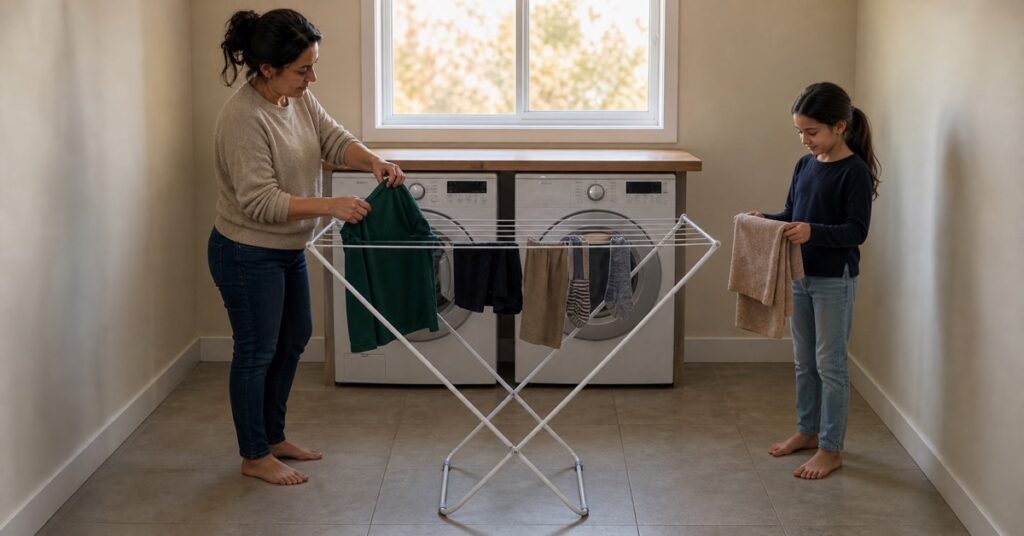
A family laundry load is never just “a load.” It is school shirts, tiny socks, two damp towels, a pair of jeans and the sweater that absolutely cannot go in the dryer—all waiting at the same time.
That is why the best foldable clothes drying rack is not automatically the biggest one. It is the rack that fits the clothes you actually air-dry, opens without blocking a busy walkway and folds into a space you genuinely have.
The short version
| Pick | Best for | Open footprint | Folded storage | What it does best | Main trade-off |
|---|---|---|---|---|---|
| SONGMICS 2-Level Drying Rack | Family-size mixed loads | About 61.8″ W × 22″ D | About 3.1″ deep | Many rails, adjustable wings and clips | Takes up a lot of width when open |
| Amazon Basics Foldable Rack | Small everyday loads | 29.5″ W × 14.5″ D | Folds flat | Simple, light and easy to store | Too compact for bedding or long clothes |
| JAUREE 79-Inch Rack | Sheets, towels and bulky pieces | About 79″ W × 27.5″ D | About 4″ wide at its narrowest profile | Long uninterrupted span | Needs a large clear setup area |
| Step Up 40-Inch Wall Rack | Zero floor-space drying | 39.5″ W × 19.75″ projection | About 1.2″ from the wall | Disappears against the wall after use | Permanent installation is the whole deal |
| OXO Folding Sweater Dryer | Sweaters and delicate knits | 26″ square | 19″ × 8″ × 2.5″ | Flat drying without stretching | Not a main rack for a whole load |
If I were choosing one rack for the broadest mix of family laundry, I would start with the SONGMICS. If storage space matters more than maximum capacity, the Amazon Basics rack is the easier everyday fit.
A 60-second way to choose
- Choose a large multi-level rack if you regularly air-dry a mixed load of kids’ clothes, shirts, towels and small pieces.
- Choose a compact accordion rack if you mostly pull a handful of delicates, activewear and children’s clothes out of each wash.
- Choose a long rail-style rack if sheets, duvet covers and bath towels are the items that never have a good place to go.
- Choose a wall-mounted rack if floor space is the problem and you are allowed to drill into the wall.
- Choose a mesh rack if sweaters and knits are your priority. Hanging them from rails can stretch them out of shape.
And one useful reality check: if a rack would block the hallway while it holds wet laundry for half a day, it is probably not the right rack for that room.
Match the rack to your real family laundry
| What you need to dry | Best rack style | Why it works | What to watch |
|---|---|---|---|
| Kids’ socks and underwear | Multi-level rack with clips | Small items get their own space instead of taking over every rail | Packing items too tightly slows airflow |
| School shirts and dresses | Adjustable wings or hangers | Garments can hang at full length with fewer fold marks | A one-sided load can make a rack less stable |
| Towels and jeans | Wide, well-braced frame | Wet, heavy fabrics need room and balanced support | Wet weight is much higher than dry weight |
| Sweaters and knits | Mesh flat dryer | Supports the whole garment so it keeps its shape | One mesh rack is not a full-load solution |
| Sheets and duvet covers | Long rail or extra-wide wings | Wider spans reduce bunching | The open rack may be wider than your usable room |
| Rain gear and swimsuits | Coated metal with generous spacing | Dripping pieces benefit from open airflow | Protect the floor and manage indoor humidity |
1. SONGMICS 2-Level Drying Rack — Best Overall for Family Loads
The SONGMICS is the most useful all-rounder here because it divides one large drying area into different zones. Its four wings create two levels with 33 rails, and the included clip section gives socks, underwear and other small pieces somewhere to go without stealing the main bars.
The upper wings also adjust to three heights. That matters more than it sounds. You can keep shorter children’s clothes on a lower section while raising one side for trousers, dresses or shirts on hangers. The highest setup reaches a little over 64 inches.
According to the model documentation, the rack opens to roughly 61.8 inches wide and 22 inches deep. Folded, it is about 3.1 inches deep, 24 inches wide and 45.5 inches tall. In other words, it stores surprisingly slim—but it is not visually small when open.
The manufacturer lists a 77-pound maximum static load when weight is distributed evenly. I would treat that as an upper limit, not a loading target. Thirty-three rails can tempt you to cover every inch, but damp clothes still need space between them to dry well.
Where it makes sense:
- mixed family loads
- children’s clothes plus adult garments
- households that want clips and adjustable-height wings in one rack
- a laundry room, bedroom corner or patio with more than five feet of clear width
Think twice when:
- your only drying spot is a narrow hallway
- you want a rack you can leave open without changing how the room functions
- children regularly run through the exact space where it would stand
The biggest decision is not whether it holds enough. It almost certainly offers enough rail space for most households. The decision is whether you can give it a stable, low-traffic area while it is open.
2. Amazon Basics Foldable Rack — Best Compact Everyday Rack
This is the uncomplicated option. It arrives assembled, opens accordion-style and measures about 29.5 inches wide, 14.5 inches deep and 41.8 inches tall.
That compact footprint works well for the pieces many families routinely pull out of a normal wash: leggings, school polos, underwear, swimsuits, baby clothes and a few light towels. It is easy to move and folds flat enough to tuck beside a washer or into a closet.
The manufacturer lists a 32-pound limit. The light frame is convenient, but it also explains why this is not my pick for a pile of wet bath towels or several pairs of jeans at once. Independent review-pattern analysis points to the same practical limitation: some owners want a larger, taller rack, and longer clothes can brush the floor.
Apartment Therapy highlighted the rack’s simple folding design and the way the top section locks into place. That matches its real appeal: there are no extra wings, wheels, clips or installation steps to manage. You open it, distribute the load and fold it away when the laundry is dry.
The families it suits best:
- small mixed loads
- kids’ clothes and activewear
- apartments and homes with a narrow storage gap
- anyone who wants the least complicated setup
Its limit:
- you primarily air-dry sheets, dresses or large towels
- you need one rack to replace a dryer for an entire family load
- you tend to place all the heaviest items on one side
Long-term complaints occasionally mention joints wearing or breaking after repeated folding. That is a good reason to open and close the rack by its frame—not by pulling on individual rails—and to stop using it if the top lock or side joints become loose.
3. JAUREE 79-Inch Clothes Drying Rack — Best for Sheets and Towels
The JAUREE solves a different problem: width.
Its long telescoping rails create a span of about 79 inches, so a sheet or duvet cover has room to spread out instead of being folded over several narrow bars. The frame is about 27.5 inches deep and 51.2 inches tall when open, then collapses to a broom-like profile for storage.
The official product page lists a folded size of about 56.3 by 4 by 2.4 inches. That long folded shape can slide beside a washer, behind a door with enough clearance or along the back of a closet. It will not fit under every bed because it remains more than four feet long.
JAUREE claims a 130-pound capacity. Because drying-rack brands do not use one shared load-testing standard, I would not compare that number directly with another rack’s claim. What matters more for family use is the locking-leg structure, the long rail span and even loading.
The company itself tells users to balance weight on both sides. That is especially important outside. A wide rack holding a sheet can behave like a sail in strong wind, even when the metal frame feels solid.
Choose it when:
- sheets, duvet covers and bath towels
- homes with a wide laundry room, garage or sheltered patio
- households that want a long rail more than dozens of small bars
- bulky items that bunch up on a compact accordion rack
Pass when:
- you cannot clear roughly six and a half feet of width
- your outdoor drying area is exposed to gusty wind
- you need a rack for many tiny items rather than a few large pieces
One low-star pattern is worth acting on: inspect the metal edges, telescoping sections and finish as soon as the rack arrives. If anything feels sharp, dirty or damaged, do not run clean laundry over it and hope for the best.
4. Step Up 40-Inch Wall-Mounted Rack — Best for Zero Floor Space
When a freestanding rack would turn the laundry room into an obstacle course, a wall-mounted design can make much more sense.
The 40-inch Step Up rack provides six metal rods and about 20 linear feet of hanging space. Open, it projects roughly 19.75 inches from the wall. Closed, it sits almost flat, so the floor remains clear for laundry baskets, children walking through or a door that needs to open.
This is a permanent fixture, not a portable rack. It comes assembled, but installation requires drilling and choosing fasteners that match the wall. The manufacturer’s instructions call for using the included template and securing as many holes as possible into studs. The listed 60-pound capacity only means something when the wall connection can support the load.
Home Depot owners repeatedly praise its sturdy feel and compact closed profile. Their most useful caution is installation: the rack is heavy and awkward enough that a second pair of hands can make the job much easier.
A smart fit for:
- laundry rooms with no spare floor space
- a bathroom, garage or covered outdoor wall
- families who want a rack available every day without storing it elsewhere
- shirts, towels, swimwear and smaller loads
Not the right fit if:
- you rent and cannot drill
- you do not know what is behind the wall
- you want to move the rack between rooms or take it outside
- you need a wide span for sheets
Do not assume the included anchors are automatically correct for every wall type. Drywall, masonry, tile and studs need different planning. If you are unsure, have an experienced installer choose the hardware.
5. OXO Folding Sweater Dryer — Best for Sweaters and Delicates
A sweater should usually dry supported, not hanging from its shoulders. The OXO gives it a 26-inch square mesh surface so air can move above and below the fabric while the garment stays flat.
The legs are offset from the corners, which helps the rack fit on a countertop, washing machine or dryer. Multiple racks can also stack, although each one is sold separately. When laundry day is over, it folds to about 19 by 8 by 2.5 inches.
Good Housekeeping’s Cleaning Lab named this model its best sweater rack after evaluating setup, stability, storage and real laundry use. The testers liked its large mesh area, light weight and stackability, while noting that it is not made for bulky pieces.
That is exactly how to think about it: the OXO complements a main drying rack. It does not replace one.
This one earns its place when you dry:
- sweaters, cashmere and knitwear
- delicate pieces that lose shape on a hanger
- stacking two or more flat-dry layers in a small footprint
- storing on a laundry shelf or in a cabinet
It cannot do the job of:
- you want to dry a mixed family load on one product
- you do not have a 26-inch-square surface for it
- your main need is towels, sheets or hanger drying
Long-term complaints most often focus on the corner pegs eventually breaking. Also check that the folding legs face the correct direction before adding a wet sweater; opening them backward can let the rack fold under the garment’s weight.
Open footprint matters as much as folded size
Product photos make every rack look as if it lives in a bright, empty laundry room. Real homes have doors, hampers, children, pets and the path everyone uses to reach the bathroom.
Before choosing a rack, mark its open dimensions on the floor with painter’s tape. Then ask:
- Can the door still open?
- Can someone carry a laundry basket past it?
- Will a child turn the adjustable wing into a handhold?
- Is there space around the clothes for air to move?
- Where will drips land?
Then measure the storage spot. “Folds flat” is not a complete answer. A rack can be only three inches deep but still be four or five feet tall. Check the full folded shape, not just its thinnest measurement.
The Amazon Basics is easiest to place in a small room. The SONGMICS stores slim but needs the biggest everyday floor area. The JAUREE needs the longest uninterrupted setup space. The Step Up trades all floor storage for permanent wall installation. The OXO needs counter area rather than floor area. Renters can use our rental-friendly babyproofing guide to separate genuinely removable solutions from safety jobs that still need a fixed anchor.
What does “holds three loads” really mean?
There is no universal washer-load test shared by drying-rack brands.
A load of toddler clothes may use many short sections of rail but weigh relatively little. A load with wet denim and bath towels may use fewer rails while putting far more stress on the frame. Sheets require width and airflow more than lots of individual bars.
Instead of comparing vague load claims, look at:
- usable width and depth
- number and spacing of rails
- flat-dry, drape and hanger options
- the manufacturer’s weight limit
- how the frame locks
- whether the load can be balanced
The right question is not “How many loads can it hold?” It is “Can it hold the specific wet items I remove from the dryer each week without crowding, dragging or tipping?”
Using a foldable drying rack safely around children
A clothes drying rack is useful household equipment, but it is not a climbing frame.
- Set it on a level floor and fully open every locking section.
- Spread wet weight across both sides instead of loading one wing first.
- Keep folding hinges, support bars and sliding rails away from little fingers.
- Do not place a tall tripod or wide winged rack in a running path.
- Move chairs and stools that would make the rack easier to climb.
- Stop using any rack with a loose joint, cracked connector, sharp edge, bent rail or rust that could transfer to clothing.
- Install wall-mounted racks with fasteners suited to the wall—not simply whichever anchors happen to be in the box.
If a child is old enough to help, give them a safe job such as matching dry socks or passing lightweight items while an adult handles the rack.
For baby and toddler laundry, our guide to hypoallergenic laundry detergents for babies can help you choose what touches those small pieces before they ever reach the rack. For a wider room-by-room check, see the complete home safety guide for babies.
How to air-dry indoors without making the room damp
Air-drying saves dryer energy—the U.S. Department of Energy specifically suggests using a drying rack or clothesline when practical—but the moisture from wet laundry still enters the room. DOE explains the laundry energy trade-off here.
Leave space between garments, open a window when weather allows or use ventilation, air conditioning or a dehumidifier. If you see condensation on windows or walls, the room needs more moisture control, not more laundry packed onto the rack.
The EPA recommends keeping indoor relative humidity below 60%, ideally around 30% to 50%, to help limit mold growth. See the EPA’s moisture guidance.
A bigger rack will not fix a damp room. Better spacing and ventilation will.
Buying guide: what to check before you order
Measure the open space first
Use the full width, depth and highest point. Adjustable wings can make a rack much taller and wider than its basic frame.
List the clothes you actually air-dry
If the answer is “mostly sweaters,” buy a flat mesh dryer. If the answer is “sheets and towels,” prioritize width. If it is “a little of everything,” choose zones, adjustable wings and clips.
Check the folding mechanism
Look for locks, support bars and hinges that are easy to inspect. A rack that is frustrating to fold is more likely to be left open—or forced closed incorrectly.
Treat weight limits as ceilings
Do not plan a normal load right at the advertised maximum. Wet fabric is heavy, and uneven weight matters as much as the total.
Decide whether you need portability
A wall-mounted rack is wonderful when the wall location is right. It is useless if you later realize that the room has poor airflow. A freestanding rack gives you more flexibility.
Look past the extras
Clips, wheels and shoe holders are helpful only after the frame, spacing, storage shape and stability fit your home.
Frequently asked questions
What size drying rack does a family of four need?
There is no one family-of-four size. A rack around five feet wide with multiple levels is a practical starting point if you air-dry a mixed load. A compact rack can be enough if you only remove delicates and activewear from each wash.
Can a foldable drying rack hold a full load of laundry?
Some large racks can hold many pieces from a medium load, but “full load” is not standardized. Towels and jeans reach weight limits much faster than children’s clothes. Leave space between items and follow the rack’s load guidance.
Is an accordion rack sturdy enough for towels?
It can hold a few towels when weight is balanced and remains below the stated limit. For several large bath towels, a wider and more strongly braced rack is the better choice.
Is a gullwing or tripod rack better for families?
A gullwing or multi-level rack is better for a mixed load draped over rails. A tripod is better when you mainly dry shirts, dresses and trousers on hangers. Tripods can look compact, but their legs still need a clear, stable footprint.
How do I keep air-dried clothes from smelling musty?
Run an extra spin cycle if the fabric is very wet, leave gaps between garments and improve ventilation. Do not fold or store anything until it is completely dry.
Can I leave a clothes drying rack outside?
Only if the manufacturer allows outdoor use, and even then, “rust-resistant” does not mean weatherproof forever. Bring foldable racks in during strong wind or long periods of rain and let the frame dry before storing it.
Are wall-mounted drying racks safe in homes with children?
They can be a good way to keep the floor clear when installed into appropriate support with suitable fasteners. The installation matters as much as the rack. Keep it above climbing reach and recheck screws periodically.
How should I dry a sweater without stretching it?
Reshape the damp sweater and lay it flat on a mesh surface. Avoid hanging it from the shoulders, where wet weight can lengthen the body and sleeves.
Final verdict
The SONGMICS is the best starting point for a family that wants one foldable rack to handle the widest mix of everyday laundry. The Amazon Basics is easier for small loads and tight storage. The JAUREE earns its space when sheets and towels are the problem, while the Step Up clears the floor entirely. The OXO is the specialist that protects sweaters the other racks cannot support properly.
The best choice is the one that fits three things at once: your wet clothes, your open floor or wall space and the place the rack will live when laundry day is over.