Updated July 27, 2026
Packing for children is not hard because their clothes are big. It is hard because the one thing you need right now—a clean shirt, pajamas, the backup outfit—always seems to be underneath everybody else’s things.
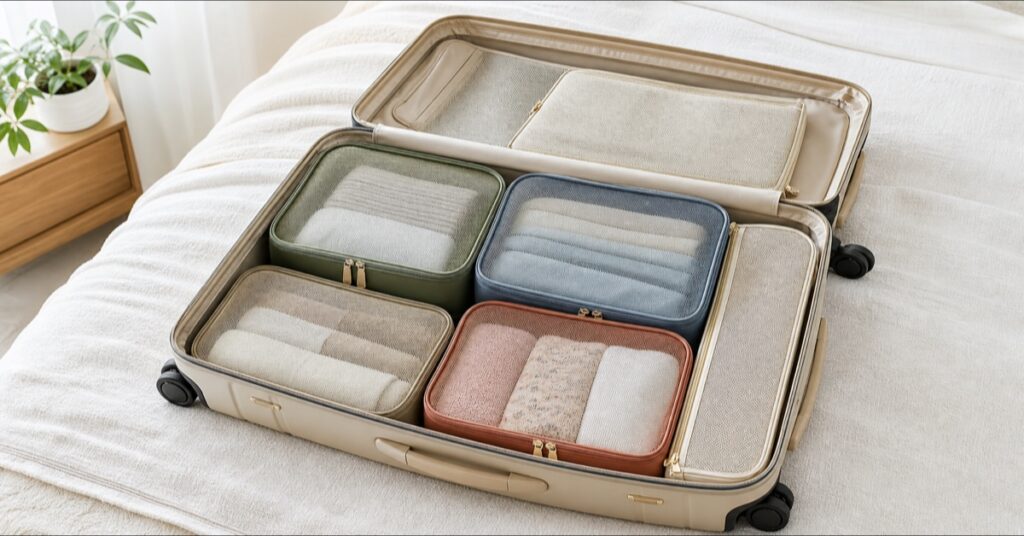
Good packing cubes give every item an address. In a shared suitcase, that matters more than squeezing in one last sweater.
For most families, my favorite setup is simple: use one color for each person, add one easy-to-reach cube for the first night, and keep a separate bag ready for dirty clothes. Compression cubes can help with bulky layers, but they do not make luggage lighter. They simply make it easier to pack more.
First, choose the set that fits your luggage. Then use the family packing system below for a weekend road trip, a carry-on flight, or one large checked suitcase for everyone.
Quick Picks
- Best overall: OlarHike 10-Set Packing Cubes. A complete set for a larger checked suitcase, with six clothing cubes plus bags for shoes, toiletries, laundry, and small items.
- Best for clean and dirty clothes: Shacke 5-Set Packing Cubes. Four roomy, easy-access cubes and a separate laundry bag, without extra compression zippers.
- Best compression set: BAGSMART 6-Set Compression Packing Cubes. Five compressible clothing cubes in useful shapes, plus a shoe bag.
- Best for color-coding: Gonex 4-Set Compression Packing Cubes. Four practical sizes and a wide color selection make it easier to assign one shade to each family member.
- Best for a shared checked suitcase: TRIPPED 7-Piece Compression Packing Cubes. Larger cubes, a laundry bag, and a shoe bag work well when several people are sharing one big case.
At a Glance
| Packing cube set | Best for | Pieces | Compression | Laundry separation | Main trade-off |
|---|---|---|---|---|---|
| OlarHike 10-Set | A complete family setup | 10 | No | Yes | Too much for many carry-ons |
| Shacke 5-Set | Clean and dirty clothing | 5 | No | Yes | Does not compress bulky clothes |
| BAGSMART 6-Set | Sweaters and other bulky layers | 6 | Yes | No dedicated laundry bag | Fabric can catch in the compression zipper |
| Gonex 4-Set | One color per person | 4 | Yes | No | Solid panels hide the contents |
| TRIPPED 7-Piece | One large shared suitcase | 7 | Mixed | Yes | XL pieces are bulky for a small carry-on |
What Matters in a Family Packing Cube Set
A family set needs more than a long piece count.
First, look at the mix of sizes. One huge cube can swallow half a suitcase, but it also forces you to move everyone’s clothes when you need one pair of socks. Several small and medium cubes are usually easier to assign and rearrange.
Next, decide whether you really need compression. It helps most with puffy jackets, sweatshirts, knitwear, and adult clothing. Thin children’s pajamas and T-shirts often benefit more from quick access than extra squeezing.
Then check the extra bags. A real laundry bag is useful. A shoe bag can be helpful. A tiny cosmetic pouch that cannot contain a leak may be less valuable than the product photos suggest.
Finally, think about the suitcase, not just the cubes. A seven- or ten-piece set can make sense in a large checked bag. The same set may feel fussy inside a compact carry-on. If each child already has a separate kid-friendly suitcase, you may need only one or two cubes per person.
The 5 Best Packing Cubes for Family Travel
1. OlarHike 10-Set Packing Cubes — Best Overall
The OlarHike set is the easiest place to start when you want one purchase to organize a full-size family suitcase.
It includes six clothing cubes: one extra-large, two large, two medium, and one small. The remaining four pieces are an accessory pouch, shoe bag, cosmetic bag, and laundry bag. That mix gives you enough flexibility to pack by person without putting every child’s clothes into one oversized cube.
For a family of four, I would use the two medium cubes for the children, one large cube for each adult, and the small cube for underwear or pajamas. The extra-large cube can hold shared layers, or it can stay home if the suitcase is already close to the airline’s weight limit. The laundry bag then has one clear job from the first day of the trip.
This is a regular packing cube set, not a compression set. That is not necessarily a disadvantage. The zipper has less work to do, and the cubes are easier to open repeatedly when someone needs a clothing change halfway through the day.
The trade-off is weight and scale. The full set weighs about a pound and a half before you add clothes, and ten pieces can crowd a carry-on. The included laundry bag may also be too small for every dirty item from a long family trip. Pack a separate wet bag for swimsuits or leaks; the cosmetic pouch should not be treated as waterproof.
Best for: A family using one larger checked suitcase and wanting a complete, non-compression system.
2. Shacke 5-Set Packing Cubes — Best for Clean and Dirty Clothes
Many families do not need more compression. They need a suitcase that stays understandable after day three.
The Shacke set keeps that job simple. It has four nylon cubes—extra-large, large, medium, and small—plus a separate laundry bag. Every cube is about four inches deep, so the set stacks more predictably than a mix of very shallow and very tall organizers.
The extra-large cube is generous enough for adult shirts and pants, while the medium and small cubes are easier to use for a child’s clothes, underwear, or sleepwear. Because the fronts are mesh, you can spot a pattern or color without opening every zipper. The laundry bag gives worn clothes a home before they begin migrating across the hotel floor.
Shacke uses water-resistant nylon and YKK zippers, but “water-resistant” should be read as protection from minor moisture, not a promise against a spilled shampoo bottle. Toiletries still belong in a leak-resistant bag, and damp swimsuits need a proper wet bag.
This is also a regular, non-compression set. It will not flatten sweaters in the way BAGSMART or Gonex can. The larger cubes can become heavy and place more strain on the seams when packed too tightly, so treat the zipper as a closure rather than a winch.
Choose this set if your biggest problem is keeping clean and dirty clothes apart. It is less complicated than a ten-piece kit and easier to live out of than a set built mainly around maximum compression.
Best for: Hotel stays, cruises, and family trips where laundry separation matters more than saving the last inch of space.
3. BAGSMART 6-Set Compression Packing Cubes — Best Compression Set
Bulky layers are where the BAGSMART set earns its place.
The six-piece set combines one large, two medium, and two slim compression cubes with a separate shoe bag. The clothing cubes expand while you fill them, then close down with a second zipper. Small label windows on the outside are a useful touch for a family: “Mom,” “Sam,” “swim,” or “first night” is faster to read than trying to remember which pale color belongs to whom.
The range of shapes also makes the set easier to puzzle into a suitcase. The slim cubes can run beside shoes or a toiletry bag, while the larger cubes handle sweatshirts, jeans, or adult clothing. If you are flying somewhere cold, that flexibility is more useful than receiving six nearly identical cubes.
Compression does require patience. Fill and close the main zipper first. Then press the cube flat and work the compression zipper around a little at a time. Loose fabric can slip into the zipper path, especially around corners. Pulling harder usually makes the problem worse.
There are two other limits worth knowing. Six pieces can be excessive in a small travel backpack, and compressed clothes may come out more wrinkled. Most important, the set reduces volume, not weight. The suitcase can look beautifully compact and still be over the airline limit.
This is the strongest choice here for thick sweaters and adult layers. For warm-weather children’s clothes that you need several times a day, a regular mesh-front set may be more convenient.
Best for: Cold-weather trips, carry-on packing with bulky clothes, and families who will actually use the label windows.
4. Gonex 4-Set Compression Packing Cubes — Best for Color-Coding
Color-coding works only when the colors are easy to buy and the set is simple enough to repeat. Gonex makes that easier than most.
The four-piece set includes extra-large, large, medium, and small compression cubes. The product family comes in many colors, so you can give each person one shade instead of asking children to remember that “the medium blue cube is yours, but the small blue cube is not.”
One set can cover one traveler from socks to sweaters. In a shared suitcase, two colors create an instant boundary between two people. Bright shades are also easier to spot inside a dark suitcase or hotel drawer.
These cubes use lightweight ripstop nylon and a second zipper to compress the contents. The material keeps the empty set under a pound, but the design has two usability compromises. The solid panels hide what is inside, and the partial opening is slower to scan than a full clamshell mesh front. A simple luggage tag or label card solves much of the first problem.
The compression zipper also needs a gentle hand. Keep fabric away from the track and do not force the cube smaller after it becomes a hard, rounded bundle. Independent travel testing found the sizes useful and the compression effective, but this is still a budget-oriented set rather than a heavy-duty expedition organizer.
Gonex is the best fit when you are building a one-color-per-person system and would rather buy practical four-piece sets than one oversized mixed kit.
Best for: Families who want a clear color assignment and the option to buy matching sets in different shades.
5. TRIPPED 7-Piece Compression Packing Cubes — Best for a Shared Checked Suitcase
The TRIPPED seven-piece set is built around a larger suitcase rather than a tiny carry-on.
It includes two extra-large clothing cubes, a large compression cube, a small compression cube, a long tube pouch, a shoe bag, and a laundry bag. The National Parks print makes the pieces easier to distinguish, and the mix gives bulky adult clothing somewhere to go without using every small cube in the family.
I would look at this set for a 26- to 28-inch checked suitcase shared by several people. One XL cube can hold adult jeans and sweaters, while the smaller cubes handle a child’s outfits or sleepwear. The tube pouch works for socks, underwear, or charging cables, and the laundry bag keeps the return trip from becoming one large mystery pile.
The brand itself positions the XL set for checked luggage and family separation. That distinction matters. The extra-large cubes can feel awkward inside a compact carry-on, especially when fully packed. If everyone is flying with a small bag, TRIPPED’s smaller carry-on set would make more sense than forcing this one to fit.
The printed panels are not see-through, and the thin fabric should not be dragged around by an overfilled zipper. The shoe bag is also better for regular shoes than bulky boots. On the positive side, a 2026 long-term review reported that the cubes and zippers held up through six months of repeated moving and packing.
Choose TRIPPED when the suitcase is large, the clothing is bulky, and you want the laundry and shoe pieces included from the beginning.
Best for: Longer trips, colder destinations, and one shared checked suitcase.
Choose the System Before You Choose the Cubes
Packing cubes stay useful only when everyone understands the system. There are three good ways to divide them.
One Color Per Person
This is the easiest system for a shared suitcase.
Give each family member a color. A child can find the yellow cube without reading a label, and one person’s clothes never need to be mixed with another’s. If you have two suitcases, split each person’s color between both bags rather than putting the entire color in one case.
Color-coding works best for families, longer trips, and children who want to help find or put away their own clothes.
One Cube Per Day or Outfit
Pack a complete outfit together: top, bottom, underwear, and socks.
This is useful for toddlers, camp, theme-park mornings, and short trips with a fixed schedule. It removes decision-making when everyone is tired. The downside is that an unexpected weather change can disrupt the whole plan, and longer trips require too many cubes.
One Cube Per Clothing Type
Put all shirts together, all bottoms together, and all underwear together.
This works well when each traveler already has a separate bag. It also makes sense for adults who repeat and mix outfits. In one shared family suitcase, however, it can create a new problem: everyone must open the same three cubes every morning.
For most shared-suitcase trips, start with one color per person. Add a day-based cube only for the first night or a special activity.
How Many Packing Cubes Does a Family Need?
There is no perfect number, but the luggage style gives you a useful starting point.
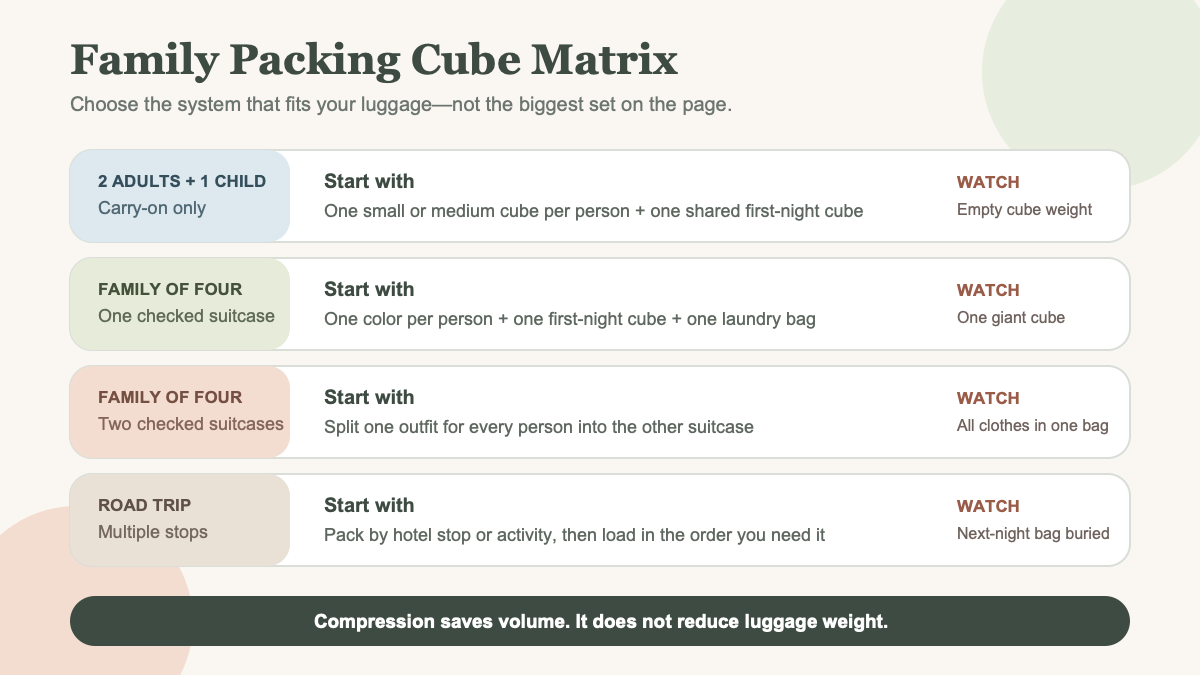
| Trip setup | A sensible starting system | Watch out for |
|---|---|---|
| Two adults and one child, carry-on only | One small or medium cube per person, plus a shared small cube for underwear or the first night | Empty cube weight and too many tiny pieces |
| Family of four, one checked suitcase | One cube per person, one first-night cube, and one laundry bag | One giant cube taking over half the suitcase |
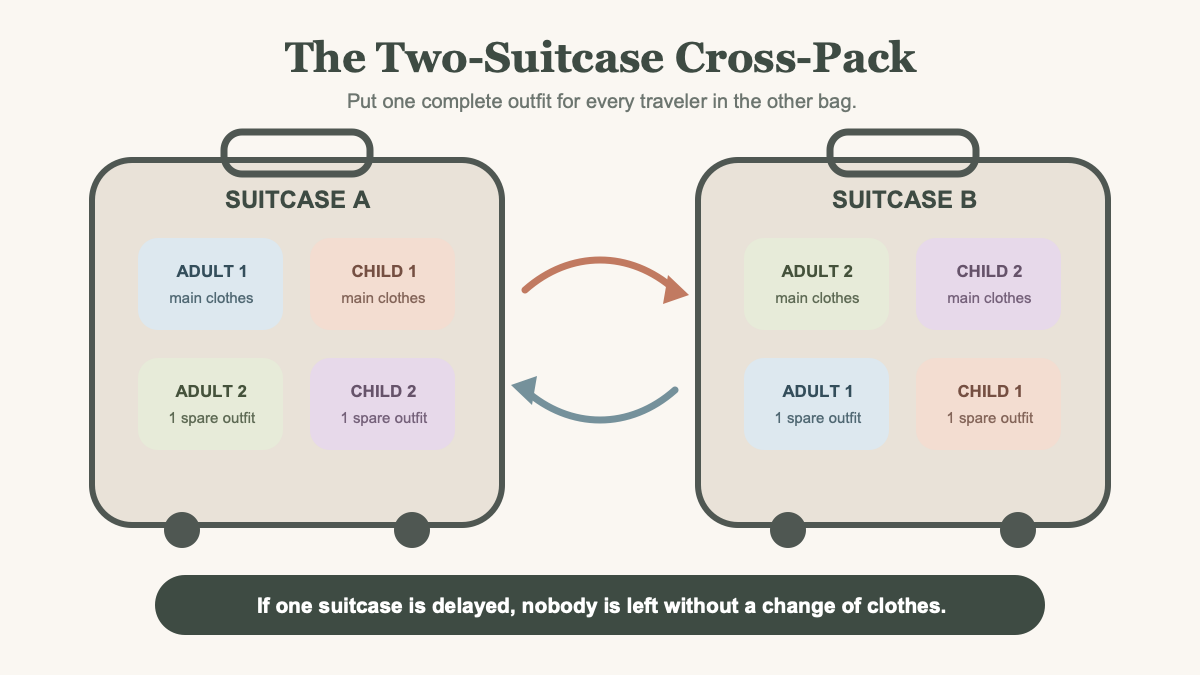
| Family of four, two checked suitcases | Split every person’s clothes between both cases | Packing one person completely in a bag that may be delayed |
| Road trip | Pack by hotel stop or activity instead of by person | Burying the next overnight bag under everything else |
If the trip includes a diaper bag, stroller, car seat, and travel crib, fewer cubes are often easier to manage. Keep the grab-and-go essentials in your minimal diaper bag setup and let the suitcase hold the items you will not need in transit.
Regular vs. Compression Cubes for Families
Regular cubes are underrated. They open quickly, usually have more visible mesh, and place less stress on the zipper. They are a good match for children’s clothes, pajamas, and anything you may need during the day.
Compression cubes make the most sense for bulky, soft items: sweaters, fleece, puffy layers, and adult pants. They can reduce empty air, but they cannot change the weight of the contents. They may also create a rounded brick that is harder to fit neatly into the suitcase.
A mixed system is often best. Use regular cubes for each child and one or two compression cubes for adult layers. You do not have to compress every cube just because the zipper is there.
My Five-Minute Family Packing Routine
- Lay out each person’s clothes separately. This catches missing pajamas and duplicate “just in case” outfits before they disappear into the suitcase.
- Choose one main system. Use colors for a shared suitcase, outfits for a short fixed itinerary, or clothing types for separate bags.
- Build a first-night cube. Pack pajamas, underwear, and the next morning’s clothes for everyone. Put it on top.
- Cross-pack two suitcases. Move one complete outfit for every traveler into the other case.
- Separate shoes and liquids. A fabric shoe bag contains dirt. A proper liquids bag contains leaks.
- Weigh the finished suitcase. Do this after compression, when it is easiest to underestimate how much has been packed.
For a road trip with a baby or toddler, the same routine works with one change: organize the cubes in the order you will remove them from the car.
A Better System for the Trip Home
Do not wait until the last morning to decide where dirty clothes will go.
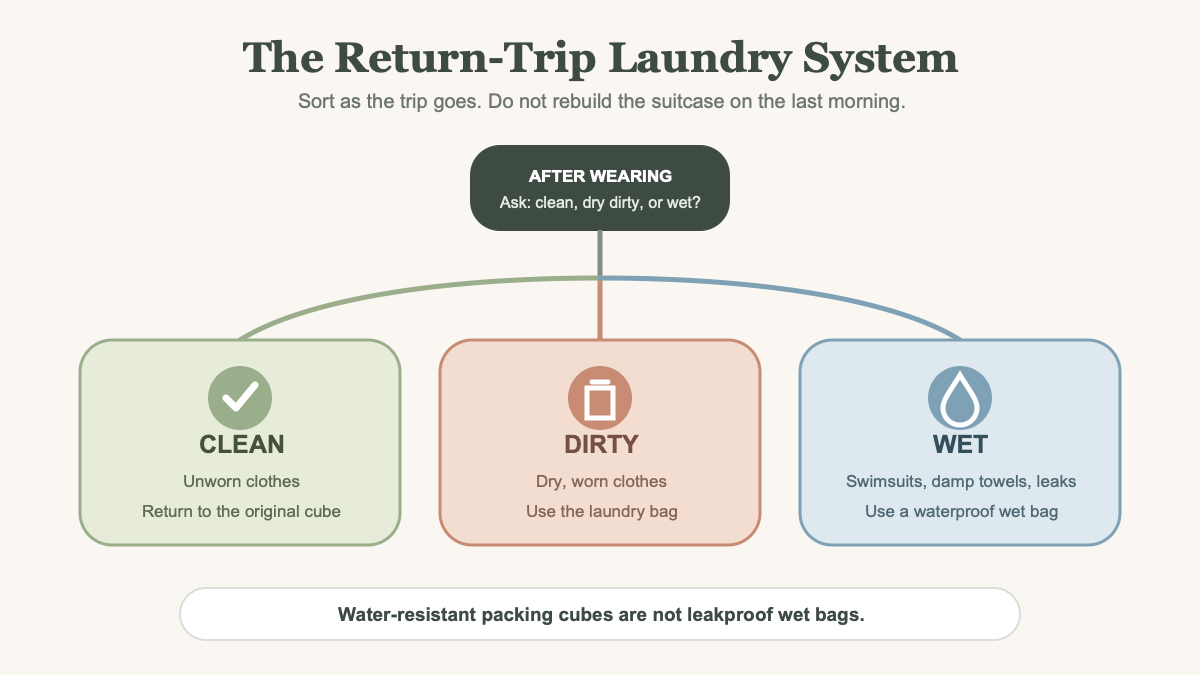
Keep unworn clothing in its original cube. Put ordinary dirty laundry in the laundry bag as the trip goes on. Wet swimsuits, damp towels, and clothes affected by a toiletry leak belong in a separate waterproof wet bag, not a regular fabric cube.
At home, carry the laundry bag directly to the laundry area. Check the care instructions before putting the cube or bag into the washing machine; some are wipe-clean or hand-wash only.
This three-part split—clean, dirty, wet—takes less effort than repacking everything and prevents one damp swimsuit from making the whole suitcase smell.
Family Safety and Care Notes
Packing cubes are luggage organizers, not toys. Keep plastic product packaging away from babies and toddlers, and do not let a child pull on a compression zipper while the fabric is under tension.
Medicines, button-battery devices, chargers, and other small electronics should not be stored in a cube a young child can open independently. A label may tell a child which bag is theirs; it does not make every item inside child-safe.
Water-resistant fabric can handle light moisture. It cannot be relied on to contain shampoo, sunscreen, or wet swimwear.
Frequently Asked Questions
Are packing cubes worth it for family travel?
Yes, especially when several people share a suitcase. Their main value is organization, not magical extra capacity. A clear system makes it easier to find clothing without disturbing everyone else’s things and keeps the room tidier during the trip.
Is it better to pack by person or by outfit?
Pack by person for a shared suitcase or a longer trip. Pack by outfit for a toddler, a short camp stay, or a schedule with predictable activities. Many families do best with one color per person plus one first-night cube packed by outfit.
How many packing cubes do I need for a family of four?
Start with four clothing cubes—one per person—plus a first-night cube and a laundry bag. Add smaller cubes only when they have a clear job. If each person has a separate suitcase, two cubes per traveler may be plenty.
Do compression packing cubes reduce luggage weight?
No. They remove empty space around soft clothing, but the clothes weigh the same. Compression can make it easier to exceed an airline’s weight limit because more items fit into the bag.
Can packing cubes go through TSA screening?
Packing cubes are generally fine inside carry-on or checked luggage, but TSA may open any bag or organizer for additional screening. TSA recommends decluttering and organizing a carry-on to facilitate screening. Liquids still need to follow the current TSA liquids rules.
Are packing cubes waterproof?
Most are not. “Water-resistant” usually means the fabric can handle light moisture. Use a dedicated leakproof liquids bag for toiletries and a waterproof wet bag for swimsuits or damp clothes.
Should clean and dirty clothes share the same cube?
Not unless the cube has a truly separate compartment. A dedicated laundry bag is simpler. Keep wet items separate from both clean clothing and ordinary dry laundry.
The Bottom Line
For one large family suitcase, the OlarHike 10-set gives you the most complete starting system. Choose Shacke if clean and dirty separation matters more than compression, BAGSMART for bulky layers, Gonex for one-color-per-person packing, or TRIPPED for a large checked case.
You do not need to use every piece in the package. Give each cube one clear job, keep the first-night bag easy to reach, and weigh the suitcase before you leave.
That is what keeps packing cubes useful after the neat departure-day photos are over.