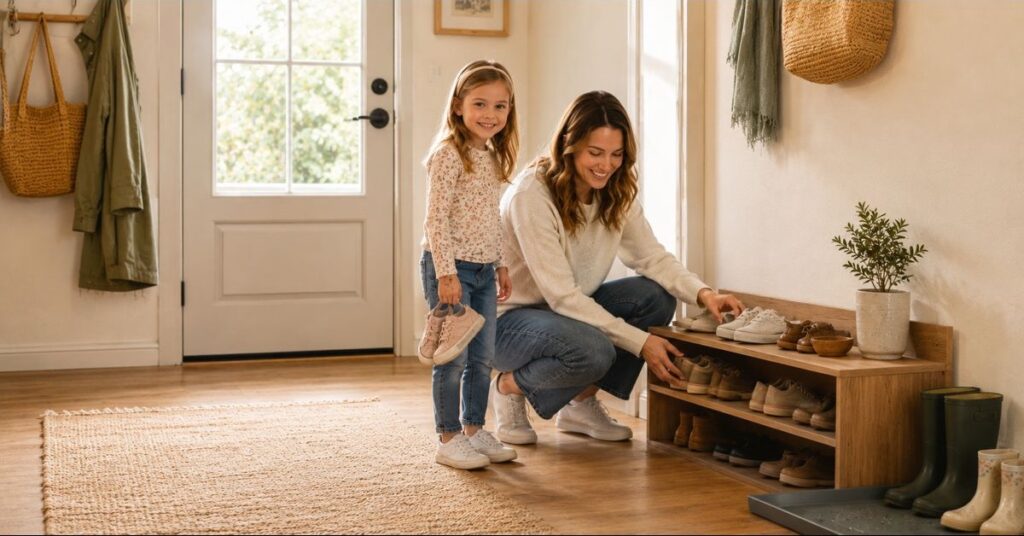
The right shoe rack is not the one with the biggest pair count on the box. It is the one that fits beside your door, holds the shoes your family actually wears this week, and does not create a new obstacle during the morning rush.
Our entryway can look completely reasonable at breakfast and somehow turn into a shoe obstacle course by dinner. One child kicks off sneakers beside the door, another leaves damp shoes with the dry pairs, and the pair needed for school is always underneath something else.
A rack helps only when it matches that real flow. Usable shelf space, stability, wet-shoe handling, and the condition of the parts on arrival matter more than the biggest capacity claim on the box.
If you want the short answer, start here.
The quick answer
Seville Classics 3-Tier Resin Slat Shoe Rack
Choose it for a low, easy-to-reach daily shoe station with solid slats and minimal assembly. It is the strongest all-around fit for sneakers, flats, and children’s shoes in a dry entryway.
SONGMICS 4-Tier Metal Shoe Rack
Choose it when you want four levels in a compact footprint and the option to set shelves flat or angled. Inspect every part before assembly; misaligned or duplicate pieces are the main risk.
| Pick | Best for | Footprint | Realistic family-use capacity | Main trade-off |
|---|---|---|---|---|
| Seville Classics 3-Tier | A simple daily rotation in a dry entry | 27.25 W × 12.75 D × 18.5 H in | About 6–9 adult or older-child pairs; more with small children’s shoes | Limited boot clearance; brand maximum assumes favorable shoe sizes and floor storage |
| SONGMICS 4-Tier Metal | More levels on a smaller budget | 27 W × 10.8 D × 25.6 H in | About 8–12 mixed-family pairs; closer to 8 bulky adult pairs | Arrival and assembly quality control; wire grid is awkward for narrow heels |
Capacity estimates above are intentionally lower than many manufacturer maximums because shoe width, high-tops, and bulky soles change what fits.
Before you buy, measure these three things
1. Your family’s daily shoe rotation
Do not begin with every pair your household owns. As a starting test, allow two active pairs per person: one everyday pair and one weather, sport, or backup pair. A family of five would begin with space for about ten pairs, then adjust after a week.
Seasonal boots, dress shoes, and outgrown children’s shoes belong somewhere else. If you are also trying to simplify the rest of the morning launch zone, see our family command center guide.
2. The door swing and walking path
Mark the rack’s width and depth on the floor with painter’s tape. Open the door fully, then walk through carrying the bags you normally have. If a stroller, sports bag, or grocery tote catches the taped corner, the rack is too deep for that spot even if it technically fits the wall.
3. Your tallest everyday shoes
Measure the high-tops and boots your family reaches for most. A rack may have enough total space but still waste a level when the openings are too short. On an adjustable rack, creating a boot level usually means giving up some pair capacity. That is a useful trade—not a flaw—when the alternative is leaving boots on the floor.
Why there is no shoe bench pick here
A shoe bench can be useful when someone needs to sit while changing shoes, but the current bench candidates raised enough recurring top-panel or documentation concerns that I am not comfortable recommending one here. If sitting matters, pair a regular rack with a separate sturdy chair, or choose a purpose-built bench only after checking its current instructions and recent structural complaints. Never treat a standard shoe shelf as a seat.
Seville Classics 3-Tier Resin Slat Shoe Rack
Best for: A family that wants a low, open shoe station for sneakers, flats, sandals, and children’s everyday pairs.
Skip it if: Your rotation is mostly boots and high-tops, your entry stays damp, or you plan to depend on stacking several units.
The Seville Classics rack is the easiest final pick to understand: an iron frame, three resin-slat shelves, leveling feet, and very little visual bulk. Its assembled footprint is about 27.25 inches wide, 12.75 inches deep, and 18.5 inches high. That low height keeps shoes within easy reach and makes the rack less imposing beside a door.
The manufacturer says the shelves can carry up to 30 pounds each when weight is evenly distributed. That is a manufacturer limit, not a target or an independent load test. For ordinary shoes, the more relevant question is width. Although the brand describes room for up to 12 pairs when the floor space underneath is included, large adult shoes change the math quickly.
What actually fits: Plan on roughly two or three pairs per shelf. Six to nine adult or older-child pairs is a sensible range, with room for more when several pairs belong to younger children. Large men’s shoes may limit a level to two pairs.
Why it made the list
- Solid slats support small shoes better than widely spaced wire.
- Tool-free assembly is simpler than the SONGMICS pick.
- Independent testing rated the Seville design highly for stability and durability.
- A long limited warranty adds useful model-level support.
The trade-off
The fixed shelf spacing is better for low footwear than for boots. Critical reviews also raised isolated welded-clip defects and wobble when units were stacked, which is why I prefer it as one dry, freestanding unit.
Check this when it arrives
- Inspect every welded clip and resin slat for a bend or crack.
- Clip the shelves into place and confirm they sit level before adding shoes.
- Adjust the feet on a flat surface and return a unit that still rocks.
- Keep heavier footwear on the lowest shelf.
SONGMICS 4-Tier Metal Shoe Rack
Best for: A mixed family shoe rotation that needs four usable levels without spending much or taking over the entry wall.
Skip it if: You want almost no assembly, cannot install the included anti-tip restraint, or store many narrow heels.
This bronze SONGMICS rack measures about 27 inches wide, 10.8 inches deep, and 25.6 inches high. Its four wire-grid shelves can be installed flat or angled, with a raised stop behind them to help keep shoes from sliding toward the wall. The manufacturer lists a 30-pound static limit per shelf and includes adjustable feet and an anti-tip kit.
This is the pick for a family whose shoe mix changes with sports and weather. Angle a level for easier viewing, leave shelves flat for children’s shoes, or remove one when tall footwear matters more than maximum pair count. I would not build the entryway plan around stacking several units; one anchored rack is the more conservative setup.
What actually fits: Expect about eight to twelve mixed-family pairs. If the rack holds only bulky adult sneakers, two pairs per shelf—about eight total—is more realistic. Narrow heels can slip into the wire openings unless you add a suitable liner.
Why it made the list
- Four levels in a footprint less than 11 inches deep.
- Flat or angled shelf positions adapt to a changing shoe mix.
- Usually sits in the lower price band of the two picks.
- The included anti-tip kit supports a safer family setup.
The trade-off
The exact product’s lower-star reviews show a recurring arrival-QC pattern: duplicate side frames, misaligned holes, missing bolts, bent parts, and pieces that do not fit. That does not look like a post-assembly collapse pattern, but it can turn assembly into a frustrating return.
Check this before you build upward
- Count the bolts and compare the left and right side frames.
- Dry-fit one lower shelf to confirm the holes align.
- Do not bend a frame or hammer parts together to rescue a defective unit.
- Keep the box until the rack is level, fully tightened, and anchored.
Which shoe-rack style fits your entryway?
| Your constraint | Start with | Why | Watch for |
|---|---|---|---|
| You want the lowest visual profile | A low open rack like Seville | Easy reach and less visual bulk | Boot clearance and damp floors |
| You need more levels for the money | A four-tier wire rack like SONGMICS | Uses vertical space efficiently | Arrival parts, heel gaps, and anchoring |
| You also need a bag-drop zone | A separate wall hook, narrow shelf, or basket beside the rack | Keeps bags off the shoe levels without turning the rack into a catch-all | Mount wall storage securely and preserve the walking path |
| Your shoes are often wet | An open rack beside a separate tray | Allows airflow without dripping through clean levels | Rust, floor protection, and wet shoes touching dry pairs |
| You want every shoe hidden | A closed cabinet | Creates a calmer visual surface | Wet shoes need to air first, and doors need operating space |
The simple family shoe-flow system that prevents overflow
1. Land wet shoes separately
Put a washable tray or absorbent mat beside the rack. Dripping shoes stay there until they are dry enough to join the rotation. This protects the floor and prevents water or mud from falling onto the pair below.
2. Keep only this week’s shoes at the door
When the rack fills, do not buy another rack first. Move one less-used pair per person to a bedroom closet or seasonal bin. A visible one-in, one-out rhythm is easier for children to follow than an entryway shelf packed edge to edge.
3. Give each person a predictable zone
A shelf or half-shelf works better than a tiny label for every pair. Put children’s shoes where they can reach them without climbing, and keep the heaviest adult shoes low. If mornings still feel scattered, pair this setup with a simple school-morning routine.
4. Reset once a week
Choose a five-minute reset point—Sunday evening, laundry day, or after sports practice. Re-pair loose shoes, move dry shoes off the tray, and return out-of-rotation pairs to their main storage. The rack stays useful because the system has an exit, not because the rack is endlessly expandable.
A family safety note
- A standard shoe rack is not a seat, step, or climbing frame.
- Use the included anti-tip restraint on taller or lightweight units, following the manufacturer’s instructions and the correct hardware for your wall.
- Place heavier footwear on lower levels.
- Stop using a rack with a bent weld, cracked load-bearing part, missing fastener, or persistent rocking.
- Keep small assembly hardware away from children.
The U.S. Consumer Product Safety Commission’s Anchor It guidance explains why unsecured furniture can become a tip-over risk around children. Always follow the exact instructions supplied with your rack.
Frequently asked questions
How many pairs should an entryway shoe rack hold for a family of four or five?
Begin with two active pairs per person, so about eight pairs for four people or ten for five. Then adjust for work shoes, sports, and weather. The goal is the weekly rotation, not every shoe the family owns.
Is an open shoe rack better than a closed cabinet for wet shoes?
An open rack usually offers better airflow, but soaked shoes should still start on a separate tray so they do not drip onto clean pairs or the floor. A closed cabinet can work after footwear has dried.
What type of rack works best for boots and high-tops?
Look for taller openings, removable shelves, or a top level with open space above it. Measure the tallest everyday pair first. Remember that removing a shelf for boots reduces total pair capacity.
Is a shoe bench better than a regular rack?
A bench can help a child or adult who benefits from sitting to change shoes, but only when the exact product is designed and documented for seating. A regular rack with a rigid top is not automatically a bench.
Can you safely stack shoe racks in a home with children?
Only stack compatible units when the current manufacturer instructions explicitly allow it, and follow every connection and wall-restraint step. For this guide, I recommend the final picks as single, properly leveled units.
How deep should a shoe rack be for a narrow entryway?
The two picks here are roughly 11 to 13 inches deep, but the correct number depends on your door and traffic path. Tape the full footprint on the floor and walk past it with your normal bags before ordering.
The bottom line
For the easiest all-around daily shoe station, I would start with the Seville Classics 3-Tier Rack. Choose the SONGMICS 4-Tier Metal Rack when budget and adjustable levels matter more than minimal assembly.
A calmer entryway does not need to hold every pair your family owns. Give this week’s shoes a home, protect the walking path, and keep wet pairs in one separate place. That is enough to make the doorway work without asking one rack to organize the whole family.