Blog

  • How to Handle Toddler Tantrums Calmly

    How to Handle Toddler Tantrums Calmly: Read the Emotion, Then Guide

    How to Handle Toddler Tantrums Calmly: Read the Emotion, Then Guide

    Mother calmly talking to her toddler on a beige rug in a cozy Scandinavian living room, symbolizing gentle parenting and emotional connection.
    Calm connection first, problem-solving second.

    Almost every 2–3-year-old has those melt-down moments: they were fine one second, then burst into tears because the banana was peeled “wrong.” If you’ve ever felt your own stress rising at such moments, you’re not alone—and your child isn’t misbehaving on purpose. Their brain and emotions are still under construction.

    Why toddlers “suddenly explode”

    The brain’s control center (the prefrontal cortex) matures slowly. Young toddlers can feel intense frustration but lack the language or impulse control to manage it. Crying, yelling, or throwing becomes their default communication.

    Key idea: your child isn’t defiant—they’re expressing overwhelm the only way they can right now.

    The autonomy (“stubborn”) stage

    Between 18 months and around 3–4 years, children enter the autonomy stage—what parents often call the terrible twos. It’s not a behavioral flaw, but a healthy step toward independence. The child is discovering “I am separate from you, and I can decide.”

    What’s really happening

    • Wants independence, lacks skill: tries to pour milk alone, then cries when it spills—will grows faster than ability.
    • Testing safety and limits: checks how far they can go before you step in. Consistency builds trust.

    Your job is to keep boundaries firm but calm—allow small choices, prevent harm, and guide communication.

    Common traps that backfire

    • “Stop crying!” → translates as “your feelings aren’t allowed.”
    • “If you cry, I’m leaving.” → raises anxiety and prolongs the meltdown.
    • “You’re always like this.” → labels the child, not the behavior.

    What actually helps

    1. Pause before reacting. Take one deep breath. Tell yourself, “This is development, not disobedience.”
    2. Get low, describe what you see. “You’re upset because play stopped, right?” Calm tone beats logic.
    3. Offer small choices. “Pick up blocks now or after one song?” Small control reduces resistance.
    4. Set rules after calm. “I get you’re angry, but throwing isn’t safe. Next time, use words.”
    5. Debrief later. Once calm, help name feelings and solutions: “Next time you can say, ‘I need help.’”

    Remember your own calm

    Your mood sets the tone. If you feel on edge, briefly step away—“I need a drink of water; I’ll come right back.” That models healthy regulation better than any lecture.

    Routines make peace easier

    • Predictable schedule: steady meals, naps, and bedtime reduce frustration from uncertainty.
    • Advance notice: “Five minutes, then bath.”
    • Few, consistent rules: clear beats many.
    • Calm corner: a soft spot with books or a plush toy to cool down—not punishment.
  • The Complete Home Safety Guide for Babies

    Baby Home Safety Guide · Little Loving Life

    Baby Home Safety Guide

    Home is familiar — and where we often miss risks

    I once saw a clip of a two-year-old pushing a car key into an outlet and bursting into tears. It stayed with me.

    For little ones, the most familiar place is where we relax our guard. Babies learn to roll, crawl, stand and toddle at home — and that’s also where outlets, sharp corners, climbable drawers, and tiny loose parts quietly live.

    Let’s walk through those “looks harmless” corners and make simple, realistic fixes.

    Living room · where bumps happen most

    Scandinavian living room with corner guards, outlet covers, and wall-anchored furniture for baby safety
    • Anchor furniture: TV, dressers and bookcases fixed to the wall. Drawer-climbing can tip things fast.
    • Pad sharp edges: Silicone corner guards on coffee/side tables and media units.
    • Outlets & cords: Outlet covers; route cables into channels or boxes so they’re not pullable.
    • Blind cords up high: Tie and secure on a cleat; don’t park sofas under windows.

    If you have a floor lamp, purifier or speaker, check whether the power cable can be tugged. Add anti-slip tape under rug edges.

    Kitchen · the tempting “mystery lab”

    • Turn pot handles inward: Hot soup and frying pans — handle-in, out of reach.
    • Sharp/chemical items go high: Knives, scissors, detergents above 40 in / 1 m. Keep tiny magnets/fridge pins out of low zones.
    • No holding baby while cooking: Even boiling water can spill; set a doorway boundary.
    • Dry floor: Anti-slip matters when you’re carrying a child.

    A “safe cupboard” with wooden spoons and light containers lets your baby “cook” nearby without danger.

    Bedroom · easy to underestimate

    • Crib stays minimal: No pillows, plush toys or heavy blankets.
    • Skip crib bumpers: Many pediatric societies (incl. AAP) advise against them.
    • Sleep sack over thick quilts: Less overheating, less airway cover risk.
    • Keep cords/outlets away: Tie blind cords high; no reachable outlets near the crib.

    Tight-fit mattress with a snug sheet — no gaps for tiny arms or legs.

    Bathroom · small room, big risk

    • Non-slip mats: In the tub and on the floor.
    • Water at 100–104°F / 38–40°C: Use a thermostatic mixer or a thermometer; test before baby goes in.
    • Products up high: Cleansers and bath items out of reach.
    • Outside-operable lock: Prevent accidental lock-ins; unplug dryers/shavers after use.
    • Prep before bath: Towel, diaper and clothing ready so you never step away mid-bath.

    Even a few seconds can be risky. Keep one hand on your baby throughout bath time.

    Hallway & balcony · last lines of defense

    • Rails & netting: Balcony gaps under 4 in / 10 cm; remove climbable furniture.
    • Baby gates: At stair tops/bottoms and room thresholds where needed.
    • Small things off the floor: Tidy toys, stash chargers, shorten or secure long cables.

    Door backs, stair turns and storage closets are easy to forget — add them to your regular patrol.

    Easy-to-miss but high-risk details

    • Button batteries & magnets: Make sure battery doors are secure; swallowed button batteries can burn tissue quickly.
    • Hair tourniquet: During changes/baths, check fingers, toes and diaper area for stray hair/threads.
    • Medicines & gummy vitamins: They look like candy — keep them locked.
    • Low glass/mirrors: Leaners and frames can tip or shatter; keep high or anchor.
    • Chargers & extension cords: Pulling can topple devices or expose live parts; use shorter, secured routes.
    • Old toy parts: Recheck sewn eyes/buttons; loose bits are a choking hazard.

    Quick-check table (print-friendly)

    AreaCommon hazardSimple fix
    Living room Sharp corners, tip-overs, loose cords Corner guards + wall anchors + cord channels/boxes
    Kitchen Outward pot handles; low sharp/chemical items Handles inward + store high + doorway boundary
    Bedroom Pillows/plush in crib; bumpers; nearby cords Clutter-free crib + skip bumpers + tie cords high
    Bathroom Slips; hot water; accidental lock-ins Non-slip mats + 100–104°F water + outside-operable lock
    Balcony/Hallway Wide gaps; climbable items; no gate Safety net/closer gaps + remove climbables + baby gate

    Before you go

    Since becoming parents, many of us sleep lighter and can’t finish stories about children getting hurt.

    Raising a child safely is hard. Global research shows unintentional injuries are a common threat — and many risks don’t come from outside. They hide at home.

    Not the road. Not the park. Often, it’s the living room, the nursery, the bathroom.

    Instead of fear, build habits. Every corner guard, outlet cover and anchored dresser adds one quiet layer of protection.

    Related reading (on Little Loving Life)

    Authoritative resources

    © Little Loving Life — practical, warm & truly useful parenting.
  • How to Set Up a Newborn Station at Home

    How to Set Up a Newborn Station at Home

    A cozy newborn care corner at home with a wooden cart by a window and beige linen curtain.
    A calm, practical newborn care corner you can easily set up at home.

    The first weeks at home are wonderful—and messy. A small newborn care corner helps a lot: keep diapers, wipes, and feeding essentials right where you can reach them, so nights run smoother.


    1) Choose a Small, Close Spot

    • Night feeds: Set a nursing corner by the bed so you don’t have to wander around half-asleep.
    • Changing area: An open-shelf changing table with a cream pad and a shallow rattan tray keeps things tidy and within easy reach.
    • Two-station trick: If you have stairs, set a main station in the bedroom and a mini one in the living room—no more trips just for wipes.
    Tip: Daytime near a window; at night, a small dimmable lamp is kinder than overhead lights.

    2) Nursing & Pumping (Keep It Grab-and-Go)

    • Nursing pillow, two burp cloths, a small tube of nipple cream
    • Breast pump & parts, water bottle, small notebook or phone stand
    • A dimmable night light (enough to see, not enough to wake the baby)

    A rolling cart is plenty: roll it into the living room in the morning, back to the bedside at night—no repacking. For evidence-based nursing help, see the AAP Breastfeeding Guide.

    3) Diaper Changing Zone

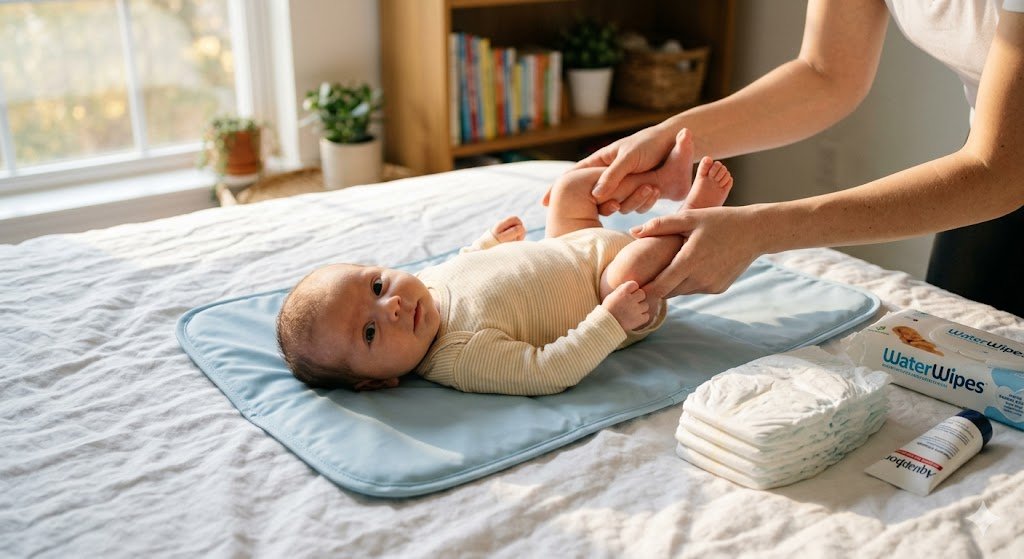
    Keep it simple and uncluttered. Use a sturdy open-shelf table with a wipeable cream pad on top. Daily grab-items live on the top; backups stay on the lower shelf. A shallow rattan tray holds cream and wipes—easy to grab and put back with one hand.

    • Diapers, wipes, diaper cream, washable pad cover
    • One spare onesie or sleeper, small bin or sealable bags
    • Anchor tall furniture to the wall; keep cords and heaters away
    Scandinavian baby changing table with cream pad, rattan tray, and organized shelves under soft daylight.
    Tray on top for lotions and wipes; backups tucked neatly on the shelf below.

    New to diaper rash? The Mayo Clinic guide covers prevention and quick fixes.

    4) Simple Organizing That Sticks

    Sort by purpose—diapering, feeding, and care. Linen or woven bins keep it cozy and make daily resets quick.

    • Top shelf: diapers + wipes
    • Middle shelf: creams, burp cloths, spare pad covers
    • Bottom shelf: bulk diapers, extra swaddles
    • Cart: pump parts, water, a small snack for you

    5) Add a Bit of Comfort

    • Warm night light and (optional) white-noise machine
    • Comfortable chair or glider, plus a light blanket
    • A small frame or a few dried flowers if you like a little décor

    No need to style for photos—just make it comfortable and easy to use.

    6) Keep It Safe & Clean

    • Store creams and medicine out of reach.
    • Anchor furniture; use outlet covers where needed.
    • Wipe surfaces daily; rotate washable items often.

    For official guidance, see the CDC Safe Sleep & Home Safety page.

    7) Quick 5-Minute Reset Checklist

    CategoryMust-Haves
    NursingNursing pillow, burp cloths, nipple cream, breast pump, water bottle, night light
    DiaperingDiapers, wipes, diaper cream, changing pad, spare outfit, trash bags
    OrganizingBaskets, dividers, labels
    ComfortChair or glider, blanket, white-noise machine, simple décor

    Final Thoughts

    Your newborn station doesn’t have to be perfect—it just has to work for you and your baby. When everything has a place, nights feel calmer and the small tasks go faster.

    If you ever need support, Postpartum Support International offers free help and community for new parents.

  • What To Do When Your Child Has a Fever: Accurate Temperature Taking, Home Care, Medicines & When to Seek Care

    Mother gently comforting her sick baby at home, sitting on a beige sofa under warm daylight, with a digital thermometer and a glass of water on a small wooden table nearby.
    Calm home moment — a mother comforting her feverish baby under soft natural light. (Photo © Little Loving Life)

    What To Do When Your Child Has a Fever: Accurate Temperature Taking, Home Care, Medicines & When to Seek Care

    Key takeaways (30-second read)

    1. Fever definition: Rectal/ear/temporal ≥100.4°F (38.0°C); oral ≥100.0°F (37.8°C); axillary ≥99.0°F (37.2°C). Mayo Clinic
    2. Look at comfort & hydration more than the number. Many fevers can be managed at home with fluids, rest, and comfort care.
    3. <3 months old: any fever ≥100.4°F (38.0°C) → contact your pediatrician promptly. AAP
    4. Medicines: Acetaminophen (all ages if advised), Ibuprofen (≥6 months). Dose by weight. No aspirin for kids/teens. AAP
    5. Skip alcohol baths & ice water. If using a bath, keep it lukewarm and stop if your child shivers. AAP

    What counts as a fever?

    Fever is a normal immune response. For practical home decisions, use these thresholds:

    • Rectal / Ear / Temporal: ≥100.4°F (38.0°C)
    • Oral: ≥100.0°F (37.8°C)
    • Axillary (underarm): ≥99.0°F (37.2°C)

    When calling your pediatrician, report the number + method (e.g., “temporal 101.2°F”).

    How to take your child’s temperature (by age & device)

    • <3 months: Prefer rectal for accuracy.
    • ≥6 months: Ear can be used if aimed correctly; earwax and cold exposure can skew readings. AAP
    • Temporal (forehead): Works across ages; let your child warm up after coming indoors; avoid sweat/glare interference. AAP
    • Axillary: convenient but least accurate; confirm with a more accurate site if results and appearance don’t match. Mayo

    Home care: comfort first

    • Fluids: small, frequent sips of breast milk/formula/water or oral rehydration solutions. Watch dehydration signs (dry mouth, fewer tears, fewer wet diapers, sunken soft spot). AAP
    • Clothing & room temp: light breathable layers; add a thin blanket only if shivering. AAP
    • Lukewarm baths only (optional): avoid cold water and never use alcohol sponges. AAP

    Fever medicines & weight-based dosing

    Goal: help your child feel better (rest, drink), not to “zero out” the number.

    • Acetaminophen (paracetamol): 10–15 mg/kg per dose, every 4–6 hours; max 4 doses in 24h. Use mL syringes, not kitchen spoons. AAP dosing table
    • Ibuprofen: 5–10 mg/kg per dose, every 6–8 hours; use only if ≥6 months. AAP dosing table
    • No aspirin in children/teens (Reye syndrome risk). AAP
    • Avoid routine alternating of acetaminophen & ibuprofen unless your clinician gives a written schedule. AAP clinical report

    When to seek care (by age & red flags)

    Go to the ER now (any age) if one or more is present

    • Breathing trouble: fast/labored breathing, chest retractions, noisy breathing/stridor/wheezing, blue/gray lips/face. AAP symptom checker
    • Very poor responsiveness: unusually sleepy/hard to wake or “looks very ill.” AAP
    • Age <3 months with temp ≥100.4°F (38.0°C). AAP
    • Repeated ≥104°F (40.0°C) or a seizure. AAP
    • Severe dehydration: very few/no wet diapers, dry mouth, no tears, sunken fontanelle, marked lethargy. AAP

    Contact your pediatrician the same day

    • Fever duration: <2 years >24 hours; ≥2 years >72 hours. AAP
    • Cough with risk signs: clearly faster breathing, chest pain, wheeze, or cough >3 weeks. AAP symptom checker
    • Poor intake + less urine: refusing to drink/nurse plus fewer wet diapers → dehydration concern. AAP
    • Your gut says your child is getting worse or still “not right” even after fever comes down. AAP

    Combo symptoms: fever + cough + poor appetite + restless sleep

    This cluster is common with viral respiratory illnesses. What matters most is breathing, hydration/urine output, alertness, and the duration of fever/cough:

    1. ER now if any breathing distress or very poor responsiveness occurs (see list above).
    2. Same-day visit if fever exceeds the duration thresholds above, if your child won’t drink + pees less, or if cough is persistent/worsening with chest pain/wheeze. Details above.
    3. Home care is fine if appetite is down but your child is still drinking, urinating normally, and interacting reasonably well. Re-check trends over 24–48 hours.

    When fever comes with a cough: simple comfort care

    • Humidified air and warm clear fluids (if age-appropriate); avoid second-hand smoke.
    • Honey can soothe nighttime cough for children >1 year (2.5–5 mL as needed). Do not give honey to infants <1 year. AAP
    • OTC cough/cold medicines: not recommended <2 years; manufacturers label most products “do not use under 4 years.” Use caution for older kids and avoid multi-ingredient combos. FDA

    Febrile seizures: what parents should know

    • Occur in about 2–5% of children (typically 6 months–5 years). Most are brief, with excellent recovery and no long-term harm. CDC
    • If a seizure happens: place your child on their side, clear nearby hazards, do not put anything in the mouth, and time the event. Call emergency care if it lasts >5 minutes or if you’re worried. CDC

    FAQ

    Do I need to bring the temperature back to “normal”?

    No. Treat if your child is uncomfortable or can’t rest/drink; the number is just one piece of the picture.

    Is an ear thermometer better than a forehead (temporal) thermometer?

    Both are acceptable when used correctly. Ear thermometers are generally for ≥6 months and must point toward the eardrum; temporal thermometers work across ages but can be affected by cold exposure and sweat. AAP

    Why do hospitals use axillary readings if they’re less accurate?

    They’re quick and noninvasive for screening/monitoring, but important decisions are confirmed with more accurate methods (rectal/temporal/ear). Mayo Clinic

    Should I alternate acetaminophen and ibuprofen?

    Not routinely. Alternating can be confusing and increases dosing-error risk. If your clinician provides a written schedule, follow it exactly and log doses/times. AAP clinical report

  • Pregnancy Essentials Checklist: What Moms-to-Be Really Need

    Pregnancy Essentials Checklist (2025 Edition): What Moms-to-Be Really Need

    Pregnancy Essentials Checklist (2025 Edition): What Moms-to-Be Really Need

    Smiling pregnant woman in beige dress by a sunlit window with flowers, mug, and notebook.

    Pregnancy Essentials (2025): What You Really Need

    Simplified must-haves with real-life tips — buy less, use more, feel better.

    Updated for 2025 · Evidence-linked guidance

    Why a Short List Works

    Pregnancy is full of change. With checklists everywhere, it’s easy to overspend. This guide keeps only what truly helps—plus clear pointers to trusted sources and practical follow-up guides at the end.

    Core Essentials (6 items)

    1) Maternity leggings / support pants / dresses

    Regular pants are fine early on, but by the second trimester they’re often uncomfortable. Support leggings ease pressure and make moving or sitting easier. In warm weather, flowy maternity dresses are breathable and effortless. Many maternity tops double as pajamas postpartum.

    2) Nursing bras (wire-free)

    Breast changes happen fast. Wire-free nursing bras feel soft yet supportive and are comfy for sleep. Choosing nursing-friendly styles means you’ll reuse them after birth.

    3) Pregnancy pillow (or extra pillows)

    Late-pregnancy sleep gets tricky. A pregnancy pillow supports bump, back, and legs for easier side-sleeping—and can double as a nursing support later. On a budget, arrange 2–3 regular pillows strategically.

    4) Basic moisturizer or body oil

    Itchiness and tightness—especially on the belly—are common. Apply lotion or oil morning and night. Consistency beats brand or price.

    5) Prenatal vitamins / folic acid (doctor-advised)

    Follow medical guidance and avoid stacking supplements yourself. Solid overview from Mayo Clinic.

    6) Pregnancy journal & document folder

    Keep checkup papers together and jot down milestones—handy now, memorable later.

    Skincare & Personal Care

    Keep it gentle and simple; you don’t have to switch everything to “pregnancy-only.” See the NHS and the American Academy of Dermatology for details.

    • Skincare: gentle cleanser + moisturizer; avoid retinoids and strong acids.
    • Makeup: light looks are fine; skip heavy waterproof products needing harsh removers.
    • Hair/body wash: mild formulas; low/no fragrance if smells trigger nausea.

    Optional Add-Ons

    • Belly support belt: helpful for long walks or back ache.
    • Compression socks: for swelling in late pregnancy (APA).
    • Yoga mat / resistance bands: if you already do light exercise.
    • Healthy snacks: nuts, granola bars, ginger candies.

    What You Can Skip

    • At-home fetal dopplers — easy to misinterpret; anxiety-inducing.
    • Seat-belt adjusters — correct belt positioning is what matters.
    • Complex multi-step skincare — one good moisturizer is plenty.
    • Anti-radiation maternity clothing —

      Despite marketing claims, there is no scientific evidence that everyday electromagnetic fields (like Wi-Fi, phones, laptops) harm pregnancy. WHO and NHS state that low-level exposure is not dangerous. These garments are often expensive, uncomfortable, and may even worsen phone emissions by blocking signal.
      WHO FAQ · NHS guidance

    • Extra “comfort gadgets” — you likely own suitable ones already.

    Final Thoughts

    Start with these essentials, then add selectively based on your body and routine.

    © Little Loving Life · Parenting & pregnancy guides with heart.

  • Toy Guide for 2–3 Year Olds: Play More, Stress Less

    Best Toys for 2–3 Year Olds: Play More, Stress Less
    Best toys for 2–3 year olds — toddler playing doctor with a plush doll using toy stethoscope on a cozy sunlit play mat

    Best Toys for 2–3 Year Olds: Play More, Stress Less

    Best toys for 2–3 year olds don’t have to be fancy—just a few reliable picks and simple play prompts. Here’s a practical guide from an experienced mom.

    After age two, kids suddenly have “ideas”: a line of blocks becomes a parking lot, a zoo, even a tiny bakery. You don’t need a house full of toys—just a few reliable friends and a simple rhythm. With the best toys for 2–3 year olds and small tweaks, days feel lively, not chaotic.

    Best Toys for 2–3 Year Olds: Our Five Go-To Categories

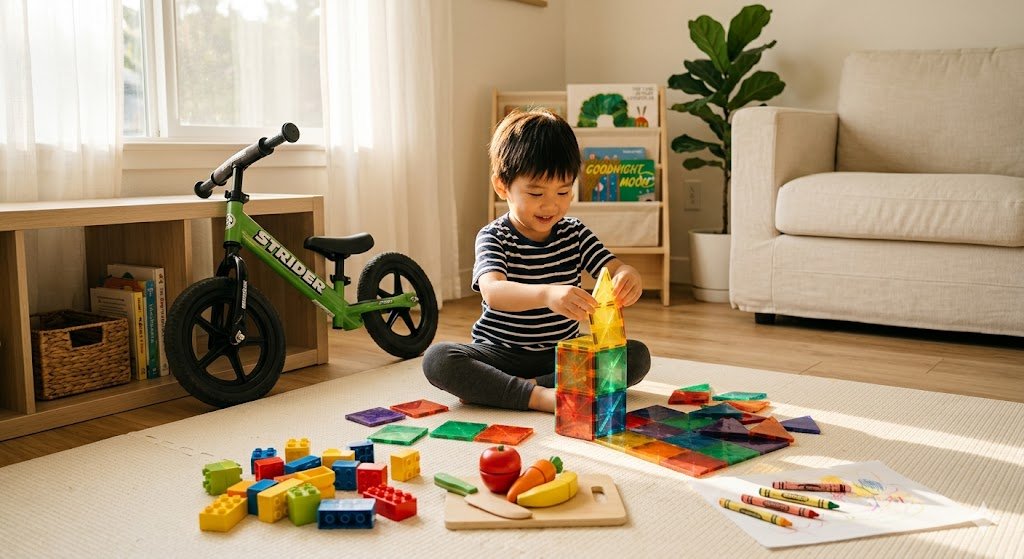
    We started with three core types (blocks/magnets, pretend play, active toys) and later added puzzles/sorting and art. Together these five cover most days without clutter.

    1) Building (blocks / magnetic tiles)

    Why it works: open-ended and expressive—kids can make anything and tell a story with it.

    Try this: build half a bridge and let your child finish; tape simple “parking spots” and play reverse-parking with toy cars.

    If it stalls: loves knocking things down? Build a small tower together, say “let’s check if it’s steady,” then knock it after building. Over time they’ll wait longer and build more before the big “crash.”

    2) Pretend play (doll / kitchen / tools)

    Why it works: everyday life becomes a game—language and cooperation bloom.

    Try this: two props are enough (pot + spoon; doll + bottle). Today “restaurant,” tomorrow “mechanic.”

    If it stalls: only copying you? Model one short line—“Baby is hungry, I’ll cook”—then hand the prop: your turn. One line from them is a win.

    3) Active play (balance bike / ride-on / soft ball)

    Why it works: big movement feels great; after moving, quiet play is easier.

    Try this: tape two “parking stops” and play drive–stop; with balls, add a simple twist: “catch it, then high-five.”

    If it stalls: lots of bumps? Shorten the route and remove obstacles. Practice balance bikes on smooth, hard ground; find balance first, then add distance or turns.

    4) Puzzles & sorting (2–4 pcs / colors / rings)

    Why it works: quick success keeps them coming back.

    Try this: two-piece puzzles → four-piece; match colors → then sort. Add difficulty little by little.

    If it stalls: getting frustrated? Switch to bigger, easier pieces for a couple of quick wins, then re-introduce a slightly harder set.

    5) Art & making (crayons / water books / play-dough)

    Why it works: hands stay busy, feelings calm down, ideas come out.

    Try this: draw and chat—“who is it, what are they doing?”; with play-dough, make buns and fruit, “open a tiny shop.”

    If it stalls: draws two lines and quits? Offer only two colors so it feels easy; once they’re into it, add a third color.

    Common hiccups (and gentle fixes)

    • Throws toys far: totally normal at this age. Make it a “throw to the target” game so it’s about aim, not distance.
    • “Stay with me!” all the time: sometimes they just need to know you’re there. Sit for one minute, then say, “I’ll get water—build me a bridge before I’m back.” Clear mini-goal = more independent play.
    • Won’t tidy up: give a heads-up (“three more throws, then tidy”), then turn tidying into a tiny game—count pieces into a basket and wheel them to the shelf together.
    Helpful flow: say it before play → remind 2–3 minutes before ending → tidy together. This beats “clean as you go,” which often backfires at this age.

    Storage & rotation (keep it easy)

    • Keep only 5–7 toys out; store the rest. Swap a few every few days—instant “new toy” feeling.
    • Tape a small circle on the floor as the “toy island.” When you say “time to go home,” drop pieces back into the bin while counting together.

    Toys we’d skip (from hard-won experience)

    • Oversized indoor slides/swings: huge footprint; the novelty fades fast.
    • Gigantic tubs of tiny blocks: fiddly to grip, scatter everywhere, painful to tidy.
    • Press-and-play singing/dancing dolls: loud, one-note play; hard to blend with other toys.
    • Buying duplicates: one kitchen set or one stroller is plenty—more equals clutter, not more play.

    Rule of thumb: fewer, better, and mixable with what you already own. Among the best toys for 2–3 year olds are sets that build, pretend, move, sort, and create.

    More for parents

    Wrap-up

    With the best toys for 2–3 year olds, you can keep play simple and joyful. Help them win a little, add a tiny challenge, then call it a day. Kids stay happy; the house stays calm.

    Written for real life—less stuff, more play.

  • Best Toys for 1–2 Year Old Toddlers (Practical, Low-Stress Guide)

    Best Toys for 1–2 Year Old Toddlers | Practical, Low-Stress Guide

    Best Toys for 1–2 Year Old Toddlers: Practical & Low-Stress

    Looking for the best toys for 1–2 year old toddlers? After the first birthday, little ones walk steadier, test space with pushing and carrying, love simple cause–effect, and begin pretend play. Keep toys simple, durable, quick to win, and easy to upgrade—that’s how you avoid clutter and keep play calm.

    What’s developing

    • Gross motor: walking, pushing/pulling, carrying, climbing small obstacles.
    • Fine motor: thumb–index pinch; insert, stack, twist, latch, and cap.
    • Cause–effect & problem solving: press, drop, pull, twist → visible results.
    • Language & pretend: pointing, naming, copying phrases; simple make-believe.
    • Autonomy: “I do it” energy; short focus; needs fast success loops.

    Best Toys for 1–2 Year Old Toddlers — Quick Summary

    Start small and get wins: the Lean 3 below covers 3–6 months; add more only if needed.

    Lean 3 (minimal buy)

    • Push/pull toy or low ride-on (pick one): begin with an empty cart on carpet; later add “cargo” (plush/blocks) for resistance.
    • Large wooden blocks (10–20 pieces): put out 5; two levels count as a win; then tidy.
    • Posting/sorting box (swap-top lid): offer 1–2 shapes at a time; start with “put in,” then match shapes.

    Nice-to-have later: a tiny pretend set (pot+spoon / doll+milk), 3–5 board books, chunky crayons + drawing board.

    Five durable categories (cover the whole year)

    • Push/pull/ride-on: “deliver a parcel” from A to B; upgrade to cargo or longer routes. If wobbly, shorten the path and use carpet.
    • Large blocks: start with two levels; upgrade to a bridge/door (two vertical + one horizontal). If stalling, tape “parking bays” and park toy cars.
    • Posting/sorting/early puzzles (2–4 pcs): first “put in,” then match; upgrade by adding one new shape. If frustrated, place the piece at the rim and let your child do the final push.
    • Pretend play (mini kitchen/phone/doll): two props are enough—take turns feeding or “calling.” Upgrade to “store/restaurant” when simple stories appear.
    • Drawing & board books: chunky crayons + big paper; 3 pages of a board book with one prompt per page. Upgrade to trace lines and “find it” prompts.
    Push toy play for 1–2 year old toddlers: delivering a soft toy to the sofa station across the play mat.
    Two quick delivery rounds are plenty—then roll the cart back to the “garage” and tidy.

    Three 10-minute play scripts (copy & go)

    1. Living-room mat — push + blocks (10 min): “Deliver the parcel to the sofa station,” unload, reload, return to the garage; do two rounds, then tidy.
    2. Table-side — sorting + board book (8–10 min): two rounds of sorting 3–4 big pieces (“Round ones here”); then read 3 pages with one prompt per page (“Where’s the spoon?”), close the book, “toys go home.”
    3. Hallway/balcony — safe throwing (8 min): tape a “basket line,” offer a soft ball; “throw from behind the line—high five if it lands in.” Count three points (misses count), then “ball goes home.”

    When play stalls (fast fixes)

    1. Only throwing? Switch to a soft-ball loop: throw → fetch → put back; three loops, then tidy.
    2. Only pushing? Make the cart a helper: transport blocks/shapes to the play spot first.
    3. Frustrated with fit-in toys? Pre-align the piece; your child does the last push; just 2–3 wins per round.
    4. Leaves in 10 seconds? Move the target close and start with a guaranteed quick win.

    Red flags & safety (read once, play easier)

    • Strong magnets/tiny beads: hard no (ingestion risk).
    • Squirt bath toys: trap water → mold; pick open, quick-drain or washable designs.
    • Big sound-and-light stations: noisy and overstimulating; prefer mechanical feedback toys.
    • Too-tight sorter holes: swap the box, not the child.
    • Heavy/long mallets: skip; use palm-press or a light short mallet.
    • Size feel: mouthable pieces roughly ≥1.75 in / 4.4 cm diameter.
    • Battery doors: screw-secured only.
    • Cleaning: daily quick wash/dry for mouthables; weekly wash for plush; drain bath toys every time.
    • Walker note: skip sit-in walkers; consider push toys later—after pull-to-stand/cruising—with low center of gravity and addable weight/adjustable resistance.

    Rotation & tidy (how to do it in real life)

    • Keep 5–7 items out (Lean 3 + 2–4 others); rotate weekly.
    • Two-bin reset: “today” bin for what you used; “on-deck” bin for the rest. Swap bins on the next day or rotation day.
    • Toy island: tape a 60–80 cm circle; toys live inside; end with “toys go home” and count while tossing them back.
    • Independent play expectation: most 1–2 year olds play 3–10 minutes per round—short rounds × more often beats one long session.

    Budget-friendly: “if you have this, skip that”

    Have: 10–20 large blocksSkip: massive 50+ piece complex building kits (for now)
    Have: posting/sorting boxSkip: multi-function sound-and-light stations
    Have: 3–5 board booksSkip: over-engineered talking story devices
    Have: one push/pull toySkip: a second, similar push toy or ride-on

    Home substitutes (free & effective)

    • Measuring cups/bowls/spoons → pouring & sorting props.
    • Cardboard + tape → posting box/drawer/ramp.
    • Washi tape → parking bays, finish line, or “basket line.”
    • Old bibs/cloth bags → “cargo” for the cart.

    Save this guide to the best toys for 1–2 year old toddlers and come back when you’re ready to upgrade difficulty.

    Further reading: AAP: Infant walkers & moving baby gear · NHS: Your toddler from 12 to 18 months · Best Toys for 6–9 Month Old Babies · Best Toys for 9–12 Month Old Babies

  • 9–12 Month Toy Guide: Practical & Low-Stress

    Best Toys for 9–12 Month Old Babies (Practical, Low-Stress Guide)

    Best Toys for 9–12 Month Old Babies: Practical & Low-Stress

    Looking for the best toys for 9–12 month old babies? At this age many little ones pull to stand, begin cruising, and love simple cause–effect. Short waits and turn-taking start to appear, and mouthing is still common. The winners are toys that are easy to hold, give instant feedback, offer a quick win, tidy fast, and can scale.

    What’s developing

    • Mobility toward pull-to-stand and cruising; balance improves on each child’s timeline.
    • Hand accuracy—lining pieces to a hole/outline gets easier.
    • Cause–effect—press → pop, post → drop, roll → reappear.
    • Short focus + brief wait for a reveal.
    • Turn-taking + imitation (“you do one, I do one”).
    • Mouthing—safe materials and easy cleaning still matter.

    How to pick

    1. Easy to hold: one-handable, no fiddly alignment.
    2. Instant feedback: mechanical actions over lights/songs.
    3. Quick win first: single-action loop (place→in / press→pop / roll→out), then add difficulty.
    4. Easy to clean & put away: washable, no water traps; one bin to reset.
    5. Upgradeable: same toy scales (slot width, piece count, distance).

    The Lean Four

    Keep these within reach. If you’ll buy one item first, choose a posting box with a swap-top shape lid and put out only 1–2 shapes at a time.

    • Posting box + large discs. Take turns—“you one, me one”—then tip out and repeat. Upgrade when baby posts several in a row without looking (≈6–8); narrow the slot or add color/number rules. If stuck: park the disc at the rim; use larger, thicker discs.
    • Object permanence (“find-the-ball”) box. Roll in, pause a beat, then find it together. Upgrade when there are a few back-to-back finds (≈3); switch to a cardboard ramp/longer path. If stuck: demo the exit once.
    • Pounding bench. Palm-press counts as success; then gentle taps with a light, short, rounded mallet. Upgrade when gentle taps are steady; tighten pegs a little or alternate hands. If stuck: two-finger presses or “one soft tap, short pause.”
    • Chunky knob puzzle (1–2 pieces). Place the piece on the outline edge and let baby push it in. Upgrade when 1–2 pieces are instant; move to three or irregular outlines. If stuck: the board may simply be too tight—swap it.
    Best toys for 9–12 month old babies: table-side turn-taking with a posting box and large discs; two quick rounds before tidy-up.
    Two turn-taking rounds are plenty. Count together as you tidy the discs back into the box.

    Quick-start play

    1. Put three large discs on a mat or tray. Take turns—“you one, me one”—for two rounds.
    2. Roll a ball into the find-the-ball box, pause briefly, then “find it” twice.
    3. Tidy together: sweep discs into the bin while counting.
    4. Quiet/tight spaces: soft ball + cardboard ramp; hand-press instead of mallet; one puzzle piece and end on a win.

    When play stalls

    1. Lower the load: fewer pieces, shorter distance, simpler action.
    2. Change the start: move the piece close to the target; baby finishes the last step.
    3. Change the field: if throwing persists, switch to a soft-ball “basket”; still intense—take it outdoors, then reset.

    Rotation & tidy

    • Keep 5–7 items out (Lean Four + 1–3 regulars/subs); rotate every 3–4 days.
    • Two-bin reset: one “out now,” one “on deck.” Swap on rotation days; evenings = toss today’s toys back in the “out” bin.
    • Toy island: tape a 60–80 cm circle on the floor; toys live inside. End with “toys go home” and count while tidying.

    These simple rotations keep the best toys for 9–12 month old babies feeling fresh without buying more.

    Home substitutes

    • Smooth edges first: cut large, slightly thick cardboard discs for posting.
    • Cardboard posting/drawer box/ramp (tape edges smooth).
    • Cutting board as a press-and-pound base; soft block as a “mallet.”
    • Sofa/coffee-table edge as a cruising rail (add corner guards).

    Keep using these (carryovers)

    • Stacking cups: pour/transfer with water; hide-and-find a small ball. Upgrade: “fill before pour.”
    • Ring stacker: try horizontal posting; limit to two colors; “pick first, then post.” Upgrade: increase distance a little.
    • Mechanical pop-up: press then wait a beat; take turns; vary button order. Upgrade: two-step sequence, then three.
    • Large soft ball: add a finish line; roll–chase–return for three rounds; try basket-to-cushion. Upgrade: move the line back.
    • Cloth/flap books: point-and-name; pause on each page. Upgrade: prompt-only (“Where’s the puppy?”).
    • Soft/wood blocks: build 2–3 levels; tape “parking bays” and push cars into the grid. Upgrade: try a bridge/door shape.

    Quick cautions

    • Too-tight shape sorters create frustration—swap the box, not the child.
    • Tiny linking beads/strong magnets—skip, or choose oversized, well-sealed versions only.
    • Bath squirt toys trap water—buy sparingly or skip; choose open, quick-drain designs.
    • Heavy, long mallets are noisy and risky—palm-press first, then light taps.

    Safety & cleaning

    • Size feel: use larger, thicker discs and balls (roughly ≥1.75 in / 4.4 cm diameter); supervise mouthing.
    • Small parts & magnets: avoid strong magnets, loose small pieces, and accessible button batteries.
    • Walker note: skip sit-in walkers; consider push toys later—once pull-to-stand/cruising—choose low center of gravity with addable weight/adjustable resistance.
    • Cleaning: daily quick wash/dry for mouthables; surface-wipe battery toys; screw-secured battery doors are best.

    Save this guide to the best toys for 9–12 month old babies and come back as you upgrade difficulty.

    Further reading: Baby’s First Foods · Best Toys for 6–9 Month Old Babies · AAP: Infant Walkers—A Dangerous Choice · NHS: Your baby at 9 to 12 months

  • Best Toys for 6–9 Month Old Babies

    This guide to the best toys for 6–9 month old babies keeps things simple: a few pieces your baby can operate, repeat, and put away easily—so play stays calm and doable.

    Minimal buy list — best toys for 6–9 month old babies

    Best toys for 6–9 month old babies: stacking cups, ring stacker, pop-up box and large ball
    Simple, replayable toys for pressing, stacking, popping, and rolling.
    1. Stacking cups

      Why: nest/stack/scoop/pour—great for hand–eye control and early spatial sense.

      Pick: 6–8 cups, rounded edges, washable; simple colors work best.

      Quick play: start with nesting, then try stacking; add a little water for a calm pour-and-dump.

    2. Ring stacker

      Why: grasp–release, aim, wrist control—richer than it looks.

      Pick: large rings; a detachable post is safer.

      Quick play: bring the post close to baby’s hand for an easy first success, then inch it away.

    3. Mechanical pop-up box

      Why: clear cause–and–effect; also builds waiting and turn-taking.

      Pick: mechanical actions (press/slide/turn), not lights-and-music only; knobs shouldn’t be too stiff.

      Quick play: you press and say “pop!”, then baby presses; add a one-second pause after each press.

    4. Large soft ball

      Why: the easiest “roll–fetch–return”; great for core and balance.

      Pick: diameter > 1.75 in / 4.4 cm, not too slippery, lightweight.

      Quick play: roll to within reach, trade the ball back and forth for three quick rounds, then put it away.

    Tip: get these four first. Park the rest of your wish list for two weeks—you’ll likely drop a few items naturally.

    Home substitutes (free & effective)

    • Measuring cups / small bowls → stack / nest / scoop / pour
    • Tissue box + scarf or fabric strips → pull-and-return (full supervision; don’t tie fabric on the child)
    • Cardboard ramp → roll the large ball down and watch the path
    • Wooden or silicone spoon → gentle tapping and hand control
    • Clean lidded food container → “fill—close—open—dump” loop

    Baseline: no small parts, no long cords, easy to clean. Quick daily wash for mouthable toys.

    Rotation that actually works

    • Keep 5–7 items out; rotate every 3–4 days.
    • Simple rhythm: Day 1 press/pop → Day 2 stack/nest → Day 3 roll/chase.
    • Evening reset (10 minutes): back to bins → wipe mouthable items → shake out the mat.

    3-step quick test (when a toy arrives)

    1. One-handable? Too tight or too heavy → return.
    2. 3+ ways to play? If it only flashes and sings → skip.
    3. Easy to clean? Washable, no water-trap cavities, minimal seams.

    Five-minute play recipes (zero prep)

    • Press → wait → react (pop-up): add a 1-second pause for “wait and see”.
    • Cup hide-and-seek (cups + ball): start with one cup, raise difficulty slowly.
    • Roll–fetch–return (soft ball): three quick rounds, then away it goes.
    • Two-color naming (cups/rings): two colors only; short words, slow pace.

    Rule of thumb: short, simple, tidy. 3 × 3 minutes beats one long session.

    Cleaning cheat-sheet

    • Daily: warm water + mild soap wipe; air dry.
    • Weekly: soak/rinse cups and balls; cloth books gentle cycle in a laundry bag or surface clean.
    • Battery toys: surface wipe only; screw-secured battery doors; keep dry.

    Toy troubles & easy fixes (three essentials)

    1. Keeps throwing toys far (throwing phase)

    • Swap the target: use a soft ball + floor basket/cushion—turn it into “basketball” or “toss to the cushion.”
    • Teach “gentle place”: model it, then play a tiny game—praise every gentle place to replace throwing bit by bit.
    • Make a boundary: tape a “toy island” circle; toys stay inside. End with a quick “toys go home” clean-up and counting.

    2. Only mouthing, not “playing” (cups/rings/ball to the mouth)

    • Feed the mouth first: rotate silicone rim, soft ring, cloth page—new textures = better cooperation.
    • Then get hands moving: aim for take–place / press–pop / push–roll; cheer small wins, fancy play can wait.
    • Narrate: short, slow phrases (“pressing,” “ball rolled here”) build interaction.

    3. Hard to operate: can’t press / keeps missing the post

    • Start easiest: on the pop-up, try the slide/push control first; for the stacker, bring the post to the hand for a first success.
    • Reduce friction: set out only two rings/two cups; choose lighter, larger rings; add a non-slip mat under the pop-up.
    • Finger-over-finger assist: press/place together; celebrate each success, then fade your help.

    Age & safety note (one-time mention)

    • Sit-in walkers aren’t recommended.
    • Push walkers are better saved for later months when baby can pull to stand.
    • Avoid long cords, strong magnets, accessible button batteries; use > 1.75 in balls with under-threes.
  • 3–6 Months Toy Guide

    Best Toys for 3–6 Month Old Babies | Top Picks: Mirror, Rattles, Mats & More

    Looking for the best toys for 3–6 month old babies? Between three and six months, babies gain steadier head and core control, start reaching intentionally, roll to their sides, explore with their mouths, and respond to simple cause-and-effect and bold, high-contrast visuals. The toy ideas below match those skills—so you buy less, use more, and play better.

    Play mat with sensory ball and cloth book — best toys for 3–6 month old babies
    Short, daily tummy time + simple toys = stronger, happier play.

    Skills taking off now

    • More stable head/neck; longer tummy time
    • Intentional reaching and hand-to-mouth exploration
    • Grasp + release, early two-hand transfers
    • Beginnings of cause-and-effect & social smiles
    • Loves faces, mirrors, bold shapes, gentle sounds

    Best Toys for 3–6 Month Old Babies (and Why)

    1) Floor mirror for tummy time core, neck, social

    Floor mirror for tummy time — toys for 3–6 month old babies
    Babies love faces—especially their own! Use a shatter-resistant floor mirror during supervised tummy time.
    • Why it’s great: strengthens head/neck, motivates lifting; social engagement boosts attention.
    • How to play: prop the mirror at baby’s chest level; narrate expressions (“You smiled!”).
    • Buying tip: look for shatter-resistant, wide base, easy-clean surface.
    • Safety: only on the floor; never in the crib; always supervised.

    2) Easy-grip rattles grasp, cause-and-effect

    Easy-grip rattle teaching cause and effect — toys for 3–6 month old babies
    Closed loops/handles help tiny hands succeed; a soft “shake-and-hear” rewards effort.
    • Why it’s great: teaches “I can make a sound,” builds grasp strength & coordination.
    • How to play: hand-to-hand transfers, shake–pause–shake games, hide under a cloth and reveal.
    • Buying tip: choose lightweight, sealed (no loose beads spilling), gentle volume.
    • Safety: watch for cracks; clean often—this age mouths everything.

    3) Soft sensory ball reach, grasp, two-hand play

    • Why it’s great: encourages reaching, bilateral hand use, and early rolling games.
    • How to play: roll toward baby in slow motion; let hands meet the ball; try two-hand holds.
    • Buying tip: choose lightweight foam/fabric with little texture nubs.

    4) Cloth / soft books language, bonding

    • Why it’s great: black-and-white or simple pictures hook attention; crinkle pages invite grabbing.
    • How to play: “read” by pointing and naming; peek-a-boo with a page; let baby mouth and explore.
    • Buying tip: machine-washable, stitched pages, no small parts.

    5) Play mat + tummy-time props gross motor, comfort

    • Why it’s great: comfy surface invites more minutes; props help lift the chest.
    • How to play: 3–5× per day, short sessions; place mirror/toy just out of reach to spark movement.
    • Buying tip: large, non-slip back, machine-washable; avoid busy overhead toys if they overstimulate.

    Optional: Teethers (4–6 months) oral exploration

    • Why/when: many babies begin teething in this window; a simple silicone ring soothes gums.
    • Tip: chill briefly (not frozen solid) for comfort; keep designs simple and easy to clean.

    How to Choose Toys for 3–6 Month Old

    • Match skills: reach, grasp, two-hand play, tummy-time lifting, visual tracking.
    • Less is more: offer 2–3 items at a time; rotate every few days to keep novelty high.
    • Easy to clean: fabric = machine wash; plastic/silicone = hot soapy water (check maker’s guide).
    • Safe design: large pieces, no small parts, seams reinforced, no strings/cords.

    Play & Rotation Tips for 3–6 Months

    • Short & frequent beats long & rare—think 5–10 minutes, many times a day.
    • Place toys slightly off-center to encourage roll-to-side and weight shift.
    • Invite two-hand holds (ball, rattle) to build midline skills.
    • Narrate actions (“You reached!”) to connect movement and language.

    Safety & Cleaning Basics

    • Use floor mirrors and toys only when supervised and on the floor—never in the crib.
    • Check weekly for loose seams, cracks, or broken parts; replace when worn.
    • Keep play areas clear of strings/cords; follow manufacturer age/cleaning guidance.

    3–6 Month Toy FAQs

    How many toys does my 3–6 month old need?

    Just a few! 2–3 out at once is enough. Rotate every few days to refresh interest. These best toys for 3–6 month old babies can cover most daily play needs.

    My baby hates tummy time—what can help?

    Try chest-to-chest on your body first, then short floor sessions with a floor mirror or soft book at eye level. Little and often works best.

    Is a play gym necessary?

    Not required. A comfortable mat, a floor mirror, and a rattle/ball can cover most 3–6 month needs.

    This article is for general information only and not a substitute for medical advice. If you have concerns about your child’s development or safety, consult your pediatrician. Helpful references: AAP, CPSC Toy Safety, CDC Milestones.