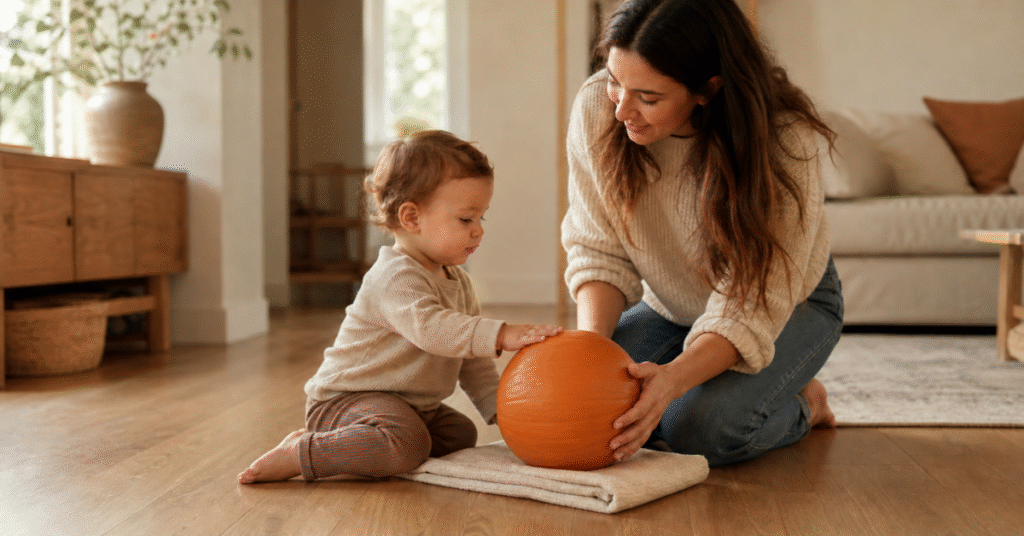
Pick one activity that fits the child you have in front of you tonight. This is not a 12-item Halloween checklist, and two interested minutes can be the whole activity.
Pick a Halloween Activity in 30 Seconds
Start with the one decision that matters most tonight:
- Still mouthing objects: choose Monster Parade, Sound Story, Jack-o’-Lantern Faces, Find the Whole Pumpkin, or adult-held Pumpkin Tap-and-Listen.
- Needs to move: choose Monster Parade or Friendly Monster Says.
- Needs a quieter connection: choose Sound Story, Find the Whole Pumpkin, or Jack-o’-Lantern Faces.
- Ready for a tool and a contained cleanup: choose Water-Paint Pumpkin or Trace a Pumpkin only when the starting-stage limits below fit.
If two choices still fit, use the full comparison:
| Activity | You need | Best starting stage | Works while still mouthing? | Setup | Mess | Adult job |
|---|---|---|---|---|---|---|
| Three-Move Monster Parade | Nothing | 12m+; seated or mobile | Yes | <1 min | 0 | Clear the floor, demonstrate, stay beside |
| Towel Ghost Peekaboo | One full-size towel | 12m+; happy to watch | Yes, adult holds it | <1 min | 0 | Keep both hands on towel; keep it away from child’s head and neck |
| Silly Jack-o’-Lantern Face Game | Securely fixed mirror | 12m+ | Yes | <1 min | 0 | Stay together; stop pulling or climbing |
| One-Minute Halloween Sound Story | Nothing | 12m+ | Yes | <1 min | 0 | Tell it softly; let watching count |
| Hungry Ghost Ball Roll | Large age-labeled ball + basket | Can sit and intentionally roll | Only with a too-large-to-mouth ball | 1–2 min | 0 | Hold basket steady; roll, do not chase |
| Find the Whole Pumpkin | One intact pumpkin | 12m+; looking is enough | Yes, adult controls pumpkin | <1 min | 0 | Place on floor; steady it if child approaches |
| Pumpkin Tap-and-Listen | Pumpkin + folded towel | 12m+ | Yes, open hands only | 1–2 min | 1 | Hold pumpkin steady; wash hands afterward |
| Friendly Monster Says | Nothing | Usually 18m+; imitates one action | Yes | <1 min | 0 | Give one low move; stay beside |
| Hand-Shadow Bat Copy Game | Adult-held light | Usually 18m+; can stay seated | Yes, child holds nothing | 1–2 min | 0 | Control light; aim only at wall |
| Water-Paint an Uncarved Pumpkin | Pumpkin, towel, damp age-labeled brush | 18m+; no brush mouthing | No | 2–3 min | 2 | Control water; stay within arm’s reach |
| Trace a Real Pumpkin, Then Scribble | Pumpkin, large paper, one age-labeled crayon | Usually 18m+; no crayon mouthing | No | 2–4 min | 1 | Trace first; remove pumpkin; watch crayon |
| Wrap One Big Stuffed Animal as a Mummy | Age-labeled plush + wide easy-tear paper | 2+; no paper mouthing | No | 1–3 min | 1 | Give one short strip at a time; collect scraps |
Fits: You want one at-home Halloween activity with no more than five minutes of setup.
Skip this list: You need a plan for costumes, candy, trick-or-treating, sleep, or an early exit. Use this calm toddler Halloween plan instead.
Still mouthing objects: Stay with the no-prop choices or a whole pumpkin that you hold. More hovering does not make a small or mouthable material a better choice.
Here is what the numbers mean:
- Low prep: five minutes or less of active setup—no advance freezing, dyeing, printing, laminating, drying, hot glue, or activity-kit run.
- Mess 0: put one or two things away.
- Mess 1: collect paper, wipe one surface, or wash hands after handling a pumpkin or crayon.
- Mess 2: use a towel for drips and wash one brush and little hands.
The age numbers are starting points, not promises. “Ages 1–3” means the full list covers that stretch; it does not mean all 12 activities fit every one-year-old. Current mouthing, balance, interest, ability to follow one simple direction, and the age label on any material matter more than the number above a cute photo.
Move Like a Monster, Ghost, or Bat
1. Three-Move Monster Parade
Clear one dry, level patch of floor. Show only three slow movements: stomp low, tiptoe, then curl small. A child who is not steady on her feet can make the same “monster” shapes while seated.
Your job is to stay beside her and keep this deliberately small. Skip costumes, capes, masks, cords, music, and props, and leave out running, spinning, climbing, and jumping. End the parade as soon as the movement gets wobbly. Three stomps still count.
2. Towel Ghost Peekaboo
Hold the towel with both hands and raise and lower it beside your own body while saying a soft “boo.” The moving edge creates the ghost; nobody needs to wear it.
You keep the towel for the entire game so you can see your child the whole time. Never put it over either person’s head or let it touch, cover, or circle your child’s head, face, or neck. If she grabs or mouths it, put it away.
3. Friendly Monster Says
Give one friendly direction at a time: “Monster touches knees.” “Monster reaches up.” “Monster makes tiny hands.” Demonstrate it in a clear, level space and let watching count as joining. Nobody is out, and there is no trick instruction designed to catch a toddler making a mistake.
Stay beside the child and keep both feet on the floor—no running, jumping, spinning, climbing, or sudden drops. If the game turns into a chase or balance gets shaky, call it done.
4. Hand-Shadow Bat Copy Game
Keep enough room light on that the space still feels familiar. Aim your light only at the wall, open and close your hands like bat wings, and let your child copy with empty hands.
The light stays with you. Skip floor lamps, loose cords, hot bulbs, and any light with a battery compartment a child can access; never point the beam toward eyes. If the shadow feels scary rather than silly, turn it off without trying to talk your child into one more turn.
5. Silly Jack-o’-Lantern Face Game
Stand or sit together and make gentle pumpkin faces: triangle eyes with your fingers beside your own face, a little round mouth, then a soft silly smile. Your toddler can copy, watch, or make the face disappear simply by looking away.
Do not use a handheld, leaning, strapped, or temporarily taped mirror, or one with a loose frame or exposed edge. Stop if your child starts hitting, pulling, or climbing toward it. If Halloween faces bring up a worried feeling, these books about toddler emotions can help you keep that conversation simple rather than pushing through the game.
Friendly Halloween Hunts and At-Home Games
6. One-Minute Halloween Sound Story
Tell a tiny story at your normal speaking volume: leaves go “rustle,” a friend goes “knock-knock,” and the wind goes “whoosh.” Pause once for your toddler to add a sound. If she watches silently, finish the story and let that be the whole game.
Skip surprise yells or any loud sound near her ears. One minute is not a teaser that has to lead to a bigger activity; it can be the quiet moment you needed before washing hands for dinner.
7. Hungry Ghost Ball Roll
Choose a ball far too large to fit—or compress to fit—entirely inside the mouth. Stabilize the empty basket on a clear floor, call its opening the hungry ghost, and roll the ball toward it from close by.
Keep the basket undecorated: no paper eyes or small add-ons. Do not substitute a sock ball or beanbag. Roll rather than throw, and stop if the game becomes a chase or the ball is damaged. The CPSC advises keeping small balls and small parts away from children under three, which is why the too-large-to-mouth boundary is not optional here.
8. Find the Whole Pumpkin
Put the pumpkin in plain sight on a clear patch of floor, with the stem turned away. Ask, “Where is the pumpkin?” A younger toddler can answer by looking; an older toddler can point.
This is not a lifting or collecting game. Never place the pumpkin on stairs, furniture, or anywhere that invites climbing. If your child approaches, steady it so it cannot roll. Find one real Halloween object, share the moment, and leave it there.
No-Carve Pumpkin and Big-Material Art
The American Academy of Pediatrics recommends that young children draw faces on pumpkins while adults do the cutting. Every pumpkin idea below stays on the no-carve side of that line.
9. Pumpkin Tap-and-Listen
Check for cracks, soft spots, or mold. Put the pumpkin on the towel, turn the stem away, and hold it steady. Show one gentle tap with an open palm, then rub the rind with the same open palm and listen for the change.
Keep sticks, spoons, fingernails, lifting, and rolling out of the activity. If your child tries to move the pumpkin, the listening game is over. Wash hands afterward; that handwashing is the only reason this is Mess 1.
10. Water-Paint an Uncarved Pumpkin
Stabilize the pumpkin on the towel on the floor. Keep the water container in your hand or completely out of reach, offer only the damp brush, and let your child watch each dark mark appear and fade. There is no paint and no carving.
Stay within arm’s reach and actively watch. Wipe spills promptly, stop if the brush goes into the mouth or begins to come apart, and empty the water immediately after the activity. A small cup is still water; AAP guidance says young children need close, constant supervision around it, so “only a little” is not a reason to step away.
11. Trace a Real Pumpkin, Then Scribble
Put the paper on the floor. Hold the pumpkin steady and trace around it with the crayon, then remove the pumpkin before handing the same crayon to your child. The outline can become orange loops, a face, or ten seconds of marks before she leaves.
Skip this if crayons still get bitten or mouthed, remove any broken piece immediately, and wash hands when you finish.
Material note: Keep the current package and follow every warning. For this activity, choose a children’s crayon whose package covers your child’s age and bears the ASTM D-4236 statement. The CPSC explains what that art-material label does and does not cover; neither it nor “non-toxic” means edible.
12. Wrap One Big Stuffed Animal as a Mummy
Check that the toy has secure seams and no loose eye, bow, button, or other detachable accessory. If the label is gone or anything is loose, choose a different activity. Keep the paper supply with you and hand over one short, wide strip at a time—never enough loose length to loop around a head or neck.
Use no tape, glue, or string. Only the toy gets wrapped, never a child, sibling, or pet. Stop at the first sign of mouthing or self-wrapping, and collect every scrap before you move on.
Materials I Would Leave Out
I skip toddler Halloween materials that are tiny, can swell inside the body, can wrap around a child, can cause severe internal injury if swallowed, or need a sealed bag to make the setup feel acceptable. That includes:
- water beads, even inside a sensory bag;
- loose or detachable magnets;
- accessible button or coin batteries and DIY LED tea lights;
- balloons and balloon fragments;
- dry rice, beans, whole corn, pasta, seeds, popcorn, nuts, candy, and other small sensory fillers;
- googly eyes, beads, buttons, glitter, mini erasers, small pom-poms, and mini toys;
- raw-flour dough, cake mix, homemade flour play clay, and borax/boric-acid slime;
- forks, skewers, toothpicks, carving tools, and child-operated carving kits.
These risks are different, but the practical decision is the same: supervision does not erase them. CPSC advises removing water beads from environments where children may be present. “Washable,” “non-toxic,” “edible,” “3+,” and “conforms to ASTM D-4236” also answer different questions; none means safe to mouth.
If cleanup burden is the part that usually stops you from starting, this toddler mess-cleanup guide can help you choose a one-surface reset. For tonight, though, do not buy a craft kit. One clear patch of floor or one whole pumpkin is enough.
Frequently Asked Questions
What Halloween activities work for a 1-year-old who still mouths objects?
Start with a no-prop activity such as the Three-Move Monster Parade or One-Minute Halloween Sound Story. A securely fixed mirror game or whole-pumpkin find can also fit when the adult controls the setup. Keep an older sibling’s craft tray out of the activity area too; the toddler version stays free of paper, crayons, brushes, small balls, loose decorations, and sensory fillers while those still go into the mouth.
What does low prep mean in this guide?
It counts the minutes your hands are actually preparing the activity, not the minute you spend finding the towel. There is no advance freezing, dyeing, printing, laminating, drying, hot glue, or special activity-kit purchase. Cleanup has its own rating because a fast setup can still leave an unreasonable mess.
Are rice, beans, pom-poms, or googly eyes safe for toddlers under 3?
They are not included here. A “3+” label on one craft supply does not make a mixed tray suitable for a younger child, and turning three does not automatically end mouthing. Choose a no-prop activity or one adult-controlled, too-large-to-mouth object instead of trying to supervise harder around loose pieces.
Can toddlers decorate a real pumpkin?
Yes, without carving. From 12 months, an adult-held firm pumpkin can work for looking or an open-palm tap. Water-painting is only for a child 18 months or older who no longer mouths the brush and whose intact brush is labeled for that age. Scribbling also waits until the crayon fits the child’s age and mouthing stage. Adults handle every cut and all carving, and the raw interior and loose seeds stay out of these activities.
What if my toddler loses interest after two minutes?
Stop. Watching without copying, pointing once, or stomping three times still gave your child a small Halloween moment. Put the item away and try the same simple idea another day if you want; do not add more pieces to win attention back.
How closely should I supervise water or art activities?
Water needs the closest version: stay within arm’s reach, keep the container in your hand or out of reach, and empty it immediately. With a crayon or brush, sit close enough to stop mouthing and remove a damaged tool at once. Movement games need you beside the child on a clear floor. None of these is independent play.