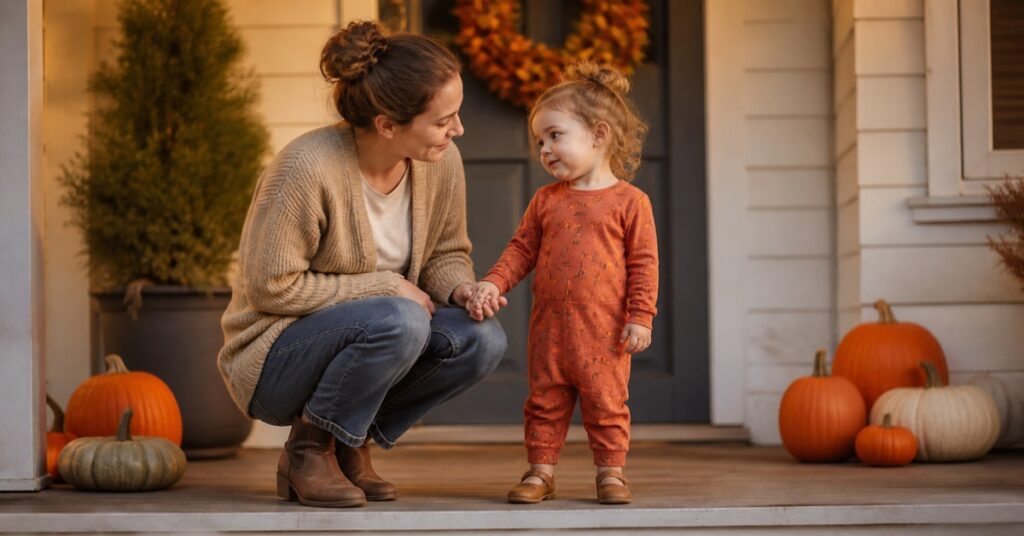
The costume is finally on. Then a neighbor in a full-face mask steps outside, your toddler wraps both arms around your leg, and Halloween appears to be over before you reach the first porch.
That is not a failed Halloween. For a toddler, watching the decorations from your arms, waving at one familiar neighbor, and going home can be the whole good memory.
If this is your toddler’s first Halloween, it does not need to look bigger than that.
The short answer: Plan the smallest Halloween your toddler can enjoy. Try the costume ahead of time, choose a route you can leave immediately, keep candy closed until you are home, and decide the exit before the first door.
Choose your starting plan in under a minute:
Porch / Stay Home
It fits when: Masks, noise, strangers, darkness, or a hard day already have your toddler holding on tightly.
Ending: One wave, a few visitors watched from inside, or no outing at all.
Familiar Doors
It fits when: Your child wants to join in but does better with known people and places.
Ending: Visit one familiar neighbor, relative, or friend, then head home.
Short Loop
It fits when: Your child is comfortable in the costume, happy to walk, and curious about the doors.
Ending: Turn around at one visible landmark before the route gets busy.
If you are torn between two plans, start smaller. Add the short loop only while your toddler is still leaning toward the next porch.
Pick the Smallest Halloween Plan Your Toddler Can Enjoy
The porch plan still gives your child something to do. Watch a few visitors from inside, or step out for one wave and come back in. Choose it when the outing matters more to the adults than it does to the child. The American Academy of Pediatrics’ toddler Halloween guidance is reassuring on this point: easing into the event, going earlier, and using an at-home Plan B are all reasonable.
Familiar doors are the middle plan. A known face removes one surprise, and a close-to-home route makes leaving much easier. A short loop is for the child who is still comfortable after the costume, the dark, and the first greeting are no longer new. Give that loop a turn-around landmark—the corner, a particular tree, or the last house before the sidewalk gets crowded. A landmark is easier to honor than a house count.
Age-by-age starting points
Age can give you a starting point, but it should not overrule the child in front of you:
- 12–23 months: Watching, waving, or visiting one familiar person may be the whole outing. Let the adult hold the bag and swap the treats at home for a familiar, age-appropriate food or a large nonfood item with no small parts or accessible batteries.
- Age 2: Practice one piece before combining everything. Try a few ordinary minutes in the costume, walk to the turn-around in daylight, or rehearse putting a pretend treat into the bag. Keep the real route familiar and make home easy to reach.
- Age 3: Let your child choose between two short routes or practice what to say at the door. The adult still decides where to cross, when to hold hands, which treats stay closed, and when the outing ends.
A cautious three-year-old may be happier on the porch. A social 20-month-old may delight in two familiar doors. Mobility, sensory comfort, bedtime, and that day’s energy matter more than making an age row come true. If your child is already covering her ears or asking to be carried before you leave, move down one plan. You are adjusting the night, not taking it away.
Make the Costume Easy Enough to Forget About
Try the costume on a boring afternoon, not for the first time while everyone is waiting at the door. Let your toddler walk, sit, crouch, and reach up. Check that the fabric does not drag, the shoes stay on, the child can see to both sides, and you can reach a diaper or bathroom clothing without dismantling the whole outfit. Test any weather layers at the same time.
This is where I would be willing to disappoint the photo. A soft shirt, ordinary pants, and one comfortable costume piece are better than a complete look your child cannot forget about. Keep theme pajamas or regular clothes ready as Plan B. If the costume comes off after the photo, Halloween can continue. I would not buy a second elaborate costume to rescue the night.
For a toddler, skip face-covering masks and long or rigid props. Decorative contact lenses are an easy skip; the FDA says decorative lenses require an eye-care professional’s fitting and a prescription. If you use face paint, use it only as labeled and patch-test a small area 24–48 hours beforehand.
The CPSC recommends well-fitting costumes and sturdy shoes, unobstructed vision, and bright or reflective material. “Flame resistant” does not mean flameproof, so keep loose fabric away from candles and other flames. Reflective material and an adult flashlight help a child be seen; they do not replace hand-holding and a safe crossing.
If you drive to the route, check the costume before buckling. Bulky padding should not sit under a car-seat harness. Following NHTSA’s harness-fit guidance, buckle your child in thin clothing so the harness lies flat and snug. Put the bulky costume on after arrival, or add a warm layer over the secured harness. A costume that makes this impossible is not the costume for that trip.
Use One Simple Order for Walking and Candy
Keep the afternoon meal or snack as normal as you reasonably can. Hunger does not make costumes, waiting, or strange doorways easier. Then give the adults simple jobs. One adult keeps a hand and full attention available for the toddler. If another adult is present, that person can handle the treat bag, siblings, stroller, or photos. The supervising adult puts the phone away while walking.
Use sidewalks or paths, cross at corners or crosswalks, pause before driveways and alleys, and never cross between parked cars. A three-year-old who can recite the rule can still move suddenly when a glowing decoration turns on. The AAP’s pedestrian guidance keeps toddlers with an adult and emphasizes hand-holding at crossings. Halloween is not the night to test independent street judgment.
For candy, use one order that is easy to remember:
- Collect outside. The adult carries or controls the bag. Every treat stays wrapped.
- Check at home. Put the bag on the counter, inspect wrappers and ingredient labels, and remove candy plus nonfood surprises that are too small for a young child.
- Eat seated and supervised—if there is an appropriate option. No candy while walking, running, riding in a stroller, or sitting in the car.
The AAP’s choking-prevention guidance and the CDC’s choking-hazard list include hard, gummy, sticky, or gooey candy, gum, caramel, whole nuts and seeds, popcorn, marshmallows, jelly beans, and similar foods. High-risk foods stay restricted until at least age four, and longer when a child’s development or chewing skills require it. Turning four is not an automatic all-clear.
There is no single candy I would label “toddler safe.” Size, texture, filling, nuts, and your child’s eating skills all change the answer. The CDC advises avoiding added sugars before age two, so keep the collect-and-swap rule for a child younger than 24 months.
For a diagnosed food allergy, read every individual wrapper, even if you know the regular-size product. Mini and fun-size versions can have different ingredients or be made on different equipment. Anything without a complete label goes into the swap pile. Follow your child’s existing clinician-provided allergy plan. If epinephrine has been prescribed, carry two doses and make sure the supervising adult knows the plan; Halloween is not the time to improvise. The AAP’s Halloween allergy guidance explains why the individual wrapper matters.
Leave While It Is Still a Good Night
The part most families forget is deciding what “done” looks like while the toddler is still doing well. Choose the cues before you leave.
Yellow cues: Clinging instead of walking, covering the ears or face, repeatedly asking to be carried, losing interest in the doors, pulling at the costume, or asking to go home. Move away from the noise, offer the smaller plan, or start home. You do not need a lecture or a bargain.
Red cues: Bolting, dropping an adult’s hand near traffic, panic that does not ease after moving away from the trigger, or crying that keeps escalating. That is the exit. Do not trade another house for cooperation, and do not wait for the bag or photo to feel complete.
Use one sentence you can say without making a new decision:
“We’re all done with doors. Now we go home for pajamas and a book.”
Your toddler does not have to agree for you to follow through calmly. If public exits usually unravel, use this leave-on-a-high-note plan. If the upset is already underway, this public toddler meltdown guide shows what to do next.
Once home, make the next few steps boring and familiar: candy bag out of reach, costume and face paint off, water, teeth, pajamas, book, bed. You do not need an elaborate recovery routine. The AAP notes that a quiet, consistent bedtime routine helps toddlers know what comes next. For a bedtime transition that stretches, use this gentle bedtime routine. For a last-minute brushing fight, try these toddler toothbrushing strategies.
If a mask or decoration frightened your child, name it simply later: “That looked scary. You came close to me, and we went home.” You do not need to persuade a toddler that it was fun. These books about toddler emotions can help name scared and worried feelings.
Halloween With a Toddler: Quick Questions
What age can a toddler start trick-or-treating?
A toddler does not need to complete a route to join in. At 12–23 months, watching, waving, or visiting one familiar door can be the whole experience.
How long should a toddler trick-or-treat?
There is no official number of minutes or houses. Leave at your planned landmark or your child’s first “done” cues—whichever comes first.
What if my toddler refuses the Halloween costume?
Switch to ordinary clothes or theme pajamas. The outing and family photo do not need to depend on the full costume.
Which Halloween treats are choking hazards for toddlers?
Hard, gummy, sticky, or gooey candy; gum; caramel; whole nuts and seeds; popcorn; marshmallows; jelly beans; and similar foods are high risk. Small objects—including toys, wrappers, stickers, and temporary tattoos—can also become choking hazards. Check the bag out of reach.
Should toddlers eat candy while trick-or-treating?
No. Keep treats wrapped during the route, check them at home, and have the child sit with an adult if you offer an age-appropriate option.
How can I protect my toddler’s bedtime on Halloween?
Keep the usual meal and nap anchors when you can, choose an easy-to-leave plan, and return to your child’s familiar bedtime order.
The Calm Toddler Halloween Night Plan
Screenshot this, print it, or copy it onto one piece of paper. The point is not to control your toddler. It is to keep the adults from renegotiating everything on a dark sidewalk.
| Decide before Halloween | Our plan |
|---|---|
| Night size | ☐ Porch / Stay Home ☐ Familiar Doors ☐ Short Loop |
| Normal anchors | Meal: ______ Nap: ______ Bedtime: ______ |
| Costume check | Walks without dragging; clear vision; weather/toilet ready; no bulky layer under the car-seat harness: ______ |
| Clothes backup | ______ |
| Route and ending | Familiar door or turn-around landmark: ______ |
| Adult roles | Toddler hand: ______ Treat bag / siblings / door: ______ |
| Candy and allergy rule | Closed until home; seated eating; swap/allergy rule: ______ |
| My child’s early “done” cues | ______ |
| Exit sentence | ______ |
| Back-home order | ______ → ______ → ______ → ______ |
Start this week with a few ordinary minutes in the costume and one walk to the turn-around point. If either one is already too much, choose the smaller Halloween now. One porch, one wave, and home for a book is not the backup version of the memory. For many toddlers, it is exactly enough.