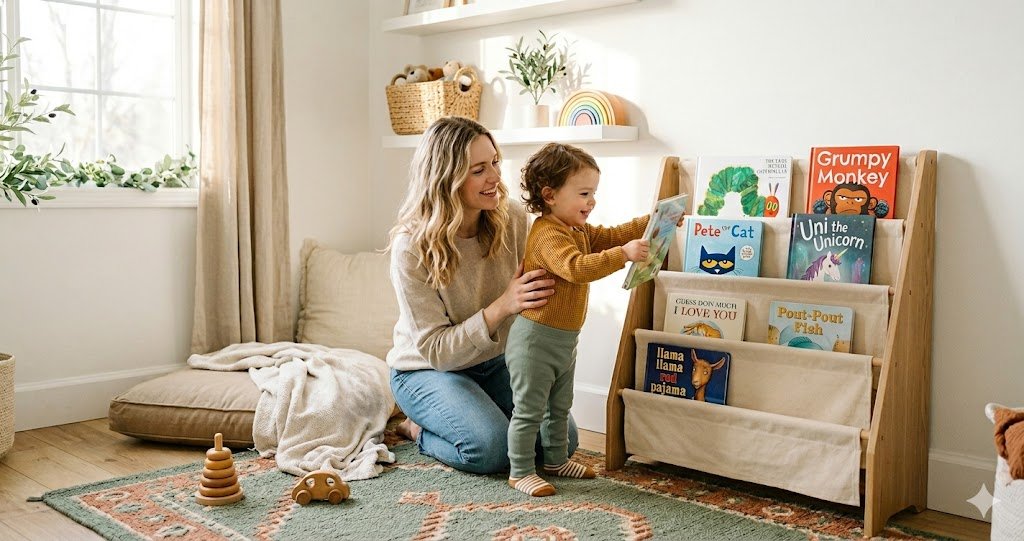
For about a year, the same handful of board books lived in a basket by our couch, and my youngest son treated them like furniture. He would climb on the basket, sit on the basket, and completely ignore the books. Then on a whim I stood a few of them up cover-out on a low shelf, and within a day he was pulling them down, flipping through, dumping them, and going back for more. To a not-quite-two-year-old, a row of skinny spines is not a library, it is wallpaper. Turn the covers out and the books suddenly read as toys. That is the entire idea behind a Montessori front-facing bookshelf, and it is one of the cheapest, lowest-effort ways to nudge a kid toward picking up books on their own.
I have three kids and roughly a decade of stepping on board books in the dark, and between me and my husband we have assembled more flat-pack kid furniture than I would like to admit. So I went into this roundup with a specific question: which front-facing shelves are actually worth the money, and which ones are just photogenic? To answer it I pulled live Amazon data, set hard cutoffs for rating, review count, and sales, and threw out anything that did not clear all of them. What is left is a short, honest list.
How I picked these (and what I threw out)
I treated this like a buying problem, not a vibe. Every shelf below had to clear four non-negotiable gates at the same time: a rating of 4.4 stars or higher, at least 50 verified reviews, steady monthly sales in the hundreds, and a confirmed in-stock listing whose specs I could verify against the manufacturer’s own description. Miss one gate, you are out. No “but it has a Best Seller badge” exceptions, because badges are not the same as a shelf that survives a determined three-year-old.
That discipline cut more than it kept. A whole crop of the gorgeous scalloped solid-wood shelves you have probably saved to a Pinterest board did not make it, and I want to be upfront about why: most of them are either sitting at 4.1 to 4.3 stars or are brand-new listings with a dozen reviews. Beautiful, yes. Proven, not yet. I would rather send you to something a few thousand parents have already stress-tested. More on the ones I skipped near the bottom.
The quick comparison
| Shelf | Best for | Type | Approx. price | Rough footprint |
|---|---|---|---|---|
| UTEX 4-Tier Sling | Best overall / value | Fabric sling, 4 tiers | ~$40 | 25″W × 28″H |
| Wildkin Canvas Sling | Best known brand | Canvas sling, 4 tiers | ~$40 | 24″W × 27.5″H |
| Twinkoo 3-in-1 | Books + toys together | Sling + toy shelf + drawers | ~$70 | 32″W × 30″H |
| Homeiju 3-in-1 | Budget books + toys | Sling + toy shelf + drawers | ~$60 | ~30″H |
| TUEGEGNS Wood | Small spaces / solid wood | 5-tier solid wood | ~$40 | 16.5″W × 15.7″H |
| OOOK Rotating Tower | Tight corners | 360° spinning, 3 tiers | ~$119 | 18″ round × 38″H |
1. UTEX 4-Tier Sling Bookshelf — best overall
Best Overall
If you want one safe default, this is it. The UTEX is a four-tier fabric sling shelf with soft cotton pockets that hold books cover-out at a height a toddler can actually reach. It is the kind of unfussy piece that just works, which is probably why it has racked up well over a thousand reviews while holding a 4.6-star average. When I cross-referenced parent feedback, the same notes kept coming up: light enough to move room to room, easy to assemble, and roomy enough to retire the floor pile.
A couple of honest caveats. Despite the “wood” language in places, the frame is MDF rather than solid wood, so treat it as a sturdy-but-not-heirloom piece. And fabric slings will bow a little under a stack of heavy hardbacks, which is normal for the style. Curate to lighter picture books per pocket and it holds its shape fine.
2. Wildkin Wooden Sling Bookshelf — best name you’ll recognize
Best Established Brand
Wildkin is a small Nashville family business that has been making kid gear for years, and if brand reassurance matters to you, this is the pick. Their canvas sling shelf carries four fabric tiers on a metal-pole frame and a thousand-plus reviews at 4.4 stars, which is a lot of accumulated parent goodwill. The mid-century-modern look is genuinely nice in a neutral room, and the fabric wipes clean, which anyone who has dealt with a yogurt-handed reader will appreciate.
Same fabric-sling honesty applies here: the body is MDF and chipboard, not solid wood, and the slings are best for lighter books. There is no toy storage built in, so this is a pure book shelf rather than an all-in-one. If you already have a toy system and just need the books visible, that simplicity is a feature.
3. Twinkoo 3-in-1 Bookshelf & Toy Organizer — best for books and toys at once
Best Book + Toy Combo
This one earns its spot for small rooms doing double duty. The Twinkoo combines a three-tier fabric sling for books, an open wooden toy shelf, a stuffed-animal pocket with elastic cords, and two pull-out drawers at the base. For a nursery or a shared kids’ room where one piece of furniture has to be a library and a toy bin, that layout is smart. It is the highest-rated combo on my list at 4.7 stars and carries Amazon’s Choice plus a New Release badge.
The thing I appreciate most as a parent is the safety detail: it ships with an anti-tip strap and non-slip pads, which not every shelf bothers to include. The trade-offs are size and material. It is the biggest footprint here at about 32 inches wide, and the structure is particleboard with iron pipes rather than hardwood. For the price and the all-in-one function, that is a fair deal.
4. Homeiju 3-in-1 Bookshelf — the budget combo
Best Value Combo
If you like the Twinkoo idea but want to spend a bit less, the Homeiju is the near-twin for around ten dollars under. You get the same general blueprint: a three-tier fabric sling on one side, an open three-tier wooden shelf on the other, and two removable bottom drawers that double as grab-and-go toy bins. At roughly 30 inches tall it sits right at the height where a preschooler can run the whole show themselves, which is the entire point of going Montessori in the first place.
It has a smaller review base than the Twinkoo, so it is a slightly less battle-tested bet, and the listing does not spell out an included anchor kit, so plan to add one. Otherwise it is a lot of organized storage for the money.
5. TUEGEGNS Solid-Wood Bookshelf — best for tiny spaces
Best Compact / Solid Wood
Not every home has a 32-inch span of empty wall, and not everyone wants fabric. The TUEGEGNS is the little solid-wood unit for those of us short on floor. It is a five-tier stepped shelf only about 16 inches wide and 16 inches tall, holds roughly a dozen books cover-out, and is genuinely solid wood with a smooth, toddler-safe finish, which several parents specifically called out as feeling more substantial than the fabric options. It is also one of the few here that ships and sells through Amazon directly, which tends to make returns painless.
Because it is short and light, the tip-over risk is lower than a tall shelf, though I would still keep it away from a baby who pulls to stand on everything. One small, repeated note in reviews: the base can rock a hair if it is not assembled perfectly level, so take your time on that step.
6. OOOK Rotating Bookshelf Tower — best for a corner
Best for Tight Corners
This is the wildcard, and it is the one my older two would have fought over. The OOOK is a three-tier spinning tower on a wide, weighted base, so book covers face out all the way around and a kid can twirl it to find what they want. It tucks into a corner and uses almost no floor, which is the whole pitch. At 4.8 stars it is the highest-rated shelf on this list, and the oversized chassis is designed to resist tipping without a wall anchor, which is unusual and useful for a rental where you would rather not drill.
Two things to weigh. It is the priciest pick by a good margin, and at about 38 inches tall the top tier sits above where a smaller toddler can comfortably reach, so it suits a slightly older kid or a mixed-age sibling setup better than a baby’s nursery.
How to choose the right one for your kid
Start with age and height, because that is the part the marketing photos quietly ignore. A front-facing shelf only works its magic if your child can see and reach the books without you. For a baby through a young toddler, go short: the TUEGEGNS or the lower tiers of a sling shelf. For a preschooler who is starting to sort and choose on their own, a taller four-tier sling or one of the 3-in-1 combos gives them more room to grow into. My daughter started genuinely picking her own bedtime stories somewhere around her fifth birthday, and what made the difference was simply that she could see the covers at her eye level instead of squinting at a wall of spines.
Then think about what else the shelf needs to hold. If books are the only job, a clean sling or the solid-wood unit keeps it simple. If you are trying to corral books and the relentless tide of small toys in one footprint, the Twinkoo or Homeiju combos earn their keep. And if you are fighting for floor space, the rotating tower or the compact wood shelf are your friends. Buying for a classroom or daycare rather than one kid? Prioritize capacity and a wipeable surface over looks, and lean toward the sling or combo units that hold the most at once.
Finally, be realistic about material. Fabric slings are light, cheap, and easy to move, but they sag and they are not forever furniture. Solid wood costs more and weighs more but lasts. Neither is wrong; they are just different bets. It is the same match-the-furniture-to-the-kid logic we used when we sorted through the best ergonomic kids’ desks and chairs.
Make it work the Montessori way
A front-facing shelf helps, but the trick that actually moves the needle is book rotation. Do not load every book you own onto the shelf. Put out six to ten at a time, keep the rest in a closet bin, and swap them every week or two. Fewer visible choices means less overwhelm and, weirdly, more reading, the same way a tidy snack drawer gets raided more than a stuffed pantry. Sit the shelf where your kid already plays, keep the covers facing out, and resist the urge to re-sort it into adult order every night. The slightly messy, kid-managed shelf is the one they will keep using. Park it where the rest of your small-space Montessori setup lives and that corner does a lot of quiet work for you.
None of this replaces the highest-impact literacy habit there is, which the American Academy of Pediatrics is clear about: read aloud with your child every day, and let them choose the book even if it is the same one for the hundredth time. The shelf just makes those choices visible. The AAP’s tips for reading aloud are worth a couple of minutes.
The ones I deliberately skipped
In the spirit of not wasting your money: the trendy scalloped solid-wood shelves are stunning and I wanted to love them, but as a group they could not clear my rating-and-review bar right now. Several sit in the 4.1 to 4.3 range, and the prettier newer ones have too few reviews to trust yet. I also passed on the big cube-style “Montessori” storage cabinets, because despite the name they store books spine-in or in bins, which defeats the entire front-facing purpose. If a scalloped shelf you love crosses 4.4 stars with a real review base later, by all means revisit it. For today, the six above are the safer buys.
FAQ
What age is a front-facing bookshelf best for?
Roughly 6 months through 7 years. Front-facing display helps the youngest babies who choose by picture, all the way up to early readers maintaining a picture-book and first-chapter-book collection. Just match the height to the child.
Are fabric sling shelves or solid wood better?
Neither is universally better. Slings are lighter, cheaper, and easy to move but will sag under heavy books and won’t last forever. Solid wood is sturdier and longer-lived but costs more and isn’t as portable. Pick based on budget and how permanent you want it.
Do I really need to anchor a small or fabric shelf?
Yes for anything a child can pull on or climb, especially taller shelves. Tip-overs are a leading furniture hazard for young kids, and anchoring is the single cheapest safety upgrade you can make. The very short, weighted units are lower risk, but when in doubt, anchor it.
How many books should I keep on the shelf?
Fewer than you think. Six to ten visible at a time, rotated every week or two, tends to get read far more than a crammed shelf. Keep the rest stored and swap them in to keep things fresh.