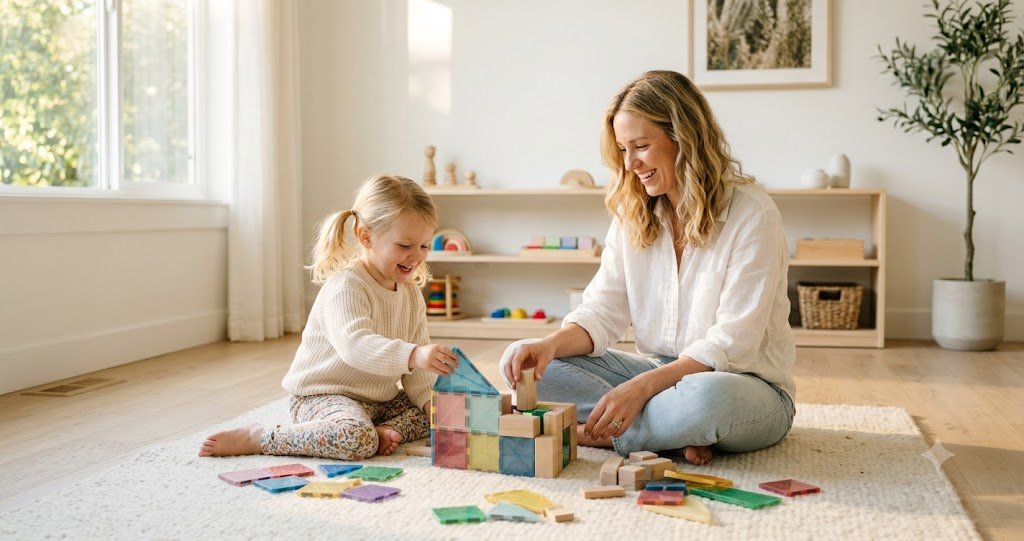
Every December I get the same text from at least three different friends: “Okay, what do I actually buy? Everything says Montessori and everything costs forty dollars.” And honestly, fair. “Montessori” has become one of the most overused words in the toy aisle, slapped on plain wooden blocks and rainbow stacking arches with equal enthusiasm and a markup to match.
So here’s what this guide is: a map. Not another list of the prettiest things on the internet, but a stage-by-stage walk through what your child is developmentally hungry for at each age from zero to six, with one genuinely open-ended pick per stage and a straight answer on which splurges are worth it. Where I’ve already gone deep on a specific toy elsewhere on the site, I’ll point you there instead of repeating myself. Between my three kids spanning baby to school age, I’ve watched a lot of toys come and go, and the pattern is consistent: the simplest ones win.
First, what actually makes a toy “open-ended”?
Montessori and open-ended aren’t quite the same thing, though they overlap a lot. A true open-ended toy has no single “right” way to play. There’s no winning, no finished picture, no battery that does the entertaining for your child. The kid supplies the imagination; the toy just sits there being useful. A set of blocks is open-ended. A plastic truck that lights up and sings the alphabet when you press a button is not — it does the work, your child watches.
The American Academy of Pediatrics has been beating this drum for years: unstructured, child-led play is how young kids build language, problem-solving, and self-regulation, and the toys that support it best tend to be the boring-looking ones (AAP, The Power of Play). If you want the full philosophy and how to set up a space that supports it, I went deep on that in my guide to a Montessori playroom for small spaces.
My quick gut-check before buying anything:
- Can they play with it five different ways? If there’s only one, it’ll get old fast.
- Does the toy do the work, or does the child? The more buttons, lights, and sounds, the less your kid actually does.
- Will it still get used in a year? The best open-ended toys grow with the child instead of being outgrown.
- Is the “Montessori” label doing real work, or just raising the price? Sometimes a $12 hardwood toy and a $38 “Montessori” version are functionally the same thing.
0–12 months: sensory exploration and grasping
At this age your baby is basically a tiny scientist running experiments with her mouth and hands. She’s learning that objects exist when she can’t see them, that things can nest inside other things, and that knocking a tower down is the single funniest thing that has ever happened. You don’t need much here, and you definitely don’t need anything expensive.
Stacking & nesting cups
Around $5–8
If I could only keep one baby toy, it’d be a simple set of nesting cups. They nest, they stack, they tip over, they hide a stray puff underneath, they go in the bath. The classic budget set most parents reach for has eight cups with numbers on the base for counting later, and drainage holes so they double as bath toys. It’s the rare toy that’s genuinely good and costs less than your coffee. Nesting cups in general were the only baby toy that reliably bought me ten minutes to load the dishwasher, and I’ve recommended a set to every new-parent friend since. Check the classic set on Amazon →
Nicer alternative: A soft silicone stacking-cup set (often rated from 6 months) doubles as a teether and is gentler on the floor (and your ears) when they get flung.
Skip, for now: anything with a screen, anything that plays music when touched, and most of the “Montessori-branded” newborn kits that bundle a few wooden rattles for the price of a stroller accessory. A baby this age is just as happy with measuring spoons from your kitchen.
→ Shopping for a first birthday? See the best 1st birthday gifts for the full list.
1–2 years: movement, coordination, and the first puzzles
Once they’re up and walking, the whole game changes. This is the climbing-on-everything, dumping-everything-out, testing-gravity-with-your-dinner stage. Toys that channel all that gross-motor energy are worth their weight, and so are the very first fine-motor challenges — the AAP notes that this kind of active play is exactly how toddlers build the fine and gross motor competence that everything else stands on. My youngest is right in the thick of this phase, and the difference between a toy that engages him and one that doesn’t comes down to whether he gets to move.
The climber: a Pikler-style triangle
A Pikler triangle is one of those things that looks like overpriced wooden nonsense until you watch a toddler use one for the first time. It’s a climbing frame built to a child’s scale, and it scratches the exact itch that makes them scale your bookshelf instead. Most current sets are foldable seven-in-one designs that reconfigure as your kid gets braver — triangle, ramp, slide, arch. Because the price and the safety details genuinely matter here, I put the foldable, small-space-friendly ones through a full write-up: my honest guide to the best Pikler triangles covers weight limits, folding, and what to look for. The short version: worth it if your kid is a climber, skippable if yours isn’t drawn to it, because not every toddler is.
The first fine-motor win: a jumbo-knob puzzle
Wooden jumbo-knob shape puzzle
Around $10
Those chunky wooden pegs are sized for a fist that hasn’t figured out a pincer grip yet, and the picture printed under each piece gives a little “you did it” payoff when they match it. Melissa & Doug makes the classic version, with five extra-thick FSC-certified pieces. It’s simple enough that a one-year-old can win at it, which at this age matters more than complexity — confidence is the whole point. The honest downside: they’ll master it fast and be ready to move up to a sorting cube within a few months. Check it on Amazon →
→ Want the whole age band? See the best toys for 1–2 year olds and gifts for 2-year-olds.
2–3 years: building, sorting, and the toy that outlasts them all
Welcome to the construct-and-destruct years. Around two, kids get genuinely good at building, sorting, and solving small problems, and their pretend play starts to bloom. My older son spends most of his day either stacking something or knocking over whatever his big sister built, which is the whole developmental arc of this age in one sentence.
First real building set: oversized bricks (DUPLO-style)
Around $42 (often discounted from $50)
Standard small interlocking bricks are rated for ages 4 and up because the pieces are a choking hazard for younger kids, so the big-brick versions are how toddlers get into building safely. The deluxe 85-piece box is a generous first set: chunky bricks plus a few familiar pieces (a little car, a couple of figures, numbered bricks) in a sturdy storage box that doubles as the lid. No batteries, all imagination. Check it on Amazon →
Problem-solving: a classic shape sorter
Twelve chunky shapes, twelve matching holes, and a deeply satisfying clunk when one drops in — it’s a problem your two-year-old can actually solve, then dump out and solve again. Melissa & Doug’s hardwood sorting cube is the sturdy classic (it will be thrown; it survives). Sorters are a whole little category of their own, though, from basic wooden cubes to shape-and-color combos, so if you’re choosing between them I lined up the best ones in my guide to the best shape sorters.
The one toy that spans every age: magnetic tiles
If you buy one toy from this entire guide, make it magnetic tiles. They’re the toy that’s outlasted nearly everything else in our house. A two-year-old uses them flat, as colorful squares to sort and stack. A three-year-old builds a wobbly tower. A five-year-old builds a marble-dropping castle with a working drawbridge. Same box of tiles, four years of play. That’s the open-ended dream, and it’s why they earn a place in a toddler’s collection even though the real payoff comes later.
The short version on brands: start with a value set to test the waters, and add a premium set later if they become A Thing in your house (they will). If you want the real answer on whether the famous brand is worth the splurge, I put the three big names head-to-head — Magna-Tiles, Connetix, and PicassoTiles — on magnets, durability, and price in my full 100-piece comparison.
→ Full age band: best toys for 2–3 year olds and gifts for 3-year-olds.
3–4 years: bigger builds and balance
Threes are builders with real stamina now, and a longer attention span to match. This is where classic construction toys shine, and where you can lean into open-ended sets that don’t tell them what to make.
Classic wooden building blocks
Around $16–28
Plain wooden blocks are the toy that pediatric-development folks have quietly recommended for a hundred years, because there’s almost nothing they can’t become. Melissa & Doug’s 100-piece hardwood set in four colors and nine shapes is the sweet spot: enough variety for bridges and castles, FSC-certified wood, and a storage box with a handle so cleanup isn’t a tragedy. It’s often listed for ages 2+, though the small shapes mean I’d supervise the younger end. Heads up that the colors can fade if they live in direct sun. Check it on Amazon →
More open-ended: A set of smooth wooden balancing stones leans even further into the no-rules Montessori spirit — there’s truly no wrong way to stack them.
→ See gifts for 4-year-olds for the full picture at this age.
4–6 years: building toward early academics, through play
By four and five, kids can follow a plan, stick with a project, and start weaving in early math and reading without it feeling like school. The toys here support that without a worksheet in sight. My daughter is right in this zone, and the toys that hold her now are the ones with the most possible outcomes.
Open-ended building: LEGO Classic Large Creative Brick Box
Around $33 (often discounted from $60)
Once small parts are safe, classic bricks become the ultimate open-ended toy. The large creative box gives you 790 pieces in 33 colors plus the useful bits — windows, doors, wheels, a couple of baseplates — and a storage tub. No themed set telling them to build a specific spaceship, just bricks and ideas. It’s rated 4 and up, compatible with every other LEGO set you’ll inevitably accumulate, and the price-per-brick is excellent when it’s on sale (which is often). Check the large box on Amazon →
Smaller / cheaper: The medium creative box is around $25 and eases a newer builder in.
Cause-and-effect engineering: a marble run
Around $65
Marble runs are pure physics disguised as fun — kids learn about slopes, momentum, and gravity by building a track and watching what happens. The glow-in-the-dark sets are a particular hit, with around 150 pieces including tracks, action pieces, bases, and glow marbles, plus a little guide on the physics behind it all. Check it on Amazon →
If your kid already loves magnetic tiles: some brands make a marble-run add-on that clicks right into their existing tiles, so the track is the build.
→ See gifts for 5-year-olds for more at this age, and screen-free gifts that compete with a tablet.
The toys that grow with your child
If your budget is tight and you want the most years per dollar, this is where the money goes. A few toys keep paying out across the entire zero-to-six span, and they’re the ones my husband and I would buy all over again without thinking twice:
- Magnetic tiles — flat sorting at two, towers at three, elaborate engineered builds at six. The single best longevity in the lineup.
- Wooden blocks — stacking and toppling as a toddler, complex architecture later. Genuinely a lifetime toy.
- LEGO / large bricks — start with the big-brick version as a toddler, graduate to classic bricks at four, never really stop.
Notice what’s not on this list: anything single-purpose, anything battery-powered, anything that does the entertaining for your child. The longevity all-stars are the toys that do the least, because that leaves the most room for your kid to do the rest.
Beyond the toys: the space matters more than you’d think
One thing that surprised me as a parent is how much a child’s environment shapes how independently they play — often more than the specific toys do. A low shelf they can reach, a small number of toys displayed instead of dumped in a giant bin, a floor they can get to and from on their own: these do more for self-directed play than any single purchase.
If you’re rethinking the bigger setup, a few pieces are worth reading before you buy more stuff: how a Montessori floor bed supports independence from infancy, how to arrange a playroom in a small space so your kid actually plays on their own, and — if screen time is the thing you’re really trying to crowd out — my roundup of screen-free gifts. Sometimes the best “toy” purchase is fewer toys and a better shelf.
Frequently asked questions
What’s the difference between Montessori toys and open-ended toys?
They overlap heavily but aren’t identical. “Open-ended” describes any toy with no single right way to play — blocks, tiles, loose parts. “Montessori” is a broader philosophy that also values real-world materials (wood, metal), child-sized tools, and self-directed activity. Most good open-ended toys fit a Montessori home, but slapping “Montessori” on a label doesn’t automatically make a toy either open-ended or worth the markup.
Are expensive “Montessori” toys actually worth it?
Sometimes yes, often no. The premium is worth it when it buys real durability or safety — magnetic tiles and a well-built climber are good examples where quality lasts for years. It’s not worth it when you’re paying triple for a plain wooden toy that a $12 version does just as well. The label alone is never the reason; longevity and safety are.
If I can only buy one toy that lasts for years, what should it be?
Magnetic tiles, hands down. No other toy in this guide stretches across as many ages — a two-year-old and a six-year-old will both play with the same set, just in completely different ways. Start with a value-brand set and add to it over time.
Are magnetic tiles safe for toddlers?
They’re rated for ages 3 and up because they contain small, powerful magnets that are dangerous if swallowed. For a securely-built tile from a reputable brand, the magnets are sealed inside and the main everyday risk is just a pinched finger. The real concern is loose or broken tiles, or a younger sibling who still mouths things — keep an eye on tile condition and supervise mixed-age play.
How many toys does a child actually need?
Fewer than you’d guess. In Montessori spaces, a small number of toys are displayed on a low shelf and rotated, rather than a giant bin of everything at once. Kids tend to play longer and more creatively with eight well-chosen open-ended toys than with eighty. If you take one thing from this guide, let it be that the shelf matters as much as what’s on it.