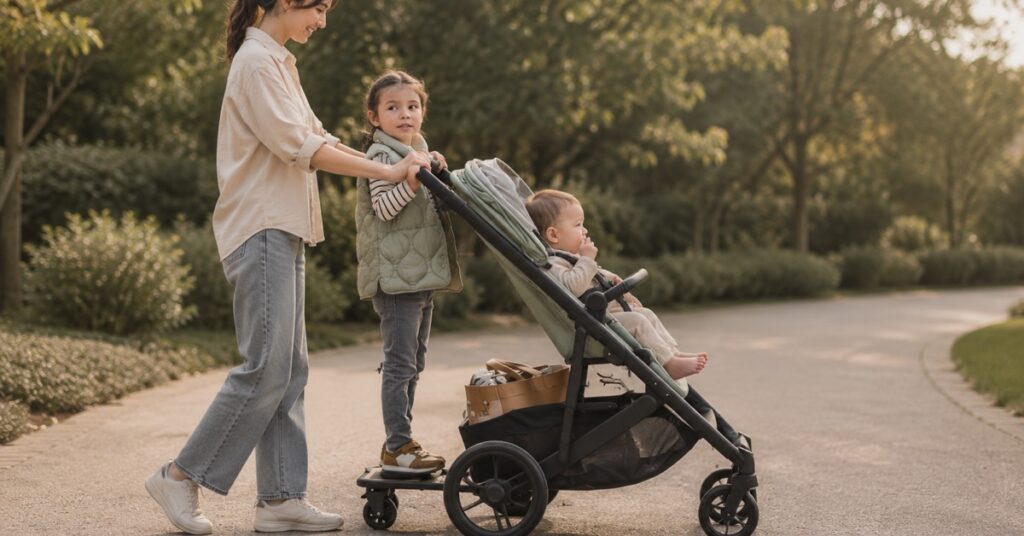
A stroller board vs double stroller decision can look like a simple choice between spending less and carrying more. It is really a choice between a place to stand and a second seat with a harness. That difference matters when your toddler refuses to walk, needs a nap, or bolts toward a curb while the baby also needs you.
If you have ever tried to carry a tired toddler while steering the baby with one hand, you already know why the wrong setup can unravel an otherwise ordinary errand.
The short answer: Choose a stroller board when your older child can stand steadily, follow directions, and walk most of a short, smooth trip—and when you already own the compatible stroller. Choose a double when that child still naps, runs off, tires without warning, or needs to stay buckled in during long, crowded, hilly, or rough outings.
If you are uncertain, choose for the hardest routine you repeat every week, not the easiest ten-minute walk you can imagine.
Stroller Board vs Double Stroller at a Glance
| Decision point | Stroller board | Double stroller |
|---|---|---|
| What the older child gets | A standing platform and brief rest from walking | A seat; usually a harness, canopy, and some recline |
| Best child profile | Cooperative, steady standing, walks most of the route | Naps, runs off, tires quickly, or needs to stay buckled in |
| Best outing | Short errands and smooth neighborhood routes | Long days, crowds, hills, rough paths, and scheduled naps |
| Caregiver effort | Lighter system, but stride can be shortened | Heavier lift and larger fold, but fewer negotiations |
| Typical complete cost | About $125–$175 if the compatible stroller is already owned | About $300 to $1,700+ depending on design and newborn setup |
| Biggest hidden risk | Buying an incompatible board or expecting it to replace a seat | Buying more stroller than fits the trunk, doorway, route, or storage space |
So which one is safer? The one that matches your children’s needs and that you can load, steer, and brake without improvising.
What Each Option Actually Solves
A board solves “I need a short break from walking”
A ride-along board clips to the rear of a single stroller. The older child stands on it, holds the stroller handle or designated grips, and steps off when ready to walk again. It adds little width, can be easier to store than a second stroller, and preserves the single-stroller setup you already know.
But a standing board is not a second seat. It has no harness, no nap position, and no reliable protection from a child who decides to jump off. It also occupies the space behind the stroller, where the adult normally walks. The practical catch is walking space: many adults have to shorten or widen their stride to avoid kicking the board.
A double solves “both children need a place at the same time”
A double stroller can provide two seated positions, although the seats may not be equal. A side-by-side such as the BOB gives both children broadly comparable space and recline. A tandem or sit-and-stand design may put one child in a smaller, lower, more upright, or less protected position. A convertible stroller may require extra seats and adapters before it is truly a double.
The tradeoff is physical: more weight to lift, more volume in the trunk, and sometimes more width or length to maneuver. That burden can still be worthwhile if it means a tired toddler can nap or a runner can remain harnessed while one adult manages both children.
If you are still choosing the stroller itself, start with our best strollers for different family routines before adding a board or second seat.
The Eight-Factor Decision Test
1. Walking reliability
Ask what happens after twenty minutes, not at the front door. A child who walks happily until suddenly asking to be carried may use a board well. A child who drops to the pavement, runs away, or refuses to hold on needs a seat more often than a platform. There is no universal birthday at which a child becomes “board ready”; balance, height, impulse control, and willingness to follow directions matter more.
2. Naps
If the older child still naps during errands, the decision leans strongly toward a double. A board offers no safe sleeping position. Even for the baby, a stroller is not a routine sleep space: the American Academy of Pediatrics’ safe-sleep guidance says to move a sleeping baby from a stroller or car seat to a firm, flat, non-inclined sleep surface as soon as practical.
3. Does your child need to stay buckled in?
Airports, parking lots, school pickup, zoos, and busy sidewalks make wandering harder to manage. A properly used five-point harness keeps a child in one place while you help the baby. A board depends on active cooperation every moment. If both children need to stay buckled in, do not ask a board to do a double stroller’s job.
4. Route and duration
Boards make the most sense on smooth pavement with frequent opportunities to walk. Cracks, curbs, steep slopes, gravel, and long distances ask more of a standing child and can make a stroller harder to control. A terrain-capable double is larger and more expensive, but its wheels, suspension, and seated support are built for a different workload.
5. One adult or two
With two adults, one can hold a hand, carry a tired child briefly, or manage a transition. If the board plan falls apart with only one adult, someone may be carrying a toddler and pushing the baby at the same time. Solo caregivers should look closely at the harnesses, brakes, and whether they can lift the folded stroller without help.
6. Your body and walking stride
A board may keep the stroller narrow, but it makes the rear longer. Taller caregivers and people with a long stride are especially likely to notice foot strikes. Shorter caregivers can also find that the child crowds the handle area or changes where they can comfortably stand. A double may steer with more mass, while a long tandem can feel slow around tight corners. If possible, test with weight in both riding positions and walk at your normal pace—not an empty showroom push.
7. Car and home storage
Measure the trunk opening, cargo floor, stairs, elevator, and storage corner. Do not rely only on folded dimensions: removable wheels or seats can change the daily routine. A stroller that technically fits but requires unloading groceries and rebuilding the frame every trip creates friction that may make you stop using it.
8. What you already own
A board saves money only when it fits a stroller you already want to keep. Buying a premium single stroller solely to attach a board can cost more than a complete value double. Existing infant car seats matter too: “same brand” does not always mean compatible, and an adapter may support only one car seat in a double.
Not sure which stroller shape fits your routine? Our guide can help you choose the right stroller type.
When a Stroller Board Is the Better Buy
A board is enough when all of these are true:
- Your older child stands securely and follows “hold on” and “step off” directions.
- They walk most of the outing and need only occasional relief.
- Napping and full-time containment are not part of the plan.
- Your routes are mostly smooth, short, and predictable.
- You already own the exact stroller generation named by the board maker.
- You have checked that your normal stride and handle position remain comfortable.
For a neighborhood preschool walk, a quick store visit, or the last ten minutes home, that can be enough. The board also lets the older child hop off without the repeated buckle-unbuckle cycle of a seat.
UPPAbaby PiggyBack for Vista: best for an existing Vista
If a 2015-or-newer Vista is already in your garage, this is the simplest board option here. It snaps on without tools, lifts out of the way, and can stay attached when the stroller folds. The 55-pound limit gives an older preschooler room to use it, but only while standing.
The catch is where everyone’s feet and head go. Your child stands close to the handle, and you may need to shorten your stride. It is a useful add-on for a Vista you already like—not a reason to buy a Vista from scratch.
UPPAbaby PiggyBack for Cruz V2/V3: best for an existing Cruz V2 or V3
Check the stroller generation before you order this one. The board fits the Cruz V2 and V3, not an older Cruz and not a Vista. That narrow fit is its biggest buying trap.
Once matched to the right stroller, it folds attached, lifts when your child wants to walk, and carries one standing child up to 55 pounds. You still lose some walking space behind the handle, so this works best for short trips rather than all-day mileage.
When a Double Stroller Is the Better Buy
Choose a double when you need two dependable riding places rather than one seat plus a cooperative passenger. It is usually worth the extra size when the older child still naps, one adult routinely goes out alone, the route is long or rough, or both children need protection from weather.
The right double is not necessarily the most expensive. Match the design to the route:
- Tandem or sit-and-stand: easier through standard-width spaces and often more affordable, but positions can differ in recline, visibility, and comfort.
- Side-by-side all-terrain: comparable seats and better rough-ground performance, but wider, heavier, and more demanding in a car.
- Convertible single-to-double: polished ecosystem and flexible configurations, but the second seat and adapters raise the true cost.
Graco Ready2Grow LX 2.0: value double with sit-and-stand flexibility
The Ready2Grow includes two stroller seats, a rear bench, and a standing platform. It can accept up to two compatible Graco SnugRide infant seats without a separate adapter. The front seat, bench, and platform have a higher limit than the rear stroller seat, so siblings may not age out of the two positions at the same time.
I would choose it for smooth errands, especially if a compatible Graco infant seat is already in the house. I would not choose it for broken sidewalks or long park days. It is heavy, the fold is bulky, the small wheels work harder on uneven ground, and the rear seat does not recline like the front.
BOB Revolution Flex 3.0 Duallie: for long walks and rougher routes
This is the double I would look at when both children need a real seat and the route includes cracked sidewalks, gravel, or future running. Each harnessed seat has its own canopy and recline, with a 50-pound limit. Walking in the stroller seats can begin at eight weeks; jogging and off-road use wait until eight months.
Its size is the price of that easier push. The stroller is about 30.5 inches wide and roughly 33 pounds, and the air-filled tires need occasional attention. For infant walking mode, you also need the correct Duallie adapter. It holds one infant seat, and jogging with that seat attached is never allowed.
UPPAbaby Vista V3 double: for families planning ahead
The Vista V3 is still a single stroller out of the box. For the usual two-seat setup, you also need the RumbleSeat V3 and upper adapters. The lower seat is smaller: it starts at three months and tops out at 40 pounds or 36 inches, while the main seat goes to 50 pounds. Check that mismatch against your children before buying.
There are extra steps, too. Load the upper child first, never leave the lower seat occupied under an empty upper position, and remove the RumbleSeat before folding. This makes sense if you want a premium single now and a double later. It is harder to justify if you already need two equal seats.
Compare the Complete Cost, Not the Box Price
| Path | What must be owned or added | Planning range | Often-forgotten cost |
|---|---|---|---|
| Vista or Cruz board | Exact compatible stroller already owned | $125–$175 | A different stroller if your generation does not match |
| Graco Ready2Grow | Stroller; documented Graco infant seat if needed | $300–$350 | No third-party infant-seat shortcut |
| BOB Duallie | Stroller; exact Duallie adapter for infant walking mode | $850–$1,060 | Tubes, pump, and tire upkeep |
| Vista V3 double | Base stroller, RumbleSeat V3, upper adapters; newborn component if needed | $1,290–$1,700+ | Second seat is smaller; configuration may require multiple components |
Do the ownership math: include the base stroller, second seat or board, upper and lower adapters, infant-seat adapter, bassinet, weather gear, tire maintenance, and any component you must remove to fit the trunk. Current prices move, so these ranges are planning tools rather than live quotes.
A board is the cheapest solution only for a compatible-stroller owner. If you are replacing your stroller anyway, compare the whole system. You may find that a complete value double costs less than a premium single plus board—or that a premium all-terrain double saves you from buying two inadequate strollers.
Compatibility Traps That Cause Expensive Returns
- Brand is not compatibility. The Cruz board is not the Vista board, and even a Cruz board has generation limits.
- “Universal” is not a substitute for a manufacturer fit list. Frame tubes, brake cables, wheel clearance, fold geometry, and center of gravity differ.
- A car-seat logo match is not enough. Graco documents specific SnugRide use in the Ready2Grow. BOB publishes an adapter chart and allows only one infant seat.
- A convertible stroller may not include its double parts. The Vista V3 base purchase is still a single; a common double setup adds a RumbleSeat V3 and upper adapters.
- Used gear needs a serial-level check. Accessories may look identical after a design or remedy changed. Confirm model, manufacture date, included hardware, and recall status before use.
Skip the Baby Trend Ride-On Board for now. Its manual points to a fit page that does not clearly name the supported stroller models. A marketplace title is not enough reason to guess.
Safety Rules for Either Setup
Use the manual as the hard boundary. Check every riding position’s age, height, and weight limit, as well as the stroller’s total limit; use the required harness; engage the parking brake when stopped; and keep bags off the handle. The AAP’s stroller guidance also emphasizes a wide base, brakes, secure buckles, and caution when an older child stands on a rear platform.
- Stop the stroller fully and engage its brake before the child steps onto or off a board.
- On a board, the child should keep both feet in the anti-slip area, hold the designated handle, and ride only while the caregiver has both hands controlling the stroller. Never let a child sit on a standing-only board.
- Do not let a child hang from the stroller handle. Rear loading can change the center of gravity and increase tip risk.
- Use only manufacturer-approved combinations. Do not improvise connectors or substitute an unapproved third-party adapter.
- Do not use a board if it blocks the brake, fold, steering, or the caregiver’s complete grip on the handle.
- In a double, use the harness for each seated child. A bumper bar is not a restraint, and a bench or standing platform still relies more on cooperation than a harnessed seat.
- Load and unload in the sequence the manual specifies. This is especially important in stacked or convertible configurations.
- Never hang a heavy diaper bag or shopping bag from the handle. Use the basket within its stated limit.
- For jogging, follow the stroller’s minimum age, wheel-lock, wrist-strap, and terrain instructions. Never jog with an infant car seat attached.
Strollers sold in the United States are subject to the federal carriage and stroller rule under 16 CFR Part 1227. That baseline does not make every accessory compatible with every frame, and it does not replace correct assembly or supervision.
Buying used? Older UPPAbaby seats, adapters, and BOB strollers have appeared in past safety actions even though the current products here fall outside those production periods. Search the CPSC recall database with the model, manufacture date, and serial number before your child rides.
Which One Should You Choose?
- Short preschool walk, smooth sidewalk, reliable older child: keep the single and add its exact-fit board.
- Older toddler still naps or bolts: choose a double with a harnessed second seat.
- Budget-first errands with a compatible Graco infant seat: the Ready2Grow is the most complete lower-cost choice here.
- Long walks, broken sidewalks, trails, or future running: the BOB Duallie earns its size and maintenance burden.
- Starting with one child and planning to add a premium double later: the Vista V3 is flexible, but budget for the extra components and the smaller lower seat.
- Frequent flying or a very small trunk: neither a large double nor a board automatically wins; compare our compact stroller options for travel.
- Two older children, gear-heavy outings, or beach/park use: a wagon may deserve a separate look at our guide to stroller wagons for older kids.
Think about the outing that usually goes wrong. If your older child only needs a lift for the last block home, buy the board. If they still nap or run off in busy places, pay for the second harnessed seat. That is the difference you will still care about after the first week.
Frequently Asked Questions
Can a two-year-old use a stroller board?
Possibly, but age alone is not enough. The child must stand steadily, keep both feet on the platform, hold on, and follow directions for the whole ride. Check the exact board manual for limits. The two UPPAbaby boards in this guide specify a 55-pound maximum but do not turn developmental readiness into a birthday rule.
Is a stroller board safe for long walks?
It can provide breaks during a walk, but it does not provide a seat, harness, or nap support. For long outings, assess whether your child can reliably stand and whether the route is smooth. If they are likely to sleep, bolt, or need sustained rest, a double stroller is the better fit.
Does a stroller board make a stroller harder to push?
Often, yes. It adds a child’s weight behind the stroller and reduces the adult’s walking space. You may need to shorten your stride to avoid kicking it. Handle height, caregiver height, terrain, and the stroller’s shape determine how noticeable that feels.
Is a side-by-side double too wide for doors?
Not always, but measure rather than assume. The BOB Duallie is about 30.5 inches wide, which can pass many standard doorways but leaves little margin in tight entrances. Also measure elevator doors, store aisles, and the trunk opening.
Can I put any infant car seat on a double stroller with an adapter?
No. Use only the stroller, adapter, car-seat model, and position named by the manufacturers. The Graco option here is limited to compatible Graco SnugRide infant seats. The BOB uses brand/model-specific Duallie adapters and accepts one infant seat, for walking only.
Should I keep both a board and a double?
Some families benefit from both: a board for short local trips and a double for long days. But start with the trip you make most often. If storage and budget are tight, one well-matched solution is better than two products that each fail the hardest outing.
About Zoe: Zoe is a mom of three with 7 years of parenting experience. Little Loving Life uses a five-layer fact-check for product guides. Fit and availability can change, so recheck the model manual and recall status before buying or using any stroller or accessory.