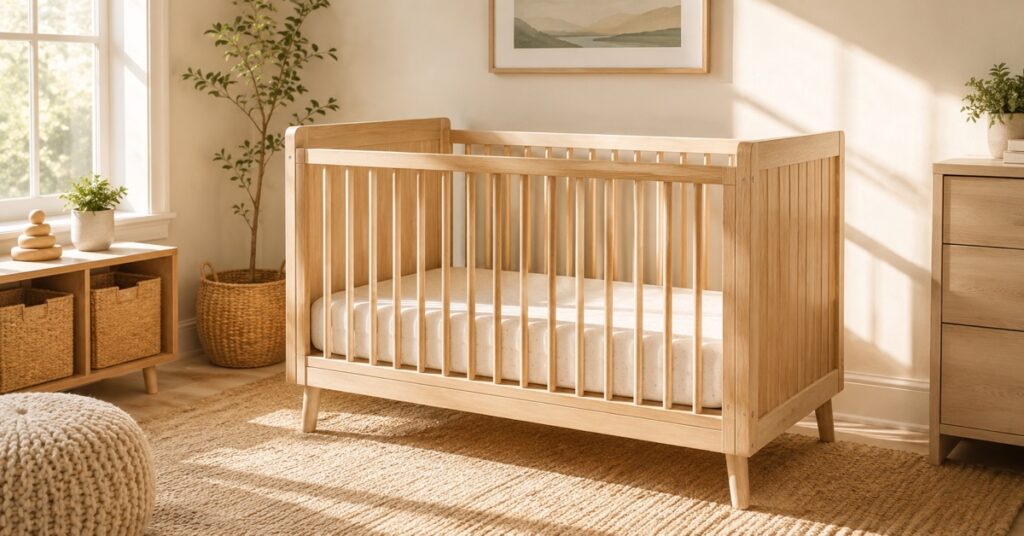
The price tag on a convertible crib is only the first number that matters. The surprise often comes later: the toddler guardrail is sold separately, the full-size rails need another support piece, or the matching finish is no longer available when your child is ready to move up.
A higher mode count does not make one crib safer or more durable. What matters is the path behind the label: the exact conversion-kit numbers, which pieces are included, whether matching kits are still available, and what the manual actually allows. This guide compares five full-size stationary-side cribs so you can choose the conversion path that matches the years you plan to use it.
Safe-sleep basics before you compare cribs
For infant sleep, use a crib that meets current U.S. Consumer Product Safety Commission requirements, with a firm, flat, tightly fitting mattress and a fitted sheet only. Put your baby down on their back. Keep pillows, blankets, bumpers, positioners, stuffed toys, canopies, and other soft or loose items out of the crib. Do not use a drop-side crib or any crib with missing hardware, broken wood, or no instructions. The American Academy of Pediatrics’ safe-sleep guidance and the CPSC full-size crib guidance are the baselines for every pick here.
A full-size crib mattress should meet the current federal crib-mattress rule and the crib manual’s fit requirements. The federal minimum is 27 1/4 by 51 5/8 inches, with a maximum thickness of 6 inches. A label that says “standard crib mattress” is not a reason to ignore a visible gap: verify the fit after assembly and whenever the support is moved.
Follow the manual’s milestones for lowering the mattress. Before a baby can pull to stand, the support should be at its lowest crib position. Stop using crib mode when your child can climb out or reaches the manual’s 35-inch limit, whichever comes first. A toddler-bed conversion has its own minimum-age and maximum-weight rules; it is not simply the crib with one side removed.
Quick picks
- Best overall: Delta Children Perry 6-in-1 — the clearest path from crib through a full-size bed, provided you budget for both rail kits and a full-size foundation.
- Best value: Delta Children Essex 4-in-1 — a lower-cost, low-profile choice for families who want crib, toddler, daybed, and sofa modes but do not need a full-size-bed conversion.
- Best with the toddler kit included: Babyletto Hudson 3-in-1 — a more predictable crib-to-toddler cost with four mattress positions.
- Best low-profile design: Carter’s by DaVinci Colby 4-in-1 — a 36-inch-high frame with strong independent testing evidence, but the lowest mattress setting still creates a deep reach.
- Best budget full-size path: Dream On Me Owen 5-in-1 — a lower starting price and exact rail numbers, with an important need to inventory every part as soon as the box arrives.
How to read 3-in-1, 4-in-1, and 5-in-1 labels
There is no useful industry-wide promise hiding inside those numbers. One brand may count a daybed and a sofa as separate modes. Another may count a full-size bed with a headboard only and the same bed with a headboard and footboard as two modes. A 5-in-1 crib is not automatically stronger, longer-lasting, or a better value than a 3-in-1 crib.
Read the bed types instead. Ask four questions: Does it become a toddler bed? Is the toddler guardrail included? Does it support a full-size bed? Which exact rails and foundation are required? Those answers reveal more than the number printed on the box.
Convertible crib comparison
| Product | Best for | Crib dimensions | Mattress positions | Actual stages | Toddler rail | Full-size support | Material | Price tier |
|---|---|---|---|---|---|---|---|---|
| Delta Children Perry | Most complete conversion path | 55 × 30.5 × 45 in | 3 | Crib, toddler, daybed, sofa, full bed in 2 headboard configurations | 0094, sold separately | Yes; 0050 rails plus full mattress and foundation | New Zealand pine and TSCA-compliant engineered wood | $$ |
| Delta Children Essex | Value without a full-bed plan | 54 × 29.5 × 34 in | 3 | Crib, toddler, daybed, sofa | 0094, sold separately | No | New Zealand pine and TSCA-compliant engineered wood; solid pine legs | $ |
| Babyletto Hudson | Toddler kit included | 53.75 × 29.75 × 35 in | 4 | Crib, toddler, daybed | Included | No | New Zealand pine | $$$ |
| Carter’s by DaVinci Colby | Low-profile frame | 55.75 × 29.75 × 36 in | 4 | Crib, toddler, daybed, full bed | M11999, sold separately | Yes; M5789 rails plus full mattress and foundation | New Zealand pine and TSCA-compliant engineered wood | $$ |
| Dream On Me Owen | Lower-cost full-bed path | 53.67 × 29.57 × 42.05 in | 3 | Crib, toddler, daybed, full bed in 2 headboard configurations | 692, sold separately | Yes; 849 rails plus full mattress and foundation | Wood construction; exact species mix not confirmed | $ |
The best convertible cribs of 2026
Best overall: Delta Children Perry 6-in-1 Convertible Crib
Best for: A family that genuinely expects to keep the same headboard through a full-size-bed stage and is willing to buy the conversion pieces early.
The Perry earns the overall spot because its official conversion path is unusually clear. It starts as a full-size crib, then becomes a toddler bed, daybed, sofa, and full-size bed. The “six” comes from counting the full bed with a headboard and footboard separately from the headboard-only setup—not from six entirely different beds.
The three-position mattress platform and 45-inch overall height make it the tallest frame in this group. The product page identifies sustainable New Zealand pine and TSCA-compliant engineered wood, and lists GREENGUARD Gold and JPMA certification. Those claims are useful, but they do not make the Perry “chemical-free” or safer than every compliant crib.
The cost detail that matters here is that the daybed/sofa rail is included, while toddler guardrail 0094 and full-size rail kit 0050 are sold separately. A full-size mattress and mattress foundation or box spring are also separate purchases. Finish codes matter: match the suffix on the crib, guardrail, and full-size rails rather than assuming that a similarly named gray or white will match.
Real limitation: This is not the lowest-cost route once all future hardware is included, and its taller back panel may be less comfortable for a shorter caregiver. Low-star reviews also repeat shipping damage, occasional cracking, odor, and confusion about separately sold kits. Those reports did not line up with a model-specific regulator report in our search, but they are good reasons to inspect every wood piece before assembly.
Skip it if: You want a low rail for easier reach or know you will buy a separate big-kid bed later.
Best value: Delta Children Essex 4-in-1 Convertible Crib
Best for: A smaller nursery budget and a family whose plan ends at toddler bed, daybed, or sofa—not a full-size bed.
At 54 by 29.5 inches, the Essex has one of the smaller external footprints here, and its 34-inch frame is the lowest in the comparison. Its real stages are crib, toddler bed, daybed, and sofa. It does not convert to a full-size bed, which keeps the hardware path simpler and makes the 4-in-1 label less likely to create a false promise.
The crib has three mattress-height positions. Delta identifies New Zealand pine and TSCA-compliant engineered wood, with solid pine legs, so it would be too broad to call the whole crib solid pine. The manufacturer lists GREENGUARD Gold and JPMA certification.
The daybed/sofa rail comes with the crib. Toddler guardrail 0094 is separate and must match the crib’s finish code. Because there is no full-bed conversion, you will not need full-size rails or a foundation for this frame—but you will eventually buy a separate larger bed if your child outgrows the toddler/daybed setup.
Real limitation: The lower upfront price is not a lifetime full-bed solution. Critical reviews repeatedly mention finish damage, odor, shipping damage, and occasional missing hardware. None formed a corroborated structural-defect signal in the public databases we checked, but missing or damaged pieces are a stop sign: request replacements before using the crib.
Skip it if: Full-size conversion is the main reason you are buying a convertible crib.
Best with the toddler kit included: Babyletto Hudson 3-in-1 Convertible Crib
Best for: Parents who prefer a more predictable crib-to-toddler purchase and do not need a full-size-bed conversion.
The Hudson takes a different approach to long-term value. It converts from crib to toddler bed to daybed, and the matching toddler conversion kit is included. That removes one of the most common future-parts problems from the purchase. Four mattress positions provide more adjustment than the three-position cribs in this guide.
The frame measures 53.75 by 29.75 by 35 inches and is made from New Zealand pine. Babyletto lists GREENGUARD Gold and FSC sourcing claims for the product. Again, those are specific sourcing and emissions-related claims, not proof that the crib contains no chemicals or is categorically safer than another compliant model.
Because the Hudson stops at a toddler bed/daybed, it has no full-size rail kit, full-size mattress, or box-spring path. That is either a clean advantage or a deal-breaker, depending on your plan. If you expect to pass the crib to another baby and buy an independent child’s bed, the included toddler rail may be more useful than a theoretical full-bed conversion.
Real limitation: It is the highest initial price tier in this group even though it does not become a full-size bed. Reviews include reports of shipping damage, finish issues, hole alignment, and occasional wood cracking. Inspect the frame and confirm that every bolt threads cleanly without forcing it.
Skip it if: You want the lowest purchase price or intend to reuse the crib frame as a full-size headboard.
Best low-profile design: Carter’s by DaVinci Colby 4-in-1 Low-Profile Convertible Crib
Best for: A parent who wants a lower outside frame and values independent assembly and fit testing.
The Colby stands 36 inches high, has four mattress positions, and converts from crib to toddler bed, daybed, and full-size bed. Its official materials are New Zealand pine plus TSCA-compliant engineered wood. The manufacturer lists GREENGUARD Gold certification.
BabyGearLab’s independently purchased sample adds context that a spec sheet cannot. Its testers reported roughly 25 minutes of assembly, about a half-inch mattress gap in their setup, and a stable result. They also found that the platform becomes deep at the lowest setting. That last point matters: a low outer frame can help at higher positions, but it does not eliminate the reach required once the mattress is lowered for a standing baby.
Toddler kit M11999 and full-size rail kit M5789 are sold separately. The full-size setup also needs a full-size mattress and a bunkie board, box spring, or other support allowed by the manual. When we checked, the matching Walnut toddler rail was available, but the Walnut M5789 full-size rail was sold out. Compatibility on paper is not the same as parts in stock.
Real limitation: If the full-size conversion is essential, confirm the exact finish of M5789 before choosing the crib—or buy and store the rail kit while it is available. The low profile also should not be marketed as a guarantee of easy access at the lowest setting.
Skip it if: You do not want to buy conversion hardware early or need a matching Walnut full-bed rail immediately.
Best budget full-size path: Dream On Me Owen 5-in-1 Convertible Crib
Best for: A family that wants a lower initial price while keeping an official full-size-bed option.
The Owen’s five modes are crib, toddler bed, daybed, full-size bed with a headboard and footboard, and full-size bed with a headboard only. It has a three-position mattress platform and a relatively compact 53.67-by-29.57-inch footprint. The official public materials identify wood construction but do not clearly break down the species and engineered-wood mix, so this guide does not label it all-solid-wood.
The exact conversion pieces are helpful: toddler guardrail 692 and full-size rails 849. Both are separate purchases. The full-size configuration also needs a full mattress and an approved support such as a bunkie board, particleboard platform, or low-profile box spring as described in the manual. The two-tone MBVOAK crib does not have an accessory color with the same two-tone suffix: 692 is offered in Matte Black and Vintage Oak, while 849 includes a Black option. The parts are functionally mapped by the manual, but a perfectly continuous two-tone finish is not promised.
The most important caveat comes from the arrival experience. Critical reviews repeatedly mention missing pieces or instructions. We did not find a matching CPSC recall, SaferProducts model report, or professional test signal that would justify calling that a structural defect. It is still a meaningful operational risk. Open the box promptly, compare every part and fastener with the manual, photograph damage, and keep a separate safe sleep space available until the crib is complete and correctly assembled.
Real limitation: Once toddler rails, full rails, a foundation, and future mattresses are counted, the low starting price is not the total price. The compatible rail may also be a coordinating single color rather than an exact copy of the crib’s two-tone finish.
Skip it if: You cannot inspect the delivery immediately or prefer a toddler rail included in the original box.
What conversion kits do to the lifetime cost
Think of the crib as one line item in a small system. A toddler conversion may require a guardrail. A full-size conversion may require metal side rails, a full-size mattress, and a foundation or bunkie board. The crib mattress usually stays in use for the toddler and daybed stages, but it does not become a full mattress.
That is why the Hudson’s higher initial tier can be rational for a crib-to-toddler plan: its toddler kit is already in the box. The Essex stays simpler because it has no full-bed promise. Perry, Colby, and Owen can travel farther, but only after more hardware and sleep-surface purchases.
If you know you want a particular conversion, buy the exact kit while the model and finish are current. Check the crib model number—not just the collection name—then label the unopened hardware and store it with the manual and receipt. Do not substitute generic rails or improvise hardware if a branded kit becomes unavailable.
Full-size crib vs. mini crib
Every recommendation here is a full-size crib. Under the federal definition, that means an interior sleep area around 28 by 52 3/8 inches within allowed tolerances. A mini crib is a non-full-size product with a different interior size and mattress requirement, even when a brand uses the same collection name.
That distinction matters with products such as the Colby: the full-size Colby and Colby Mini are different cribs with different mattresses and conversion parts. Never transfer a mattress, rail, or model number from one to the other because the names look similar. If you are still building the wider nursery list, the Baby Registry Checklist separates the essentials from the easy-to-skip extras.
Assembly, mattress fit, and when to lower the platform
Before assembly, find the model label and manufacture date, download the exact manual, and lay out every fastener against the parts list. Do not power-drive a bolt unless the manual explicitly allows it; cross-threading or over-tightening can damage wood inserts. Assemble on a protected floor, use two adults for large panels, and move the finished crib without dragging it.
Once assembled, press around the mattress perimeter and inspect the gap. Use only the mattress size and maximum thickness allowed by the crib label and manual. A second mattress, topper, folded towel, or gap filler is not a safe fit fix. If the mattress does not fit tightly, stop and contact the crib or mattress manufacturer.
Keep the platform high only while your baby’s development and the manual allow it. Lower it as mobility increases, with the lowest position in place before pulling to stand. Check bolts periodically and after every move or conversion. Stop using the crib if a slat, support, insert, or fastener is cracked, loose, stripped, or missing. The room-by-room baby-proofing checklist covers the surrounding nursery once your baby becomes mobile.
Frequently asked questions
Is a 5-in-1 crib better than a 3-in-1 crib?
No. The number is a marketing count of configurations, not a durability or safety grade. Compare the actual bed types, included parts, required kits, and the likelihood that you will use those stages.
Do convertible cribs include the toddler rail?
Sometimes. The Babyletto Hudson in this guide includes its toddler kit. Perry, Essex, Colby, and Owen require a separately sold toddler guardrail. Always verify the exact kit number and finish before ordering.
Does a full-size conversion use the crib mattress?
No. Toddler and daybed modes generally continue to use the crib mattress. A full-size conversion needs a full-size mattress and, for the models here, an approved foundation, box spring, bunkie board, or platform support specified by the manual.
When should I convert the crib to a toddler bed?
Use the manual’s conditions rather than choosing a birthday alone. Stop crib mode when your child can climb out or reaches 35 inches, whichever comes first. A toddler bed is intended for children at least 15 months old under the federal product definition, but the crib manual’s age, weight, and developmental limits still apply. If climbing starts before the toddler conversion is allowed, move to another age-appropriate sleep setup rather than modifying the crib.
Should I buy the conversion kit with the crib?
If you are confident you will use the conversion, buying the exact kit early reduces the risk of a discontinued finish or backorder. Confirm the crib model and color suffix first, and store every labeled part securely. A kit you never use is wasted money, so families planning a separate big-kid bed can reasonably skip the full-size rails.
Can I use a used convertible crib?
Only after verifying the model, manufacture date, current recall status, exact manual, complete original hardware, and absence of damage. Do not use a drop-side crib, a crib with a homemade repair, or one with missing or substituted parts. Check CPSC recalls again before assembly.
Final take
The Delta Children Perry is the most balanced choice if a full-size-bed conversion is genuinely part of your plan. The Essex is the more economical answer when toddler and daybed stages are enough. Hudson makes the toddler transition easier to budget because the rail is included. Colby combines a lower outer frame with the strongest independent test detail, while Owen keeps the initial cost down but demands prompt parts inspection.
The best convertible crib is not the one with the largest mode number. It is the one whose exact mattress, rails, hardware, and stopping rules you can verify—and whose future pieces you are willing to buy and store.