By Zoe, founder of Little Loving Life and mom of three
As a mom of three, I know how quickly a nursery fills up with dust, lint, and all the traces of everyday family life. Add a shedding pet, pollen, or a smoky week outside, and an air purifier can feel like a sensible addition.
But a quiet machine is not helpful if it barely moves air, and the biggest “up to” room number is often based on only one air change per hour. I would rather leave enough capacity to run below the loudest setting, with controls that will not light the room and a cord well beyond little hands.
I compared exact-model manuals, safety databases, standardized data, independent tests, original filter costs, and current owner feedback. These picks suit different rooms; none is a medical device or can make an unhealthy room healthy.
Quick picks
- Best overall: Levoit Vital 200S‑P — the most balanced mix of airflow, nighttime controls, a washable prefilter, and practical smart features.
- Best smart pick: Levoit Core 400S‑P — useful when you want quiet-setting performance, schedules, a display lock, and a narrower footprint.
- Best simple, app-free pick: Coway Airmega AP‑1512HH Mighty — a mature, straightforward design with low recurring filter cost, but no child lock.
- Best for larger nurseries: Blueair Blue Pure 311i Max — the strongest smoke CADR here and very low measured noise, with an electrostatic stage that cannot be switched off.
- Best for pet hair and dander: Winix 5510 — a washable prefilter, substantial airflow, and quiet low-to-medium settings, though its filter is relatively expensive.
Nursery air purifier comparison
| Product | Best for | Conservative room size | Smoke CADR | Lowest independently measured noise* | Lights fully off? | Child lock | Ionizer / electrostatic disclosure | Est. annual filter cost | Approx. purifier price |
|---|---|---|---|---|---|---|---|---|---|
| Levoit Vital 200S‑P | Best overall | 175–300 ft² | 250 cfm | 32.7 dBA | Yes | Yes | No ionizer; mechanical filtration | $50–$100 | Under $200 |
| Levoit Core 400S‑P | Smart controls | 150–275 ft² | 231 cfm | 33.7 dBA | Yes | Yes | No ionizer on this exact model | $50–$100 | Under $200 |
| Coway AP‑1512HH | Simple, app-free use | 150–275 ft² | 233.6 cfm | 33.5 dBA | Not all indicators | No | Optional ionizer; can be off | $48–$60 | Roughly $200–$250 |
| Blueair 311i Max | Larger nurseries | 250–400 ft² | 283 cfm | About 28 dBA | Brightness and Wi‑Fi LED controls; full blackout not established | Yes | Integral electrostatic assistance; cannot be off | $45–$70 | Roughly $180–$230 |
| Winix 5510 | Pet hair and dander | 200–350 ft² | 253 cfm | 28.1 dBA | Air-quality light off in Sleep; full blackout not established | No | PlasmaWave can be off | About $80 | Under $200 |
*Noise figures come from RTINGS for the Levoit and Coway models and TechGearLab for Blueair and Winix. Test rooms, meters, distances, and settings differ, so treat them as product-specific evidence rather than a perfectly controlled ranking.
How I narrowed the list
I began with clean-air delivery, not the largest number in an ad. Smoke CADR is a useful sizing anchor for small particles. I also checked dust and pollen CADR, standardized room references, and quieter-setting performance when an independent lab published it.
Then came the details that matter at 2 a.m.: can the display go dark, will a curious toddler change the speed, does the purifier work without an app, and what happens to airflow in Sleep mode? I matched every purifier to its original filter and estimated a realistic annual range without assuming that every family needs the shortest possible replacement schedule.
Finally, I checked exact models against CPSC recalls, public SaferProducts.gov data, CARB, and ENERGY STAR, then looked for repeated serious-failure patterns. Buyer complaints can reveal a pattern, but are not automatically verified facts. No selected model had an exact formal recall or a repeated, corroborated severe electrical pattern in the records reviewed.
What an air purifier can—and cannot—do in a nursery
A portable purifier can reduce some airborne particles that pass through its filter, including dust, pollen, smoke particles, and pet dander. A carbon layer may help with some ordinary odors, although the thin carbon filters in household machines are not a substitute for removing a pollution source.
It cannot remove every indoor pollutant or fix active mold, a gas leak, secondhand smoke, unsafe emissions, or poor ventilation. Start with source control: do not smoke indoors, repair water damage, clean appropriately, ventilate when outdoor air is suitable, and follow local wildfire guidance.
An air purifier does not prevent SIDS, RSV, asthma, allergies, colds, or any other disease. If your child has breathing symptoms or another medical concern, ask your pediatrician about the room and the child—not which shopping link to click.
For a broader nursery setup, see this gentle newborn sleep schedule.
How to size an air purifier for a baby’s room
Measure the room’s length and width, then multiply them for square footage. Most room ratings assume an approximately eight-foot ceiling. A tall ceiling, open doorway, or adjoining space increases the volume of air the purifier must handle.
Ignore a huge “covers up to 1,800 square feet” claim until you find its air-change assumption. A standardized room recommendation around 4.8 air changes per hour is much more useful than a one-air-change marketing maximum.
For extra particle removal, EPA guidance suggests choosing a tobacco-smoke CADR at least two-thirds of the room’s square footage; wildfire-smoke guidance may justify a still larger CADR. In a nursery, sizing below the machine’s maximum rating also gives you room to use a quieter setting without reducing airflow to a token breeze.
There is an important catch: “Sleep” usually means less fan speed. In RTINGS’ below-45-dBA test, the Vital 200S supported about 135 square feet and the Coway about 130, while the Core 400S reached about 254. Those are different from the maximum-speed room figures. If you need meaningful overnight cleaning in a 250-square-foot nursery, buy enough capacity for the speed you will actually tolerate.
1. Levoit Vital 200S‑P — Best Overall
Verdict: This is the easiest all-around recommendation for a typical nursery because it balances useful airflow, thoughtful night controls, and manageable maintenance without requiring Wi‑Fi.
Best for: Roughly 175–300-square-foot rooms, especially homes with a shedding pet or parents who want schedules without giving up physical controls.
The Vital’s standardized smoke CADR is 250 cfm, with dust at 254 and pollen at 289. Its 388-square-foot standardized room reference is a maximum comparison point, not my nursery recommendation. RTINGS measured a somewhat lower maximum PM1 cleaning rate that corresponded to 337 square feet, then 135 square feet when configured at no more than 45 dBA. That is why I would keep it closer to 300 square feet for nursery use and smaller if you plan to leave it very quiet all night.
The wide front intake and washable prefilter are useful around pet hair and lint. Sleep mode lowers the fan and turns off the display; a light sensor and display lock add bedtime convenience. Panel controls work without an account, while the app adds schedules and remote adjustments.
This exact model uses mechanical fan-and-filter cleaning and is listed at 0 ppb in its ENERGY STAR record. Its original Vital 200S‑RF filter generally costs about $50 and is rated for roughly six to twelve months, putting a reasonable annual estimate at $50–$100.
Pros
- Good balance of standardized airflow and low noise
- Display off, light sensor, and display lock
- Washable prefilter helps with visible hair and lint
- App is useful but not required
Cons
- Wider than a slim round tower
- Quiet operation reduces the room size it can clean effectively
- Two filter changes in a dusty or smoky year can approach $100
- Some recent owners describe fan noise developing with age
Skip it if: You need to clean a large open suite, want a truly narrow footprint, or expect a modest carbon layer to solve strong gases or persistent odors.
Check the Levoit Vital 200S‑P on AmazonGenuine Vital 200S‑RF filter
2. Levoit Core 400S‑P — Best Smart Pick
Verdict: Choose the Core 400S when quiet-setting airflow, a narrow footprint, and flexible schedules matter more than a washable prefilter.
Best for: Approximately 150–275 square feet, including medium nurseries where the purifier needs to keep working below a loud high speed.
The Core 400S has a smoke CADR of 231 cfm, dust CADR of 240, and pollen CADR of 259, with a 358-square-foot standardized room reference. RTINGS measured 241 cfm for PM1 at maximum and, more importantly for bedtime, 163 cfm while staying at or below 45 dBA. That quiet-setting result corresponded to about 254 square feet in its method—the strongest directly comparable low-noise result among the Levoit and Coway finalists.
Display Off darkens the panel except for a due filter reminder, and Display Lock prevents accidental taps. The touch panel works without Wi‑Fi; optional scheduling can run a higher speed before bedtime and a gentler one later.
Model names matter here. The selected Core 400S‑P is the mechanical model represented by the exact Amazon listing and ENERGY STAR record; it should not be confused with Levoit’s separately named PlasmaPro version. The Core 400S record reports 0 ppb.
The genuine Core 400S‑RF filter is around $50. Depending on actual dust, smoke, pets, and runtime, plan on roughly one or two per year. The prefilter can be gently vacuumed but is not the washable screen found on the Vital.
Pros
- Excellent independently measured airflow below 45 dBA
- Full display-off and display-lock controls
- Smaller floor footprint than the Vital or Coway
- App schedules are optional rather than mandatory
Cons
- High speed is clearly audible and can sound higher-pitched
- Prefilter is not washable
- Recent owner feedback includes recurring fan or bearing noise over time
- Filter changes can run $50–$100 per year
Skip it if: You want a washable prefilter, dislike round machines that need open intake space on every side, or prefer a completely app-free product.
Check the Levoit Core 400S‑P on AmazonGenuine Core 400S‑RF filter
3. Coway Airmega AP‑1512HH Mighty — Best Simple, App‑Free Pick
Verdict: The Coway is a capable, proven choice for parents who want buttons instead of accounts, provided they can live without a child lock and check a new filter for odor.
Best for: Roughly 150–275 square feet and families who prefer a straightforward panel, automatic fan adjustment, and a lower-cost annual filter kit.
Its standardized ratings are 233.6 cfm for smoke, 247.7 for dust, and 232.2 for pollen, with a 362-square-foot room reference. RTINGS measured 222 cfm for PM1 at maximum, equivalent to 346 square feet in its test. At a quieter setting below 45 dBA, that fell to 83 cfm and about 130 square feet. In other words, the Coway can clean a medium room well, but its gentle nighttime setting is better suited to a small nursery.
There is no app. Auto mode reacts to its particle sensor, and Eco mode can stop the fan after the air has remained clean for a set period. The main air-quality light can be switched off, but the manual does not promise that every small status indicator will disappear. There is also no child lock.
The Coway’s optional ionizer has a physical off control. Its ENERGY STAR record reports 9 ppb—below CARB’s limit, but not the same as zero. Because restart behavior is unclear, check the indicator after an outage if you prefer it off.
The genuine annual filter kit is around $50 and includes the main particle filter plus carbon sheets for midyear changes. Some recent buyers describe a strong chemical smell from a new unit or filter. That is not proof of an electrical fault, but I would not “air it out” beside a sleeping baby: stop using it there and arrange a return or replacement if the odor is strong or persists.
Pros
- Strong standardized CADR without an app
- Original annual filter kit is comparatively affordable
- Auto and Eco modes simplify everyday operation
- Optional ionizer can be switched off
Cons
- No child lock
- No confirmed full blackout of every indicator
- High speed is louder than the other picks
- Recent new-unit and new-filter odor complaints deserve attention
Skip it if: The controls will sit within a toddler’s reach, tiny status lights bother you, or the delivered unit/filter has a persistent chemical odor.
Check the Coway Airmega AP‑1512HH on AmazonGenuine Coway filter set
4. Blueair Blue Pure 311i Max — Best for Larger Nurseries
Verdict: The Blueair offers the most airflow in this group with impressively low measured noise, but its electrostatic assistance is built in rather than optional.
Best for: Approximately 250–400 square feet, including a large nursery, nursery-plus-reading nook, or a room where you want more headroom below maximum speed.
Its standardized smoke CADR is 283 cfm, dust 314, and pollen 365, with a 439-square-foot room reference. TechGearLab measured about 28 dBA at the lowest setting and 48 dBA at the highest. Those numbers come from a different method than the RTINGS figures above, but they support the same practical point: the 311i Max moves a lot of air without becoming one of the louder machines in its class.
The manual provides a child lock, adjustable interface brightness, and a way to turn off the Wi‑Fi LED. Night mode is available, and you can use the physical controls without connecting the app. I have not found enough exact manual wording to promise a pitch-black panel in every state, so parents who are very light-sensitive should test the nighttime display during the return window.
Blueair’s HEPASilent system combines mechanical filtration with electrostatic charging. The charging stage is part of the design and cannot be turned off. Blueair points to Intertek’s Zero Ozone Verification, CARB lists the exact model as electronic, and ENERGY STAR reports 2 ppb. Those records indicate low emissions, but they do not make the technology purely mechanical or justify hiding it from parents.
The light body has a fabric-covered 360-degree intake that needs open space and vacuuming. Its F3MAX filter falls around $35–$45 and is rated for up to nine months, making $45–$70 a sensible annual allowance.
Pros
- Highest smoke CADR among the five picks
- Quiet independent measurements at both ends of the speed range
- Child lock, brightness control, and optional app
- Low standardized energy use and a fairly priced original filter
Cons
- Electrostatic assistance cannot be disabled
- Full display blackout is not clearly established in the manual
- Fabric prefilter shows and collects hair and lint
- Not necessary for a very small nursery
Skip it if: You want purely mechanical filtration, have nowhere to leave its circular intake unobstructed, or need heavy-duty gas and odor adsorption.
Check the Blueair Blue Pure 311i Max on AmazonGenuine Blueair F3MAX filter
5. Winix 5510 — Best for Pet Hair and Dander
Verdict: The Winix is a strong, quiet performer with a washable prefilter and meaningful medium-speed airflow, but it needs more floor space and carries the highest filter cost here.
Best for: Approximately 200–350 square feet in a pet-owning home, especially when you can place the purifier out of reach and do not mind checking one extra setting.
ENERGY STAR lists smoke, dust, and pollen CADR at 253, 252, and 247 cfm, with a 392-square-foot room reference; the manual uses a slightly more conservative 380 square feet. TechGearLab’s exact-model test found an ideal room size around 375 square feet and measured 28.1 dBA on low, 42.5 on medium, and 53.7 on high. That quiet medium result makes the 5510 useful when Sleep mode would be too gentle.
The washable prefilter catches visible pet hair before it reaches the replaceable filter. Physical controls, Auto mode, and fan speeds work without Wi‑Fi, while the app adds remote control. Sleep mode lowers the fan below Low and disables the air-quality light. A small status light may remain, and there is no child lock, so the control panel must be inaccessible to a curious child.
PlasmaWave is ion-generating but has a physical off button; Sleep mode disables it by default. ENERGY STAR reports 0 ppb and CARB lists the model as electronic. If you prefer it off, verify the indicator after a power interruption because restart persistence is unclear.
The downside is recurring cost. Genuine Filter Q is around $80 and is replaced annually. The carbon stage is more substantial than a flimsy carbon sheet, but that does not turn it into a solution for dangerous gases or a reason to leave pollution sources in the room.
Pros
- Strong exact-model particle-removal result
- Quiet low and medium settings
- Washable prefilter is practical around shedding pets
- PlasmaWave can be switched off
Cons
- No child lock
- Full blackout is not confirmed
- Original annual filter costs about $80
- Taller, bulkier design needs 12–18 inches from walls for best airflow
Skip it if: Buttons will be within reach, you do not want to verify the PlasmaWave setting after an outage, or your nursery is too small to place it with proper clearance.
Check the Winix 5510 on AmazonGenuine Winix Filter Q
Filter replacement cost comparison
Budget about $45–$70 a year for Blueair, $48–$60 for Coway, $50–$100 for either Levoit, and about $80 for Winix. These are planning ranges, not promises. Smoke, construction dust, pets, fan speed, and runtime can shorten filter life; a clean room and well-maintained prefilter may extend it.
Use the indicator as a reminder, then inspect the filter and follow the manual. Do not wash a disposable main filter. Do not choose an unknown bargain replacement only because it fits the opening: dimensions alone do not verify sealing, airflow resistance, filtration, or carbon content.
If you are also comparing moisture control, remember that a humidifier solves a different problem and requires its own cleaning routine. See our guide to the best baby humidifiers for nurseries.
Nursery placement and cord safety
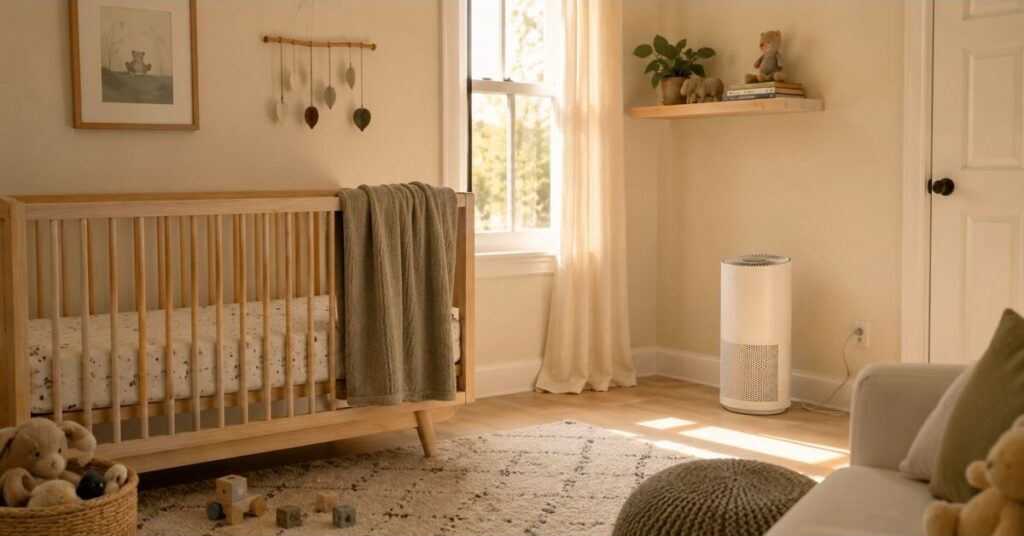
Put the purifier on the stable, hard, level surface described by its manual. Leave the required clearance around every intake and the top outlet. A 360-degree machine loses much of its advantage when squeezed behind a chair or pressed against curtains.
Keep it well outside the crib and play area—never inside a crib, on a crib rail, or close enough for a child to grab the housing or cord. Route the cord so it cannot become a strangulation or tripping hazard, and do not run it under a rug. The Winix manual asks for 12–18 inches from walls for maximum airflow; use the exact manual when its requirement is more specific.
Do not aim a strong stream of air continuously at the baby’s sleep surface. Do not place blankets, laundry, or toys over the outlet. Never add essential oils, fragrance, cleaning liquid, or disinfectant to a purifier or its filter unless the exact manual expressly provides a designed accessory—and none of these five needs added fragrance to clean particles.
A purifier’s fan can add steady background sound, but it is not a calibrated white-noise machine. For sleep-audio guidance, see our guide to the best white noise machines for babies.
How to choose among these five
Start with room size and the speed you will actually use. For a small nursery where low lights and locked controls matter, the Core 400S‑P is especially convincing. For a typical medium room with pet hair, the Vital 200S‑P is the best-balanced choice. For a larger room, the Blueair 311i Max offers the most airflow and stays impressively quiet, as long as you are comfortable with its disclosed electrostatic stage.
Choose the Coway if you want no app and can place the controls out of reach. Choose the Winix if pet hair, washable prefilter maintenance, and quiet medium-speed airflow matter more than the annual filter bill.
Before ordering, check that the purifier fits with its required clearance, the child cannot reach the cord or panel, and the genuine filter fits your budget. Those details matter longer than a coupon.
Frequently asked questions
Do babies need an air purifier in the nursery?
Not automatically. A purifier can reduce some airborne particles, but source control, cleaning, ventilation when appropriate, smoke avoidance, and repairing moisture problems come first. It is an optional household appliance, not a requirement for healthy sleep.
What size air purifier is best for a nursery?
Measure the room and compare it with smoke CADR and a higher-air-change room rating, not a one-air-change marketing maximum. EPA’s general particle-sizing rule is a smoke CADR at least two-thirds of room area; choose more headroom if you plan to run a quiet setting or manage wildfire smoke.
Is HEPA filtration safe for babies?
Mechanical particle filtration does not intentionally add anything to room air. The main practical concerns are safe placement, electrical and cord safety, keeping filters dry, and following the manual. “HEPA,” “HEPA-Type,” and proprietary names are not interchangeable, so check the exact model’s documentation.
Are ionizers safe to use in a baby’s room?
Ion and electrostatic technologies deserve model-specific review because some can produce ozone. CARB certification means the device meets California’s emissions limit; it does not mean every electronic purifier produces absolutely zero ozone. The Coway and Winix features can be switched off. Blueair’s electrostatic assistance is integral. If you want to avoid the question entirely, choose the mechanical Vital 200S‑P or exact Core 400S‑P.
Where should an air purifier go in a nursery?
Place it on a stable surface with the manual’s clearance around the intake and outlet, outside the crib and beyond the child’s reach. Keep the cord inaccessible, avoid curtains and soft clutter, and do not direct a strong airflow at the sleep surface.
Should an air purifier run all night?
It can, if the exact product is operated as directed and placed safely. Continuous low or medium speed often gives steadier particle control than short bursts. Remember that the quietest Sleep mode may move much less air, so size for the setting you can tolerate.
Can an air purifier help with dust, smoke, or pet dander?
It may reduce the airborne portion that passes through the filter. It will not remove dust already settled on furniture, pet hair on fabric, or the source of smoke. Cleaning, source control, and outdoor-air guidance still matter.
How often should I replace the filter?
Follow the exact filter indicator and manual. In this group, guidance ranges from roughly six months to a year. Heavy smoke, dust, or pets can shorten that interval. Never increase replacement frequency solely because an affiliate link exists.
Is a humidifier–air purifier combination better?
Not necessarily. Purification and humidification solve different problems. A separate humidifier may be easier to size and clean, while combination units reduce appliance count. Any humidifier must be maintained carefully to avoid dispersing minerals or microbial growth.
Can an air purifier prevent allergies or asthma?
No purifier can promise to prevent or treat allergies or asthma. Particle reduction may be one part of an environmental plan, but symptoms and treatment belong with a pediatrician or other qualified clinician.
Final verdict
For most medium nurseries, I would start with the Levoit Vital 200S‑P. It offers the most comfortable balance of airflow, darkness, locked controls, washable prefilter maintenance, and optional smart features. The Core 400S‑P is the sharper choice for a smaller room where strong low-noise performance and a narrow footprint matter. For more space and more airflow, the Blueair 311i Max stands out—provided its non-disableable electrostatic stage fits your preference.
The right purifier moves enough air at a tolerable speed while sitting safely out of reach. Buy for the real room, not the biggest number on the box.
Sources and methodology note
This guide used the EPA Guide to Air Cleaners in the Home, EPA guidance on ozone-generating air cleaners, CPSC recall search, SaferProducts.gov, CARB’s certified air-cleaner list, and ENERGY STAR room-air-cleaner records. Exact-model manuals and product pages supplied control, filter, and placement details. Independent performance evidence came from RTINGS, TechGearLab, HouseFresh, and exact-model Consumer Reports listings. Specifications and availability were checked through July 24, 2026; verify current seller, price range, and filter availability before purchase.