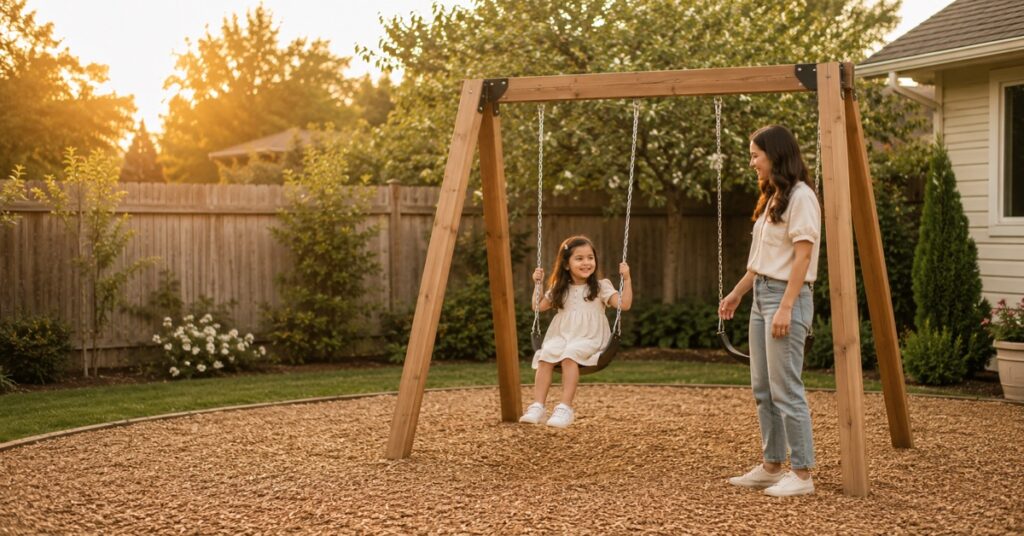
A cedar swing set can look compact online and still need more than 500 square feet of clear yard.
One playset in this guide measures roughly 9 by 10 feet, but its manual calls for a play area larger than 22 by 23 feet. A basic swing frame can have an even smaller footprint and still need more room because the swings travel forward and backward.
That is the detail many “compact swing set” lists miss.
With three kids, I think of our backyard in zones: space for active play, space for quieter activities, and enough open room for everyone to move without crossing directly in front of a swing. When I am planning a play area for my daughter, I would rather rule out a set on paper than discover after delivery that the safe layout takes over the entire yard.
This guide will help you do that same space check before you buy.
The Three Measurements That Matter
Product pages tend to emphasize one number: the assembled dimensions. For a safe and usable layout, you need three.
1. The footprint
The footprint is the space occupied by the frame, slide, ladders, posts, and other fixed parts.
This tells you whether the structure can physically sit in the yard. It does not tell you whether children have enough room to use it.
2. The clearance
Clearance is the open space between the equipment and fences, walls, trees, sheds, hard landscaping, overhead wires, branches, and other obstacles.
The CPSC home playground handbook recommends locating equipment at least 6 feet from structures or obstacles. The exact product manual may require more.
3. The use zone
The use zone includes the area where a child could fall, run, exit a slide, or travel while swinging.
For a standard to-fro swing, the CPSC says the protective area in front and behind the swing should extend to twice the height of the top bar from which the swing hangs. That is why a simple swing frame can need a surprisingly long rectangle of clear yard.
Case Study 1: A Compact Playset With a 500-Square-Foot Safety Zone
The Backyard Discovery Buckley Hill is marketed as a starter playset for smaller yards. Its official manual makes the difference between footprint and safe play area easy to see.
| Measurement | Buckley Hill manual |
|---|---|
| Ground dimensions | 8 ft 11 3/8 in × 10 ft 2 7/8 in |
| Approximate footprint | 91.6 sq ft |
| Safe play zone | 22 ft 1 1/4 in × 23 ft 4 7/8 in |
| Approximate safe-zone area | 517.4 sq ft |
| Maximum fall height | 5 ft 8 1/2 in |
The safe play zone is about 5.6 times the area of the structure itself.
That does not mean the product is unusually inefficient. It means the manual accounts for the places where children swing, climb, slide, land, and move around the frame.
The useful buying question is not, “Can I fit a 9-by-10-foot playset?” It is, “Do I have a level, obstacle-free area a little larger than 22 by 23 feet, plus a sensible route around it?”
Case Study 2: A Smaller Frame That Can Need More Clear Space
The Swing-N-Slide Ranger is a simple A-frame with two belt swings and a ring/trapeze bar. The frame measures about 104 by 92 inches, for a footprint of only 66.4 square feet.
That sounds much easier to fit than a playset with a fort and slide. The swing arc changes the calculation.
The Ranger’s top bar is 82 inches high. Its installation manual repeats the CPSC rule: extend the use zone in front of and behind a to-fro swing to twice the top-bar height.
Here is what that means on the ground:
- Allowing 6 feet beyond each end of the 104-inch beam creates a width of about 20 feet 8 inches.
- Twice an 82-inch top-bar height in both the front and rear creates a swing-direction length of about 27 feet 4 inches.
- A conservative planning rectangle is therefore about 565 square feet.
This is an estimate for laying out the yard, not a substitute for the manufacturer’s use-zone drawing or an installer’s site review. The actual protected shape is not always a perfect rectangle.
Still, the lesson is clear: the Ranger has the smaller frame, but its planning zone can be larger than the Buckley Hill’s printed safe play zone.
How Large Does the Clear Part of Your Yard Need to Be?
There is no universal definition of a “small backyard,” and there is no single clearance number that works for every swing set.
Use the following ranges only as a first filter:
| Clear, level space available | What it may mean |
|---|---|
| Less than about 20 ft in the swing direction | Many traditional swings will not fit their full use zone |
| Around 22 × 24 ft | Some compact combination playsets may fit, depending on the exact manual |
| Around 21 × 28 ft | Some basic A-frame swings may fit, depending on top-bar height |
| More than these ranges | You still need the exact use-zone diagram and obstacle check |
Measure the clear rectangle, not the full property dimensions. A 30-foot-wide yard may have only 18 usable feet after accounting for a patio, trees, an air-conditioning unit, a shed, drainage, and access paths.
If the manual’s use zone does not fit, rotating the product may help. Shrinking the required clearance does not.
A 15-Minute Backyard Measurement Test
You can reject a poor fit before comparing colors, slides, or accessories.
Step 1: Find the level area
Choose an area that is visible from the house and away from streets and driveways. Note any slope or low spot where loose-fill surfacing could wash away.
Step 2: Mark every fixed obstacle
Include:
- fences and walls;
- trees, roots, rocks, and low branches;
- sheds, patios, fire pits, and raised beds;
- clotheslines and overhead wires;
- air-conditioning equipment;
- hard landscape edging;
- gates, mower routes, and drainage paths.
Step 3: Draw the swing direction
The long safety dimension usually runs in front of and behind the swings. Make sure the slide does not exit into that travel path.
Step 4: Find the exact manual
Match the model number—not just the product name—to the current manual. Look for:
- safe play zone or use zone;
- top-bar height;
- maximum fall height;
- anchoring instructions;
- surfacing requirements;
- overhead clearance;
- age and weight limits.
Step 5: Mark the full zone on the ground
Use garden flags, chalk, painter’s tape on a patio edge, or a length of rope that is removed immediately after measuring. Walk the entire outline.
Do not leave a rope or cord attached to play equipment. The CPSC warns against attaching jump ropes, pet leashes, clotheslines, or other cords because they can create an entanglement hazard.
Step 6: Watch how the rest of the yard functions
Can a child reach the sandbox without crossing the swing path? Can you open the gate, mow, and reach the equipment for maintenance? Does the set block the only open running area?
For more ways to divide a compact yard into useful play zones, see our toddler backyard setup guide.
“Cedar” Does Not Mean Maintenance-Free
Cedar is popular for backyard play equipment because naturally durable wood can be a practical outdoor material. The CPSC lists cedar and redwood as examples of woods that are naturally resistant to rot and insects.
But “cedar” on a product page does not identify one universal species or maintenance schedule.
For example, the Buckley Hill manual identifies its wood as “C. lanceolata.” Missouri Botanical Garden and NC State Extension list Cunninghamia lanceolata under the common name Chinese fir. That does not automatically make it unsuitable; it means “cedar” is not enough information by itself.
Read the species and maintenance pages in the manual. The Buckley Hill manual calls for regular sealing and says climate may make treatment necessary once or twice a year. The Ranger manual suggests sealing or staining every two or three years, or more often when the climate requires it.
Also plan to:
- inspect wood monthly for raised grain, splinters, checking, or deterioration;
- tighten hardware as wood expands and contracts;
- check swing seats, ropes, chains, and cables;
- replace damaged parts rather than covering a structural problem with stain.
Budget for the Whole Play Area
The price of the wooden frame is not the cost of the finished project.
Your planning budget should include:
equipment + delivery + site preparation + assembly + anchors + protective surfacing + edging/drainage + wood care + replacement parts
A compact cedar structure may sit in the low-$300s to mid-$400s, but assembly can add several hundred dollars. On one current manufacturer listing checked in July 2026, optional professional assembly for a compact playset was priced in the same general range as the playset itself.
The use-zone calculation also changes the surfacing budget. Buying protective material for a 90-square-foot frame would badly underestimate a play zone of more than 500 square feet.
Get local material and labor quotes rather than relying on one national total. Soil, drainage, access, permits, and homeowners-association rules can change the project substantially.
What Should Go Under a Swing Set?
Grass and bare dirt may look soft, but the CPSC does not treat them as reliable protective surfacing because wear and weather reduce their ability to absorb an impact.
For equipment up to 8 feet high, the CPSC home handbook recommends maintaining at least 9 inches of materials such as wood mulch or chips, engineered wood fiber, or shredded/recycled rubber mulch. It notes that an initial 12-inch fill may compress to about 9 inches.
That is a general home-playground guideline. Match the selected material to the equipment’s maximum fall height and follow the exact manual and the surfacing manufacturer’s tested specifications. Thin outdoor mats and ordinary artificial turf should not be assumed to provide adequate fall protection.
Installation and Maintenance Safety Checklist
Before children use the set:
- Confirm the model number and follow the current manufacturer manual.
- Install on level ground.
- Keep the required distance from fences, buildings, trees, poles, wires, and other obstacles.
- Preserve the longer front-and-rear use zone for swings.
- Install the specified anchors and cover exposed anchor points.
- Add protective surfacing to the correct depth and area.
- Separate quiet activities, such as a sandbox, from the swing path.
- Check that slide exits and climbing routes do not cross moving swings.
- Confirm all age, occupant, and weight limits.
During the play season:
- Tighten hardware at the schedule in the manual.
- Check wood for splinters and deterioration.
- Inspect swing seats, ropes, chains, and cables at least monthly.
- Rake and measure loose-fill surfacing so it does not become compacted or shallow.
- Keep cords, leashes, and added ropes off the structure.
- Have children remove bicycle and sports helmets before playing on the set.
This list supports the manual; it does not replace it.
What If a Traditional Swing Set Does Not Fit?
A too-small safety zone is a reason to change the equipment, not to move a swing closer to a fence.
Depending on your child’s age and abilities, consider:
- a ground-level playhouse without an elevated platform;
- a compact freestanding slide with its own verified landing zone our backyard toddler slide guide;
- a covered sandbox positioned away from active movement our guide to the best sandboxes for kids;
- portable balance or stepping equipment that can be stored after use;
- no-equipment outdoor movement games these no-equipment physical activities for kids;
- a public playground for full-size swinging, with the home yard reserved for lower-motion play.
The right answer for a small backyard may be two smaller play zones instead of one permanent structure.
FAQs
How far should a swing set be from a fence?
The CPSC recommends at least 6 feet between play equipment and an obstacle such as a fence. A product manual may require more. In front of and behind a swing, allow the longer swing-use zone rather than stopping at a general 6-foot perimeter.
How much clearance is needed in front of and behind a swing?
For a standard to-fro swing, the CPSC guideline is twice the height of the top bar in front and twice the height behind. An 82-inch top bar therefore produces about 13 feet 8 inches in each direction from the point beneath the suspension bar.
Can a swing set go on grass?
The frame may be installed over an appropriate level site if the manual allows it, but grass is not a substitute for impact-absorbing protective surfacing in the use zone.
Is cedar the best wood for a swing set?
Cedar can be a suitable outdoor material, but species, structural design, hardware, maintenance, warranty, and installation quality all matter. “Cedar” alone is not enough to judge a set.
Do cedar swing sets need to be sealed?
Many do. Follow the exact manual. The two manuals reviewed for this guide recommend different schedules, ranging from annual or climate-dependent treatment to every two or three years.
Can I put a swing set on a slope?
Do not assume a slope is acceptable. Both the CPSC and manufacturer instructions emphasize level ground. Significant grading or drainage work should be evaluated before installation.
Does a compact playset work for a small backyard?
Sometimes, but only if the complete safe play zone fits. A structure with a 90-square-foot footprint can require more than 500 square feet of clear, protected play area.
Should I assemble a wooden swing set myself?
Use the manual to assess the number of people, tools, time, and site preparation required. If you cannot level, anchor, and verify the structure as instructed, include professional assembly in the budget.
Final Takeaway
For a small backyard, the best swing set is not the one with the smallest product-page dimensions. It is the one whose complete use zone fits without compromises.
Start with the manual. Measure the swing direction. Mark the entire safety area. Price the surfacing and installation before ordering.
If the zone fits, then compare features and materials. If it does not, choose a different kind of outdoor play. That is safer than squeezing a swing beside a fence, and far less frustrating after delivery.