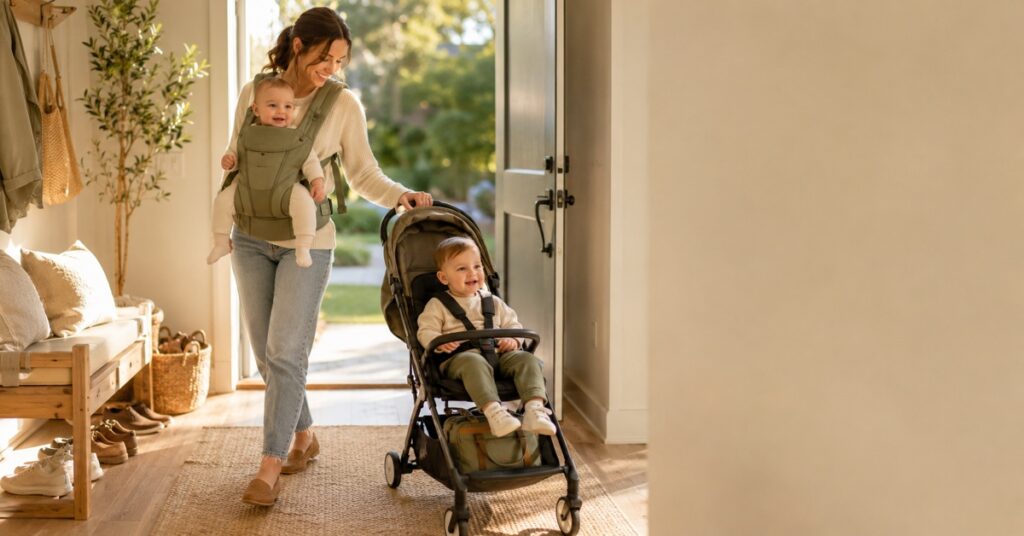
Two under two · Baby gear · Daily routines
It is 7:42 a.m. The baby needs feeding, your toddler has removed one shoe, and the diaper bag is somehow empty again. Two-under-two gear helps when it removes one decision or gives you one safe next move. Everything else is just another thing to clean.
This is not a second newborn registry. You probably still own bottles, burp cloths, a baby bath, and several mysterious pieces of plastic you have not identified since your first child outgrew them. What changes is the overlap: the baby needs feeding while your toddler needs shoes, a snack, and help finding the toy already in their hand.
As a mom of three, I have learned that useful gear does one of four things: it moves children safely, gives one child an appropriate place while you help the other, stops you from carrying the same supplies around the house, or makes a necessary transition more predictable. That is the test I use throughout this guide.
The short answer
Most families do not need two of everything. They need a dependable plan for these seven pressure points:
- Getting around: a double stroller, or an existing stroller paired with a properly fitted baby carrier.
- Putting the baby down: a compliant sleep space and a separate supervised awake-time spot.
- Keeping the toddler nearby: a genuinely childproofed area for short transitions.
- Changing two diaper sizes: a small, clearly divided supply cache where you spend the most time.
- Feeding one while helping the other: an arm’s-reach setup that does not depend on entertaining the toddler for half an hour.
- Leaving the house: one hands-free bag and one simple reset routine.
- Monitoring sleep: another camera only when your room arrangement creates the need.
Start with the moment that keeps going wrong
Before buying anything, picture an ordinary weekday. Not a holiday, not an airport, and not the beautifully staged version of your living room. Where does the day repeatedly fall apart?
- Does your toddler still nap during walks or errands?
- Do they run when you need both hands on the baby?
- Are you carrying diapers up and down stairs all day?
- Does every outing begin with repacking the same bag?
- Will the children sleep in different rooms?
- Will one adult regularly handle both bedtime and the morning exit?
Those details matter more than a generic essentials list. A family that walks to daycare needs a different transport solution from a family that drives everywhere. A two-story home may benefit from duplicated wipes and changing pads, while a small apartment gets harder to manage when every surface turns into a baby station.
A useful buying rule
Buy for the repeated bottleneck, not the imagined emergency. If a problem happens several times a week and the same piece of gear would reliably remove it, the purchase may earn its space. If the scenario begins with “maybe someday,” wait.
Choose a transport plan, not automatically a double stroller
If your toddler still sleeps on outings, runs off, or cannot walk the full route, a double stroller makes a strong case for itself. It gives a tired child a place to rest, keeps a runner harnessed near traffic, and lets one adult move both children without negotiating every block.
It is not the only workable answer. If most outings are short, your trunk is small, and you and the baby are both comfortable with babywearing, a carrier plus your existing stroller may be simpler. You avoid storing and lifting another large frame, and your toddler keeps the seat they already know.
| Your everyday reality | Best starting point | What to check before buying |
|---|---|---|
| Your toddler naps on outings, runs off, or cannot walk the whole route. | Double stroller | Newborn configuration, seat limits, trunk fit, doorway width, fold, and whether both positions work for your children’s current stages. |
| You take short trips, have limited storage, and are comfortable babywearing. | Existing stroller plus carrier | Carrier fit, infant positioning, weather, caregiver comfort, and whether you can safely buckle and unbuckle the toddler while wearing the baby. |
| Your older child is close to two, follows directions, and wants occasional walking breaks. | Possibly a compatible stroller board | Manufacturer-listed compatibility, the board’s age and weight requirements, brake and fold clearance, and whether your child can stand reliably. |
| You frequently go out alone for long or unpredictable trips. | The setup that lets you secure both children consistently | Do not optimize only for the smallest fold. Think about parking lots, naps, bad weather, and the moment one child refuses to cooperate. |
If you are weighing a board against a second seat, use the full stroller board vs. double stroller decision guide. If babywearing is likely to carry most of the load, start with the baby carrier guide rather than choosing a carrier only because it packs small.
Babywearing still needs your full attention
Your baby’s face should stay visible, with the nose and mouth clear and the chin away from the chest. Check frequently, especially with a young infant. The American Academy of Pediatrics has a concise carrier safety guide. Follow your carrier’s instructions and ask your baby’s clinician before babywearing if your baby was premature or has breathing concerns.
Hands-free does not make hot cooking, sharp tools, or carrying hot drinks around a baby safe. A carrier gives you mobility; it does not turn every chore into a babywearing chore.
Create appropriate places, not a bouncer in every room
One of the hardest two-under-two moments is simple: the toddler needs help in the bathroom, but the baby is in your arms. Buying an infant seat for every room creates more equipment without settling the question. Decide in advance where each child can appropriately be for that short transition.
For infant sleep
Use a crib, bassinet, portable crib, or play yard that meets current safety requirements and is intended for sleep. Keep the surface firm, flat, and free of pillows, loose blankets, toys, and added padding. Put the baby down on their back.
For supervised awake time
A clear floor area or age-appropriate play space may be all you need. It should be away from toddler traffic, cords, unstable furniture, choking hazards, and anything the older child can drop or climb onto. “The baby is contained” is not the same as “the baby is safe without supervision.”
For the toddler
Choose one genuinely childproofed room or gated area where your toddler can stay nearby while you change or feed the baby. At the top of stairs, the U.S. Consumer Product Safety Commission advises using a gate that screws to the wall; pet gates are not child safety gates. Its home childproofing guide is a useful room-by-room check.
If the baby falls asleep somewhere else
Car seats, strollers, swings, bouncers, carriers, and nursing pillows are not routine sleep spaces. If your baby falls asleep in one, move them to a firm, flat sleep surface on their back as soon as practical. See the AAP’s current safe sleep guidance.
Use one refill system for two diaper sizes
Two children in diapers sounds like a reason for twice the storage. In practice, too many stations can create another job: four half-empty places that nobody remembers to refill.
Start with one main supply and one small cache in the part of the home where you are most likely to get stranded. If you have stairs, that may mean a few diapers in each size, wipes, cream, a washable changing pad, and one outfit per child on the second floor. In a one-level home, a single portable setup may be easier.
Separate the diaper sizes so you can identify them with one hand. A labeled divider, two different pouches, or opposite sides of a basket is enough. Keep bulk supplies in one place, then refill every cache from the same basket. A beautiful cart is optional. Grabbing the right diaper halfway through a messy change is not.
For a fuller room-by-room setup, see how to build a newborn station at home. This two-under-two version should stay smaller: one central inventory, tiny satellites, and a reset schedule.
Plan feeding around a toddler-sized interruption
A newborn feed can last longer than your toddler’s interest in any carefully prepared activity. Do not build the whole plan around keeping the older child quietly entertained until the baby finishes.
Instead, put the things you need within reach before you begin: your water, a burp cloth, feeding supplies, a phone charger, and a safe place to set down anything that should stay away from the toddler. Keep one or two simple activities nearby, but expect the toddler to wander back, ask for help, or suddenly need the exact cup that is in the dishwasher.
If you prepare a toddler snack or water ahead of time, offer it while the child is seated upright and supervised. It should not become a way to keep a young child eating unattended while your attention is elsewhere.
A nursing pillow may make feeding more comfortable, but it is not a place for the baby to sleep or lounge without active supervision. When the feed ends, move the baby to an appropriate surface before shifting your attention to the toddler.
Build one leaving-the-house system you can reset
The best two-under-two diaper bag is not necessarily the largest one. An enormous bag can become a dark archive of outgrown diapers, crushed crackers, and four changes of clothing for the wrong season.
Use one hands-free bag with a visible place for each child’s essentials. Pack a small clean-change pouch for each child, a separate wet or dirty pouch, and only the feeding supplies needed for that outing. If you drive, a modest backup cache in the car can hold spare clothing and nonperishable basics. Check it for heat-sensitive items, expiration dates, and outgrown sizes.
Keep the bag in the stroller basket or another manufacturer-approved storage area rather than hanging a heavy load from the handle, which can affect stroller stability. The stroller manual gets the final word on storage limits.
Reset the bag when you get home: remove rubbish and wet clothes, replace what was used, and return it to the same place. If your current bag cannot stay organized when packed for two, the diaper bag guide can help you compare layouts. You probably do not need a separate full bag for each child.
Buy monitoring for the room plan, not the child count
A second baby does not automatically require a second monitor. If the baby sleeps in your room and your toddler’s current monitor still works, wait. You will understand the real camera angles, wall locations, and nighttime routine much better once the sleeping arrangement changes.
A second camera or split-screen display becomes useful when the children sleep in different rooms and you genuinely need to see both without repeatedly switching views. Before buying, check how many cameras the parent unit supports, whether simultaneous audio is possible, what happens during a power or Wi-Fi outage, and how mounting hardware and cords stay out of reach.
A monitor is a convenience, not a substitute for a safe sleep space or appropriate adult supervision. When the room plan makes an upgrade worthwhile, use the baby monitor guide to compare the main system types.
What to add, reuse, wait on, and skip
| Add because both children need it at once | Reuse after inspection | Wait until the routine proves the need | Skip by default |
|---|---|---|---|
| An age- and size-appropriate car restraint for each child. | Clothing, a baby bath, and complete gear that remains within its limits and has no recall or damage. | A double stroller if a carrier plus your existing stroller may cover the early months. | A full duplicate nursery. |
| An appropriate sleep space for each child who needs one. | A known-history car seat only when it passes every item on the NHTSA used-seat checklist. | A second monitor, camera, or sound machine before the room plan changes. | Infant loungers or support cushions used for sleep. |
| Small duplicates of high-use supplies where distance repeatedly causes trouble. | Your existing stroller or carrier if it fits the current child, remains complete, and is used according to its manual. | Extra changing furniture, feeding appliances, and elaborate storage carts. | Stroller accessories that are not confirmed compatible with your exact stroller. |
Secondhand gear deserves more than a quick visual check. Confirm the model and manufacture date, look for recalls, find the manual, and make sure every required part is present. The NHTSA used car seat checklist explains the conditions a secondhand seat should meet. CPSC also maintains a searchable recall database.
For a complete item-by-item breakdown, continue with what to reuse for a second baby. This guide is concerned with the narrower question: will both children need this item at the same moment?
The five-minute evening reset
- Refill the small diaper cache in both sizes.
- Replace the spare outfits that were used.
- Remove rubbish and wet items from the leaving-house bag.
- Return feeding supplies and supervised toddler activities to their usual places.
- Charge the devices you actually rely on.
- Clear the infant sleep space so it is ready for the next sleep.
Still deciding what belongs on your list? Use the complete baby registry checklist to review the basics, then come back to this two-under-two plan for the items that solve overlapping needs.
Frequently asked questions
Do I really need a double stroller for two under two?
Not always. A double is usually the stronger choice when the older child still naps on outings, runs off, cannot walk the full route, or needs a dependable seat while one adult manages both children. A carrier plus your current stroller may work for shorter trips and families comfortable with babywearing.
Can I use a baby carrier and single stroller instead?
Yes, if the carrier fits both baby and caregiver, the baby can be positioned with a clear airway, and the setup still lets you secure and help the toddler safely. Weather, recovery after birth, caregiver comfort, and the baby’s preferences can all change how practical this feels.
What do I actually need two of?
If you travel by car, each child needs their own appropriate restraint, and each child needs an age-appropriate place to sleep. Small duplicates such as diapers, wipes, and spare clothes can help when stored at a genuine point of use. Most other items can be shared, reused, or purchased only after a conflict appears.
Do I need two cribs?
Not necessarily two full-size cribs, but the baby needs an approved infant sleep space, and the older child needs a sleep setup appropriate for their age and development. If your toddler remains within the crib manufacturer’s limits and is not climbing out, do not rush the transition solely to give the crib to the new baby. Choose each child’s arrangement based on current safety needs, not matching furniture.
Do I need a two-camera baby monitor?
Only when the sleeping arrangement makes it useful. If the baby is in your room and the toddler’s current monitor works, there may be nothing to add yet. Revisit the decision when the children sleep in separate spaces.
How do I leave the house alone with two under two?
Use the same order every time: secure the child most likely to move away, load the second child, then load the bag. Reverse the process when you arrive. The exact order depends on your vehicle, stroller, driveway, and children’s stages, so practice at home, keep both children within immediate reach, and never walk away from a child in or around a vehicle.
The bottom line
You do not need two of everything. You need a dependable plan for the moments when both children need you.
Start with transport, appropriate places for each child, and the one household transition that currently creates the most scrambling. Reuse what still fits. Duplicate the cheap supplies that save repeated trips. Wait on the gadgets whose job does not exist yet.
There will still be mornings when one child is crying and the other has hidden a shoe. The right setup will not make those mornings effortless. It can, however, keep you from searching three rooms for wipes while carrying a baby and negotiating with a barefoot toddler—and that is a meaningful kind of help.