You’ve got two Zingo boxes open on your phone, and you keep going back to the one that says Sight Words. If your child is starting school, it’s easy to wonder whether that’s the more useful purchase. I wouldn’t choose by the label alone.
For a child age 4 or older who isn’t reading yet, I’d start with the original for a family matching game. Sight Words is worth considering for ages 5 and up when you want to revisit the particular words in that box. Both games involve racing to call a match, so choosing pictures doesn’t remove the competition.
Which Zingo should you buy first?
| What matters at the table | Original Zingo | Zingo Sight Words |
|---|---|---|
| Recommended starting age | 4+ | 5+ |
| What your child matches | Pictures with words underneath | Written words |
| What your child calls out | The picture’s name | The word |
| Contents to consider | Picture-matching game | 24 different words, repeated across 72 tiles |
| Dispenser included in the linked complete set? | Yes | Yes |
| Basic play | First correct caller gets a shared tile | First correct caller gets a shared tile |
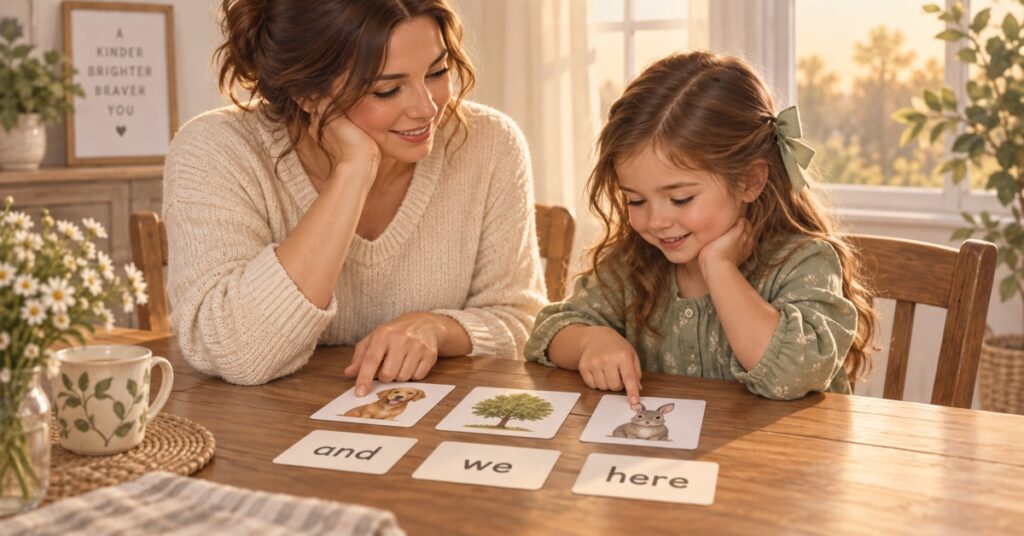
The original Zingo cards and tiles have pictures with words underneath. A child can spot a cat, find the matching cat on their card, and call its name without reading “cat.” That matters when you want your child to join in without needing you to read each tile first.
You’ll still want to go through the pictures together before the first game. Knowing what to call a picture is different from simply spotting the same shape. An adult can operate the Zinger dispenser while your child gets familiar with watching for a match and saying its name.
In Sight Words, players match written words and call them out. The U.S. manufacturer lists this complete game from age 5. That age label isn’t a deadline for recognizing the words. A child may need you beside them to read through the tiles before the competitive game makes sense.
Check these 24 words before buying Sight Words
The Sight Words instructions show 72 tiles: 24 different words, with three tiles for each word. That’s the detail I’d check before buying. Repeated tiles support the game, but they don’t give you 72 new words to work through.
Here is the included word list:
and, are, come, for, have, here, in, me, my, now, our, said, she, the, there, they, three, two, want, we, went, what, where, who.
If your child brings home a word list from school, put it beside this one. Look for words you actually want to revisit together. The words don’t all have to be new; familiar ones can be part of the game too. There’s no need to turn the comparison into a quiz or expect your child to read the whole list before you buy.
If your child already knows all 24 words and you’re shopping for new ones, I’d skip this set. You can still enjoy a game with known words, but the contents won’t change with the next round. It also won’t necessarily cover the list your child’s teacher sends home.
Before the first competitive game, sit together with the cards and say the words. The instructions encourage getting familiar with the pieces first. That gives you a chance to explain what’s on a tile without another player claiming it while you’re talking. This is a small, fixed set to play with; I wouldn’t buy it expecting a complete reading course.
If those are the words you want to revisit and your child likes calling out a match, the complete Sight Words game is the version I’d consider.
View Zingo Sight Words on Amazon
What the red and green sides change
The red and green sides change how competitive the game is. In the original Zingo instructions, green cards have fewer pictures in common. Red cards share more, which means more players may be after the same tile. The Sight Words instructions also describe green as less competitive and red as more competitive.
Turning a card over doesn’t reveal a new, harder word bank. The basic rules ask everyone to use the same colored side. There’s a separate official Multi-Card variation using one card of each color; that’s a different way to play.
Picture a word sliding out while one child is still scanning their card and another has already called it. The first correct caller takes the shared tile. If there’s a tie, the dealer returns it to the dispenser. That pace can be exciting, but it may be frustrating when players need different amounts of time to respond.
I’d use the green side for a gentler start, as the instructions suggest. It still has competition. If your main goal is a game where each child can take an unhurried turn, I’d hesitate over either box. Adult help can make the words more familiar; it doesn’t change who gets a shared tile under the basic rules. I wouldn’t use who calls first as a reading test.
Do you need the original to play Sight Words?
You do not need the original Zingo to play the complete Sight Words game linked here. It includes its own Zinger, cards, and tiles. The original linked here is also a complete game. Choose the contents you want to play with; you don’t need to buy them in sequence.
When you check the product page, look for the dispenser in the included contents. Expansion packs are also sold under the Zingo name. For a first purchase, make sure you’re ordering a full game with a dispenser rather than a pack of extra cards and tiles.
Already have an original that your child enjoys? I’d keep playing it. Starting school or having another birthday doesn’t, by itself, create a reason to replace it. There needs to be something you actually want to do with the Sight Words contents.
What to check when your game arrives
Before bringing the game to the table, check that the pieces match the contents on your particular box. The original linked here is the Amazon bonus-card version; original Zingo packages can differ in card count. Check the cards and tiles are in the expected language, inspect for damage, and operate the dispenser as instructed.
Some buyers have reported missing pieces, damaged sets, language mismatches, or a dispenser that fails to release both tiles. I’d check those things before setting up the first game. Request a return or exchange for an incomplete, damaged, or faulty set rather than taking it apart or altering tiles.
Follow the recommended ages, and put the small pieces away where younger children cannot reach them.
Before you order, take a look at the word list and think about who’ll be sitting around the table. If you only wanted a picture-matching game, there’s no need to turn this into a two-box purchase.
Still choosing a gift? Browse these screen-free gifts for kids.