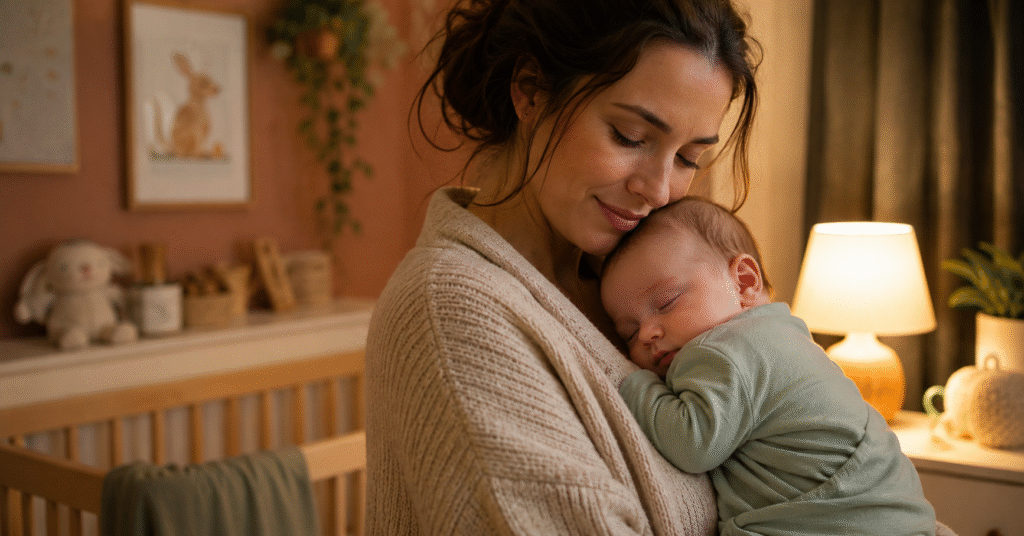
My daughter was thirteen weeks old the night I put a $340 smart bassinet accessory, two swaddles, a lavender pillow spray, and something called a “womb sound bear” into an Amazon cart at 2:47 AM. She had been sleeping five-hour stretches. Then, seemingly overnight, she was up every 90 minutes, wide awake, furious, and completely uninterested in going back down.
I didn’t buy the cart. (Mostly because she started crying again before I found my credit card.) And I’m glad, because most of it wouldn’t have helped. Here’s what nobody tells you at 2:47 AM: the 4-month sleep regression is not a problem you can purchase your way out of. It’s your baby’s brain permanently upgrading how it sleeps, and no product cures that.
But. Two babies later, I know exactly which obstacles make those weeks worse — and the right gear earns its keep not by fixing the regression, but by clearing those obstacles out of the way. A baby fighting the swaddle transition on top of new sleep cycles. A 5 AM sunrise turning a brief stirring into a full wake-up. A hallway floorboard creak undoing forty minutes of rocking.
This is the survival kit I’d hand a friend whose baby just hit The Wall: eight things that actually help, organized by the specific problem they solve, plus three heavily-marketed products I’d skip no matter how desperate the night gets.
What’s Actually Happening (The 90-Second Version)
Around 3 to 5 months, babies stop sleeping like newborns and start cycling through sleep stages more like adults do — with brief, light-sleep surfacing between cycles. An adult rolls over and doesn’t remember it. A four-month-old surfaces, notices the swaddle is gone or the room looks different or you are no longer holding them, and files a formal complaint.
Two things follow from this. First, it’s permanent — this isn’t a phase that reverses, it’s new sleep architecture, and the rough patch is your baby learning to link those cycles. Second, it’s normal, it typically settles within a few weeks, and it has nothing to do with anything you did wrong.
I’m keeping the science short here because we’ve already written the full deep-dive — signs, timeline, week-by-week expectations, and what to do when nothing works. If you’re not sure this is even the regression you’re dealing with, start with our complete guide to the 4-month sleep regression, then come back for the gear.
First, the Part You Can’t Buy
Before the products, an honest disclaimer, because I promised myself this article wouldn’t be the thing I resented at 2:47 AM.
The heavy lifting during this regression is done by boring, free things: a consistent (short!) bedtime routine, age-appropriate wake windows so your baby isn’t overtired at bedtime, and giving them a little space to practice falling asleep — putting them down drowsy-ish sometimes, pausing a beat before rushing in at every squeak. If wake windows are new territory for you, our gentle newborn sleep guide breaks them down by age.
Everything below supports that work. Nothing below replaces it. Okay — now the kit.
Problem #1: The Swaddle Has to Go, and Your Baby Disagrees
Here’s the cruel timing of the 4-month regression: it tends to arrive right as your baby starts showing signs of rolling — which is exactly when swaddling has to stop, for safety. So just as sleep falls apart, you also remove the one thing that was containing the startle reflex. Fantastic system. No notes.
⚠️ Safe sleep first: The American Academy of Pediatrics says to stop swaddling as soon as your baby shows any signs of trying to roll. Always place babies on their back on a firm, flat surface with nothing else in the sleep space — no blankets, pillows, bumpers, or stuffed animals. The full guidelines are worth ten minutes of your time: AAP’s parent guide to safe sleep.
HALO SleepSack (100% Cotton)
This is the wearable blanket you’ve probably already seen in hospital nurseries and on every registry checklist, and it tops nearly every “what comes after the swaddle” list for a reason. It does one job with zero drama: keeps baby warm without loose bedding, arms completely free. The inverted zipper opens from the bottom, so middle-of-the-night diaper changes don’t require a full evacuation.
What I like: Foolproof for every caregiver — your partner, your mom, the babysitter, nobody needs instructions. The cotton 0.5 TOG works for warmer rooms; there’s a micro-fleece 1.0 TOG for cooler ones. Survives industrial quantities of laundry.
Watch out: The listing has an enormous number of size, fabric, and print combinations, and it’s genuinely easy to order the wrong one half-asleep. For a typical four-month-old, you want Small — the Medium is sized 6–12 months. Check the size chart against your baby’s weight, not their age.
Love to Dream Swaddle Up Transition Swaddle
Not every baby accepts the swaddle-to-sleep-sack jump in one move. My older son was our arms-up sleeper — the kind who fought every wrap that pinned his hands down — so I know exactly which babies this design exists for. The Love to Dream Transition is built for this precise moment: the “wings” zip off one at a time, so you can free one arm for a few nights, then the other, instead of changing everything at once.
What I like: It’s the only product in this category actually engineered for the transition itself rather than for after it. One arm out, see how the night goes, adjust. For babies with a strong startle reflex, that gradual step-down can be the difference between a rough three nights and a rough three weeks.
Watch out: It’s the priciest option here, and it’s a bridge product — once both wings are off for good, you’ll still want a regular sleep sack for the long haul. Budget for both, or go straight to the HALO if your baby is adaptable.
Want the full comparison — including bamboo options, TOG ratings explained, and what we’d buy on a budget? Our complete sleep sack guide covers all of it.
Problem #2: They Now Wake at the Sound of a Cabinet Closing Two Rooms Away
New sleep cycles mean more time in light sleep, and light sleep means your formerly portable, sleep-through-a-dinner-party newborn is suddenly a very light sleeper. White noise doesn’t put babies to sleep — it masks the sounds that pull them out of it. During regression weeks, when every cycle transition is fragile, that masking earns its keep.
⚠️ Volume matters: Keep any sound machine across the room from the crib — not on the rail, not right next to it — and at a moderate volume — no louder than soft rainfall or a calm conversation. Louder is not better for developing ears. When in doubt, place it farther away and turn it down.
Yogasleep Dohm Classic
This is the machine that’s been humming in nurseries since before apps existed, and it’s still the one veteran parents name first. There’s no app, no Wi-Fi, no firmware updates — just a real mechanical fan inside a plastic shell, which is why the sound has a natural, non-looping quality that recordings can’t quite match. You twist the housing to adjust the tone, flip a switch for two speeds, and that’s the entire user manual.
What I like: Zero learning curve and nothing to troubleshoot at 3 AM. It also never gets a notification, never needs the Wi-Fi password at grandma’s, and never has a server outage.
Watch out: Some parents report units wearing out or the motor dying earlier than they’d hoped, which stings at this price. There’s also no timer and no remote — it runs until you physically turn it off, which is honestly how most sleep-regression households use it anyway.
Hatch (Sound Machine + Night Light)
The Hatch is the machine I kept hearing about from friends and kept seeing on every registry, and after going through what it actually does, I understand why it owns this category. It’s a sound machine, a dimmable night light, and a programmable routine-builder in one — and you control all of it from your phone. During a regression, that specific feature is not a gimmick: you can nudge the volume up when the neighbor’s dog starts barking without opening the nursery door, which is the highest-stakes door in your home right now.
What I like: The core functions — sounds, lights, routines — work without any subscription, and the baby version currently includes a stretch of free chat access to sleep consultants, which is a genuinely useful perk in month four. It also grows with your kid: the same device becomes a toddler “okay to wake” clock later, so the price amortizes over years.
Watch out: It needs Wi-Fi and a phone to set up, and the expanded content library (extra sounds, stories, premium features) sits behind an optional subscription. If the idea of your sound machine having a companion app makes your eye twitch, get the Dohm and live happily.
Problem #3: The 5 AM Sunrise Club
Once sleep cycles mature, the early-morning hours become the lightest sleep of the night. If dawn light is leaking into the room at 5 AM, a baby who surfaces between cycles sees it and decides the day has begun. Darkness isn’t a luxury during this regression — it’s one of the few environmental levers that directly helps babies link cycles, both at 5 AM and for daytime naps.
The test I use: go into the nursery at nap time, close everything, and hold your hand out. If you can clearly see it, there’s work to do.
SUN AWAY Portable Blackout Curtain
Before you spend real money on custom blackout treatments, this is the straightforward fix: a blackout panel that suction-cups directly onto the window glass, sealing light at the source instead of letting it glow around curtain edges. No drill, no hardware, no argument with your landlord. It comes with a travel bag, so it doubles as your hotel-room solution.
What I like: Attaching to the glass itself is the trick — even good blackout curtains leak light around the edges, and this doesn’t. Setup takes about two minutes. One size, one listing, nothing to get wrong.
Watch out: Suction cups want clean, smooth glass; give the window a quick wipe first or they’ll let go at 4 AM with a very startling thwack. And it’s one panel at roughly 66 by 51 inches — oversized or unusual windows may need two.
SlumberPod (Blackout Sleep Tent)
The SlumberPod is a breathable blackout canopy that goes over a pack-and-play or mini crib, creating a dark little sleep cave regardless of what the room around it is doing. It’s the product every traveling parent I know either owns or has borrowed. The age minimum on the label is four months — meaning your baby grows into it exactly as this regression hits, which is either great product design or a very dark joke.
What I like: It solves the two situations where window solutions can’t: hotel and grandparent-house rooms you can’t modify, and room-sharing, where it lets you exist — lights on, suitcase unzipping, normal human activity — after baby’s bedtime. There’s a pouch for a video monitor and one for a small fan. The maker had it safety-tested by independent labs with all vents closed and no fan running, and it’s designed from breathable fabric with ventilation flaps.
Watch out: It’s a real investment, and prices swing noticeably with promotions, so check before assuming. In warm rooms without air conditioning the air inside can get stuffy — parents consistently recommend opening the vent flaps and using the fan pouch, and I’d skip it entirely in a hot, non-climate-controlled space. It fits playards and mini cribs, not a standard full-size crib, and it’s for indoor use only.
Problem #4: The 3 AM Pacifier Hunt
A quick word on why pacifiers earn a spot in a sleep kit: sucking is one of the few self-soothing tools a four-month-old actually has, and the AAP notes that offering a pacifier at nap time and bedtime is associated with a reduced risk of SIDS. (If you’re breastfeeding, the usual advice is to have nursing well established first — by four months, most families are there.)
The regression-specific problem is different: your baby surfaces between cycles, the paci has fallen out, and they can’t yet reliably find and replug it themselves. That skill comes later. Until it does, your job is logistics: the right paci, in quantity, findable in the dark.
BIBS Natural Rubber Pacifier (Size 1, 0–6 Months)
BIBS has been making these in Denmark for over forty years, and among the moms I know they’ve become the default answer to “my baby rejects every pacifier.” The cherry-shaped natural rubber nipple is softer and closer to the real thing than standard silicone, which is often exactly what a picky, breastfed baby will finally accept. The round shield curves away from the face so it doesn’t trap drool against the skin.
What I like: The acceptance rate, mostly. When a baby is refusing sleep and refusing every paci in the drawer, this is the one worth trying before giving up on pacifiers altogether.
Watch out: Natural rubber is a consumable — BIBS themselves say to replace them every four to six weeks, so this is a recurring cost, not a one-time buy. Rubber is also latex, so if latex allergy runs in your family, choose a silicone version instead. Make sure you’re ordering Size 1 (0–6 months); the listing carries multiple sizes.
NUK Comfy Pacifiers (5-Pack, 0–6M)
The other approach to the 3 AM paci hunt: overwhelming force. Five one-piece silicone pacifiers for less than the price of a single fancy one means there’s a paci in the crib, one in the diaper bag, one clipped to the stroller, and two in reserve. The one-piece molded design has no seams or joints to trap gunk, so they can just live in the dishwasher basket.
What I like: The heart-shaped shield sits under the nose instead of against it, and the orthodontic nipple shape comes from NUK’s pediatric-dentist heritage. Mostly, though: five of them. During a regression, redundancy is a feature.
Watch out: Firmer silicone feel — some babies who love soft rubber will spit these across the room with surprising velocity. At this price, finding out is a cheap experiment.
Three Things I’d Skip (No Matter How Tired You Are)
Sleep deprivation makes us all vulnerable to products that promise miracles. These three categories market hard at exactly your situation, and they’re the ones to walk past:
1. Weighted swaddles and weighted sleep sacks. The gentle-pressure pitch sounds soothing, but the AAP’s safe sleep guidance explicitly recommends against weighted swaddles, weighted blankets, and weighted objects on or near a sleeping baby. Whatever they promise, it’s not worth it.
2. Inclined sleepers and “anti-startle” angled loungers. Inclined sleep products have been linked to infant deaths and are now banned from sale in the US under the Safe Sleep for Babies Act, along with crib bumpers. If someone offers you a secondhand one, decline. Flat and firm is the whole rulebook. The CPSC’s safe sleep page is the definitive reference.
3. Loveys, plush “sleep buddies,” and crib positioners. The cuddly marketing photos always show them in the crib. For babies under 12 months, nothing soft belongs in the sleep space, full stop. If a well-meaning relative gifts one, it can live on a shelf as decor until the first birthday.
You’ll notice a pattern: everything worth skipping goes in the crib, and almost everything in the kit above works around it — on the window, across the room, over the playard, or on your baby as safe sleepwear. That’s not a coincidence.
Putting It Together: One Rough Night, Start to Finish
Here’s how the kit actually runs at 6:45 PM on a regression night. Blackout panel already up, so the room reads “night” even in June. Short routine — feed, fresh diaper, sleep sack on (one arm out this week, if you’re mid-transition), thirty seconds of the same song, because the routine is the signal, not the performance. Sound machine on, across the room, moderate volume. Paci in. Baby down drowsy but awake, or as close as tonight allows.
Then: 1:40 AM, crying. You wait a beat at the door — sometimes they’re surfacing between cycles and resettle on their own if given ninety seconds. If it escalates, go in, keep it dark and boring, replug the paci, hand on chest, minimal excitement. Back out. Repeat with as much patience as remains. Some nights the kit makes this a five-minute interruption. Some nights nothing works and you’re rocking a furious small person at 3 AM anyway, because it’s a regression and that’s the deal. Both kinds of night are normal, and both kinds end.
Quick Answers for the 3 AM Googler
How long does the 4-month sleep regression last?
For most babies the roughest stretch settles within two to six weeks, though the underlying sleep-cycle change is permanent. If it’s dragging on much longer, the usual culprits are wake windows that no longer fit or a strong feed-to-sleep association — our full regression guide walks through troubleshooting both.
Should I start sleep training right now?
Most pediatric sleep experts suggest holding off on formal sleep training until around five to six months. What you can do now is lay groundwork: consistent routine, right wake windows, occasional drowsy-but-awake practice, and a pause before rushing in. Talk to your pediatrician about what’s right for your baby.
Does every baby go through it?
Every baby goes through the sleep-cycle change; not every baby makes it dramatic. Some barely blink. If yours is one of them, tell no one at your mom group and enjoy your good fortune quietly.
Will things go back to how they were?
No — and that’s actually fine. Your baby isn’t broken; they’ve upgraded. Once they learn to link the new cycles, many sleep in longer, more organized stretches than before. There is another side, and you will reach it.
You’re in the hard part right now, and the hard part is temporary even when it doesn’t feel like it at 2:47 AM. Set up the room, keep the routine boring, forgive yourself for the nights that go sideways, and put the credit card down. You’ve got this.