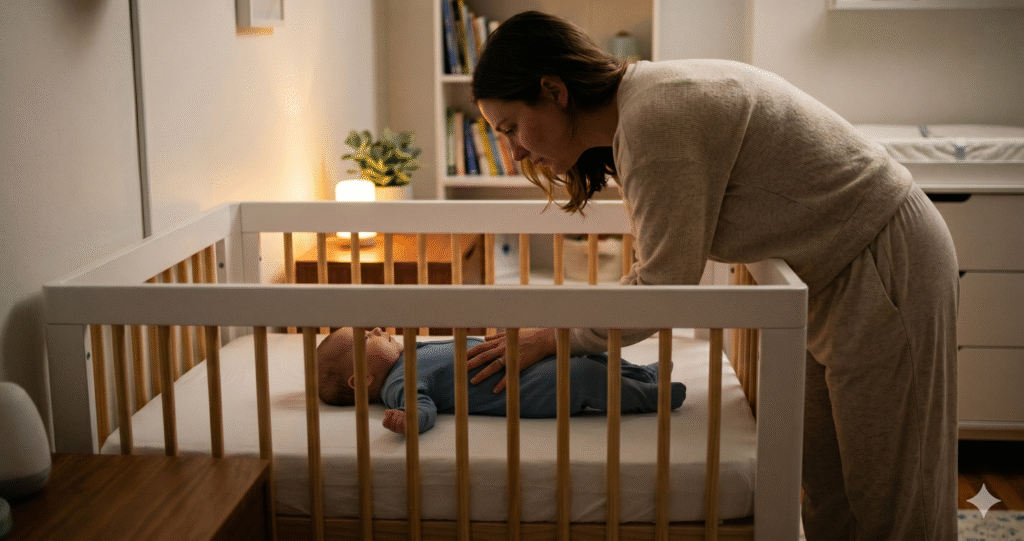
It was 2 a.m. on a Tuesday, and I was standing at my daughter’s crib for what felt like the tenth time that night. She’d been sleeping four-hour stretches for weeks — not perfect, but survivable — and then, almost overnight, she started waking every 45 minutes like clockwork.
I did the thing every exhausted mom does: I Googled. And I found out there was a name for this: the 4-month sleep regression. I also found out that “regression” is kind of a misleading word for it — because what’s actually happening inside your baby’s brain isn’t a step backward at all.
Here’s what the 4-month sleep regression actually is, why it hits so hard, and what you can realistically do about it tonight and in the weeks ahead.
What Is the 4-Month Sleep Regression, Really?
Most regressions are temporary blips — a developmental leap, a growth spurt, or a new skill that disrupts sleep for a week or two before things settle back down. The 4-month sleep regression is different. It’s a permanent change in how your baby’s brain organizes sleep, and once it happens, it doesn’t go back.
Here’s what’s going on: newborns spend most of their sleep cycling between just two stages — active sleep and quiet sleep. These cycles are relatively short, and babies can often fall back asleep between them without much trouble.
Around 3.5 to 4 months, the brain matures and starts producing more complex sleep architecture — the same kind adults have, with distinct stages including light sleep (N1, N2), deep sleep (N3), and REM. Each full cycle lasts roughly 45 minutes. And here’s the part that will make your 2 a.m. suddenly make a lot of sense: at the end of each cycle, your baby briefly rouses. Adults do this too — we just don’t notice because we’ve learned how to fall back asleep independently. Your baby hasn’t yet.
So when my daughter suddenly started waking every 45 minutes on the dot, she wasn’t sick, she wasn’t hungry every time, and I hadn’t done anything wrong. She had simply become more neurologically sophisticated. Which is genuinely good news — even when it doesn’t feel like it at 3 a.m.
According to HealthyChildren.org (the American Academy of Pediatrics’ parent resource), this shift in sleep architecture is a normal and expected part of infant brain development in the first months of life.
Signs Your Baby Is Going Through the 4-Month Sleep Regression
Not every rough patch at 4 months is a regression — sometimes babies are teething early (the first front teeth can break through anywhere from 4 to 7 months, and the discomfort genuinely fragments sleep), hitting a growth spurt, or just having an off week. If your baby is gnawing on everything in sight, drooling rivers, and seems most miserable when something firm is pressing on their gums — you’re probably looking at teething, not a sleep regression. The fix there is different: cold pressure on the gums, a chilled (not frozen) teething toy, and the wait. But if you’re seeing a cluster of the following signs without teething cues, it’s likely your baby’s sleep has changed for good:
- Suddenly waking every 45–60 minutes at night after previously sleeping longer stretches
- Short naps that feel impossible to extend — your baby wakes up exactly as one sleep cycle ends
- Much harder to settle at bedtime than they used to be, even when clearly tired
- Fussiness and overtiredness that seems out of character
- Increased feeding at night — sometimes hunger-related, sometimes comfort-seeking
- Shorter, choppier nap stretches during the day too, not just at night
When Does It Start — and How Long Does It Last?
Most babies hit this regression somewhere between 3.5 and 5 months, with 4 months being the most common window. Some babies get there a little earlier if they’re developmentally ahead; others take a bit longer.
As for how long it lasts — the version no one tells you upfront: unlike other regressions, the 4-month sleep regression doesn’t fully resolve on its own. The sleep cycle change is permanent, which means the frequent wake-ups won’t just disappear in two weeks the way they might with a growth spurt.
What tends to happen instead is one of two things:
- Parents gradually establish stronger sleep associations — nursing, rocking, or patting to sleep at every single wake-up — which actually makes the problem worse over time.
- Parents start working on independent sleep skills — in whatever way feels right for their family — and wake-ups start to space out within 4–8 weeks.
Here’s a rough sense of the timeline:
Peak chaos. Everything feels broken. You’re surviving in shifts.
Acute phase starts to ease. Baby becomes slightly more predictable if you begin building a consistent bedtime routine.
With consistent responses and gentle sleep shaping, most babies start connecting cycles more reliably.
If sleep is still fragmented, sleep associations have likely become deeply established — solvable, but takes more deliberate effort to shift.
What Makes the 4-Month Regression Worse
Nursing or rocking to full sleep every time
If your baby needs you actively involved in getting them to sleep at the start of the night, they’ll need the same thing when they rouse between each 45-minute cycle. Over time, this can mean being needed 8–10 times a night. It’s not a parenting failure — it’s just how sleep associations work at this age.
Letting overtiredness build
At 4 months, most babies can comfortably stay awake for only about 1.5 to 2 hours between sleep periods. Letting that window stretch too long makes falling asleep harder, not easier, and leads to more fragmented sleep overnight.
Too much stimulation close to bedtime compounds this — the 4-month brain is newly wired to notice everything. Bright screens, noisy environments, or a lot of excited interaction in the hour before bed can push cortisol up right when you need it coming down.
What Actually Helps: Practical Steps by Timeline
Tonight (immediate relief)
You’re not going to fix the regression overnight, but you can make things slightly less brutal right now:
- Darken the room significantly. Blackout curtains or a portable blackout blind make a real difference at this age. The 4-month brain is newly light-sensitive.
- Use white noise. A consistent sound machine running throughout the night can help bridge sleep cycles — place it at least 7 feet from the crib, not right next to your baby’s head. Mayo Clinic notes that masking household sounds this way may reduce overnight arousals.
- Watch wake windows. At 4 months: roughly 1.5–2 hours of awake time maximum, then back down for a nap or bedtime.
- Divide night shifts with your partner. Even if you’re breastfeeding and handling all feeds, your partner can take any resettling attempts that don’t need you. Staying in bed while someone else tries first is not laziness — it’s triage.
This week (start building structure)
Even three simple steps done consistently can start to shift things:
- Pick a bedtime and stick to it. For most 4-month-olds, somewhere between 7 and 8 p.m. works well. An earlier bedtime doesn’t cause an earlier wakeup — overtired babies often wake earlier, counterintuitively.
- Build a short, predictable bedtime routine. Bath, feed, book, song, down — or any three-step version that reliably signals “sleep is coming.” Consistency matters far more than the specific steps.
- Practice putting baby down while still slightly conscious. That drowsy state — heavy eyelids, slow blinking, limbs going soft but still making small sounds — is the window. Not deeply asleep, but clearly on the way. The goal is for your baby to experience being in the crib as they drift off, not already unconscious in your arms. It rarely works perfectly at first. Try anyway.
This month (longer-term sleep shaping)
If you’ve spent 2–3 weeks on the above and sleep is still very fragmented, this is the window where many families start thinking more deliberately about independent sleep skills. That doesn’t have to mean crying it out — there are gentler options that still work. More on that below.
The broader goal this month is to gradually reduce the active role you play in getting your baby back to sleep between cycles. That might look like offering a pacifier instead of feeding, trying a hand on the chest instead of picking up, or slowly shortening nursing sessions before putting baby back down.
For more on setting up a sleep-friendly space, see our full guide to baby sleep essentials — including white noise machines and blackout solutions that actually work.
Do You Need to Sleep Train During the Regression?
No. But 4 months is actually one of the better windows to start if you’re considering it — your baby’s sleep architecture is now mature enough to support longer independent stretches, and habits aren’t as deeply entrenched as they will be at 8 or 12 months.
There’s a lot of noise around sleep training, and I’m not here to tell you there’s one right method. A few approaches families commonly use at this age:
- Gradual fading: Slowly reduce the amount of intervention at each wake-up over one to two weeks. Still present, still responsive — just doing a little less each night.
- Pick-Up-Put-Down (PUPD): Pick up to soothe when crying escalates, put down once calm, repeat. Labor-intensive but very hands-on for parents who aren’t ready to step back fully.
- Ferber / graduated extinction: Involves timed check-ins with increasing intervals. Works quickly for many families; others find the check-ins more destabilizing than helpful for their particular baby.
- Structured programs like Taking Cara Babies: A popular method in the U.S. for this exact age range, with a gentler approach designed for babies 0–4 months. Worth looking into if you want step-by-step guidance.
What all of these have in common: they take consistency across multiple nights before you see results. One night of attempting something and then abandoning it when it gets hard doesn’t teach anything — for you or your baby.
If you’re not ready to sleep train, that’s completely valid. Many families navigate this regression without formal training, just with some structural tweaks and patience. You know your family best.
Survival Tips for Parents (Because You Matter Too)
Most sleep regression articles are all about the baby. But you’re a person who needs sleep, and chronic fragmentation hits differently than one bad night.
- Divide and conquer with your partner. If your partner is sleeping through every wake-up, it’s worth having a direct conversation about it — ideally during daylight hours and not at 3 a.m. when tone is harder to manage. Even taking alternate nights or splitting the first half of the night can help. If you’re in deep recovery yourself, our guide to postpartum recovery products might help you feel slightly more human while you’re at it.
- Nap when you can, not when the baby does. The laundry can wait. Actually, the laundry can really, really wait.
- Lower the bar aggressively. “Good enough” parenting during a sleep regression is excellent parenting. You do not need to be optimizing anything right now except sleep — yours included.
- Tell your people what’s happening. Accept the meal drop-offs, the baby-holding offers, the “come over and nap on my couch” invitations. This is not the season for performing fine.
Four months is such a brief window in the long arc of your child’s development, even when it feels endless from inside it. The same baby keeping you up every 45 minutes will, one day, sleep for 10 straight hours and make you feel slightly unnecessary. I know that’s cold comfort at 4 a.m. — but it’s true.