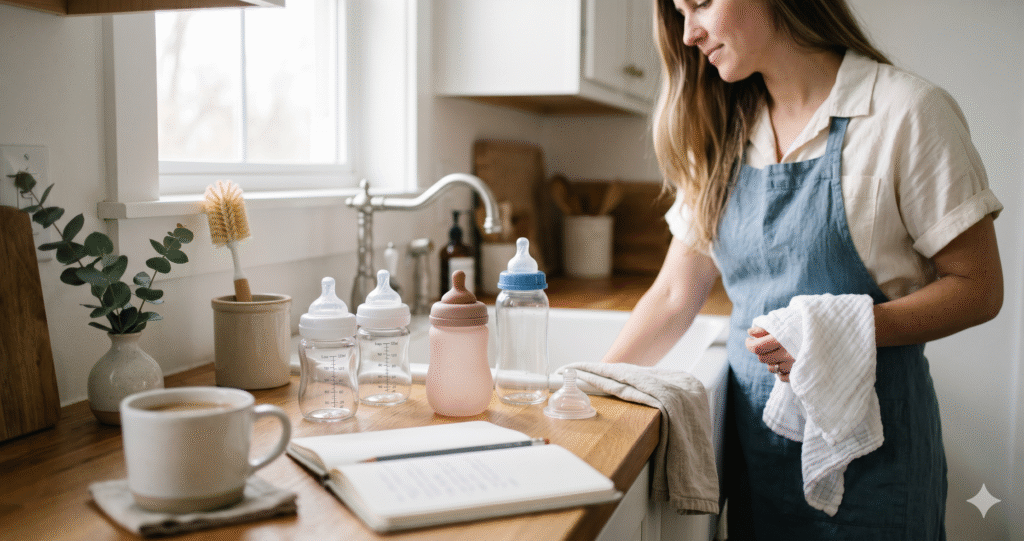
Across three babies, I’ve made both mistakes. With my first, I registered for twelve bottles before she was born, and ended up donating half of them at her first birthday. By baby number three, I thought I’d finally cracked the code — until I ran out of clean bottles on day two of our daycare transition and spent a panicked hour at a baby store with a very unhappy toddler in the cart. The honest answer is, there’s no single right number. It depends entirely on how you feed.
Bottles are just one line on the newborn checklist. If you’re still sizing up the whole haul, start with the full rundown of how many newborn onesies, bottles, and diapers you really need, then come back here for the bottle math by feeding method.
How many baby bottles do I need? The quick answer
Quick answer, then the details and reasoning below.
| Feeding method | 4oz bottles | 8oz bottles | Total |
|---|---|---|---|
| Exclusively breastfed (occasional bottle) | 3-4 | 0 | 3-4 |
| Formula-fed | 4-6 | 6-8 | 10-14 |
| Combo feeding | 3-4 | 4-6 | 7-10 |
| Exclusively pumping | 4-6 | 8-10 | 12-16 |
Size matters too: most babies start with 4oz bottles, then transition to 8oz around the 4-month mark when single feeds grow past 4 ounces. If you’re buying ahead, a mix of both sizes is smarter than going all-in on one.
Why the number depends on how you feed
The real question isn’t “how many bottles” — it’s “how many can I have dirty at once before I need to wash?” Formula and pumped milk both require a fresh, clean bottle for every feed, since they can’t sit at room temperature for long. Breastfed babies who only take an occasional bottle don’t create that rotation problem. So the more feeds a bottle handles in your daily life, the more bottles you need in circulation.
Exclusively breastfed, with the occasional bottle (3-4 bottles)
If breastfeeding is your main show and you just want bottles for date nights, appointments, or rare separations, you don’t need much. With my daughter, I nursed full-time for nine months and used a bottle maybe once every ten days. Three 4oz bottles covered me comfortably: one in use, one backup, one in the drying rack.
A few notes:
- Stick with 4oz. Breastfed babies don’t scale up feed volume the way formula babies do. Milk supply adjusts to maintain roughly 3-4oz per feed throughout bottle-feeding months. Big bottles will feel half-empty forever.
- Timing matters. The AAP advises waiting until breastfeeding is well-established before introducing a bottle — most lactation consultants put that window around 3-4 weeks. Wait too long (past 6-8 weeks) and some babies develop full bottle refusal.
- Have a backup brand. Some breastfed babies are picky. If yours rejects the first bottle, you’ll want to try a second brand. Buy one bottle of a second brand before baby arrives rather than six of the same.
If you’re still putting the nursery together, I put a full breastfeeding essentials list together from what I actually used in those first few months.
Formula-fed baby (10-14 bottles)
Formula-fed babies go through bottles fastest. You’re looking at 6-8 feeds a day in the newborn stage, and every single one dirties a bottle. Prepared formula only stays safe at room temperature for about 2 hours, or 1 hour once baby has started drinking from the bottle — which means a clean bottle for every feed.
Recommended mix:
- 4-6 × 4oz bottles for the first 4 months, when feeds are 2-4 oz
- 6-8 × 8oz bottles from 4 months on, when feeds climb to 4-6 oz
Real talk: you will not wash after every feed in the newborn trenches. Nobody does. Having a full day’s worth of bottles means you can batch-wash once every 24 hours (hello, dishwasher) instead of standing at the sink at 2am.
Keep your cleaning game strong: the CDC has specific guidelines on daily sanitizing for babies under 2 months.
Combo feeding (7-10 bottles)
Combo feeding is the trickiest to plan because your usage shifts as baby grows. When I went back to part-time work with my daughter around month four, I had three small bottles left over from her mostly-nursing days, and I scrambled to buy four more the week before my start date.
Recommended mix:
- 3-4 × 4oz bottles
- 4-6 × 8oz bottles
The main variable is how often you’re away from baby. If you’re out for two feeds a day (daycare plus one more), 7 is fine. If your partner handles morning feeds and you go out in the evenings, you’ll want closer to 10.
One thing I wish someone had told me: with pumped milk, most sessions yield 3-4 oz per bottle. Those 8oz bottles will feel half-empty forever and you’ll feel like you’re wasting space. Lean heavier on 4oz bottles than the table suggests if your pump output runs small.
Exclusively pumping (12-16 bottles)
Exclusive pumpers need the most bottles by a wide margin, because you’re using them for both pumping and feeding. Each pump session fills one or two bottles (depending on your pump), and those get transferred or used directly to feed. That’s essentially double the rotation.
Recommended mix:
- 4-6 × 4oz bottles (useful for smaller pump outputs and early feeds)
- 8-10 × 8oz bottles
- Plus your pump’s own bottles — most pumps include 2-4 that screw directly onto the flanges
Pump compatibility also shapes what to buy. Not every bottle fits every flange. If you haven’t picked a pump yet, our best breast pumps for 2026 breaks down which bottles pair with which pump brands.
A mom in one of my online groups pumped exclusively for 11 months with twins and kept 16 bottles on rotation. Her exact words: “Future-you will thank past-you for buying more.”
What else affects the number
The scenario table is a starting point. These factors can nudge your number up or down:
- Daycare: add 2-3 bottles. Most centers require 2-4 prefilled bottles per day, and you’ll still need a day’s worth at home drying.
- Frequency of separations: regular date nights, travel, appointments. Each one adds rotation pressure.
- Dishwasher vs. handwashing: if your dishwasher runs every two days (normal for most families), plan for two days’ worth of bottles. Hand-washers cycle faster and can get away with fewer.
- Number of caregivers: more hands on deck means bottle feeds spread across the day, faster rotation, and fewer bottles needed total. If your partner does the overnight feeds, you’ll cycle through supplies quicker.
- Travel: add 2-3 extras for trips. Washing on the go is harder than you think.
When you might need to buy more
Plan to reassess at these moments:
- Growth spurts (around 3 weeks, 6 weeks, 3 months, and 6 months): babies feed more often, not more volume per feed, so more bottles get dirtied.
- Daycare transition: see the daycare section below for a realistic minimum.
- Returning to work: add a pumping set if you weren’t pumping before.
- The 4-month volume jump: if you only have 4oz bottles, you’ll need to add 8oz.
- Starting solids around 6 months: fewer feeds per day = slightly fewer bottles needed, though most moms don’t actively downsize.
- Bottle refusal troubleshooting: if baby rejects your main brand, you may cycle through 2-3 brands before finding the winner. Budget a 20-30% overshoot.
When to retire a bottle
Bottles don’t last forever. Here’s when each type needs to go:
- Plastic bottles: every 4-6 months, or sooner if they get cloudy, scratched, or hold onto smells after washing. Scratches can harbor bacteria and, in older plastics, leach microplastics.
- Glass bottles: use until they crack or chip. Glass doesn’t degrade, which is one of the reasons moms like me rotate it in for the long haul.
- Silicone bottles (Comotomo, Nanobebe Flexy): 6-12 months, or when they lose shape or develop sticky residue that won’t wash out.
- Any bottle that’s been dropped and hairline-cracked: retire immediately. It will leak or break at the worst possible moment.
- Nipples: replace every 2-3 months regardless of bottle type. They soften, yellow, or develop enlarged holes that change flow speed in ways babies notice.
The daycare bottle playbook
When I was planning my return to work with my daughter, I called three daycares before choosing one, and each had slightly different bottle rules. The pattern is roughly:
- 2-4 prefilled bottles per day (each 4-6 oz depending on baby’s age)
- Name-labeled in permanent marker, front of the bottle AND on the lid
- Sent in an insulated bag with a frozen ice pack
- Unused milk discarded at the end of the day (policy varies; ask yours)
Do the math: a daycare baby needs 4 bottles for daycare + 3-4 for home + 1 drying = minimum 8-9 total. If you’re combo-feeding with daycare, aim for the high end of the 7-10 range. And always keep a labeled spare in your diaper bag for pickup-day emergencies. Traffic happens.
A few bottles worth considering
I’m not going to re-rank every bottle in this post (that’s what the best baby bottles guide is for), but a quick cheat sheet on what tends to work for each feeding style:
- Breastfed babies: wide-neck silicone (Comotomo) or nipple-shape-mimicking designs (Dr. Brown’s Natural Flow, Lansinoh) tend to cause fewer rejections. And if you only need a handful for the occasional bottle, a small glass set like the MAM Feel Good glass 3-pack works nicely.
- Formula-fed babies: anti-colic designs with active venting (Dr. Brown’s Options+, MAM) matter more. Formula tends to produce more gas than breastmilk.
- Combo feeders: keep it simple. Pick one bottle brand and stick with it. Multiple brands in rotation is the most common trigger for bottle refusal.
- Exclusive pumpers: check pump compatibility first. Some bottles screw directly onto your flange; others need an adapter (usually included with the pump).
FAQ
Can I mix different bottle brands?
Yes, but with a caveat. Babies can develop nipple preference: they get used to one flow rate and nipple shape and refuse others. If you’re mixing brands intentionally (for variety, or because of baby shower gifts), introduce both early (around 3-4 weeks) and alternate regularly. Once baby is locked onto one brand, switching mid-stream can trigger a feeding strike. Combo-feeding babies in particular do better with a single consistent bottle.
How often should I replace baby bottles?
It depends on material. Plastic: every 4-6 months, or sooner if they get cloudy, hold smells, or show scratches. Glass: until visible damage (crack or chip). Silicone: 6-12 months, or when they lose shape. Nipples: every 2-3 months regardless of bottle material. They soften and widen with use, which changes flow speed in ways babies notice.
What about 9oz bottles — do I need them?
Most babies don’t. Breastfed babies stay around 4-5 oz per feed throughout bottle-feeding. Formula-fed babies may hit 6-8 oz by 6 months, which 8oz bottles handle with plenty of room. 9oz bottles are really only useful for high-volume formula feeders (rare) or if you like future-proofing; some brands convert to toddler sippies. For most families, skip them.
The bottom line
You’re going to buy either a few too many or a few too few. That’s just part of figuring this out. Start at the low end of your category, keep the receipts, and add 2-3 more if baby takes to the bottle easily. It’s much easier to buy a few more than to return eight unopened ones (most stores won’t accept opened baby gear, and even sealed items can get tricky past 90 days).
Whatever number you land on, remember: the “right” answer is whatever keeps your sink from overflowing at 9pm. Everything else is optimization.