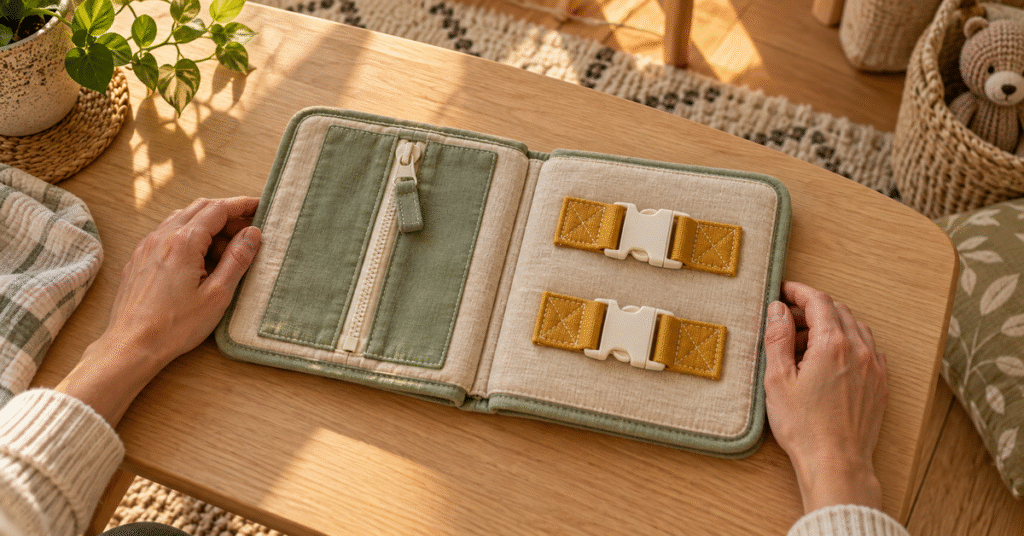
Toddler hands playing with a felt busy book showing fine motor activities on a sunlit table, best busy boards for toddlers

Best Busy Boards for Toddlers 2026: 8 Mom-Tested Picks (CPSC-Vetted)

This post contains affiliate links. As an Amazon Associate, I earn from qualifying purchases. If you buy through our links, we may earn a small commission at no extra cost to you. All products are independently researched and recommended based on real parent needs — never sponsored.

My older son hit the busy board obsession somewhere around two and a half. Buckles on his car seat. Zippers on every jacket within reach. The little plastic clip on the diaper bag, undone and fastened and undone again, for thirty straight minutes on a drive across town. If you’ve watched a toddler discover fasteners, you know exactly what I mean.

That’s the stage when busy boards earn their keep. Used well, they turn the fasten-and-unfasten compulsion into fine motor practice and the kind of independent play that buys parents a quiet twenty minutes. Used badly, they end up shedding tiny pieces all over the back seat and gathering dust on a shelf within a month.

Below are the eight busy boards I’d recommend after cross-checking CPSC recall records, independent reviewer coverage, and the real-world complaints that bury themselves in 1-star reviews. I’ve also included a short section on sensory walls, because that search lands a lot of parents here, and the honest answer is more nuanced than Amazon’s results suggest.

A quick note on age and small parts
Most felt busy books in this category carry a “3+ years, choking hazard, small parts” warning from the manufacturer. Those warnings are not marketing decoration. If you’re shopping for a child under 3, look for boards that explicitly state no loose components, or stick to wooden boards designed for younger toddlers. Two of the picks below were specifically chosen for the 1-2 age range; the rest assume 3+ with adult supervision.

Quick Picks

  1. Best Overall: Esjay Toddler Busy Board (Blue Dinosaur)
  2. Best for 1-2yo / Safest Out of the Box: hahaland Farm Animals Busy Book
  3. Best for Girls / Pink Theme: Exorany Pink Busy Board
  4. Best US-Based Seller: SaFeli Space Busy Board
  5. Best Wooden with Lights: Hoarosall LED Switch Board
  6. Best Classic Montessori: Melissa & Doug Latches Activity Board
  7. Best Premium Brand / Best Travel: HABA Town Magnetic Maze
  8. Best for Buckle Practice: WHITE DOLPHIN Toddler Buckle Backpack

How We Vet Every Busy Board: 3 CPSC Actions Worth Knowing

Before any product makes a roundup on this site, I check it against the U.S. Consumer Product Safety Commission’s recall database. For busy boards, the relevant history is more recent than most parents realize:

  • Feb 2026: CPSC recalled the Joyreal wooden busy board (sold by Indream Store on Amazon) for a detachable mirror that posed choking and laceration hazards.
  • Oct 2024: CPSC issued a consumer warning on Kindly Toys’ customized busy boards after the seller refused to cooperate with a recall request (detachable clock hands, beads, and propeller pieces).
  • May 2025: Fat Brain Toys recalled its PlayTab Rollers Tile for a magnet ingestion hazard, a reminder that even respected sensory-toy brands aren’t immune to component failures.

None of the eight picks below carry an active CPSC recall. Beyond that baseline, my husband and I both lean toward boards with no small detachable mirrors or magnets, secure stitching, and either a strong review history or an established brand. For newer sellers, Sold-by-Amazon fulfillment makes the return process meaningfully easier if anything arrives damaged.


The 8 Best Busy Boards for Toddlers

Best Overall Esjay Toddler Busy Board (Blue Dinosaur)

Ages 3+ · Skills: fine motor, dressing self-help, alphabet, counting, shape matching

The Esjay Blue Dinosaur is the busy book that shows up in nearly every “best busy board” list for a reason. It’s accumulated thousands of verified Amazon reviews, holds a sub-category Best Seller position in felt activity boards, and is available in roughly eight thematic variations (dinosaurs, unicorns, alphabet, fairies) covering nearly any toddler obsession.

The board itself is built around eight interactive pages of varying difficulty, ranging from simple velcro shape matching to genuinely tricky activities like shoe lacing, belt buckling, and zipper practice. Each page also includes a clock, a calendar, and a hook-and-loop alphabet set for early literacy. The fabric is reinforced at the seams, the corners are soft, and the whole thing folds down to a handled book that fits in a diaper bag.

One trade-off worth knowing about: this is not a tear-off-the-shrinkwrap toy. Most reviewers note that the initial setup takes roughly thirty minutes. You’ll need to apply velcro dots to the back of the puzzle pieces and animal shapes before the activities work. A meaningful minority of reviewers also report shipments missing one or two specific letter or number pieces (the letter Y and number 7 come up more than statistically likely). For a board designed to last several years of toddler use, the setup is a one-time cost. For a gift you’re handing over at a birthday party, pre-assemble it first.

Check Price on Amazon →

Best for 1-2yo hahaland Farm Animals Busy Book

Ages 1-3 · Skills: cause-and-effect, sensory exploration, finger puppet play, color and shape recognition

If you’re shopping for a child under three, this is the felt busy book I’d point you to first. Two specific design choices set it apart from the Esjay-style boards above. First, the manufacturer’s listing states the toy is built to meet CPSC safety standards and contains no loose parts or small pieces, the only board in this roundup with that level of safety language built into its product description (worth flagging that this is the brand’s own claim rather than a CPSC certification, but the design backs it up). Second, it ships fully assembled. There are no velcro dots to apply, no small puzzle pieces to organize, no missing parts to chase down. You unzip the velcro closure and play.

The activity density is actually higher than Esjay’s, with twenty different mechanisms spread across ten pages: a spinning windmill, finger puppets for farmyard storytelling, button-pushing, lacing, seasonal changes on a tree, a small mouse-and-cheese matching game, vegetable identification, and several stick-and-move actions. The farm theme gives the whole thing a narrative coherence that the more activity-buffet boards lack, your toddler isn’t just doing exercises, she’s running a farm.

The catch: at roughly $32, it’s the most expensive felt option here. The premium goes toward the no-assembly-no-loose-parts build and Amazon’s direct fulfillment, both of which matter more for younger toddlers and gift-giving. If your child is over three and you want maximum activity variety per dollar, the Esjay is still the value pick.

Check Price on Amazon →

Best for Girls Exorany Pink Busy Board

Ages 3+ · Skills: same skill range as Esjay (fine motor, dressing, literacy, shape matching)

The Exorany Pink is functionally Esjay’s sister product, with the same general format and activity types, and the same caveat about needing initial velcro setup. The meaningful differences are the pink and unicorn-leaning theme set, a slightly lower price point, and review patterns that lean a touch more positive on fabric quality.

The board carries a multi-page felt book format with a handle, velcro closure, zipper pockets, lacing practice, button-and-snap pages, and a hook-and-loop alphabet for early literacy. The page count and activity variety are competitive with the Esjay, and the overall review consensus is strong.

For families whose kid has clear pink-everything preferences, this is the pick that won’t end up neglected on the shelf because the cover doesn’t match the child’s current aesthetic taste. If you’re choosing between this and the Esjay, color preference is genuinely the deciding factor, quality is comparable.

Check Price on Amazon →

Best US Seller SaFeli Space Busy Board

Ages 2-4 · Skills: fine motor, sensory exploration, themed imaginative play

For parents who specifically prefer U.S.-based sellers, whether for return logistics, customer service, or values reasons, SaFeli is the strongest pick in this roundup. The Space-themed board is twelve pages organized into roughly three zones: two pages of fine motor activities (buckles, zips, shoelaces, belts), eight pages of preschool learning (alphabet, shapes, colors, drawing), and two space-themed imagination pages. The listing also notes certifications under CPC, ASTM, and CPSIA. Those are real toy safety standards, the kind that get tested rather than self-advertised.

The twelve-page count is meaningfully higher than the eight-page format that dominates the category, and the space theme gives boys (and space-curious girls) a coherent visual identity that can support pretend play beyond pure fine-motor practice. The brand also markets itself as preschool-classroom-tested, which lines up with the activity selection, most of the pages reinforce skills that show up on early childhood educator checklists.

Where this falls short: the review base is solid but smaller than Esjay’s. That’s partly a function of the brand being newer to the category, and partly a function of the U.S.-seller logistics meaning fewer flash sales than the Chinese-seller equivalents. If you’ve been burned before by international-seller returns, the slightly higher price is worth it for the easier recourse if anything arrives wrong.

Check Price on Amazon →

Best Wooden + Lights Hoarosall LED Switch Board

Ages 1+ with supervision · Skills: cause-and-effect, fine motor, switch operation

This one is the wooden, light-up entry-level board for kids who haven’t yet aged into the felt-book complexity range. Eight different switches (toggle switches, rocker switches, slide switches) control eight corresponding LED lights mounted on a compact wooden plate roughly the size of a small clipboard (it takes 2 AAA batteries, sold separately). The board holds the sub-category Best Seller position in electronic early development toys.

The educational depth is shallower than the felt books once your child masters cause-and-effect, which usually clicks around age two. It’s a phase-specific toy rather than something that grows with the child for three years, and that’s okay, because the phase it covers is the right one for it.

The appeal is the cause-and-effect feedback loop. Toddlers around twelve to twenty-four months are obsessed with the fact that switches make things happen. A board like this channels that obsession into eight different switch mechanisms rather than your actual light switches and TV remotes. The wooden frame is solid enough to survive being dropped repeatedly, and the compact size makes it genuinely portable.

Read before buying any wooden busy board with mirrors or lights
The Joyreal recall covered above involved this exact product category, a wooden LED-and-switch board with a small attached mirror. Hoarosall doesn’t include a detachable mirror in its current design, but the broader lesson stands: when you receive any wooden electronic board, check the mirror, the battery compartment, and any small attached components for secure attachment before handing it to a toddler. Adult supervision is essential for any toy in this format, especially under age 3.

Check Price on Amazon →

Best Classic Montessori Melissa & Doug Latches Activity Board

Ages 3+ · Skills: fine motor precision, problem-solving, counting, color recognition

This is the board that occupational therapists have been recommending since before “busy board” became an Instagram phrase. Melissa & Doug is a U.S. toy brand with over thirty years of history and an established Montessori line, and the Latches Activity Board is the one product that consistently shows up across major roundups (Babylist, The Bump, Mother & Baby) because it does one specific thing exceptionally well.

The format is simple: a solid wood board with six numbered doors, each secured by a different real-world latch type (hasps, slide bolts, hooks). Open each door and you find an animal picture and a number underneath. The skill demands are precise: your child needs to figure out how each latch works, manipulate it with the right finger movements, and remember which animal lives behind which door. It’s a single product that pulls together fine motor practice, problem-solving, counting, and animal identification.

My older son got this one shortly after he turned three. The shift in how he handled real latches (gate latches, the bathroom door slide, the security chain on our front door) was visible within a couple of weeks. That’s not coincidence; it’s the design intent of the toy. (Worth noting: Melissa & Doug’s brand-level partnership with the American Academy of Pediatrics around early-childhood play is something a few of our preschool families specifically cite when choosing this brand.)

Worth flagging before you buy: it’s strictly 3+. The latches are real metal, and the finger movements would frustrate most younger toddlers. It’s also a static product, once your child has solved all six latches and remembers what’s behind each door, the replay value drops faster than a multi-page felt book. For a 3-to-4 window, it’s exceptional. After that, it tends to become a quietly retired toy.

Check Price on Amazon →

Best Premium / Best Travel HABA Town Magnetic Maze

Ages 2-4 · Skills: hand-eye coordination, fine motor pen control, focus

HABA is a German pediatric brand with an 80-year history and a reputation for design rigor that doesn’t really exist among the felt-book sellers. The Town Magnetic Maze is the most-reviewed and longest-listed product in this entire roundup. It’s been on Amazon for over a decade and has accumulated more than ten thousand verified reviews, and the design earns it.

The format is unusual for a “busy board” but solves a specific problem better than any felt book. A flat, sealed plastic case contains a magnetic maze underneath, and a small attached pen with a magnetic tip moves colored balls through the maze paths from one location to another (the theme is a small town map, with stops at parks, buses, and buildings). The entire thing is sealed. Nothing comes out, nothing gets lost, no batteries to worry about. The pen is attached by a cord.

For travel, it’s unmatched. A flat ten-inch case fits flat in any diaper bag or seat pocket, and there’s no setup, no loose pieces, and no choking hazards to manage in a moving vehicle. We tossed ours into a backpack for a long flight earlier this year and didn’t take it out until landing.

The thing to know going in: it’s a single-activity toy, not a multi-activity board. The hand-eye coordination and focus skills it develops are real, but you’re paying premium pricing for one mechanic rather than ten. If you already own a felt busy book and want a travel companion that won’t shed pieces, this is the pick. If you only have budget for one board, the multi-activity options give more variety per dollar.

Check Price on Amazon →

Best for Buckles WHITE DOLPHIN Toddler Buckle Backpack

Ages 2-4 · Skills: buckle and clip operation, zipper practice, learn-to-tie shoelaces

The most form-factor-distinctive pick on the list. Instead of a board or a book, this is a wearable backpack with the fasteners sewn directly onto the bag itself: side-release buckles, ladder buckles, snap closures, zippers, and a lace-up tie-shoe panel. A child who is currently obsessed with their car seat buckle gets to wear and operate the same mechanics on a toy.

The skill focus is narrow but deep. Where the felt books spread practice across alphabets, shapes, colors, and counting, this one product targets exactly the fastening-and-clipping fine motor work that occupational therapists prioritize for kids in the two-to-four window. The wearable format also adds a small pretend-play layer, kids treat it like an actual hiking pack.

What it doesn’t do: cover the multi-skill ground felt books cover. Once your child masters the buckles, the educational depth tapers off. It also doesn’t replace a multi-activity board for general fine motor variety. But for the specific phase where your kid is undoing every buckle in the house, this is the most direct intervention available.

Check Price on Amazon →


What About Sensory Walls?

Half the parents reading this Googled “sensory wall” and landed here. The honest answer most lists won’t give you: Amazon does not carry true commercial sensory wall panels for home use. The wall-mounted modular panels you’ve seen on Pinterest (the ones with abacus tracks, gear wheels, and sliding bead mazes) are almost exclusively manufactured for commercial daycare, therapy office, and pediatric clinic settings. Brands like BumbleBeeSmart, Fun and Function, and Discount School Supply sell them direct to institutions, generally starting around several hundred dollars per panel.

If you want the sensory-wall effect at home without the institutional price, here’s the budget-conscious route most Montessori families take: mount two or three of the wooden boards above on a pegboard wall, or directly onto IKEA TRONES storage units, using French cleats or simple screws. The Melissa & Doug Latches Board, the Hoarosall LED Switch Board, and a small magnetic maze together create a vertical activity center for roughly $60 to $100, depending on what you already own. Add a mounted abacus and a small mirror at toddler height (securely fastened, see the CPSC notes above) and you have a workable home sensory wall. Our Montessori playroom setup guide walks through how to mount this kind of vertical activity area in a small space.

For families with neurodivergent kids who need genuine therapy-grade panels, the institutional brands are worth the investment and ship to residential addresses. But for typical toddler sensory development, the DIY route covers the same ground for a fraction of the cost.

How to Choose: Age, Skill Stage, and Travel Frequency

Three questions will narrow this list down to the right one or two boards for your family.

How old is your child? Under two, lean wooden and electronic. The Hoarosall LED Switch Board targets the cause-and-effect window before fine motor complexity matters. Two to three, the hahaland Farm is the safest felt option because it ships fully assembled with no loose parts. Three and up, the felt books (Esjay, Exorany, SaFeli) open up, as does the Melissa & Doug Latches Board for Montessori-aligned learning.

What skill is most frustrating right now? If your kid is destroying every buckle in the house, the WHITE DOLPHIN backpack targets that obsession directly. If they’re climbing on every chair to reach light switches, the Hoarosall makes the LED-switch combo a toy. If they’re working through self-dressing (buttons, zippers, laces), the multi-page felt books distribute practice across all of those at once. If your child is in daycare or preschool, it’s worth asking the teacher which fine motor skills they’re focusing on this term; the answer is often weirdly specific and points to one of these boards over the others. Our low-prep fine motor activities guide pairs well with any of these boards as no-purchase complements.

How often do you travel? For frequent flyers and road-trippers, prioritize boards with handles and no loose pieces, the HABA Town Magnetic Maze and the hahaland Farm are the strongest travel picks. For mostly home use, the multi-activity felt books give more variety per session.

Frequently Asked Questions

When can babies start using a busy board?

The earliest reasonable age is around twelve months, and only with wooden boards designed for that age range and direct adult supervision. Felt busy books almost universally carry a 3+ age rating because of small velcro pieces, alphabet letters, and puzzle components. The U.S. Consumer Product Safety Commission’s small parts rule prohibits toys with small components from being sold for children under three, so the 3+ rating on those felt books isn’t a marketing suggestion, it’s a federal safety standard. Check the manufacturer’s age rating and resist the temptation to push it younger.

Are felt busy books actually safe for toddlers under three?

Most aren’t, despite marketing language suggesting otherwise. The two boards in this list explicitly rated for ages one to three are the hahaland Farm (which specifically advertises no loose parts) and the Hoarosall LED Switch Board (a wooden electronic format). Anything with detachable velcro alphabet pieces, removable puzzle shapes, or small magnetic components should be treated as a 3+ toy regardless of how the listing is titled.

Wooden busy boards or felt busy books, which lasts longer?

Wooden boards generally outlast felt books on durability, solid wood and metal latches survive years of use. Felt books last longer on educational depth, because the activity variety supports two or three years of skill progression before a child outgrows them. If you’re buying one board, felt books typically give you more play hours for the money. If you want something that survives long enough to hand down to a second kid, wood is the safer bet.

Do busy boards actually help with development, or are they just quiet-time toys?

Both, when they’re matched to the child’s stage. Independent play time is itself developmentally valuable, it builds focus and self-direction. The specific skills these toys target (fine motor precision, hand-eye coordination, problem-solving with real fasteners) line up with milestones most pediatric occupational therapists track between ages two and four. Both things are happening at the same time, not one at the expense of the other.

Is it worth buying multiple busy boards, or just one?

For most families, one multi-activity felt board plus one travel-specific option covers the territory. A reasonable starter combination would be the Esjay or hahaland Farm for everyday home use plus the HABA Town Magnetic Maze for travel. Adding the Melissa & Doug Latches Board makes sense once your child crosses three and is ready for Montessori-style precision work, though it works alongside the felt book rather than replacing it, since the two cover pretty different ground.

For more ways to keep toddlers genuinely engaged without screens, my guide to screen-free activities covers the routines and small-purchase setups that have actually worked in our house. And if you’re building a sensory toy collection from scratch, the best sensory toys roundup covers picks beyond busy boards.

Want all 15 sensory bins on printable cards?

Grab the free Sensory Bin Quick-Start Cards — each card has materials, setup steps, age range, and mess level. Print them and stick on your fridge.