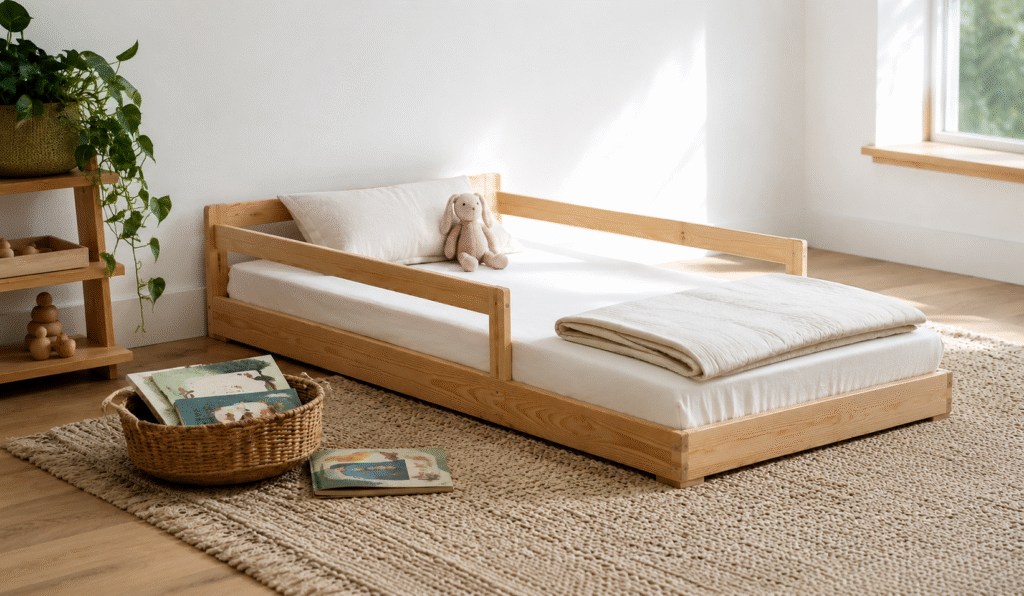
A floor bed lets a child get out without an adult lifting them. That makes the bed’s age limits and mattress fit only part of the decision: the child can also reach the rest of the room. This is a research-based comparison, not a hands-on test of these six products.
This guide compares six different bed designs, including traditional toddler frames, fenced floor frames and a portable foam option. They do not all have the same intended use or age limits. Exact-model certification and current recall checks are still being reviewed; the safety corrections below are not a completed verification of every recommendation.
But before any of that, the safety conversation. This is the section I wish someone had handed me earlier.
What a Montessori floor bed actually is (and what it isn’t)
The Montessori floor bed concept is straightforward in theory. It’s a sleep surface low enough to the ground that a child can climb in and out independently, supporting the Montessori principle of “freedom within limits.” In practice, that covers a wide range of products.
At one end of the spectrum, you have a traditional low-profile toddler bed. The mattress sits on a frame six to twelve inches off the floor, with short rails to prevent rolls but plenty of access. At the other end, you have what most people picture when they hear “Montessori bed”: a wooden frame with a tall fence around the perimeter and a small swinging door, sized for either a crib mattress, a twin, or a full. And then there’s the simplest version of all: a mattress directly on the floor, no frame at all.
I’ll be honest with you. After working through the options, I’d argue that the “Montessori floor bed” label gets applied loosely. The genuine Montessori philosophy doesn’t actually require a fence or a door. What it does require is independence, accessibility, and a fully baby-proofed room around it. That’s where most of the work actually lives.
Floor bed vs. toddler bed: when each one makes more sense
This is worth slowing down on, because it’s where I see the most parental whiplash. The two terms get used interchangeably, but they serve slightly different goals.
A traditional toddler bed is essentially a small bed sized for a crib mattress, with two side rails and a low entry point. It’s an in-between step between crib and a real “big kid” bed. The Dream On Me models in this roundup are the gold standard here. They’re sturdy, certified, and easy to set up. They prioritize sleep, not floor play.
A true Montessori floor bed, by contrast, often takes a twin or full-size mattress with a fence high enough that the bed doubles as a play space, a reading nook, or a quiet retreat during the day. The Bellemave, Ocodile, and Timy frames in this roundup fit this category. They’re built for kids who are ready to use the whole bedroom as their environment, not just sleep there.
The appropriate choice depends on the exact product and your child, not the Montessori label. Check the minimum age, weight limit, mattress fit, permitted rail configuration and room setup. A low height or fence alone does not establish a lower risk.
Age limits depend on the exact sleep product
Infant safe-sleep advice is not a universal floor-bed age label. Check the bed type, minimum age and weight limits, mattress dimensions and permitted configuration before use. A Montessori label, low height or fence does not establish that a bed is appropriate for your child.
Once your child can leave the bed, the whole room needs attention. Anchor furniture, remove accessible cords and choking hazards, secure windows and stairs, and keep the route out available to an adult in an emergency. Use cordless window coverings; cutting or tying up a cord is not a complete solution.
Check both the sleep product and the room. Preparing one does not compensate for an unsuitable setup in the other.
How I chose these six picks
The questions that matter here are the exact model, intended age, mattress fit, permitted assembly, current recall status and documented safety requirements. Ratings, product photographs and a Montessori label cannot establish those facts. Where a claim has not been checked against the exact current product, treat it as unverified.
Do not treat a general statement about a brand’s recall history as clearance for a bed. Match the manufacturer, model and production details against current CPSC recalls and the manufacturer’s notices before use. This safety update does not certify that all six exact products are recall-free.
Okay. The picks.
1. Dream On Me Classic Design Toddler Bed (Steel Grey)
The Dream On Me Classic Design Toddler Bed is the workhorse of the toddler bed category, and there’s a reason it’s earned thousands of customer reviews. It sits low to the floor, has two side safety rails to prevent rolls, and a reinforced center leg for stability. The frame is solid pine wood with gently arched headboards and footboards, and it is listed for a crib-size mattress. Reuse an existing mattress only if its dimensions, thickness and condition meet the exact bed instructions.
What pushed this into the top spot for me is the certification stack. It’s Greenguard Gold certified for low chemical emissions, Baby Safety Alliance certified (formerly known as JPMA), and it meets or exceeds ASTM and CPSC standards. The finishes are non-toxic and free of phthalates, latex, lead, and BPA. That’s about as strong a certification profile as you’ll find in this price range.
The honest tradeoffs from the parent review patterns: pine wood scratches more easily than hardwood, and a few buyers have flagged that assembly hardware can be fiddly if you’re working alone. The 50-pound weight limit means it’s not a forever bed. But for the transition window between crib and a real twin, it’s hard to beat at around a hundred dollars.
Specs at a glance: 53″L × 28″W × 30″H · supports up to 50 lbs · solid pine wood · two side safety rails plus center leg · 12 finish options · standard crib mattress (sold separately).
2. Dream On Me Finn Toddler Bed (Vintage White Oak)
If the Classic feels too “baby furniture” for your taste, the Dream On Me Finn Toddler Bed is the more design-forward sibling. The Vintage White Oak finish has a soft, lived-in look that fits a modern nursery much better than the high-gloss painted options, and the overall profile is about five inches lower than the Classic, sitting just 24.5 inches at the highest point.
The Finn is made from sustainably sourced New Zealand pinewood, which is the same material as the Classic but with a more carefully finished surface. It carries the same Greenguard Gold and Baby Safety Alliance certifications, has reinforced side rails, and includes sturdy center legs for stability. The stated weight limit is 50 pounds. Do not infer an age range from the neighboring model; check the Finn instructions and do not use a toddler bed for a child under 15 months.
Follow the exact Finn assembly and placement instructions. Do not infer a wall-attachment requirement from another furniture product or add straps, screws or other modifications without the manufacturer’s directions. Anchor other furniture in the room as instructed and prevent access to climbing hazards.
Where I see this bed shining: parents who want a Montessori-style aesthetic but aren’t ready to commit to a full-fence floor bed setup. The Finn lives in that comfortable middle ground.
Specs at a glance: 53″L × 30″W × 24.5″H · supports up to 50 lbs · New Zealand pinewood · two reinforced side rails plus center leg · 7 finish options · 1-year limited warranty · standard crib mattress (sold separately).
3. Ocodile Crib-Size Montessori Floor Bed (Gray)
The Ocodile Toddler Bed with Rails is listed for a crib-size mattress. Before reusing a mattress, compare its actual dimensions, thickness and condition with the exact frame’s instructions. A shared size label does not establish a safe fit or guarantee an easier sleep transition.
The construction is what sets this one apart in the Montessori-labeled category. The side frames are built as a single piece for stability, the edges are rounded, and the middle guardrail is removable. Do not remove a rail based on how quickly a child learns the bedtime routine; use only a configuration permitted by the exact instructions. Two openings on the long side make the bed truly accessible from either direction.
Product photographs and favorable customer reviews do not establish mattress fit, structural performance or chemical-emissions certification. We have not verified GREENGUARD Gold certification for this exact frame.
What clinches it for the toddler stage: standard crib mattress fit, removable middle rail, two entry points, and a price point that sits comfortably below the full Montessori frames.
Specs at a glance: 55″L × 29.5″W × 15.4″H · uses standard crib mattress up to 6″ thick (sold separately) · solid wood with a painted finish · one-piece side frames · removable middle guardrail · two side openings · 5 color options.
4. Bellemave Full Size Floor Bed with Fence and Door (Natural)
When parents picture a “true” Montessori floor bed, they’re often picturing something like this. The Bellemave Full Size Floor Bed with Fence and Door wraps a full-size mattress in a low wooden fence with a swinging door that has actual hinges and a steel latch. The door can be opened and closed by your child, which is genuinely delightful from a Montessori freedom-within-limits perspective. The door is also removable if you want to drop it later.
What I like about choosing a full size at this stage: it grows with the child. The bed isn’t outgrown at five years old. The mattress can move with them eventually, and the bed frame becomes a piece of furniture, not a transition tool. The listed construction uses pine and plywood slats. Do not remove slats or substitute a foam pad to create a younger-child configuration unless the exact manufacturer instructions expressly permit it for that child and mattress.
A few things to know before you commit: at 27 pounds for the frame and over 60 pounds for the shipping package, this is a serious assembly project. Plan for a partner or a friend to help, and don’t tackle it on a school night. The certification disclosure is also thinner than the Dream On Me models — there’s no explicit Greenguard Gold listed for this specific SKU. The customer ratings, while solid enough to clear the bar I set for this roundup, are the lowest in the group.
Who this is for: a Montessori-committed family with a child who’s at least three, a room that’s already baby-proofed properly, and an appetite for a piece of furniture that will earn its place for several years.
Specs at a glance: 77.5″L × 56.5″W × 17.5″H · full-size mattress (sold separately, no box spring needed) · solid pine wood frame with plywood slats · use only the manufacturer-permitted support and door configuration · steel latch on swinging door · 22+ color variations.
5. Timy House Shape Twin Size Montessori House Bed (White)
This is the one my older son would have lost his mind over at age four. The Timy House Shape Twin Size Montessori House Bed is built around an actual house silhouette with a peaked roof frame, transforming what would be a regular floor bed into something that doubles as a fort, a reading nook, and a stage for whatever world your kiddo is currently constructing.
The listed frame is metal, but material alone does not prove resistance to tipping or climbing loads. Do not let children climb roof posts, hang from the frame, or attach fairy lights, cords or other looped decorations to the bed. The listed design includes guardrails and an entry opening; check the exact instructions for assembly, mattress fit and permitted use. Storage features do not make a frame suitable for climbing.
The honest tradeoffs: metal feels cooler to the touch in winter, especially if the bed isn’t dressed with thick sheets. The frame is tall — nearly 60 inches at the roof peak — which works against you if your child’s bedroom has lower ceilings or a sloped roofline. Assembly involves more pieces than a simple wooden bed. And the certification documentation is thinner than the Dream On Me models, with no explicit Greenguard Gold or CARB Phase 2 listing for this SKU.
What earns this its spot: at this age and stage, the bed is as much an environment as it is a sleep surface. The house-shape design rewards imagination in a way the rectangular frames don’t.
Specs at a glance: 78.6″L × 39.9″W × 59.6″H · twin mattress (sold separately, no box spring needed) · 6″ to 8″ recommended mattress thickness · full metal frame · guardrails on front, back, and one side with an entry opening · end-of-bed storage rack and caddy included · 5 color options.
6. LIFTOZA Toddler Travel Bed Sandwich Style (Large, Ages 2–6)
The LIFTOZA Toddler Travel Bed is a portable foam sleeping pad with raised edges. It serves a different purpose from a fixed bed frame. Check its own age, size and intended-use limits; a travel label does not make it suitable for every child or sleep setting.
The listed design combines a flannel cover, foam padding and raised foam edges. Those edges do not establish protection against falls or replace the product’s age and fit requirements. A Children’s Product Certificate is issued by a manufacturer or importer for applicable rules; it is not a government safety approval. We have not verified an exact-model certificate here. The cover is removable and machine-washable. The whole thing weighs under six pounds and folds compactly, which makes it actually portable in a way that an inflatable travel bed isn’t (no pump, no battery, no slow leak in the middle of night two of a road trip).
The honest limitations: this is a secondary bed, not a primary one. The foam is firm and supportive for travel use, but it’s not designed for nightly sleep over years. The 50-pound effective weight ceiling means it’s outgrown by school age. And because it’s so lightweight, an exceptionally active sleeper can shift it across a hotel room floor overnight.
Where it shines: grandparent visits, sleepovers, vacation rentals, daycare nap mats, or as the backup when your child has decided that tonight, they sleep next to the cat.
Specs at a glance: 54″L × 25″W × 7″H · 5.8 lbs · ages 2–6 (Large size) · foam with a flannel lining · raised foam edges · machine-washable removable cover · zippered cover · exact-model certificate not verified.
How to make a Montessori floor bed safe (the room is where it counts)
This is the section I’d hand to anyone before they hit “buy” on any of these frames. Get down on your hands and knees in the room and look at it from your child’s eye level. Once they’re no longer in a crib, the whole room becomes the sleep environment.
The non-negotiables I work through with every family I talk to about this:
- Secure furniture and TVs against tip-over. Follow the furniture, TV and anchor manufacturers’ installation instructions, using hardware suitable for the wall and item. Do not assume one strap or fixing method suits every piece. CPSC’s Anchor It! guidance explains why proper anchoring matters.
- Protect accessible outlets. Use outlet protectors or plates that a child cannot easily remove and that are too large to choke on. Include outlets behind furniture if the child can reach them. Follow CPSC’s outlet-protection guidance; no device is completely childproof.
- Address window cords. CPSC recommends cordless window coverings where young children are present. Keep beds, furniture and toys away from windows and cords. Tying a cord high up does not eliminate the strangulation hazard.
- Audit choking and ingestion hazards at floor level. Remove small parts and loose or accessible batteries and magnets from the room. Do not use a household paper tube to decide that an item is safe to leave within reach.
- Decide on the door. Some families use a baby gate at the doorway instead of closing the door. Some use a knob cover that lets the door open from outside but not inside. Some leave the door open entirely with the room fully secured. I’d recommend never locking a child in a room — emergency egress matters.
- Mattress and frame must work together. Follow the exact product’s required mattress dimensions, thickness, support and clearances. Do not wedge a mattress into an enclosure, fill gaps with soft items, or remove support parts to improvise a sleep space. Low height does not resolve entrapment hazards.
- Monitor or check-in routine. A floor bed means your child can leave the bed at any time. A video monitor or a clear bedtime check-in routine matters more than it does with a crib.
Mattress recommendations
None of these beds include a mattress, so this is the next purchase. A few notes from comparing dozens of options.
For a crib-mattress-sized toddler bed, use the mattress dimensions and thickness required by that exact bed’s instructions. “Standard size” or “close” is not enough if the fit leaves a hazardous gap. Follow the mattress manufacturer’s directions for which side to use; neither a second birthday nor a certification logo overrides those directions.
For a twin or full frame, verify the required mattress size, thickness, support and relationship to the rails in the exact manual. Do not apply one six-to-eight-inch mattress rule to every frame or use an infant’s age to justify altering the listed assembly.
Frequently asked questions
Is a Montessori floor bed safe for a baby under one year?
No. A baby’s first birthday is not a universal floor-bed clearance. Follow the infant guidance linked above, then check the exact next sleep product’s age, weight, mattress and assembly requirements. A crib-mattress-sized toddler bed has a 15-month minimum; other products can have different or stricter limits. Ask your pediatrician for help if a child outgrows the crib before a suitable transition is clear.
Will my toddler just leave the bed all night?
Some will. This is the most common parent fear and the most common Reddit thread topic. The honest answer from the parent community is: probably yes, for a while. A consistent bedtime routine, a fully baby-proofed room (so leaving the bed is safe), a video monitor, and a clear “back to bed” walk-back protocol are what most families rely on. Expect a transition window of two to six weeks for most kids.
Do I need rails on a Montessori floor bed?
Use the rails and mattress configuration required by the exact bed instructions. Do not remove rails merely to follow a Montessori style, add an incompatible portable rail, or assume a fence eliminates falls and entrapment. Room preparation does not make an unsuitable bed suitable.
How do I prevent my toddler from falling out?
Do not make a bed rail from pool noodles, rolled towels or other soft items under the sheet. Choose an age-appropriate bed and use only the rail and mattress configuration allowed by its instructions; keep the surrounding floor clear. Children’s portable bed rails are a separate product category for an adult bed and a child able to get in and out unassisted, typically ages two to five. They are not a workaround for a younger child’s sleep setup.
What about Greenguard Gold certification?
UL GREENGUARD certification concerns chemical emissions. Check the current certification listing for the exact model and finish. It does not replace age, assembly, mattress-fit or entrapment checks, and a missing logo does not tell us why a product lacks certification.
The picks at a glance
- Best traditional transition bed: Dream On Me Classic Design Toddler Bed
- Best aesthetic upgrade: Dream On Me Finn Toddler Bed
- Crib-size Montessori-style option, subject to exact age and fit checks: Ocodile Crib-Size Montessori Floor Bed
- Best full Montessori frame for the long haul: Bellemave Full Size Floor Bed with Fence and Door
- Best house-shape for imaginative play: Timy House Shape Twin Size Montessori House Bed
- Best travel option: LIFTOZA Toddler Travel Bed Sandwich Style
Before using any of these designs, confirm the exact bed’s age limits, mattress fit and permitted assembly, then address hazards throughout the room. A prepared room cannot make an unsuitable bed appropriate.