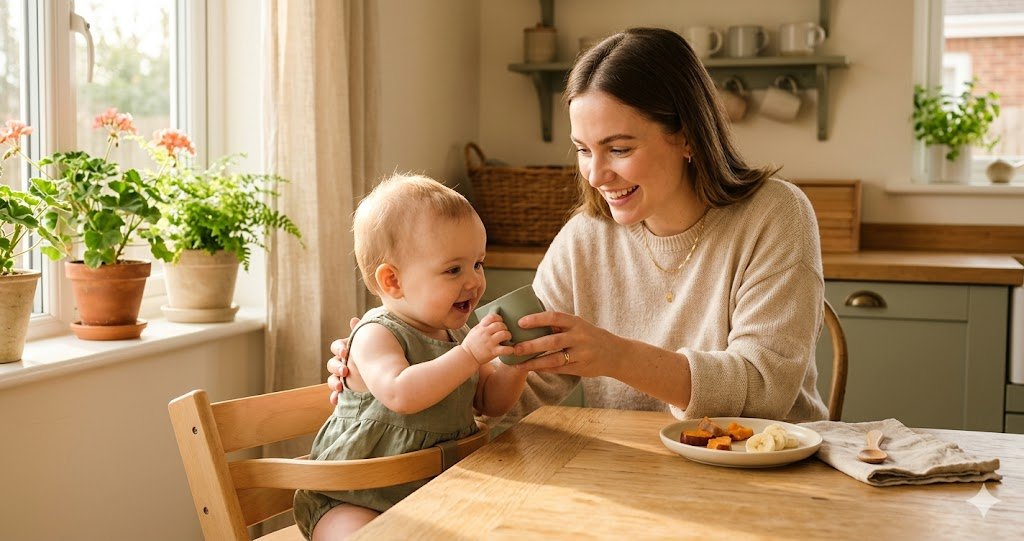
By the time my third baby was around seven months old, I had already lived through the “learning to drink from a cup” stage twice. You’d think the third time would feel routine. It didn’t, mostly because my youngest treated every cup as a chew toy first and a drinking vessel second. But that’s exactly the point of starting young: the messy practice is the milestone.
If you’re standing in the cup aisle wondering why anyone makes a teeny two-ounce cup for a baby, here’s the short version. The American Academy of Pediatrics suggests offering a cup when your baby starts solids, usually around six months, and notes that an open cup is a perfectly good choice. Drinking from an open cup builds lip closure, a mature swallow, and the oral-motor skills tied to speech, which is why feeding specialists are such fans of it.
I’m a mom of three with about a decade of feeding-table chaos behind me, and for this guide I leaned on that plus a deep read of independent reviews, brand specs, and current pediatric guidance. Below are the six open cups I’d hand a beginner, what each one is best at, and (because no cup is perfect) the honest catch with every single one.
The 6 best open cups for babies (at a glance)
| Pick | Best For | Size | Material | Ages |
|---|---|---|---|---|
| ezpz Tiny Cup | Best overall | 2 oz | 100% silicone | 4 mo+ |
| haakaa Training Cup | Best budget | 5 oz | One-piece silicone | 6 mo+ |
| WeeSprout Cups (2-pack) | Best value set | 2 oz each | Soft silicone | 6 mo+ |
| otterlove Training Cup | Best premium silicone | 4 oz | LFGB platinum silicone | 6 mo+ |
| Ahimsa Stainless Cup | Best plastic-free | 8 oz | 304 stainless steel | 1–3 yr |
| Munchkin Splash (4-pack) | Best for transition | 7 oz | BPA-free plastic | 18 mo+ |
Prices move around, so check the live listing before you buy.
What makes a good open cup for a baby
After three rounds of this, the cups that work all share a few traits worth scanning for before you buy.
- Tiny size. A 2-to-5-ounce cup isn’t a gimmick. A small, light cup fits little hands, and a full cup is a small spill rather than a flood.
- A weighted or wide base. This is the difference between a cup that rights itself and one that tips the second a chubby hand bumps it.
- Soft, safe material. Food-grade silicone and 304 stainless steel are the two I trust most for this age, and both skip the plastic question entirely.
- An easy-to-grip shape and a shallow rim. Handles or a curved body help small hands, and a shallow or nose-cutout rim means your baby doesn’t have to crank their head back, which makes choking more likely for new sippers.
Match the capacity and age rating to where your baby is, not where you wish they were.
1. ezpz Tiny Cup — Best Overall
ezpz Tiny Cup
If I could only recommend one, this is it. The ezpz Tiny Cup is a barely-there 2-ounce silicone cup designed by a pediatric feeding specialist (an M.S., CCC-SLP, the kind of person who literally teaches kids to swallow safely). The interior is angled to control flow, the base is weighted with little grippy bumps so it resists toppling, and the soft non-slip body is sized for a four-month-old’s hands. It’s the cup parents and feeding therapists name most often, and the pattern across reviews is consistent: babies seem to get it faster than they do with bigger cups.
Material: 100% food-grade silicone; BPA/BPS/PVC/lead/latex free
Ages: 4 months and up
Care: Dishwasher safe; hot and cold safe
Price: around $11 (single)
Best for: a baby’s very first sips, parents who want the most-vetted starter cup, anyone following baby-led weaning.
Honest drawbacks: it’s small (2 oz), so you’ll refill it a lot, and your baby will outgrow it within a year. Think of it as a specialist starter cup, not a forever cup. (ezpz makes larger cups for the next stages.)
2. haakaa Silicone Training Cup — Best Budget
haakaa Silicone Training Cup
haakaa’s training cup is the one I point budget-conscious friends to. It’s a single piece of food-grade silicone with two big easy-grip handles and a clever nose cutout on the rim. That little notch lets your baby drink without tipping their head all the way back, which feels safer in the early wobbly weeks. It’s transparent with measurement marks (handy for tracking how much went in versus on the bib), heat-resistant, and dishwasher safe. A lot of cup for around thirteen dollars.
Material: one-piece 100% food-grade silicone; BPA/PVC/phthalate free
Ages: 6 months and up
Care: Dishwasher safe; heat resistant
Price: around $13 (single)
Best for: 6-month-plus self-feeders who do better with handles, parents who want a no-tilt rim, anyone keeping a tight budget.
Honest drawbacks: it’s lightweight, so a full 5 oz can still get knocked over, and many parents recommend starting with just 5–10 ml of water. Fair warning, too: plenty of babies decide it’s a teether first.
3. WeeSprout Silicone Training Cups (2-Pack) — Best Value Set
WeeSprout Silicone Training Cups, 2-Pack
Here’s a truth about tiny cups: one is never enough, because one is always dirty. WeeSprout solves that by selling two soft 2-ounce silicone cups for under ten dollars. They have a weighted base and a non-slip exterior, the silicone is gentle on sore teething gums, and the whole thing is dishwasher safe. Same first-cup philosophy as the ezpz, in a buy-one-get-a-spare package.
Material: soft food-grade silicone; BPA/PVC/phthalate free
Ages: 6 months and up
Care: Dishwasher safe (top rack)
Price: around $10 (2-pack)
Best for: parents who want a clean backup always on hand, families easing into open-cup practice without spending much.
Honest drawbacks: like the ezpz, 2 oz is small and you’ll refill constantly. And unlike the haakaa, there’s no nose cutout, so your baby tilts their head back a bit more. Fine with supervision, just something to watch early on.
4. otterlove Training Cup — Best Premium Silicone
otterlove Natural Grip Training Cup
If you’re the parent who reads the materials list twice, otterlove is your cup. It’s made from 100% platinum-cured LFGB silicone with no fillers. The brand even invites you to do the “pinch test” (cheap silicone turns white when twisted; theirs won’t). It’s OT-approved, unbreakable, and has a smart interior ridge that slows the flow of liquid plus a wide base that resists tipping. At 4 oz it also lasts a little longer into toddlerhood than the 2 oz cups.
Material: 100% LFGB platinum silicone, no fillers; plastic-free
Ages: 6 months and up / baby-led weaning
Care: Dishwasher, microwave, freezer, oven safe
Price: around $17 (single)
Best for: parents who prioritize material purity, hot-weather use (it’s freezer and dishwasher friendly), babies who throw everything.
Honest drawbacks: soft silicone has a downside, in that a determined baby can squeeze the cup and send water flying. At around seventeen dollars for a single cup, it’s also the premium option here. You’re paying for the peace of mind.
5. Ahimsa Stainless Steel Kids Cup — Best Plastic-Free
Ahimsa Stainless Steel Kids Cup
My daughter is six now, and the toddler years taught me how much easier daily life gets with a cup that won’t break, stain, or hold onto smells. That’s exactly what Ahimsa is going for. It’s a pediatrician-and-mom-designed 8 oz cup in food-grade 304 stainless steel, MADE SAFE certified, with a weighted base, smooth rounded rim, and a titanium (PVD) color finish that doesn’t peel. It stacks for storage and is built to outlast your kids, with a no-peel, made-to-last guarantee behind it.
Material: 304 (18/8) food-grade stainless steel; MADE SAFE certified; plastic-free
Ages: best for 1–3 years (a “first big-kid cup”)
Care: Dishwasher safe; lifetime durability
Price: around $16 (single); 4-pack available
Best for: the graduation cup, plastic-free households, families who want one cup that lasts for years.
Honest drawbacks: at 8 oz it’s really a first big-kid cup for the 1-to-3 crowd, not a six-month starter. Metal is opaque (you can’t see the liquid level), it’ll feel cold and clang if it hits the floor, and the 4-pack runs around sixty dollars.
6. Munchkin Splash Open Cups with Training Lids (4-Pack) — Best for the Transition Stage
Munchkin Splash Open Cups with Training Lids, 4-Pack
By the time my older two hit a year and a half, the problem wasn’t “can they drink from a cup,” it was “can they drink from a cup without me hovering.” The Munchkin Splash is the practical answer: a spoutless open cup with a removable press-fit training lid. The lid has a flow opening that directs the liquid, so a tip doesn’t dump the whole cup, and you can pop the lid off entirely once they’ve got it. Four cups for around twelve dollars, they nest for storage, and they look like mini grown-up tumblers (toddlers love that).
Material: BPA-free plastic
Ages: 18 months and up
Care: Dishwasher safe (top rack); stackable
Price: around $12 (4-pack)
Best for: the 18-month-plus stage, daycare and on-the-go, parents ready to step back from full supervision.
Honest drawbacks: be clear-eyed about the lid, because it is not spill-proof. It presses on rather than screwing on, so a kid who throws cups will pop it off, and if it’s misaligned it leaks. It’s also plastic and rated 18 months and up, so it’s a transition tool, not a starter cup for a younger baby.
A quick word on the best-seller I left off
If you’ve shopped this category, you’ve seen the Reflo Smart Cup all over the bestseller lists, and you might wonder why it’s not on mine. It’s a popular, well-marketed open-cup design with a huge number of reviews. But its overall rating sits just below the 4.4-star bar I hold every pick in this guide to, so it didn’t make the cut. That’s not a knock on the concept, just my line in the sand. Plenty of parents are happy with it; I’d rather point you to the cups clearing the higher rating.
How to teach your baby to drink from an open cup
The cup matters less than the practice. Here’s the rhythm that worked for all three of mine.
- Start at mealtimes, around six months. When your baby sits up well and is starting solids is the natural window. Put a tiny bit of water in, a tablespoon, not a full cup.
- Hold the cup with them at first. Bring it to their lips, tilt slowly, and let them feel the liquid arrive.
- Let them make a mess. Dribbling, gulping, and blowing bubbles are all motor practice. Resist the urge to switch to a spouted cup the second it gets messy.
- Offer it daily. Consistency beats any one cup. Within a few weeks of regular tries, most babies start to anticipate the tilt. My husband and I traded off cup duty at dinner, and the steady practice from both of us is what moved the needle.
One reason feeding pros nudge families toward open and straw cups: the AAP considers it healthiest for kids to be drinking from an open cup by about age two, and treats the spouted sippy as a temporary bridge rather than a destination. A supportive seat helps, too; if you’re still sorting that out, our guide to the best high chairs for baby-led weaning covers what to look for.
Open-cup FAQ
When can my baby start using an open cup?
Most families start around six months, alongside solids, with a small amount of water and a lot of help. Some specialist cups (like the ezpz) are rated from four months for breast milk or formula practice; check with your pediatrician before introducing water that early.
How much water should I put in?
Start small. Think 5–10 ml, or a shallow splash. It keeps spills manageable and lets your baby focus on the mechanics rather than the volume.
Open cup, straw cup, or sippy cup?
Open and straw cups are the two feeding specialists generally favor for oral-motor and speech development; the hard-spout sippy is the one many now suggest using only as a short bridge. A lot of parents just use both, an open cup at the table and a straw cup for on-the-go.
Is a weighted base really necessary?
Not strictly, but it dramatically cuts down on the “bumped it with an elbow, soaked the high chair” moments. For a beginner, I think it’s worth it.