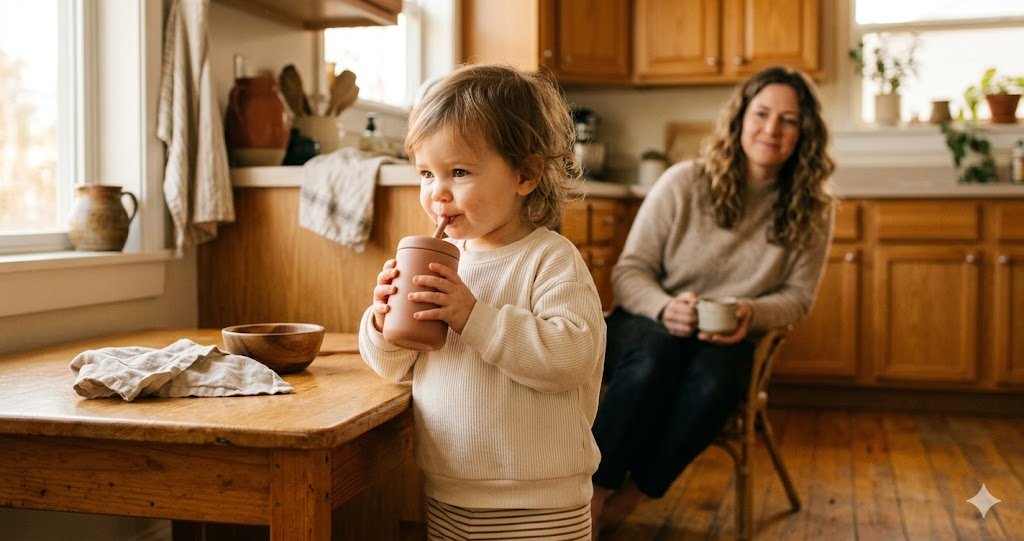
The Cup Transition Roadmap: Bottle to Sippy to Straw to Open Cup, by Age
By the time my third baby came along, I thought I had the cup thing figured out. I did not. The bottle was never the hard part for us; the cups were. With my youngest son I bought what felt like every cup on the shelf, spouts and straws and little open tumblers, sure one of them held the secret. Spoiler: none of them did. The cup is just a tool. What actually matters is when you introduce which skill, and giving your little one enough unglamorous practice to get there.
The trouble is that “bottle to sippy to straw to open cup” sounds like a tidy staircase, and it really isn’t. Pediatric guidance and the feeding-therapist world don’t fully agree on the middle steps, and a lot of parents (hi, past me) waste months on a cup that isn’t teaching anything. So I built the roadmap below to lay the whole thing out by age: what to reach for, what the goal of each stage actually is, and where the experts diverge. There’s a printable version further down for the fridge.
The roadmap, at a glance
Read it top to bottom — the left column is age, and each row tells you the cup to reach for, what you’re actually doing that month, why it matters, and the milestone you’re watching for.
Want this on the fridge? Grab the one-page printable version — same roadmap, sized to print at home.
Wait — should you even use a sippy cup?
Here’s the part nobody tells you at the baby shower: the experts don’t fully agree on the “sippy” step, and that disagreement is worth understanding before you spend money.
The American Academy of Pediatrics takes a flexible line. It says you can offer a spouted training (“sippy”) cup or a cup with a straw when your baby starts solids around 6 months, and that some kids go straight to an open cup, which is fine too. The AAP is also refreshingly blunt that the sippy is an optional step — plenty of children move from breast or bottle to a regular cup with no sippy in between. The one firm caveat: if you do use a sippy, skip the ones with a no-spill valve, because a valve forces your baby to suck exactly like a bottle and teaches nothing new. A simple, valve-free spout is the version to look for.
Many pediatric speech-language pathologists go a step further. Their concern is oral-motor development: a hard spout keeps the tongue in the same forward, bottle-style pattern, while open cups and straws encourage the mature swallow that supports clear speech later. So the feeding-therapist camp generally suggests introducing an open cup first, then adding a straw cup, and skipping the hard spout altogether. (That ordering and the “around 6–9 months for straws” timing are their recommendation, not an official AAP timeline. The AAP simply groups straw introduction in with offering a cup around 6 months.) A few therapists have also cooled on the popular 360-style rim cups, citing how some kids end up using them.
My honest take after three kids: you don’t need to pick a tribe. A valve-free option is fine if it gets your bottle-attached toddler drinking, and open and straw cups are the ones genuinely building skills. I leaned hard on a weighted-straw cup with my youngest as he moved off nursing, and kept a little open cup at every dinner for practice. If you want the deep dive on each type, I broke them down in our guide to the best open cups, plus a look at valve-free transition cups if you want a middle step.
How to read each stage without losing your mind
0–9 months: it’s practice, not a drink
This is the stage I most want to underline, because it’s the one I got wrong. Early cup time is not about hydration. Under 6 months, breast milk or formula covers everything — no water, no cup. Once solids start around 6 months, you can offer a little water in a cup, but the AAP notes that small amount won’t replace much milk; the real point is letting your baby rehearse the motion. A few sips at the high chair, lots of dribbling down the chin, and a parent who treats spills as part of the deal. That’s the whole assignment.
9–18 months: the actual weaning
This is where the calendar matters most. The AAP frames bottle weaning as a gradual process that begins around 6 months and completes somewhere between 12 and 18 months. The reasons are concrete: a bottle that lingers past the second year bathes the teeth in milk sugars (the classic cause of early cavities), can crowd out solid food, and is genuinely harder to give up emotionally the longer it stays. The approach that works for a lot of families is dropping bottles one slot at a time, daytime first and the bedtime bottle dead last — then swapping that last one for an extra story and a few minutes of cuddling rather than a cup right at sleep. Your daycare or sitter will need the same script, so loop them in.
18 months and up: making the open cup normal
By around age 2 the goal is for the open cup to just be the cup. We kept lidded straw cups alive for the car and the park (a spill in a car seat is its own special misery), but at the kitchen table it was an open cup with a small pour. The trick that finally clicked was a child-height water station: a little open cup by the bathroom tap so my older son could serve himself and feel like the big kid he desperately wanted to be. For out-and-about days, a straw-top toddler water bottle covers you without undoing the open-cup habit at home.
The snags almost everyone hits
- The cup-as-security-blanket. A toddler who roams the house all day sipping will often drink way too much and graze instead of eating meals. Keep cups mostly at the table; offer a little plain water between meals, then set it aside.
- The bedtime bottle that won’t budge. It’s the hardest one for a reason — it’s soothing, not nutritional. Build a new wind-down (story, song, snuggle) so the comfort isn’t coming from the bottle.
- Total cup refusal. Normal. Try putting the milk they already like in the new cup before you try water, and model it yourself; toddlers copy what they see you drink.
- Juice creep. Once a transition cup becomes the juice cup, water gets a lot harder to sell. Plain water and milk are the whole menu; if you offer juice at all, keep it tiny.
Grab the free Bottle & Cup Cheat Sheet
This whole roadmap, plus a printable bottle-weaning checklist and a “which cup, what age” quick-reference — the version I wish I’d had with my first.
Enter your email below and I’ll send the printable PDF straight to your inbox.
Sources: American Academy of Pediatrics, From Bottle to Cup: Helping Your Child Make a Healthy Transition (HealthyChildren.org); American Academy of Pediatrics, Recommended Drinks for Children Age 5 & Younger (HealthyChildren.org); American Academy of Pediatrics, Choose Water for Healthy Hydration (HealthyChildren.org), source for the 6–12-month water figure (about 4–8 oz, or ½–1 cup, a day until age 1). Oral-motor sequencing reflects guidance commonly shared by pediatric speech-language pathologists; it is not an official AAP timeline. This article is general information and not a substitute for advice from your pediatrician.