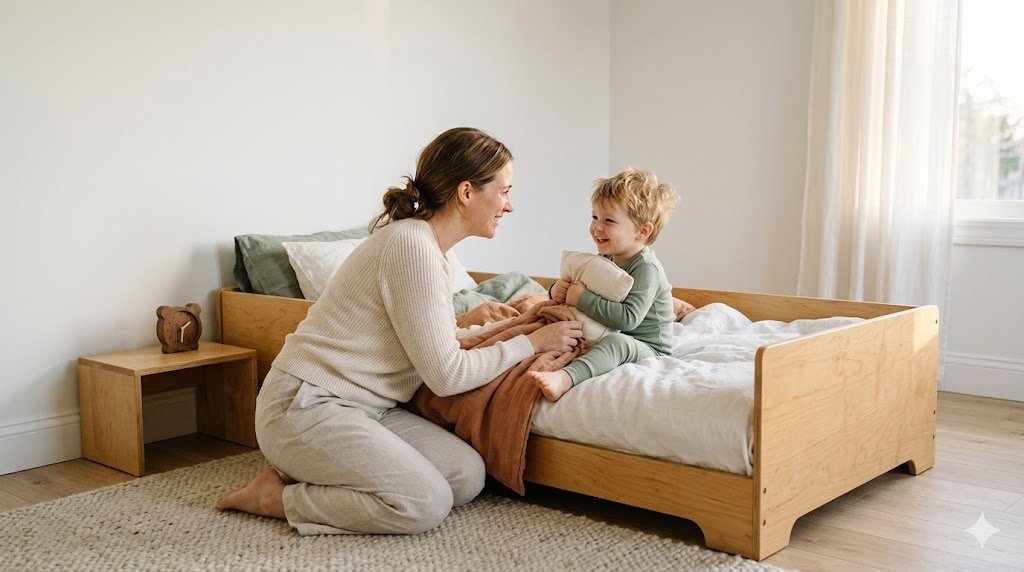
The thud came at 5:40 in the morning. Not a crash, exactly. More like a sack of flour deciding it was done with the pantry shelf. By the time I got to my older son’s room, he was standing next to his crib looking extremely pleased with himself, and I was standing in the doorway doing the math every parent does in that moment: how high is that rail, how hard is that floor, and how on earth did we get here.
If you’ve landed on this article, I’m guessing you’ve had your own version of the thud. Or you’re watching a leg swing over the rail in the monitor and trying to get ahead of it. Either way, the questions are the same: when do you actually move a toddler out of the crib, how do you do it without blowing up everyone’s sleep, and what do you genuinely need to buy (spoiler: less than the baby aisle wants you to believe, but the few things that matter really matter).
This is the third time I’ve done this transition, with three very different kids, and I made most of the available mistakes on the first one. So let’s walk through it properly: the when, the how, and the short shopping list.
When to Make the Move (and Why Later Is Usually Better)
The official guidance first. The American Academy of Pediatrics says it’s time to transition once your child can climb out of the crib, and pediatric guidance generally points to 35 inches in height as the practical threshold. At that height, the crib rail sits around chest level, which turns your crib from a safe container into climbing equipment. A fall from the top of a crib rail is a serious fall for a small body.
So the hard signs are:
- They’re climbing out, or seriously attempting to. One successful escape means the crib’s main job, keeping them safely contained, is over.
- They’re around 35 inches tall, or the rail hits at or below their chest when they stand, even with the mattress on the lowest setting.
- Potty training is underway and they need to get to the bathroom at night without summoning you like room service.
- Daycare has moved their class to nap cots or mats. If your child is already sleeping out of a crib five days a week, home can usually follow.
Here’s the part most articles bury, though: if none of those signs are present, waiting is not lazy parenting. It’s the better strategy. A crib isn’t a cage your child needs liberating from. It’s a boundary, and toddlers sleep better with boundaries. Sleep consultants widely observe that transitions made closer to age three go more smoothly, because a two-year-old’s impulse control is, to put it kindly, a work in progress. A 22-month-old in an open bed doesn’t hear “stay in bed, sweetie.” They hear “the room is now a buffet.”
My youngest is 19 months old as I write this, and he is staying in his crib until he gives me a reason. He has not yet filed a complaint.
When NOT to Make the Move
A few situations where the calendar says maybe, but the answer is not yet:
A new baby is coming and you want the crib back. This is the classic trap, and I walked straight into it with my daughter, our oldest. Evicting a toddler from their crib right as a sibling arrives stacks two enormous changes on top of each other, and your toddler will absolutely connect the dots: the baby took my bed. If you need the crib, either make the move two to three months before the due date so the toddler bed is old news by delivery day, or wait until a couple of months after the baby arrives and let the newborn sleep in a bassinet in the meantime. Honestly, a second crib or a borrowed one is cheaper than a month of toddler sleep regression. Ask me how I know.
You’re in the middle of another big change. New daycare, a move, potty training boot camp, dropping the nap. Pick one upheaval at a time. Toddlers are tiny creatures of routine, and the bed transition goes best when everything else in their world is boring.
They’re under two and not climbing. There is no prize for early. Nobody asks on a college application when you left the crib.
The In-Between Option: Mattress on the Floor
If your kiddo is climbing but you’re not ready to commit to a bed (or the bed hasn’t arrived), the AAP’s own suggestion is wonderfully low-tech: take the crib mattress and put it on the floor. Low height, zero fall risk, familiar mattress smell, and it buys you time.
Some families discover they like this arrangement so much they never bother with a bed frame at all. That’s essentially the Montessori floor bed approach, which we’ve covered in detail in our Montessori floor beds guide. It’s a legitimate end state, not just a layover. (If you’re rethinking the mattress itself at this point, our crib mattress guide covers what carries over to a toddler bed.)
How to Actually Do the Transition
The mechanics matter less than the consistency, but here’s the sequence that has worked across our three very different sleepers:
- Put the new bed in the crib’s old spot. Same corner, same wall, same view of the ceiling. You’re changing one variable, not redecorating.
- Keep the bedtime routine identical, word for word. Same bath, same books, same songs, same order. The bed is new; everything else should be aggressively familiar. (If bedtime is already a fight, our bedtime battles guide is worth reading first.)
- Let them pick the sheets. A toddler who chose their own dinosaur sheets has a stake in this bed. It’s a small thing that does a surprising amount of work. If you’re shopping, we’ve rounded up our favorite toddler bedding in our toddler bedding roundup.
- Introduce the bed during the day. Let them sit on it, jump on it (once, supervised, you saw nothing), read a book on it. The first encounter shouldn’t be at lights-out.
- Set expectations in toddler language. “Big kids stay in their bed until morning.” Short, repeatable, said at bedtime every night for a while.
- Expect a honeymoon, then a test. Many toddlers do great for three or four nights, then realize the door-shaped possibilities. That’s normal. Hold the line calmly (more on this in the troubleshooting section).
Room-Proofing: The Step Everyone Skips
Here’s the mental shift: the night your child moves into an open bed, their bedroom becomes the crib. You’re no longer childproofing a mattress; you’re childproofing a room that a curious person can now explore at 2 a.m. without supervision.
Work through this checklist before night one:
- Anchor every piece of furniture that could tip. Dressers, bookshelves, anything a climber could pull over. This is the non-negotiable one, because furniture tip-overs are exactly the kind of accident that happens in the quiet minutes you’re not watching. Anti-tip straps are cheap and fast to install. A highly rated option like the Booda Brand furniture anchor kit (around $10 for a multi-pack, Best Seller badge in its category) uses metal cables rated for hundreds of pounds, and the maker recommends at least two anchors per piece, spread toward the top corners. Yes, it means drilling into the wall. Drill into the wall.
- Move the bed away from windows, and get blind and curtain cords completely out of reach. Cordless window coverings are the gold standard in a kid’s room.
- Cover outlets and clear floor clutter along the path they’d walk at night.
- Decide your door strategy. The AAP notes a safety gate across the bedroom doorway can keep a wanderer safe while you sleep. Don’t lock the bedroom door; in an emergency you need that door to open fast.
- Look at the room from knee height. Literally crouch down. You’ll spot things you’ve never noticed standing up.
What You Actually Need: The Short List
The transition aisle is full of things you don’t need. After researching the current market and cross-referencing independent reviews against safety records, here’s what I’d actually put in the cart, organized by the problem each one solves.
The safety rule most parents never hear: portable bed rails are federally regulated, and the CPSC is explicit that they’re intended only for children ages 2 to 5 who can get in and out of bed on their own, and must never be used with a child under 2. The danger isn’t falling over the rail; it’s becoming trapped in a gap between the rail and the mattress. Children’s bed rails sold in the US must meet a mandatory federal standard, and within the past year the CPSC has publicly flagged several rail brands sold on Amazon for violating it. Before buying any rail, search the brand name on cpsc.gov. It takes thirty seconds. Also worth knowing: bed rails are designed for adult beds and standard mattresses, never for cribs, bunks, or inflatable beds.
If they’re moving into a big bed: a foam bumper or a bed rail
Hiccapop Toddler Bed Rail Bumper
This is the option I’d point most parents to first, because it solves the falling-out problem without creating the gap problem. It’s a long, firm foam wedge that sits under the fitted sheet along the edge of the mattress, a speed bump your sleeper rolls against and instinctively rolls away from. No frame, no hardware, no gap for a small body to slip into. The foam is CertiPUR-US certified, the cover is washable with a non-slip backing, and the maker states it passes the federal safety standards for bed rails. It works on everything from a toddler bed to a king. The honest trade-off: it’s lower than a metal rail, so a truly acrobatic sleeper might still make it over the top. The manufacturer is clear it should never be used on a top bunk or loft bed.
ComfyBumpy Swing-Down Bed Rail
If your child has moved straight into a twin or full and rolls like a rotisserie chicken, a traditional rail gives you more height. This one stood out in my research for the things that matter in this category: a sturdy metal frame with breathable mesh, a swing-down design so your kiddo can get in and out without a ladder routine, and a triple attachment system (velcro for slat bases, straps for box springs, screws for wooden platforms) so it actually stays put, which is precisely the thing that makes a rail safe or unsafe. It comes in several lengths and heights for mattresses from low-profile up to standard thickness. Note the manufacturer’s own instruction: it’s for adult beds, for kids in the 2-to-5 window, like every rail in this category.
If you’d rather keep things kid-sized: a dedicated toddler bed
Delta Children Canton Toddler Bed
The quiet genius of a dedicated toddler bed is that it takes the same full-size crib mattress your child has been sleeping on all along, so the bed changes but the actual sleeping surface, with all its familiar comfort, doesn’t. The Canton is the one I’d look at first: solid wood, low to the ground (a fall from this height is a non-event), built-in guardrails on both sides, and the certifications that matter in kids’ furniture: Greenguard Gold for chemical emissions and JPMA certification against CPSC and ASTM standards. It carries a Best Seller badge in toddler beds, and the manufacturer rates it for 15 months and up with a 50-pound weight limit. That limit is the honest fine print: this is a two-ish-year bed, not a forever bed. For some families that’s a feature; for others, going straight to a twin with a rail makes more sense.
For the 5 a.m. problem: an OK-to-wake clock
Nobody warns you about this one. The biggest side effect of the bed transition usually isn’t bedtime. It’s the morning, when a child who used to babble contentedly in the crib until you fetched them discovers they can now self-serve. An OK-to-wake clock gives a pre-reader a rule they can actually follow: red means sleep, green means morning.
Windflyer “Little Teddi” Sleep Training Clock
A small bear-faced clock that glows red at sleep time and green when it’s okay to get up, with facial expressions that make the rule legible to a two-year-old. It layers in the useful extras (night light, white noise, a nap timer) and has an optional “play mode” that glows pale green shortly before wake time, signaling it’s fine to look at books quietly but not to come find you. In my research the recurring complaint is that the settings take some fiddling to program, and adjusting times on the fly can mess with your presets, so set it up before night one, not at 9 p.m. with a toddler audience.
Yoto Mini (2024 Edition)
If your transition is happening closer to age three, which, as we covered, is the smoothest window anyway, the Yoto Mini is worth a look because it refuses to be just one thing. It’s a screen-free audio player that kids control with physical story cards, and it doubles as an OK-to-wake clock, sound machine, and bedtime storyteller, with no camera, no microphone, and no ads. The official age range starts at three, so this is the pick for older transitioners, and unlike a clock your child will age out of, this one grows with them well into elementary school. In the mornings, the little pixel display does the red-light-green-light job; at bedtime, a sleep-sounds card earns its keep.
And that’s genuinely the list. Bed or rail, sheets they chose themselves, a wake clock, and furniture anchors. Everything else in the category is optional at best.
Troubleshooting: The First Two Weeks
The jack-in-the-box
They pop out of bed. You put them back. They pop out again. The technique that works is boring on purpose: walk them back silently, every single time, no lecture, no negotiation, no carrying that resembles a hug, just a calm “it’s bedtime” the first time and silence every time after. If you have a partner home, tag-team the walk-backs; the consistency matters far more than who does the walking. The first night might take twenty returns. The third night it’s usually two. Toddlers stop performing when the show gets no reviews.
The 5 a.m. visitor
This is the wake clock’s job, but the clock only works if you enforce it. If your little one shows up before green light, walk them back with the same boring consistency and point at the clock: “It’s still red. I’ll come get you when it’s green.” Then, and this is the part that matters, make green-light mornings a tiny celebration for a while.
The regression
If week two falls apart after a smooth week one, you haven’t broken anything. Novelty wore off and your toddler is checking whether the rules survived. They should. Keep the routine identical, keep returns boring, and resist the urge to add new interventions every night. Most kids settle within two to three weeks.
The full retreat
And if it’s genuinely not working, if sleep has cratered for everyone and your child seems distressed rather than mischievous, putting the crib back is allowed. It’s not failure; it’s data. A child who isn’t ready at 26 months is often a completely different sleeper at 32 months. We waited, tried again months later with my daughter, and the second attempt was almost insultingly easy.
FAQ
Should I move my toddler to a bed before the new baby arrives?
Only if you can finish the move two to three months before the due date. Otherwise wait until a couple of months after, and let the baby use a bassinet in the meantime. Don’t let the crib handoff and the sibling arrival happen in the same week.
Is 18 months too early for a toddler bed?
If they’re not climbing out and not over the height threshold, yes, it’s earlier than necessary, and earlier transitions tend to be bumpier because impulse control is still under construction. If they ARE climbing at 18 months, safety wins: move the mattress to the floor or to a low toddler bed, and know that you’ll be doing more walk-backs than the parent of a three-year-old would.
Can I use a bed rail in the crib, or for my one-year-old on our bed?
No, and this one matters: bed rails are designed and federally regulated for children 2 to 5 on adult beds only. Used with younger children, the gap between rail and mattress is an entrapment hazard. Under two, the safe sleep space is the crib.
How long until they stay in bed all night?
Most toddlers are reliably staying put within two to three weeks if the response is consistent. If you’re months in and every night is still a negotiation, look at the schedule first; an overtired or undertired toddler fights the bed no matter what bed it is.