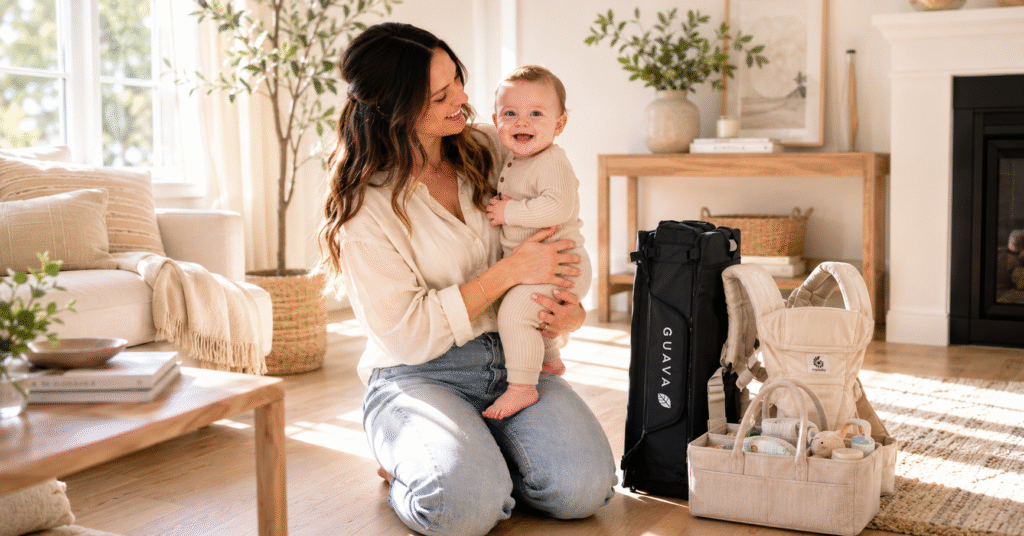
The first time we drove up to my parents’ place with a baby in the back seat, I packed like we were emigrating. Two giant duffels, a trunk that wouldn’t close, and a mental list I’d rewritten four times. And somehow I still forgot the one thing that actually mattered that weekend: a way to make my son’s borrowed bedroom dark enough to sleep in at 7 p.m. while the sun was blazing through lace curtains my mom has had since the nineties.
Visiting the grandparents is its own specific kind of trip. You’re not checking into a hotel that’s seen a thousand toddlers. You’re walking into a home that probably hasn’t had a baby in it for twenty or thirty years, where the outlets are bare, the coffee table is glass, and the “crib” is whatever drop-side relic has been living in the attic. You also can’t bring your whole nursery, so the game becomes figuring out the smallest kit that still covers the three things that reliably go sideways: sleep, meals, and a house that was never childproofed.
So this isn’t a “47 baby travel essentials” list. It’s the curated kit I’d actually pack, organized by what tends to go wrong, with honest notes on where each pick falls short. Most of these I researched the way I research everything for our family now: reading the spec sheets, then reading the one- and two-star reviews to find out what people regret. I’ll flag the trade-offs as we go.
Start here: non-negotiables vs. nice-to-haves
If you remember nothing else, remember this order. Sleep gear is the non-negotiable, because a baby who can’t sleep turns a four-day visit into a four-day endurance event for everyone. Safety gear is a close second, and it’s the part most people forget entirely. Feeding and getting-around gear you can often improvise or borrow. Everything else is comfort.
I’ll go through all five, but if you’re packing in a hurry at 11 p.m. the night before a holiday drive (hi, it’s me), do the sleep and safety sections first.
Sleep: the part that makes or breaks the trip
Grandparents almost never have a safe, current place for a baby to sleep. Either there’s nothing, or there’s something from another era that I’d really rather you didn’t use (more on that below). So you bring the sleep setup. For us, getting this right was the difference between a relaxed visit and my husband and I taking shifts in a recliner.
A travel crib you can actually carry
A lightweight travel playard is the anchor of the whole kit. The Pamo Babe Compact Pack and Play is a solid budget pick: it folds down small, comes with a thin mattress pad and a carry bag, and the mesh sides let you actually see your baby. It’s the kind of thing that lives in the trunk so you’re never scrambling. Two honest caveats from digging through reviews: a few parents found loose threads or stitching on arrival, so give it a once-over before the first use, and the included pad is thin by design (that’s a safe-sleep feature, not a flaw, but don’t expect plush).
If your baby already sleeps in a playard at home, even better. Familiar bed plus familiar smell equals a much better shot at a normal bedtime in a strange house.
Darkening a too-bright room (for next to nothing)
Grandma’s curtains almost never block light, and a room that’s still bright at 7 p.m. can wreck bedtime. You don’t need a fancy gadget for this. A couple of cheap portable blackout panels (the kind with suction cups) pack flat into any bag, and in a pinch a dark blanket clipped over the curtain rod, or a trash bag and some painter’s tape on the window, gets you most of the way there. It’s not elegant, but a dark room is half the battle, and it costs almost nothing.
A sound machine that fits in your hand
New houses are loud in unfamiliar ways: a different fridge hum, cousins thundering down the hall, a dog that barks at the mail. A portable sound machine smooths all of that over. The travel-sized Hatch Rest Go is built for exactly this: it’s about the size of a baseball, clips onto a stroller or playard, runs on a rechargeable battery that lasts roughly a long night, and needs no app or Wi-Fi.
Where it frustrates people: the button can be fiddly, it starts at the lowest volume so you’ll occasionally wonder if it’s even on, and a handful of owners report theirs dying after several months. If you want something dead simple, a basic single-button white-noise machine works too. But the Hatch travels well, and bonus, one reviewer noted it’s easy enough that grandparents can run it themselves.
Mealtimes: a seat that goes where the food is
Most grandparents don’t have a high chair anymore, and the ones who do often kept something that’s been recalled twice over. A portable seat means your little one eats at the table with everyone, which, beyond the logistics, is half the point of the visit.
The clip-on splurge
The Inglesina Fast Table Chair clamps right onto the edge of a table, so your baby sits up at grandma’s dinner table without anyone hauling a bulky chair across the country. It weighs about four pounds, folds into its own bag, and the twist-tight clamps won’t scratch the table. It’s a longtime baby-registry favorite, and you can see why. It’s the priciest seat here, and worth knowing: it will not work on every table. Glass tops, single-pedestal tables, and tables with a deep apron underneath are out, so do a quick recon of grandma’s dining setup before you rely on it.
The budget all-rounder
If you’d rather spend a quarter of that, the Bright Starts Pop ‘N Sit is the folding booster that straps onto any adult chair, sits on the floor, or holds a snack tray. It collapses flat and comes with its own bag. The trade-off is fit: the crotch strap sits a little far back, and plenty of parents say it runs small, so it’s happiest with babies and younger toddlers rather than a tall almost-three-year-old. For a short visit, though, it’s hard to beat for the price.
Honestly? Bringing both isn’t overkill if you have kids at different stages, which is exactly the boat we’re in.
Getting around: one stroller, maybe a carrier
You don’t need your everyday stroller at grandma’s. You need a lightweight travel stroller that folds fast and, crucially for this trip, reclines, because a lot of the “getting around” ends up being a walk that turns into a nap.
The travel stroller I’d reach for
The Graco Ready2Jet is the one I’d pack. It self-folds with one hand (a small miracle when you’ve got a baby on your hip), stands on its own, weighs about thirteen pounds, and most importantly the seat reclines into multiple positions so your little one can actually sleep in it. It has a big sun canopy, all-wheel suspension, a convertible 3- or 5-point harness, and it accepts Graco infant car seats if you’re still in that stage. Graco rarely shows up in recall news, which I weight heavily for anything my kid rides in.
The honest part: it’s marketed as “overhead friendly,” but in real life most parents end up gate-checking it, so don’t bank on it fitting the bin. And the belly bar has to come all the way off to load and unload, which is a minor daily annoyance.
The ultralight backup
If your trips are short and your baby naps fine in the carrier or car, the Dream On Me Aero umbrella stroller is about seven pounds, folds one-handed, and costs about what you’d spend on takeout for the family. It’s a basic seat, it runs a touch small, and it doesn’t recline much, so I’d think of it as the “extra set of wheels in the trunk” option rather than your main ride.
(If you’re flying and overhead-bin space is your whole personality, the gb Pockit Air folds smaller than anything else out there. I left it off the main list because the version that fits the bin doesn’t recline, and there have been collapse complaints on the all-terrain model, so it’s a niche pick rather than a baby-trip default.)
A carrier for hands-free everything
A soft structured carrier quietly does more work than almost anything else on a family trip, and it doubles as a nap tool when the stroller won’t fit. The Infantino Flip 4-in-1 is the budget standby: four carry positions, a convertible seat that adjusts as your baby grows, a real waist belt that takes the load off your shoulders, and straps that adjust easily enough that you and your partner (and yes, grandparents) can all share it. Worth knowing: the inward-facing position is the truly ergonomic one, the buckles feel stiff until you’ve broken them in, and taller toddlers will outgrow it on the early side. For a few days of carrying, it more than does the job.
The part everyone forgets: babyproofing a house that hasn’t been childproofed in decades
This is the section I’d circle in red. Your own home is locked down. Grandma’s is a wonderland of open outlets, cabinets full of cleaning supplies and medications at exactly toddler eye level, and a hundred sharp corners. And here’s the catch that makes travel babyproofing its own category: you can’t drill into someone else’s cabinets. You need the no-tools, leaves-no-trace kind.
Adhesive cabinet locks (no drilling)
The Skyla Homes adhesive cabinet locks stick on with 3M adhesive, no screws or magnets, and they come off later with a little heat from a hair dryer. That’s exactly what you want for a place you’re borrowing. They’re adjustable, they work on cabinets, drawers, the fridge, even the oven, and the pack comes with alcohol wipes to prep the surface (don’t skip that step or they won’t stick). One real limitation: once you click the strap to length, you can’t readjust it, so measure before you commit. Pop a couple on the cabinets that hold meds and chemicals first, then worry about the rest.
Outlet covers
Simple plug-in Wappa Baby outlet covers slide into unused outlets and are tough for little fingers to pry out. A bulk pack covers a whole house with extras to spare. One safety nuance worth knowing: those small caps are themselves a choking hazard once they’re popped out, so for outlets that are actually in use (where a curious kid is most likely to fiddle), a self-closing sliding cover is the safer style. For the dozens of empty outlets around grandma’s house, the caps are perfect.
Keeping it all organized
Two small things make the actual changing-and-diapering part of the trip dramatically less chaotic, especially in a house with no dedicated baby zone.
A portable changing pad
The Kopi Baby changing pad folds into a little clutch with a wipeable, waterproof surface, a built-in pillow, a wipes pocket, and room for a few diapers. You can change a baby on grandma’s guest bed, the floor, or the back of the car without thinking twice. The one weak spot reviewers mention is the carry strap’s clip, which can give out, so I wouldn’t load it like a suitcase.
A caddy to build a “diaper station”
The Parker Baby diaper caddy is a soft felt bin with a removable divider and a long handle. Drop your diapers, wipes, and creams in it before you leave, and the second you arrive you’ve got an instant diaper station you can carry room to room. The brand literally markets it for “visits with grandparents,” which made me laugh, but it’s accurate. It’s felt, not wipeable plastic, so it’s more organizer than spill-proof, but for corralling the chaos it’s great.
Two ways to build your kit
You don’t need every single thing on this list. How I’d actually assemble it comes down to your budget and how often you travel.
The minimalist build (roughly $230): Pamo Babe travel crib, Hatch Go sound machine, Bright Starts booster, Dream On Me Aero stroller, the Infantino carrier, plus the cabinet locks, outlet covers, changing pad, and caddy. That covers sleep, meals, wheels, and safety without overthinking it.
The splurge build (roughly $430): swap in the Inglesina table chair and the Graco Ready2Jet stroller for the upgrades you’ll feel every day. Pricier, but these are the pieces that get reused trip after trip for years.
Whatever you pack, I’d keep a running checklist on your phone so you’re not rebuilding it from memory at 11 p.m. every time. After a couple of trips it becomes muscle memory, I promise.
Frequently asked questions
Do I really need a travel crib for just one night?
For one night, if your baby is young enough, a carrier nap plus a safe surface might be enough, but I’d still bring the playard. A safe, familiar place to sleep is the single biggest predictor of whether the visit goes smoothly, and it’s a lot easier than improvising a safe sleep spot in a house that doesn’t have one.
What if we don’t have a car and we’re flying?
Lean on the carrier and a stroller you can gate-check; our guide to flying with a baby goes deeper on that. Consider whether a sound machine and a couple of blackout panels are worth their space (for a light sleeper, absolutely). Many travel cribs are gate-checkable too. If overhead-bin fit is your priority, that’s the one scenario where an ultra-compact stroller earns its place.
Does it change anything if I’m breastfeeding vs. formula feeding?
The gear above is the same either way. If you’re formula feeding, the main additions are a way to clean bottles in a kitchen that may not have your usual supplies and a small insulated bag, neither of which needs to be fancy. If you’re nursing, you’ve already got the most portable feeding system there is.
How far ahead should I babyproof once we arrive?
Do a lap of the house in the first hour, before your little one is loose and exploring. Hit outlets at floor level, cabinets with anything dangerous, and obvious hazards like a TV that isn’t anchored or a glass table at head height. Our room-by-room babyproofing checklist walks through the rest. You won’t catch everything, and that’s what supervision is for, but the worst risks take ten minutes to handle.
Grandma kept my old crib. Can we use it?
Please don’t, especially if it’s a drop-side model. See the note above. Bring your own current, standards-compliant sleep surface. It’s not a knock on grandma’s housekeeping, it’s just that crib standards have changed a lot, and this is one place not to compromise.