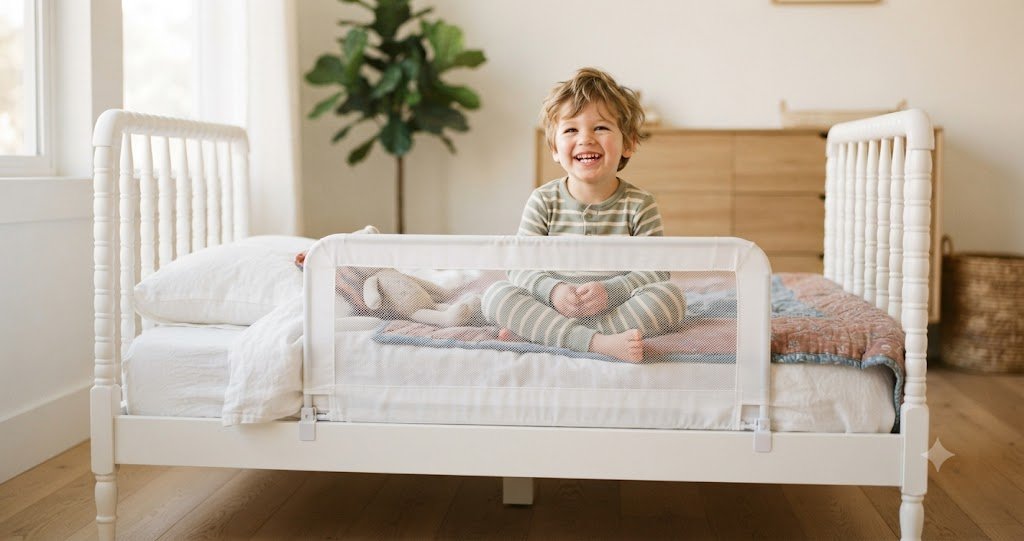
The first week after we moved my older son out of his crib, I heard it at 2 a.m.: a soft thud, a pause, and then the world’s most offended crying. My husband and I played a very sleepy round of rock-paper-scissors over who would go check. He’d rolled straight off his new bed and onto the rug, more startled than hurt, but that was the night I went down the bed rail rabbit hole. And what I found surprised me.
The category has a strange secret: most of the “toddler bed rails” on Amazon are not allowed on actual toddler beds. I pulled the instruction manuals for the bestselling rails, and one after another they say the same thing in the fine print: adult beds only. Some of the biggest sellers in the category are also brands the Consumer Product Safety Commission has publicly warned parents to stop using immediately because of deadly entrapment risks.
So this roundup works a little differently. Instead of ranking five rails from “best” to “also fine,” I’ve organized them by the bed your child actually sleeps in — because that single detail decides which rails are safe and which are banned by their own manuals.
The Right Rail for Your Bed (at a glance)
| Your child’s bed | Pick | How it attaches | Price range |
|---|---|---|---|
| Converted crib / toddler bed | hiccapop Convertible Crib Bed Rail | Clamps to the crib frame | $30–40 |
| Toddler bed (soft option) | hiccapop Foam Bed Bumper | Under the fitted sheet | $30–40 |
| Twin/full/queen with box spring | Regalo Swing Down Bed Rail | Anchor straps under mattress | $25–35 |
| Platform or slat-base bed | ComfyBumpy Extra Long Bed Rail | Velcro, straps, or screws | $55–70 |
| Travel / grandparents’ house | hiccapop Inflatable Bed Rails (2-pack) | Under the fitted sheet | $50–65 |
Wait — Does Your Toddler Bed Even Need a Rail?
Honest answer: maybe not. Most toddler beds sold in the US come with built-in guardrails on the upper portion of the bed, and they sit so low to the ground that a roll-off is more of a gentle slide than a fall. Before you buy anything, try this for a week:
- Check what’s already there. If your toddler bed has partial rails and your kiddo sleeps like a starfish glued to the center, you may be done.
- Try the floor cushion trick. A folded comforter or a firm play mat next to the open side of a low toddler bed softens the landing while your child learns their new boundaries. Plenty of families never need more than this.
- Watch how they fall. A once-a-month slow roll is different from a nightly launch. My older son was firmly in the “nightly launch” camp, so we needed actual hardware.
If you’ve done the week of observation and you’re still finding a small person on the floor, keep reading. The right rail depends entirely on which bed you own.
How I Vetted These (The Boring-But-Important Part)
Every rail here had to clear the same bar: strong ratings across a large review base, consistent availability, a manufacturer with a real US presence, and — crucially — no appearance on the CPSC’s recall or warning lists. That last filter did serious damage. The CPSC has flagged multiple Amazon bed rail brands since 2025 for violating the mandatory federal standard, several of which sat near the top of the bestseller charts while their sellers ignored recall requests. I also read each product’s actual instruction manual, because as you’re about to see, the manual and the marketing don’t always agree.
One more note on honesty: I research these products the way I researched them for my own family — through manuals, safety databases, and thousands of parent reviews, including the angry one-star ones, which are frankly where all the useful information lives.
If Your Child Sleeps in a Converted Crib or Toddler Bed
This is the group most “toddler bed rail” shoppers actually belong to, and it’s the group with the fewest legitimate options. Standard mesh rails need a big mattress and often a box spring to anchor against, which a toddler bed simply doesn’t have. Two products genuinely work here.
hiccapop Convertible Crib Bed Rail — The One Actually Built for This Job
This is the rare rail designed specifically for a crib that’s been converted to a toddler bed. Instead of wedging under a mattress, it clamps directly onto the crib frame with a reinforced anchor, so it can’t drift away and open up a gap — the exact failure mode behind those CPSC warnings. It folds down with a two-hand release for bedtime stories, installs without tools, and hiccapop backs it with a lifetime guarantee. Parents in reviews consistently describe it as the sturdiest option they tried after wobblier universal rails failed them.
One honest caveat before you click: it fits all standard cribs except IKEA. IKEA cribs use their own proprietary rail system, and hiccapop is upfront about offering refunds to IKEA owners.
Size: 33″ × 16″
Install: Tool-free, clamps to bed frame; folds down for stories
Typical price: $30–40
Best for: Converted cribs and toddler beds — the setup most standard rails are banned from.
Honest drawbacks: Crib-conversion use only; doesn’t transfer to a twin bed later. IKEA crib owners are out of luck.
hiccapop Foam Bed Bumper — The No-Hardware Option
If the idea of clamping metal to your child’s bed feels like overkill, a foam bumper is the gentler route. This is a long, firm foam wedge that slips under the fitted sheet, so there’s no gap for a child to slip into, nothing to install, and nothing to pinch little fingers. hiccapop confirms it works on toddler beds (a little snug, since toddler mattresses are narrower, but it fits), and it travels well too.
The trade-off is height: a foam bumper is a speed bump, not a fence. It reliably stops sleepy rolling, which is what most kids do, but a determined mid-dream gymnast can still make it over.
Style: 52″ foam wedge under the fitted sheet, water-resistant washable cover
Install: None — lift the sheet, slide it in
Typical price: $30–40
Best for: Toddler beds, gentle rollers, families who want zero hardware.
Honest drawbacks: Lower than a metal rail; won’t stop an athletic sleeper. Manufacturer rule: bottom bunk only.
If Your Child Moved Straight to a Twin, Full, or Queen Bed
Regalo Swing Down Bed Rail — The Classic, With One Big Condition
This is the rail you’ve seen in a thousand nursery photos: 43 inches of all-metal frame and mesh, no tools needed, certified by the Baby Safety Alliance, and built around Regalo’s patented Gap Guard designed to keep the rail pressed tight against the mattress. It swings down out of the way when you’re changing sheets or lying down for one more story (we all know it’s never one more story). Among tens of thousands of reviews it holds a strong rating, and it’s often the least expensive metal rail from an established US brand.
Now the condition, straight from Regalo’s own manual: this rail is for adult beds with a mattress and box spring, twin through queen, full stop. Not toddler beds, not bunk beds, not platform beds, and never with a child under 2. The manual also requires the rail to sit at least 9 inches from the headboard and footboard, with zero gaps against the mattress. If your bed frame is a modern platform style with no box spring, skip to the next pick — the swing-down mechanism also may not fold flat on those setups, which is the most common complaint in critical reviews.
Size: 43″ × 20″, all-steel frame with mesh
Install: Tool-free anchor straps under the mattress; swing-down access
Typical price: $25–35
Best for: Kids who skipped the toddler bed and went straight to a real bed with a box spring.
Honest drawbacks: The box spring requirement rules out most modern platform beds, and the swing-down may not fold flat on some frames.
If You Have a Platform or Slat-Base Bed (No Box Spring)
ComfyBumpy Extra Long Bed Rail — Built for Modern Bed Frames
Here’s the gap in the market Regalo leaves open: most beds sold in the last decade don’t have a box spring at all. ComfyBumpy’s answer is a triple attachment system — velcro straps for slat bases, anchor straps for box springs, and screws for solid wood platforms. That flexibility is the whole reason it earns its spot, along with an extra-long 55.5-inch span that covers most of a twin bed, so there’s no uncovered corner to roll around.
Sizing matters here more than with any other pick. The standard 19.5-inch-tall version is made for low-profile mattresses about 2–8 inches thick; there’s a taller version for standard 8–12 inch mattresses. Measure before you order, because a too-short rail on a thick mattress is exactly how gaps happen. And the same manual rule applies: adult beds only — never on a toddler bed, bunk, loft, or crib.
Size: 55.5″ long; 19.5″ height for 2–8″ mattresses, taller version for 8–12″
Install: Triple system — velcro to slats, straps to box spring, or screws to wood base
Typical price: $55–70
Best for: Platform and slat-base beds that standard rails can’t grip; extra coverage for long twin beds.
Honest drawbacks: The priciest pick here, and you must measure mattress thickness before ordering.
For Travel, Hotels, and Grandma’s House
hiccapop Inflatable Bed Rails (2-Pack) — The Suitcase Solution
Dragging a metal rail through an airport is nobody’s idea of a vacation. These inflatable bumpers deflate flat into a suitcase, then slide under the fitted sheet of whatever bed you land on, with a non-slip, machine-washable cover to keep them planted. The two-pack covers both sides of a strange bed, which is exactly what you want when your kiddo is sleeping three feet off the ground in a hotel queen for the first time.
Two habits worth building: give them a quick firmness check each night (inflatables slowly lose air, and a soft bumper is a useless bumper), and remember that inflatable bumpers fall under the same federal bed rail standard as everything else here — so the under-2 rule travels with you.
Style: Inflatable pair with non-slip machine-washable covers; packs flat
Install: Inflate, slide under sheet; check firmness nightly
Typical price: $50–65 for the pair
Best for: Hotels, grandparents’ houses, and any bed your child sleeps in fewer than seven nights a year.
Honest drawbacks: Slow air loss means nightly checks; not a substitute for a permanent rail at home.
The 5-Point Buyer’s Checklist
Whatever you choose, run through this before the first night:
- Match the rail to your bed base. Box spring → Regalo-style anchor straps. Slats or platform → velcro/screw systems like ComfyBumpy. Converted crib → frame-clamping rail only. This one decision prevents most gap problems.
- Match the height to your mattress thickness. Measure your mattress. A rail rated for 2–8 inch mattresses on a 12-inch pillow-top leaves a climbable ledge and a possible gap.
- Respect the 9-inch rule. Rails must sit at least 9 inches from the headboard and footboard so a child always has an open exit path.
- Do the gap check weekly. Push the rail toward the mattress. If you can see daylight or slide your flat hand into a space between rail and mattress, re-tighten the straps before bedtime — and never stuff a gap with pillows or blankets.
- Check the recall list once. It takes two minutes to search your brand on the CPSC’s recall database, and given how many bed rail brands have been flagged recently, it’s two minutes well spent.
Sleep is a whole journey, not just a bed rail. If you’re in the thick of the switch, our step-by-step guide to the crib-to-toddler-bed transition pairs perfectly with this list — and if 5 a.m. wake-ups are the real enemy, start with the best OK-to-wake clocks instead.
Quick Answers for Tired Parents
Can I use a bed rail with my 18-month-old?
No, and this one isn’t a judgment call. Federal safety standards require bed rail warnings to state they must never be used with children under 2, because younger children have died after becoming trapped between a rail and the mattress. Under 2, the safe options are a crib or a floor bed in a fully childproofed room. I know the crib-escape-artist phase makes this feel impossible; it’s still the line.
My toddler bed came with short built-in rails. Can I add a portable rail to extend them?
Check your bed’s manual first, but for most toddler beds the answer is no; portable rails are designed and tested for adult mattresses, and their own instructions prohibit toddler bed use. If the built-in rails aren’t enough, a foam bumper under the sheet or a cushioned landing zone on the floor are the safer workarounds.
What about the bed rails marketed for seniors or adults?
Different product, different standard — and adult assist rails have their own troubling safety record with entrapment. Never repurpose an adult bed rail for a child. Buy something certified to the children’s portable bed rail standard.
When do we stop using the rail?
Manufacturers design these for roughly ages 2–5, but most kids outgrow the rolling phase well before kindergarten. When you notice a few weeks of still, centered sleeping, try folding the rail down for naps first, then retire it. For a lot of kids that happens somewhere around age four; our resident night gymnast, on the other hand, may be keeping his until college.