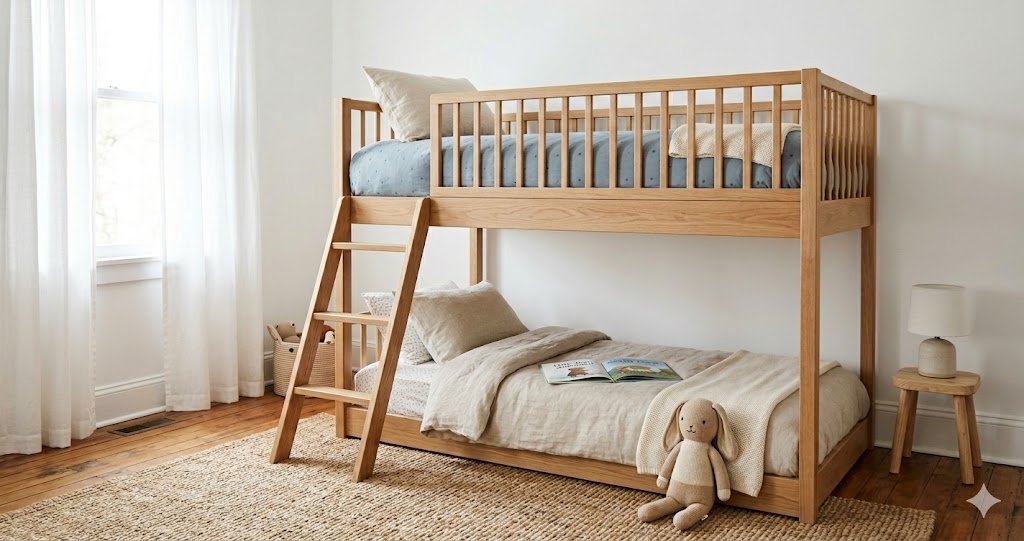
When my daughter turned five and announced she was “too big” for her toddler bed, I figured a bunk bed was the obvious next move. Two of my three share a room, floor space is tight, and a bunk seemed like the grown-up, space-saving answer. Then I started reading the safety fine print, and my whole shopping list changed.
Nobody mentions this in the dreamy nursery photos, but the federal warning label stapled to every bunk bed in America says not to put a child under six on the top bunk. With a curious toddler in the house who climbs literally everything, that single line reshaped how I thought about the whole purchase. So this isn’t a list of the tallest, coolest-looking bunks. It’s a list built around what actually makes sense when your kids are still little.
Read this before you buy anything: bunk bed safety for the 3–6 crowd
I’m not trying to scare you off bunk beds. Plenty of families use them happily. But the 3–6 age range sits right in the zone where most bunk-related injuries happen, so a few rules really do matter.
A few more things I learned the slightly-anxious way:
- Guardrails on both sides, the right height. Federal rules (16 CFR 1213/1513) require continuous guardrails on both sides of the upper bunk, and the top of the rail has to sit at least 5 inches above the mattress.
- Watch your mattress thickness. This one surprised me. A too-thick mattress quietly cancels out your guardrail height. Most bunks are built for a 6–8 inch mattress, so resist the urge to throw a plush 12-inch one up top.
- Mind the gaps. The standards exist mainly to prevent entrapment, where a child’s head or body slips through an opening. Buy from a brand that meets current CPSC/ASTM standards and don’t improvise with hand-me-down rails that don’t fit.
- Lower is friendlier. A floor or low bunk gives the bottom sleeper a tiny drop and makes the whole frame more stable. For preschoolers, I’d take a 46-inch low bunk over a 70-inch tower any day.
- Stairs beat ladders for small legs. If your budget stretches, a staircase (especially one with storage) is genuinely easier and steadier for a four-year-old than a rung ladder.
- Anchor it. Same as any tall furniture, strap it to the wall. The AAP’s guidance on preventing furniture tip-overs spells out exactly why.
What I looked for in a bunk for little kids
Once the safety stuff clicked, my buying checklist got a lot shorter and a lot more specific:
- Low or floor height so the bottom bunk is genuinely close to the ground.
- Full-length guardrails on the top, not the stubby little ones.
- Converts into two separate beds. This was my favorite feature. You can run it as two floor-level beds now, while everyone’s small, and stack it later. It basically buys you years.
- Solid, low-VOC or certified materials. Kids breathe in that room ten-plus hours a night, so a low-emission or GREENGUARD Gold certified frame earns points.
- Stable, no-wobble build with a real weight rating (most quality bunks hold around 400 lbs per surface).
If you’re styling the room around it, two companions worth a look: the right toddler bedding set in a thin-enough mattress so those guardrail rules still hold, and once a desk moves into the room, my guide to the best kids’ desks and chairs for ages 4–6 pairs nicely.
The 5 best bunk beds for kids 3–6
Best Overall
Max & Lily Fundamental Twin Low Bunk Bed
If I had to point one family at one bed, this is it. The whole frame tops out at just over 49 inches, and the bottom bed sits low to the floor, which is exactly the low profile you want with preschoolers around. It’s a stripped-back, fewer-headboards design, so the bottom bunk is easy to climb into from any side. Solid wood with a non-toxic finish, tall 14-inch guardrails up top, and each surface is rated to 400 pounds, so it’ll long outlast the toddler years.
The detail that won me over: like all of this brand’s bunks, it separates into two standalone beds. So you can keep both kids on the floor for now and stack it whenever your oldest hits six. The angled ladder rounds its edges and can mount on either side.
What’s great
- Genuinely low (~49″) profile
- Solid wood, non-toxic finish
- Splits into two separate beds
Keep in mind
- Pricier than the metal options
- Big, two-person assembly
Best Value & Lowest Profile
TOLEAD Low Floor Bunk Bed, Twin Over Twin
This is the lowest bunk on my list, and for a 3-year-old that matters. The solid pine frame keeps the whole thing close to the ground, which makes it feel sturdier and far less nerve-wracking. It has full-length guardrails on the upper bunk and a built-in three-step ladder that bolts to the frame instead of leaning against it, so there’s no wobble.
It also has a convertible streak: the bottom can run as a low floor bed, or you can configure it for one or two kids however your room needs. For the price, it’s a whole lot of bed.
What’s great
- Lowest height here (~46.5″)
- Built-in, attached ladder
- Easy on the wallet
Keep in mind
- Fewer reviews than the big brands
- Ships from a third-party seller
Best Storage & Stairs
ADORNEVE Low Bunk Bed with Storage Staircase, Twin Over Twin
For little legs, a staircase beats a ladder, and this one hides a drawer in every step plus a couple of open shelves, a genuine lifesaver for the toy avalanche. The staircase mounts on the left or right, the top bunk has a wrap-around guardrail, and there’s an anti-tip kit to anchor it to the wall. The slats snap in without tools.
Two honest notes. The frame is metal with MDF panels rather than solid wood, and it comes with color-changing LED strips and a little power outlet that read more “big kid” than “preschooler.” For this age I’d lean on the storage stairs and the anchoring, and treat the light show as a someday-bonus.
What’s great
- Storage staircase, not a ladder
- Anti-tip wall anchor included
- Tons of built-in storage
Keep in mind
- MDF, not solid wood
- LED/outlet skews older
Best Certified & Convertible
Storkcraft Caribou Twin Over Twin Bunk Bed
Storkcraft is a name a lot of American parents already know from the nursery years, and the Caribou is GREENGUARD Gold certified, meaning it’s tested for low chemical emissions. With thousands of reviews behind it, it’s about as proven as a bunk gets.
It’s a standard-height bunk rather than a low one, so the top is not for your under-six. But here’s why it still made my list: it converts into two individual twin beds. My honest play for a 3–6 household is to run it as two separate beds now (no stacking, no top bunk, no worry) and assemble it into a true bunk once your oldest is past six and ready.
What’s great
- GREENGUARD Gold certified
- Splits into two twin beds
- Trusted brand, huge review base
Keep in mind
- Standard height; top bunk is 6+ only
- Use as two beds while kids are little
Best for the Look Your Kid Will Beg For
LIKIMIO House-Shaped Bunk Bed, Twin Over Twin
Let’s be real: the house-shaped frame is the one your four-year-old will point at and gasp over. It’s the most affordable pick here and the best-selling style by a mile, with a cheerful little-cottage silhouette, a high guardrail up top, metal slats, and locking buckles. Some versions include wall-anchoring hardware.
I’m including it honestly, with a caveat in bold: at nearly 72 inches it’s a full-height bunk with a ladder, not a low bed.
What’s great
- The house look kids adore
- Most budget-friendly here
- Strong seller, solid reviews
Keep in mind
- Tall (~72″); top is 6+ only
- Ladder, not stairs; some report basic headboard feel
So how would I actually use a bunk bed at this age?
If your kids are all under six, my advice is simple: don’t think of it as a bunk yet. Buy a convertible low bunk, run it as two floor-level beds, and let the “top bunk” stage arrive when your oldest is genuinely ready for it. You get the space-saving footprint without the part that keeps you up at night. When the day comes, my husband and I plan to walk our oldest through the rules out loud: ladder only, no jumping, no playing up top, the same way you’d teach any new big-kid privilege.
Bunk bed FAQ for parents of little kids
What age can my child sleep on the top bunk?
Six is the widely cited floor, and it’s printed right on the federal warning label. Even at six, judge your own kid — some are ready, some need another year, and that’s completely normal.
Are low or floor bunk beds actually safe for a 3-year-old?
The bottom bunk of a low bed is one of the gentler options for a preschooler, since the drop is small and the frame is stable. Keep your toddler on the bottom, skip the top entirely until six, and you’ve removed the biggest risk.
Do I really need a bunk-specific mattress?
You need a thin enough one. Most bunks are built for a 6–8 inch mattress so the guardrail stays at least 5 inches above the sleeping surface. A pillow-top tower will undo that protection fast.
Bunk bed or two separate beds?
If everyone’s under six, two separate beds win, which is exactly why I leaned toward frames that convert. You get both options out of one purchase.
Grab my free Toddler Room-Sharing & Sleep Setup Checklist
Putting two (or three) little ones in one room is its own puzzle. I made a one-page printable that covers bed placement, the bunk safety checks above, and the little tricks that finally got my crew sleeping in the same room without 5 a.m. chaos.
Pop your email in below and I’ll send it straight over.