Updated July 27, 2026
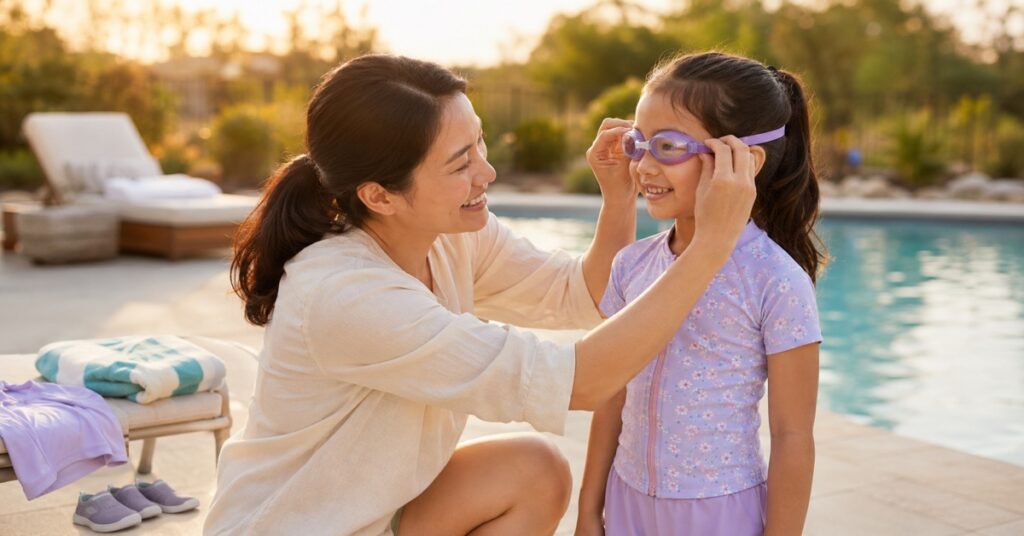
A new pair of kids’ swim goggles can look perfect on the kitchen counter and fail five minutes into swim lessons. One eye cup fills with water. The strap catches a curl. You tighten it, and now your child says it hurts.
The problem is often the shape of the goggles, not a lack of features. A soft seal still has to match the width of your child’s face and the space around their eyes. If it does not, pulling the strap tighter usually turns a leaky pair into a leaky, uncomfortable pair.
I narrowed this guide to four current options with distinct jobs. I checked official model information, independent child testing and recent complaint patterns instead of accepting “leak-free” as a promise. None is right for every face, so each pick includes the child it suits and the reason to skip it.
For a roomier everyday fit, start with the Speedo Hydrospex. The Speedo Skoogles makes more sense for a smaller face. The Speedo Sunny G has a no-snag bungee strap for children who hate hair pulling, while the TYR Swimple has the quickest poolside adjustment for a small, low-profile fit.
The Quick Picks
| Kids’ swim goggles | Best for | Fit clue | Main trade-off |
|---|---|---|---|
| Speedo Hydrospex | Roomier comfort for ages 6–14 | Average-to-wider face | The strap takes more effort to adjust |
| Speedo Skoogles | Younger children with smaller faces | Compact eye cups and a soft frame | Can feel cramped on a wider face |
| Speedo Sunny G | Hair-sensitive children who want easier on and off | No-snag bungee strap | More rigid outer frame; not for rough pool play |
| TYR Swimple | Swim lessons and fast adjustment | Small unibody frame | Seal and durability feedback is mixed |
How I Narrowed the List
Comfort came first. A child who keeps lifting the eye cups or rubbing a painful nose bridge will not care how many lens coatings are printed on the box. I looked for soft silicone seals, a realistic face-size match and an adjustment system a parent can manage without turning the strap into a tourniquet.
Then I looked at what happens after the first happy review. Do recent owners repeatedly mention leaking, broken strap connections, distorted vision or a coating that scratches with ordinary handling? Is the exact model still available, and do its current details match the version discussed by an independent tester?
Several popular pairs fell out here. The four below still have drawbacks, but each one can be tied to a particular face shape or use. Independent testing also supports at least one useful reason for each pick. In one round of BabyGearLab’s child testing, face shape made a major difference: only about half of the tested goggles stayed leak-free. That is why the fit check later in this guide matters more than the order of this list.
The Best Kids’ Swim Goggles for Comfort and Leak Protection
1. Speedo Hydrospex — Best Overall for Ages 6–14
The Speedo Hydrospex is the most balanced choice here for an older child who wants comfortable goggles for lessons, recreational laps and long afternoons at the pool. Instead of sitting deep inside the eye socket like a racing goggle, its larger silicone frame spreads pressure around a roomier outer rim.
Speedo lists this junior version for ages 6–14. The current model has anti-fog-coated lenses and UVA/UVB protection, so the same pair can move between an indoor lesson and a bright community pool. BabyGearLab’s child testers found the Hydrospex comfortable, secure and leak-free during their test. That is useful support, but it is still not a guarantee for a different face.
The frame works best on an average-to-wider face. On a narrow six-year-old, the cups may be too broad to seal evenly. Do the no-strap test before letting your child fall in love with the color. If one side releases immediately, choose a smaller frame rather than cranking down the band.
Adjustment is the main everyday annoyance. The side mechanism is not as quick as the push-button Swimple or the bungee-style Sunny G. A younger child may need an adult to get the tension even before every lesson. Recent low-star feedback also includes warped gaskets, thin straps and an anti-fog coating that becomes cloudy after the inside is rubbed. Some Amazon reviews are pooled across related Speedo styles, so those comments do not establish a failure rate for this exact pair. They do show what to inspect when the goggles arrive.
Best for: Ages 6–14 with an average-to-wider face who want a roomier, softer everyday goggle rather than a low-profile racing fit.
Skip it if: Your child has a very narrow face, wants to adjust the strap alone or dislikes a larger frame around the eyes.
2. Speedo Skoogles — Best for Smaller Faces
Start with the Speedo Skoogles when a preschooler’s face is simply too small for roomier junior goggles. Its eye cups are compact, the frame feels soft against the face and the gasket rests closer to the eye socket than the Hydrospex frame.
Speedo markets Skoogles for younger children and equips the current style with side-release Speed Fit clips, anti-fog lenses and UV protection. BabyGearLab’s young testers found them comfortable and leak-free during testing. The same review noted the small eye openings, which is both the advantage and the limitation: they can make a petite face easier to fit, but a child with wide-set eyes may feel crowded.
Age on the label is only a starting point. A broad-faced four-year-old may outgrow this shape before a narrow-faced six-year-old does. In recent low-star reviews for this product family, “too small” appears alongside complaints about fussy adjustment. There are also occasional strap-break reports, including failures near the point where the band splits. Check that area when the goggles are new, and replace the pair if the silicone begins to tear.
The side clips sound child-friendly, but some parents still find them difficult to move while the goggles are on. It is easier to adjust the band with the goggles off, then place them gently on the child’s face. If your child needs a small tweak during every lesson, the Swimple’s push-button system may be less frustrating.
Best for: Younger children with small or narrow faces who need compact eye cups and a soft seal.
Skip it if: Your child has a wider face, dislikes pressure close to the eye socket or needs very fast mid-lesson adjustment.
3. Speedo Sunny G — Best No-Pull Bungee Strap for Younger Kids
The Speedo Sunny G solves a different kind of pool-day problem: the goggles might fit, but the ordinary silicone band snags wet hair every time it moves. The Sunny G uses a comfortable no-snag bungee cord. It is easier to stretch over a ponytail and simpler for many young children to pull on and off without wrapping hair around the strap.
The current Amazon version is sold for ages 3–8. Its larger, sunglasses-style shape also feels less like a tiny racing goggle, which can be reassuring for a hesitant beginner. Good Housekeeping’s kids’ goggle guide highlights this style for younger children and easy adjustment.
That larger shape is less flexible than the soft Skoogles frame. If the curve does not match your child’s face, tightening the bungee will not create an even seal. Darker versions can also feel too dim in an indoor lesson, so choose a clear or lightly tinted lens when your child needs to see a coach across the pool.
There is one safety detail I would not skip. A 2022 SaferProducts.gov consumer report describes an eye-area cut that required emergency treatment after two children collided underwater while one child wore an older Sunny G product code. The reported code is not the same as the current part shown on Amazon, and the report page does not list a recall. It is still a reason to treat a rigid, sunglasses-style frame differently from a soft eye cup: use it for calm swimming, not chasing or head-to-head rough play. Stop using the goggles if the frame develops a crack, warped edge or sharp spot.
Best for: Ages 3–8 who hate hair pulling, wear a ponytail or want an easier strap to manage independently.
Skip it if: Your child plays roughly in the pool, has a narrow face that does not match the curve or needs a flexible low-profile frame.
4. TYR Swimple — Best Quick-Adjust Pick for Swim Lessons
The TYR Swimple is the smallest, lowest-profile choice in this group. It is designed for young swimmers and has a push-button release that lets an adult loosen or tighten the strap quickly without pulling the goggles halfway off the child’s face.
TYR lists the current Swimple Tie Dye line for ages 3–10. The small unibody frame uses soft silicone gaskets, and the polycarbonate lenses have anti-fog treatment plus UVA/UVB protection. The clear Blue/Green non-mirrored version linked here makes the most sense for indoor lessons because it does not darken the pool the way a mirrored lens can.
The evidence on fit is mixed. Good Housekeeping includes the Swimple as a performance-minded children’s option, while BabyGearLab’s young tester experienced leaking with its Swimple pair. Recent feedback on this exact Blue/Green version also includes a broken band, a damaged gasket and strap-attachment failures after limited use. Those complaints are a reason to inspect the goggles closely, not proof that every pair will fail. The quick adjustment is still useful at poolside.
I would choose the Swimple only after the cups hold gently and evenly during the no-strap test. If they leak unless the band is painfully tight, the unibody bridge does not match your child’s face. Move to another shape. A lesson should not begin with five minutes of tugging and end with two deep red rings around the eyes.
Best for: A young beginner with a small face who needs a low-profile goggle that an adult can adjust quickly before a lesson.
Skip it if: Your child has a broad face, needs a roomier outer-eye frame or cannot get an even seal without strong strap pressure.
Do This 30-Second Fit Test Before You Keep a Pair
The best time to discover a bad match is at home, while the packaging and return window are still available.
- Move hair away from the seal. The skin around the eyes and the silicone gasket should be clean and dry.
- Leave the strap off. Hold both eye cups against your child’s face and press very gently.
- Look for light, even suction. Both cups should feel comfortable and stay in place briefly without painful pressure. Speedo’s current goggle-fit guidance uses this same no-strap check.
- Compare the two sides. If one cup releases immediately, recenter the bridge once. If it still will not hold, that frame is probably the wrong shape.
- Add the strap last. Place it around the widest part of the back of the head and tighten only enough to keep the cups stable.
A slight ring after swimming can happen, but deep marks, a headache, pain at the nose or a child who cannot wait to rip the goggles off are not signs of a secure fit. They are signs to loosen the band or change the frame.
Why Kids’ Goggles Leak—and What to Try
| What you see | Likely cause | What to try |
|---|---|---|
| Only one cup leaks | Off-center bridge, trapped hair or a face-shape mismatch | Remove the goggles, clear the seal and repeat the no-strap test |
| Both cups leak right away | The frame may be too wide or the strap may sit too low | Reposition the strap; if suction still fails, try a smaller shape |
| Tightening makes them hurt but not seal | The gasket is being pulled out of shape | Loosen and reset once; then stop and change models if needed |
| A once-dry pair starts leaking | Warped silicone, a torn strap connection or residue on the gasket | Rinse, air-dry and inspect every edge under good light |
| They leak only when the child laughs or talks | Facial movement breaks an already marginal seal | Try a more flexible gasket or a different bridge width |
Do not cover a poor fit with endless strap tension. If your child has to choose between pain and water in the eyes, the shape is wrong. Keep the receipt and return it.
Clear, Tinted or Mirrored Lenses?
Clear or lightly tinted lenses are the easiest choice for an indoor pool, an evening lesson or a child who needs to see the coach clearly. They do not reduce glare as much outdoors, but they keep the pool from looking unnecessarily dark.
Smoke or darker tinted lenses make bright outdoor swimming more comfortable. They can be too dim indoors, especially for a hesitant beginner who already feels unsure underwater.
Mirrored lenses help with glare in strong sun and can suit an outdoor team or open-air pool. The mirror finish does not improve the gasket, the anti-fog coating or the strap. Choose it for light conditions, not because it looks more “professional.”
For a first pair, I would rather give a child a clear view of the instructor and the pool wall than the darkest or most reflective lens in the color they like.
How to Keep the Anti-Fog Coating Clear
Many complaints about blurry new goggles begin after someone wipes the inside with a towel. The inside surface can have a delicate anti-fog treatment. Once it is scratched or rubbed unevenly, the view may stay cloudy even after the goggles dry.
- Rinse the goggles gently in lukewarm fresh water after swimming.
- Do not use soap, detergent or a household cleaner unless the exact manufacturer says to.
- Do not rub the inside with fingers, a towel or a shirt.
- Lay the goggles flat and let them air-dry completely.
- Store them in a protective pouch instead of loose beside sandy water shoes for toddlers, pool toys or hair clips.
- Keep them out of direct sun when they are not being worn.
Anti-fog performance does not last forever. Care can extend the coating’s useful life, but a well-used pair may eventually fog sooner than it did when new.
A Short but Non-Negotiable Pool-Safety Note
Goggles help a child see underwater. They are not safety equipment for preventing drowning. Swim lessons and a clear view do not replace close, constant adult supervision.
The CDC’s swim-safety guidance says an adult should stay within arm’s reach of a young child in or around water. Use a properly fitted U.S. Coast Guard-approved life jacket whenever the activity or the child’s swimming ability calls for one. Goggles do not change either rule.
HealthyChildren.org from the American Academy of Pediatrics includes properly fitted goggles as useful swimming gear, but it also says never to swim alone. Follow the instructor’s policy during lessons, especially when a beginner is learning breath control. This guide focuses on ordinary eye-cup goggles, not masks that cover the nose or mouth.
Save chasing, pushing and diving games for times when the instructor or supervising adult says they are appropriate. A rigid frame can become an injury point during a collision. Inspect every pair for cracks, sharp edges, a torn gasket or a strap connection that is beginning to split.
For the rest of a summer swim kit, pair a well-fitted goggle with a protective toddler rash guard. A child who is not reliably toilet trained also needs the pool’s required layer, which may include a fitted reusable swim diaper.
Frequently Asked Questions
What age can a child start wearing swim goggles?
There is no single starting age for every child. Follow the age guidance for the exact model and the policy of the swim instructor. The goggles should stay below the eyebrows, avoid the nose and feel comfortable without a very tight strap. A child who cannot explain pain, blurry vision or a broken seal needs especially close adult help with fitting.
How tight should kids’ swim goggles be?
Tight enough to keep a comfortable seal, not tight enough to create pain or deep rings. The eye cups should show slight suction before the strap goes on. If the goggles leak unless the band is painfully tight, change the shape or size instead of tightening again.
Why do my child’s goggles leak on only one side?
One-sided leaking often comes from trapped hair, an off-center bridge or one eye cup that does not match the face. Remove the goggles completely, clear the gasket and repeat the no-strap test. If the same side releases again, a different frame shape is the better fix.
Are bungee straps better for long or easily tangled hair?
They can be. A fabric-covered or smooth bungee is less likely to wrap itself around wet strands than a thin silicone band, and it is often easier for a child to stretch over a ponytail. The strap does not determine the seal, though; the eye cups still have to match the face.
Should kids use clear or tinted goggles for indoor lessons?
Clear or lightly tinted lenses are usually easier indoors because the child can see the instructor, lane markers and pool wall without making the room look darker. Save smoke or mirrored lenses for bright outdoor conditions unless the child has a specific preference or light sensitivity discussed with the instructor.
Do goggles make swimming safer?
They can make it more comfortable to open the eyes underwater, but they do not prevent drowning and do not replace adult supervision, swim lessons or an appropriate life jacket. Treat them as comfort and visibility gear, not flotation or rescue equipment.
Which Kids’ Swim Goggles Should You Choose?
Choose the Speedo Hydrospex for an older child with an average-to-wider face who wants a soft, roomier frame. Choose the Speedo Skoogles when a smaller preschool face needs more compact eye cups.
Choose the Speedo Sunny G when avoiding hair snags and making on-off easier matter most, and your child will use the rigid frame for calm swimming rather than rough play. Choose the TYR Swimple when a small, low-profile fit and quick adult adjustment are the priority for lessons.
Whichever pair looks closest, keep the packaging until it passes the no-strap test on your child’s actual face. The right goggles should not need painful strap tension to stay comfortable and dry.