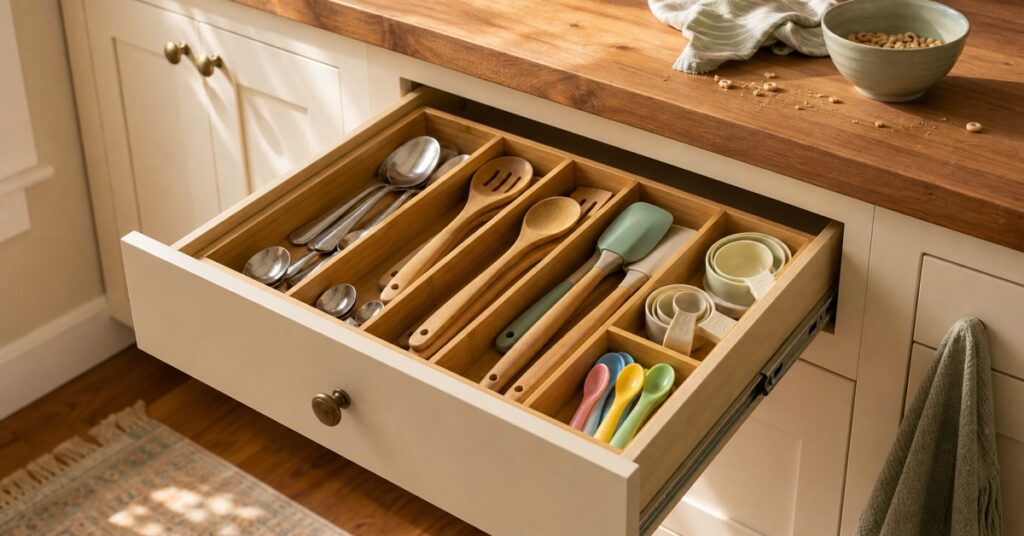
In a family kitchen, the flatware drawer rarely holds only forks and spoons. Kids’ utensils move in. Then come the serving spoons, corn holders, bag clips, measuring cups and the can opener that never seems to have a real home.
That is why a tray that looks roomy online can feel surprisingly small once it reaches your kitchen. The issue is usually not the number of compartments. It is a mismatch between the organizer, the inside of the drawer and the things your family actually uses.
I researched these picks by checking current U.S. product listings, brand specifications, professional organization advice and recent critical reviews for the specific products named below. I looked for products that solve different drawer problems instead of four nearly identical trays.
The short answer: choose the Lifewit for a large flatware drawer, the Pipishell if you want bamboo and can keep it dry, the OXO for long cooking tools, and the Vtopmart set for small gadgets.
Building your baby gear list?
Grab the free Baby Gear & Registry Checklist — every item sorted by budget, what to skip, and what’s safe to buy used, plus the safety & recall checks I run before buying.
The quick picks
- Best for a large family flatware drawer: Lifewit Extra Large Silverware Drawer Organizer
- Best bamboo organizer: Pipishell Bamboo Expandable Silverware Organizer
- Best for long and odd-shaped kitchen tools: OXO Good Grips Large Expandable Kitchen Tool Drawer Organizer
- Best modular set for small gadgets: Vtopmart 25-Piece Clear Drawer Organizer Set
Measure first: the five-minute drawer fit check
The most useful thing you can do before shopping is empty the drawer and measure the inside—not the cabinet front.
- Measure the inside width in three places. Check the front, middle and back. Older drawers are not always perfectly square.
- Measure the usable depth. Start at the inside front wall and stop before the back wall, hardware or anything else that reduces the space.
- Measure the usable height. A tray can fit inside the drawer box and still jam against the cabinet rail when you close it.
- Measure your longest tool. Tongs, ladles and spatulas often decide whether you need an open tool organizer instead of a flatware tray.
- Check your thickest handle. Put a ruler across the widest fork, spoon or toddler-utensil handle. Narrow slots that work for slim flatware may feel cramped with chunky handles.
For an expandable organizer, both ends of the size range matter. The organizer must fit at its smallest setting, and it should not need to press hard against the drawer walls when expanded. Leave a little breathing room so you can lift it out for cleaning.
If you are unsure how a layout will feel, cut paper or scrap cardboard to the organizer’s footprint and place it in the empty drawer. It is a simple way to see how much space will remain before you order anything.
Kitchen drawer organizer comparison
| Organizer | Best for | Size or fit | Material | Cleaning | Main watch-out |
|---|---|---|---|---|---|
| Lifewit Extra Large | Family flatware in a large drawer | 13–22.4″ W × 15″ D × 2″ H | PP plastic | Rinse or wipe; no dishwasher | Narrow, deep slots may not suit thick handles |
| Pipishell Bamboo | A warm wood look in a dry drawer | About 13–19.6″ W × 16.92″ D × 1.92″ H | Bamboo | Wipe lightly and dry completely | Moisture can lead to odor, swelling or mold |
| OXO Large Expandable | Long-handled and irregular tools | About 9.9″ W × 16.35″ D × 2.5″ H before expansion | Plastic | Removable parts for cleaning | Dividers can move; not a maximum-capacity tray |
| Vtopmart 25-Piece Set | Small gadgets and custom layouts | Four bin sizes, all 2″ high | Clear plastic | Damp cloth | Tapered bins are smaller inside than they look |
How I chose these organizers
I started with one rule: each pick had to solve a different family-kitchen problem. A large flatware tray should not compete directly with a set of tiny bins, and neither should be presented as the answer for long-handled cooking tools.
I checked the current listing for the specific size and color selected for fit, material, care instructions and availability. I also looked closely at lower-rated reviews because they are where fit problems usually appear: thick handles that will not sit flat, dividers that move, bamboo that does not tolerate damp conditions, or bins that look larger in photos than they are in a drawer.
None of these is perfect. The useful question is whether a limitation can be avoided by choosing the right household and drawer. These four could. Products with repeated complaints about failing at their main job were left out.
1. Lifewit Extra Large Silverware Drawer Organizer
Best for: A wide family flatware drawer with at least 15 inches of usable depth.
The Lifewit Extra Large Silverware Drawer Organizer is the most straightforward choice when a standard five-slot tray no longer holds your everyday flatware. It contracts to 13 inches wide and expands to 22.4 inches, so the side sections can take serving spoons, reusable straws or other pieces that would otherwise sit on top of the forks.
The plastic construction is practical for a busy drawer. It can be rinsed when crumbs collect in the corners, and you do not have to treat it as carefully as bamboo. The two-inch height is also low enough for many standard kitchen drawers, although you should still measure the clearance above your tallest handles.
The biggest limitation is the shape of the compartments. They are relatively narrow and deep. That works well for standard flatware, but chunky toddler utensils, rounded ergonomic handles and thick steak-knife handles can crowd the slots. When only a few pieces are in a deep compartment, they may also sit low enough to be less convenient to grab.
Skip it if: Your drawer is less than 15 inches deep, or most of your flatware has very wide handles.
Care note: Rinse or wipe it clean. The manufacturer says not to put it in the dishwasher.
2. Pipishell Bamboo Expandable Silverware Organizer
Best for: A dry drawer, a moderate amount of flatware and a family that prefers the look of bamboo.
The Pipishell Bamboo Expandable Silverware Organizer looks warmer than a black or clear plastic tray, especially in a wood kitchen. It expands from about 13 to 19.6 inches wide, revealing side compartments for serving pieces or small cooking tools.
Professional organizers often like this style because it combines categories in one footprint: everyday flatware in the center, less uniform pieces at the sides. It can make a wide drawer look more finished without requiring a custom insert.
Its limits come from the same material that makes it attractive. Bamboo should not stay damp. Recent critical reviews include reports of odor, splitting and mold, so I would not treat moisture care as a small footnote. Dry washed utensils completely before putting them away, wipe the organizer with a barely damp cloth and let it dry before returning it to the drawer.
The compartments are also shallower than the Lifewit’s. That can make flatware easy to see, but a large household set may pile up instead of settling into clean rows.
Skip it if: Your drawer is often humid, utensils go away while still wet, or you need the highest possible capacity.
Care note: Do not soak it or put it in the dishwasher. Stop using it if you see mold, a deep crack or a sharp splinter.
3. OXO Good Grips Large Expandable Kitchen Tool Drawer Organizer
Best for: Spatulas, tongs, ladles, can openers and other long or awkwardly shaped tools.
Flatware trays make sense for repeating shapes. Cooking tools are different. The OXO Good Grips Large Expandable Kitchen Tool Drawer Organizer uses a long open area, movable dividers and a small removable cup so you can create broader zones instead of forcing every tool into a narrow slot.
That open layout is the reason to choose it. A ladle can lie beside a spatula without the handles crossing into a pile, while bag clips, corn holders or wine stoppers can stay in the small cup. Non-slip feet help the organizer stay in place, and the removable pieces make corner crumbs easier to reach.
There are two important limits. First, the dividers are adjustable rather than permanently locked. They can shift or lift if a drawer is overfilled or a tool catches underneath one. Second, organizing creates boundaries, but boundaries take up space. If you currently have thirty tools stacked in one drawer, this organizer will not magically make all thirty fit.
Use it for the tools you reach for most. Move duplicates, seasonal grilling tools and rarely used gadgets somewhere else first. If those supplies still need an easy-to-reach home, compare our 3-tier rolling carts for family organization.
Skip it if: Your goal is maximum pile-it-in capacity, or your longest tools exceed the usable depth of the drawer.
Fit note: The closed footprint is roughly 9.9 inches wide by 16.35 inches deep and 2.5 inches high. The side expands, so check the current size image for this product before buying.
4. Vtopmart 25-Piece Clear Drawer Organizer Set
Best for: Measuring spoons, bag clips, peelers, thermometers and all the little pieces that disappear beneath larger tools.
The Vtopmart 25-Piece Clear Drawer Organizer Set is not a traditional flatware tray. It is a box of clear bins in four sizes, which makes it much more useful for a junk drawer or a mixed gadget drawer.
The set includes three 9-by-6-inch bins, six 9-by-3-inch bins, eight 6-by-3-inch bins and eight 3-by-3-inch bins. All are two inches high. You also get silicone pads to place on the bottoms after you settle on a layout.
This is the flexible choice for an awkward drawer because you do not need to fill every inch with one fixed shape. Start with the tools that truly need a boundary, then leave an open strip for something long. Clear sides make it easier to see small items, and unused bins can move to a bathroom, desk or craft drawer.
Look carefully at the dimensions before ordering. Many of the pieces are small, and the sides taper inward. That means the usable bottom is smaller than the outside rim. They are good for small gadgets but not for a family’s full set of forks and spoons.
Skip it if: You mainly need flatware storage or expect the largest bins to hold long cooking utensils.
Care note: Wipe the bins with a damp cloth. Do not put them in the dishwasher; high heat can warp the plastic.
One drawer, three family zones
Before putting everything back, sort it by how it is used rather than by what happens to fit.
1. Everyday flatware
This is the easy-to-reach zone for the forks, spoons and table knives adults use every day. Children’s spoons and other age-appropriate utensils can have their own compartment so a child is not digging beneath heavier adult pieces.
2. Cooking tools
Keep frequently used spatulas, tongs, ladles and openers close to the food-prep area. If a tool only comes out for a holiday or a summer barbecue, it does not need prime drawer space. The same principle helps when setting up a practical family meal-prep area; our guide to glass food storage container sets covers the container side of that setup.
3. Sharp and small items
A drawer organizer is not a child-safety device. The American Academy of Pediatrics’ HealthyChildren kitchen-safety guidance recommends keeping knives, forks, scissors and other sharp instruments separate from safe utensils and storing sharp cutting tools out of reach or in a locked space.
The CPSC also recommends safety latches or locks to reduce children’s access to knives and other sharp objects. No latch is completely childproof, so it still needs to be closed after every use.
For a toddler-accessible low drawer, keep only items that are safe for that child to handle. Adult knives, sharp forks, kitchen shears, peelers, corn holders and other pointed or very small tools belong in a locked drawer or somewhere the child cannot reach. Use our room-by-room babyproofing checklist to check the rest of the kitchen at the same time.
How to organize a kitchen drawer in 15 minutes
- Take everything out. Crumbs are much easier to remove before a new organizer goes in.
- Make three piles: daily, weekly and rarely used.
- Remove duplicates. You probably do not need four vegetable peelers in the most convenient drawer.
- Group by shape and job. Flatware, long tools and tiny gadgets need different boundaries.
- Test the footprint. Use paper or cardboard if the organizer has not arrived yet.
- Place daily items toward the front. Put less-used serving pieces toward the back or outer side.
- Open and close the drawer several times. Listen for scraping and check whether tall handles hit the cabinet above.
- Add non-slip pads last. Wait until you know the layout works before sticking anything down.
The goal is not to make the drawer look perfect for a photo. It is to make the right tool easy to retrieve and easy to put back on a rushed Tuesday night.
Cleaning and moisture care
Crumbs and small spills will eventually get underneath any tray. Every month or two, lift the organizer out, vacuum or wipe the drawer and clean the organizer according to its instructions.
- Rinse or wipe the Lifewit, but keep it out of the dishwasher.
- Wipe the Pipishell lightly and let both the bamboo and utensils dry completely.
- Remove the OXO dividers and cup to clean the corners.
- Wipe the Vtopmart bins with a damp cloth; do not expose them to dishwasher heat.
Replace an organizer if it develops mold that cannot be fully removed, sharp splinters, a deep crack or peeling plastic.
Frequently asked questions
What is the best type of kitchen drawer organizer?
It depends on the contents. Use a traditional or expandable flatware tray for repeating shapes, an open-zone organizer for long cooking tools, and modular bins for small gadgets. One type rarely handles all three well.
How do I measure for a kitchen drawer organizer?
Measure the internal width, depth and usable height. Check width at the front, middle and back, then measure your longest tool and thickest utensil handle. Compare those numbers with the current product page for the size and color you plan to buy, not only the listing title.
Is bamboo or plastic better for a utensil drawer?
Bamboo looks warmer and can feel more like a built-in insert, but it needs a dry environment and gentler cleaning. Plastic is usually easier to rinse and is the more forgiving choice for a busy family drawer. Neither material is automatically better for every kitchen.
Can I put kitchen knives in the same organizer as flatware?
Do not leave loose sharp knives mixed with everyday utensils, especially in a home with children. Use a purpose-built knife organizer in a locked or unreachable drawer, or another secure knife-storage method. Keep sharp adult tools separate from the utensils children are allowed to access.
What works best in a shallow drawer?
Start with the drawer’s usable height, including the space needed for handles. A two-inch-tall organizer may still jam if thick utensils sit above its rim. For an unusually shallow drawer, low-profile individual bins can be easier to fit than an expandable tray.
How do I stop a drawer organizer from sliding?
Choose a close fit without forcing the organizer against the walls. Add the included silicone feet, a thin non-adhesive drawer liner or removable museum gel if the manufacturer permits it. Clean dust and grease from the drawer bottom first.
Are plastic drawer organizers dishwasher-safe?
Only if the manufacturer explicitly says so. Plastic that looks sturdy can still warp under dishwasher heat. The Lifewit and Vtopmart organizers in this guide should be cleaned by hand.
Should kids’ utensils have their own compartment?
It can make daily routines easier, especially when children help set the table. The compartment should contain only age-appropriate items. A separate section does not make sharp adult flatware safe for a child to reach.
Which organizer should you choose?
Choose the Lifewit if your main problem is a large family flatware set spreading across a wide drawer. Choose the Pipishell if you want bamboo and know the drawer stays dry. Choose the OXO when spatulas, tongs and other long tools are the real source of the mess. Choose the Vtopmart set when tiny gadgets keep vanishing beneath everything else.
Measure first, choose the structure second and buy the product third. That order is less exciting than clicking on the prettiest tray—but it is much more likely to give you a drawer that stays organized after the first week.