Updated July 30, 2026
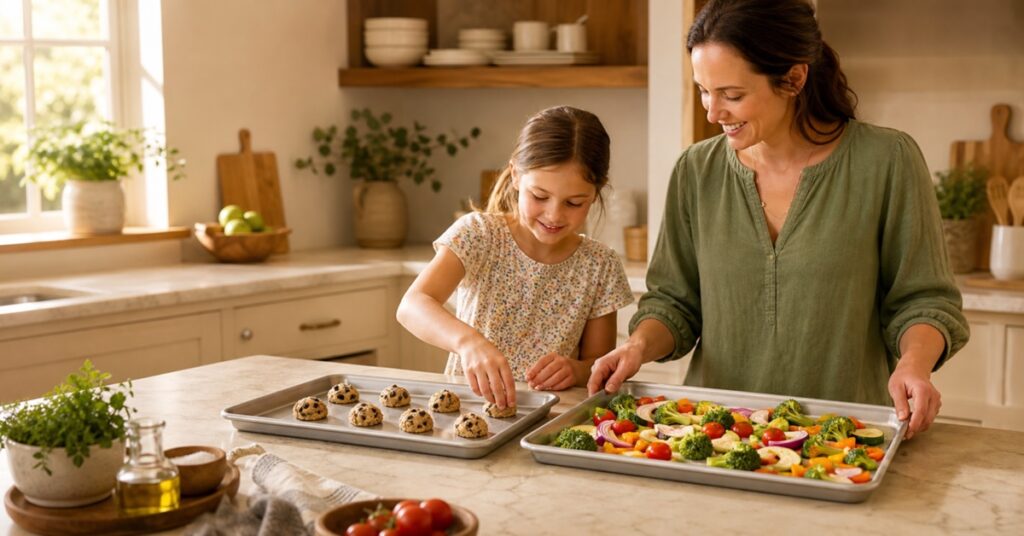
One baking sheet sounds like enough—until the chicken takes up half of it, the vegetables are packed too tightly to brown, and a bowl of cookie dough is still waiting on the counter.
The first choice is simpler than it looks: do you need two matching half sheets for batch cooking, or several sizes for jobs that range from a full dinner to a small tray of snacks? A good set gives every pan a reason to leave the cupboard.
If you want one purchase that covers the widest range of jobs, the Nordic Ware 3 Piece Baker’s Delight is the strongest starting point. Choose the Nordic Ware Half Sheet 2-Pack for two-rack baking and larger meal prep, or the Quarter Sheet 2-Pack when a full half sheet is usually more pan than you need. The USA Pan Half Sheet Set is the convenience pick for readers who prefer a coated surface and are willing to follow stricter care rules.
You will notice that three of the four picks come from Nordic Ware. That is deliberate. Several independent kitchen tests have repeatedly favored the brand’s uncoated aluminum half sheet, while the three sets below solve meaningfully different size problems. Brand variety is not helpful when it requires recommending a weaker pan.
The Quick Picks
| Baking sheet set | Best for | Set layout | Material | Care | Main trade-off |
|---|---|---|---|---|---|
| Nordic Ware 3 Piece Baker’s Delight | One versatile starter set | Half, jelly-roll and quarter sheet | Uncoated aluminum | Hand wash | Inspect nested pans for shipping scratches or dents |
| Nordic Ware Half Sheet 2-Pack | Batch cooking and two-rack baking | Two matching half sheets | Uncoated aluminum | Hand wash | Requires more oven and storage space |
| Nordic Ware Quarter Sheet 2-Pack | Smaller jobs and compact ovens | Two matching quarter sheets | Uncoated aluminum | Hand wash | Too small for a crowded family dinner |
| USA Pan Half Sheet Set of 2 | Easier release and cleanup | Two matching half sheets | Coated aluminized steel | Hand wash; no cooking spray | The coating needs gentler use and has a shorter lifespan than bare metal |
Start With the Layout, Not the Coating
A two-pack of half sheets and a three-size set can sit beside each other on a product page and still belong in different kitchens.
Choose two matching half sheets when…
- You often bake two trays of cookies or biscuits.
- A sheet-pan dinner needs more breathing room than one tray provides.
- You want different seasonings or meal components on separate pans.
- You already own smaller pans for nuts, reheating and side dishes.
Two identical pans also simplify timing. You are not asking a large pan and a small pan to brown the same food at the same rate. Your oven may still have hotter areas, though, so watch the food rather than assuming two racks will finish together.
Choose graduated sizes when…
- You want one half sheet for dinner and smaller pans for side dishes.
- You regularly toast nuts, reheat a few portions or bake a small batch.
- You prefer pans that nest into a tighter stack.
- You do not need two full-size trays in the oven at once.
Before buying either layout, measure the oven rack, the opening at the door and the shelf where the pans will live. Use the pan’s exterior dimensions. The cooking surface can be smaller than the footprint that must pass through the oven door.
The Best Baking Sheet Sets for Family Dinners and Baking
1. Nordic Ware 3 Piece Baker’s Delight — Best Overall
The Baker’s Delight set is the easiest recommendation for a family starting from scratch. It includes one quarter sheet, one jelly-roll pan and one half sheet, so the set can move from a small reheating job to cookies and then to a full tray of roasted vegetables without making every task use the biggest pan.
The official exterior measurements are 12.25 by 8.87 inches for the quarter sheet, 15.12 by 10.75 inches for the jelly-roll pan and 17.25 by 12.25 inches for the half sheet. All three have a rim just under an inch high. Those sizes are close enough to nest but different enough to earn separate jobs.
The pans are pure, uncoated aluminum with steel reinforcement inside the rims. Aluminum heats and cools quickly, which helps cookies begin baking promptly and reduces carryover cooking after the pan leaves the oven. The light-colored surface also gives you more room to judge browning than a dark coated pan.
This same construction is why the set will not stay showroom-pretty. Bare aluminum scratches, develops a patina and can darken in a dishwasher. Tomato, vinegar and other acidic ingredients may also discolor or pit the surface when they remain in contact for a long time. Those marks are different from a peeling coating, but readers who want a permanently spotless pan may find them frustrating.
Shipping condition deserves a careful look. Recent feedback for this exact three-piece set includes pans arriving scratched or dented where they were nested together. Unpack all three, run a hand carefully around the rims and set each pan on a flat surface before the return window starts ticking.
Best for: A family that wants one compact set for a large sheet-pan dinner, medium baking jobs and small portions.
Watch-outs: Hand wash, avoid metal knives and abrasive pads, and inspect every pan for shipping damage.
Skip it if: Two matching full-size pans are more useful to you than three graduated sizes.
2. Nordic Ware Naturals Half Sheet 2-Pack — Best for Batch Cooking
If your usual problem is not pan size but pan traffic, buy two matching half sheets. Each pan has an exterior footprint of about 17.9 by 12.9 inches and an interior measuring about 17.1 by 12.1 inches. That is enough surface to spread food out instead of building a small vegetable mountain in the center.
Independent tests give this pan unusually consistent support. The Kitchn’s 2026 testing chose the Nordic Ware Naturals half sheet after cookies, broccoli, cleaning and a high-temperature warp test. Food Network selected it as its aluminum pick, noting the same combination of even conductivity and a reinforced rim. Bon Appétit also chose it after repeated test rounds.
For a family dinner, the practical advantage is spacing. One pan can hold the ingredient that needs more time while the second holds a faster-cooking component. For baking, two identical pans let one batch cool while the next goes into the oven. They can also keep different flavors or dietary needs separate, as long as your utensils and work surfaces stay separate too.
Do not assume two half sheets will fit side by side or that every oven handles two racks evenly. Measure first. When both racks are in use, check browning and follow the recipe’s guidance about swapping rack positions. Opening the oven repeatedly can slow cooking, so rotate with a purpose rather than on a timer you copied from a different oven.
The main complaints are about fulfillment and finish rather than the basic cooking surface. Some buyers report receiving only one pan from the two-pack, while others describe dents, scratches or dishwasher discoloration. Count both pans immediately, inspect the rolled rims and keep them out of the dishwasher.
Best for: Two trays of cookies, two-part dinners, larger batches and households that already own smaller pans.
Watch-outs: Confirm that both pans arrived. Hand wash and expect the bright finish to develop marks with use.
Skip it if: Your oven, sink or storage shelf is tight, or you rarely need more than one large tray.
3. Nordic Ware Naturals Quarter Sheet 2-Pack — Best for Smaller Jobs
A quarter sheet is the pan you reach for when the half sheet would create more washing than dinner. Each pan in this two-pack measures about 12.9 by 9.6 inches on the outside, with an interior surface of about 12.1 by 8.8 inches. That makes it useful for a side of vegetables, a few cookies, toasted nuts, reheating pizza or keeping two small batches separate.
The pair can be especially practical in a kitchen with a compact oven. One pan might hold a mild seasoning for a child while the second carries the spicier version for adults. One can catch drips beneath a small baking dish while the other handles a snack. Smaller pans are also easier to fit into a sink after dinner.
Compact does not mean universal. Toaster ovens and air-fryer ovens vary widely, and handles, rack rails and door shapes can steal usable space. Measure the appliance rather than trusting the phrase “quarter sheet.” This set is also too small to be the only choice for a crowded family dinner.
Recent complaints for this exact two-pack cluster around dishwasher darkening, open-box-looking pans and packages that contained only one tray. Those are annoying but manageable boundaries. Hand wash the pans, count them when the box arrives and return a set that appears used or damaged.
Best for: Small batches, side dishes, reheating and compact-oven tasks after measuring the appliance.
Watch-outs: It is not a replacement for a half sheet. Dishwasher detergent can darken bare aluminum.
Skip it if: Your main goal is fitting a complete dinner on one tray.
4. USA Pan Half Sheet Set of 2 — Best Nonstick Option
USA Pan is the convenience choice, not the durability winner. Each half sheet is made from aluminized steel with a corrugated surface and the brand’s Americoat silicone nonstick coating. The official baking surface measures 17.25 by 12.25 inches, while the exterior measures 17.75 by 12.75 inches.
Granola, sticky glazes and baked-on cheese are where the coated, ridged surface earns its place. Food should be easier to lift and the pan should need less soaking afterward. The trade-off is less freedom at high heat and more care every time the pan is washed.
That convenience comes with rules. USA Pan lists a maximum of 450°F for this model. The company recommends hand washing, avoiding cooking spray and using silicone, nylon or wooden tools. A sharp metal spatula, knife or abrasive cleaner can shorten the life of the surface. Choose a bare aluminum pan for broiling or any recipe that routinely pushes above the coated pan’s limit.
Coating wear is the reason this pick stays fourth. Recent feedback for the same half-sheet pan includes difficult-to-clean grooves, early surface wear and occasional warping. A few of those complaints match the exact two-pan package. The overall evidence does not support calling the problem universal, but it does make “easy cleanup forever” an unrealistic promise.
Inspect the surface before the first use and keep checking it as the pan ages. If the coating begins to peel, chip or expose the base metal, retire the pan from coated food-contact use and contact the manufacturer. Parchment can help prevent messes; it cannot repair a failing coating.
Best for: A frequent baker who values release and cleanup and is comfortable protecting a coated surface.
Watch-outs: Stay at or below 450°F, hand wash, skip cooking spray and avoid sharp metal tools.
Skip it if: You broil often, want to scrape the pan freely or expect one set to last like uncoated metal.
What Baking Sheet Size Works for a Family Dinner?
Sheet-pan names came from commercial kitchens, so they can sound more exact than they are. A commercial full sheet is about 26 by 18 inches and is usually too large for a home oven. A half sheet is roughly 18 by 13 inches and is the everyday home workhorse. A quarter sheet is roughly 13 by 9 inches. A jelly-roll pan often falls between a quarter and a half sheet, but brands do not use the term consistently.
Size affects more than how much food fits. Food packed edge to edge traps moisture and steams instead of browning. A bigger pan—or a second one—can improve spacing, but it does not create a fixed serving count. Chicken pieces, broccoli florets and cookies all need different amounts of room.
Measure these three places before ordering:
- The oven opening: A pan that fits the rack still needs to clear the door frame.
- The usable rack: Leave room to grip the pan with oven mitts.
- The storage shelf: Half sheets are awkward when they must lean behind heavier cookware.
Uncoated Aluminum vs Coated Steel vs Stainless Steel
The material changes how the pan heats, how it ages and how much maintenance it needs.
Uncoated aluminum
Aluminum conducts heat quickly and is the material most consistently favored in current professional sheet-pan testing. Epicurious calls bare aluminum the most versatile option for heat response and browning, while still noting its tendency to stain, scratch and react with acidic foods.
Choose it when performance and longevity matter more than appearance. Use parchment, a silicone mat or the fat directed by the recipe when release matters. Hand washing protects the finish, although the pan will still develop a working-kitchen patina.
Coated aluminized or carbon steel
A coated pan can release food more easily, but it has a manufacturer temperature limit and a surface that can wear. Darker finishes may brown the bottoms of cookies faster than a light pan, so begin checking early when a recipe was developed on bare aluminum.
Choose coated steel for convenience, not for carefree abuse. No broiler, metal knife or dishwasher routine should be assumed safe unless the exact current manufacturer directions say so.
Stainless steel
Stainless steel avoids an applied coating and may be easier to clean aggressively, but it does not conduct heat like aluminum. That can change browning and timing. None of the stainless sets reviewed for this article had a strong enough combination of exact-model support, current performance feedback and independent testing to become a named pick.
How to Reduce Warping, Rust and Coating Damage
- Do not shock a hot pan with cold water. Let it cool on a stable heat-safe surface first.
- Stay within the exact temperature limit. A recipe that uses the broiler may need an uncoated pan.
- Avoid long empty preheats. Follow the recipe and manufacturer directions instead of heating an empty pan “just in case.”
- Hand wash when possible. Dishwasher detergent can discolor aluminum and shorten coating life.
- Dry rolled rims and seams. Water trapped around reinforced edges can lead to rust-colored runoff when steel is present inside the rim.
- Match the utensil to the surface. Coated pans need wood, silicone or nylon; bare aluminum still benefits from avoiding knives and deep scratches.
- Use parchment for cleanup, not concealment. A liner reduces sticking but does not make peeling coating safe to ignore.
A Simple Two-Pan Family Dinner Workflow
Two pans help most when they separate food by cooking time, not simply by color.
- Put the slower-cooking component in first, following a tested recipe.
- Add the faster component later or place it on the second pan.
- Leave space around ingredients so hot air can circulate.
- Use separate tools and surfaces for raw meat and ready-to-eat food. A two-cutting-board system can make that separation easier.
- Check doneness with a food thermometer rather than color alone.
- Move both hot pans to stable heat-safe surfaces beyond a child’s reach.
Family food-safety note: FoodSafety.gov recommends the clean, separate, cook and chill approach. Wash utensils and surfaces that touched raw meat, poultry, seafood, eggs or flour before reusing them, and follow the current USDA safe minimum temperature chart. Children can help with cool ingredients away from the oven; an adult should move hot pans and handle raw proteins.
Once dinner is cool enough to store, move leftovers into glass food storage containers designed for refrigeration rather than covering the sheet pan and taking up an entire shelf. For baking days, setting out measured ingredients in mixing bowls before the oven gets busy can also make the two-pan rhythm calmer.
Baking Sheet Set FAQs
What is the difference between a baking sheet and a cookie sheet?
The names are often used loosely. A rimmed baking sheet or sheet pan has raised edges on all four sides, which makes it safer for roasted foods, oil and juices. A traditional cookie sheet may have one raised edge and otherwise be flat so cookies can slide off. For family dinners, a fully rimmed pan is usually the more versatile choice.
Is a half sheet pan too large for a home oven?
A half sheet is designed as a common home-oven size, but compact, wall and countertop ovens vary. Measure the exact rack and oven opening against the product’s exterior dimensions. Do not rely only on the words “half sheet.”
Is aluminum or stainless steel better for baking?
Uncoated aluminum is usually the easier choice for predictable cookie browning and quick heat response. Stainless steel is durable and uncoated but transfers heat differently, so a recipe developed on aluminum may brown or finish differently. The pan’s thickness, rim and finish matter too.
Can baking sheets go in the dishwasher?
Follow the exact manufacturer directions, but hand washing is the safest default for the four sets here. Dishwasher detergent darkens bare aluminum, and repeated machine washing can shorten the life of a nonstick coating. A “dishwasher-safe” label does not necessarily mean the pan will keep its appearance.
Do I need parchment paper on a nonstick baking sheet?
Not for every recipe, but parchment can still reduce residue and protect the finish. Check the parchment package for its own heat limit. Never place parchment under a broiler or exposed to heat beyond its directions.
Why did my baking sheet pop in the oven?
Metal expands as it heats. Uneven temperature changes can make a pan flex suddenly and make a popping sound. Some pans settle flat again as they cool; others develop a permanent warp. Reduce thermal shock, avoid pouring cold liquid onto a hot area and stop using a pan that no longer sits securely on the rack.
When should I replace a coated baking sheet?
Replace or contact the manufacturer when the coating peels, chips, blisters or exposes the base metal. A few baked-on stains are different from structural coating failure. When in doubt, follow the brand’s current support guidance rather than trying to cover damaged coating with foil or parchment.
Which Set Should You Choose?
Choose the Nordic Ware 3 Piece Baker’s Delight when you want one nesting set that can handle large, medium and small jobs. Choose the Nordic Ware Half Sheet 2-Pack when two full trays are part of your weekly routine.
The Quarter Sheet 2-Pack is the smarter buy for small portions, side dishes and compact-oven tasks after measuring the appliance. Pick the USA Pan set only when easier release matters enough to justify a 450°F limit and gentler coating care.
Buy for the job you do every week, not the piece count on the box. The best set is the one that gives your dinner enough room and does not leave two forgotten pans at the back of the cupboard.