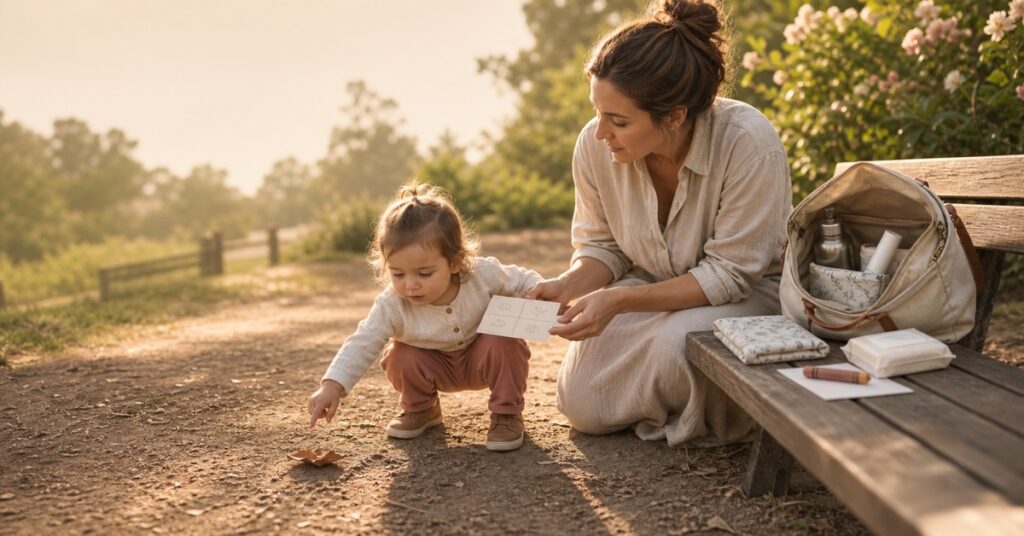
One shoe is on. The water cup is still upside down in the drying rack. Your toddler has already brought you a plastic shovel and three rocks that apparently need to come too.
This is usually the moment a simple walk starts to feel like a field trip.
Here is where I would start: do not buy the little explorer backpack. For a 30- to 90-minute walk near home, sun protection, water, and somewhere to put the wet sock that appears on the way back will help more than a set of binoculars. The learning part can begin on an index card.
The one list to check before you leave
You probably own most of it already. Buy only where your current item leaves a real gap.
| Pack this | Why it earns space | Buy only if… |
|---|---|---|
| Your current sunscreen, or Blue Lizard Baby Mineral SPF 50, 3 oz | Covers exposed skin as part of a sun plan | You need a small mineral option and your child’s skin tolerates it |
| Your current water cup, or THERMOS BABY 10 oz Straw Bottle, Rose | Makes a quick water stop easier for an 18m+ child | The cup you own leaks, is hard for your child to use, or rarely gets fully clean |
| A four-box index card | Gives the walk one small thing to notice | No purchase—draw it at home |
| WaterWipes Sensitive+ On The Go, 28 Count, or a damp cloth | Removes visible dirt until you reach soap and water | You do not already carry a suitable wipe or cloth |
| ALVA 2-Pack Wet/Dry Bags, 01 Grey, or a large zipper bag | Keeps wrung-out socks and muddy clothes away from the rest of the bag | You expect wet ground and have no reusable alternative |
| Honeysticks Super Jumbo Crayons, 6 Pack | Lets a child make one after-walk mark instead of bringing nature home | Your child is at least two, past mouthing art tools, and you do not own a chunky crayon |
| Carson BugView 5X HU-10 | Offers a brief, adult-led close look for a careful child 3+ | Your child can wait, follow a release cue, and use it under direct supervision |
| A few bandages from home | Covers the ordinary small scrape | No purchase—use your existing first-aid supplies |
Before the door opens, solve sun and water
Fill the water cup you already own, turn it upside down over the sink, and check two things: does it leak, and can your child drink without handing it back to you? If it passes, put it in the same side pocket every time and stop shopping.
If it fails, the THERMOS BABY 10-ounce straw bottle is the first product I would consider replacing. It is intended for children 18 months and up, with a covered straw and a body small hands can hold. Ten ounces keeps it compact for a short walk; it also means it is not an all-day water supply. The bottle is for cold drinks only, and the straw and seals must come apart for cleaning. A lid assembled in a hurry can leak, so give it the same upside-down check before it goes beside your phone.
See the exact Rose 10 oz bottle on Amazon
Use the sunscreen that already agrees with your child’s skin. There is no benefit in opening a new formula just because it appears on a packing list.
If you do need a small mineral option, the Blue Lizard Baby Mineral SPF 50 3-ounce tube is a reasonable bag-size choice for children over 6 months. It is broad-spectrum and labeled water resistant for up to 80 minutes. The tradeoff is easy to feel: the lotion is thick, takes time to spread, and may leave a strong white cast. Some families also report irritation. Apply it at home while the shoes are still off, and stop if it bothers your child’s skin.
The American Academy of Dermatology recommends broad-spectrum, water-resistant SPF 30 or higher for children over 6 months, used as directed on skin clothing does not cover. Shade, protective clothing, and a useful brim still matter. If your child has eczema or very reactive skin, keep using the plan recommended by their clinician rather than experimenting on the morning of a walk.
Let one small question lead the walk
A toddler nature walk does not need six activities. On an index card, draw four boxes:
- something green;
- something rough;
- a bird or bird sound;
- one thing that changed since the last walk.
Choose one box before you leave. If your toddler ignores it and watches an ant, let the card stay in the bag. The point is to notice something together, not finish an assignment.
An adult phone can save one photo, which is usually enough. In parks and protected places, the National Park Service recommends leaving natural objects where they are. A photo or one mark on paper lets the leaf, rock, or flower stay outside.
For a child who wants to make something afterward, one Honeysticks Super Jumbo crayon and a small piece of paper are plenty. I would wait until at least age two and until mouthing art supplies is truly over. The large shape is easy to hand over one at a time, but the beeswax is firm, the color can look faint, and it is not washable. Keep the box with the adult and discard a crayon if it cracks, chips, or leaves a loose piece. If chunky crayons already live in your kitchen drawer, use those.
The Carson BugView HU-10 is a later, more selective add-on. For a careful child age three or older, its 5× lens can offer a brief close look without putting a cord around the child’s neck. I would begin by holding it over bark, moss, or a safe fallen leaf. Nothing needs to be caught.
If you do use the sliding door with a familiar, harmless ground insect, the adult should demonstrate, control the tool, and release the insect quickly. The door can warp or come out of alignment, so inspect it at home and return a faulty one. Skip this product if your child is likely to chase, jab, squeeze, or run with it. Do not use it around bees, wasps, spiders, caterpillars, or anything you cannot confidently identify as safe. Carson’s instructions also warn that the magnifier must be kept out of direct sunlight because it can focus light and create a fire risk.
Older preschoolers who genuinely want several observation tools are making a different purchase; that is where a dedicated nature explorer kit guide is more useful. For this toddler walk, I would not add binoculars, a whistle, a compass, or a net.
Plan for the wet sock, not the perfect photo
The part worth planning for is the part nobody photographs. Your toddler touches damp bark, reaches for a snack, then sits in wet grass.
A compact pack of WaterWipes Sensitive+ On The Go can remove visible dirt until you reach soap and water. That sentence is the boundary: these wipes clean visible mess; they do not disinfect hands, and they are not for cleaning a cut. The small pack is convenient, but its clear resealable flap can tear or stop sticking. If you already carry a damp cloth or a wipe that suits your child, keep using it. If you buy this pack, check the seal before it disappears into the bottom of the bag.
The ALVA two-pack wet/dry bag is the product I would add before another learning toy when rain, puddles, or wet grass are likely. Fold one empty bag at the bottom of the adult bag. On the way home, wring out damp socks or muddy pants and zip them inside so they do not sit against the sunscreen, clean clothes, or paper.
The fabric resists moisture, but the stitched seams can leak. It is not a container for dripping swimwear or pooled water, and it will not seal in every odor. Empty it as soon as you get home and let it dry fully. A large zipper bag or reusable grocery bag works just as well if you already have one.
See the exact ALVA 01 Grey two-pack on Amazon
Then slide a few bandages from your home supplies into a clean envelope. That is enough for an ordinary small scrape on a local walk. A remote trail, known allergy, long day, or place far from help needs a proper first-aid plan for that outing; this small envelope is not meant to replace one.
What changes after rain or on a longer walk
Do not rebuild the whole bag. Change only what the ground and the clock change.
- For a dry 30-minute loop: take the core items in the table and leave the crayon and BugView at home.
- After rain: add the ALVA bag, spare socks or pants, and either WaterWipes or a damp cloth. Skip the crayon while hands are wet.
- For 60–90 minutes: check that 10 ounces of water is enough for the route or plan a refill. Bring your child’s familiar, age-appropriate snack only if the timing crosses snack time, and supervise eating.
- For a curious child 3+: add the BugView only if you already intend to stop and supervise it. Do not pack every optional tool simply because you own it.
Hot, buggy, smoky, or poor-air-quality days can change the outing itself. Check current local conditions and shorten, move, or cancel the walk when needed. If insects are the main problem, use an age-appropriate insect repellent guide rather than adding an unverified spray to this bag.
Start with the bag you already own
Put the water cup in the same pocket. Fold the wet bag at the bottom if the ground is damp. Slide one hand-drawn card beside your phone.
That is enough to try tomorrow. If the walk goes smoothly, you do not need more gear. If one repeated problem remains—leaking water, no clean place for wet clothes, or a three-year-old who truly wants a closer look—then the next purchase has a reason to be there.