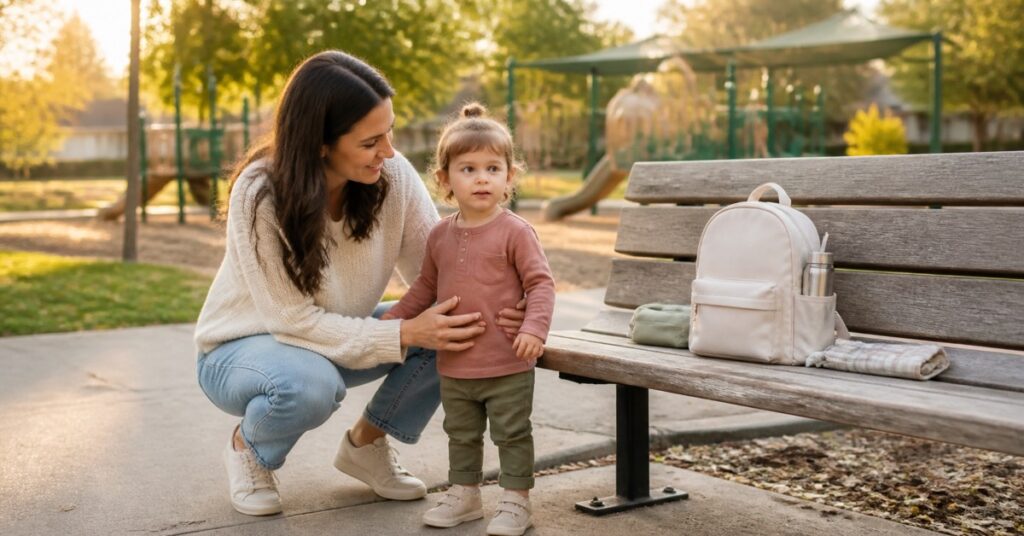
A one-hour park trip has a funny way of producing three bags—while the wipes you actually need are still on the kitchen counter.
After enough outings with my sons, I have found that short trips feel easier when every item has a job. You need water, a diaper or potty plan, and a clean way to handle small messes. Everything else should earn its place.
This checklist is for a neighborhood playground and about one to three hours away from home—not a theme park or all-day outing. The goal is one small backpack, with bulky backups in a genuinely nearby car.
Quick answer: Pack water, wipes, a realistic diaper or potty plan, one change of clothes when accidents are plausible, a containment bag, and the parent essentials that let you leave quickly. Add a seated snack, sun or bug items, splash gear, and a tiny first-aid pouch only when the trip actually calls for them.
The 30-Second Toddler Park Bag Checklist
| Always in the small bag | Add only when needed | Leave in the car or stroller basket |
|---|---|---|
| Water in a cup your toddler already knows | A seated snack if the trip crosses snack time | A bulky standalone travel potty |
| Diaper, pull-up, or realistic potty plan | Sunscreen for a scheduled reapplication | Extra clothes beyond one needed change |
| Wipes | Bug repellent when mosquitoes or ticks are likely | Spare shoes and a full-size towel |
| One change of clothes when accidents are plausible | Splash-play clothes or swim diaper | Refill supplies and a larger first-aid kit |
| Wet bag or another containment bag | Light rain or wind layer | Other non-urgent “just in case” gear |
| Phone, keys, payment method, and personal emergency medicine | Tiny first-aid pouch | — |
That is the quick answer. Before you zip the bag, use four questions to delete what your particular park trip does not require.
Use This Four-Question Filter Before You Pack
1. One hour or three?
A quick loop may not cross a snack, diaper, sunscreen, or potty interval. Pack around your toddler’s usual rhythm, not an arbitrary item count.
2. Is the restroom usable?
“There is a restroom” is not the same as open, close, and workable with a toddler. A reliable toilet may justify a compact seat reducer; no toilet may justify a standalone potty during toilet learning.
3. Water, mud, or sand?
A splash pad changes the bag more than an extra hour of ordinary play. Add the usual water-play gear, one dry outfit, a small towel, and a wet bag only when needed.
4. Is the car truly close?
A trunk half a mile away is not a backup layer. A nearby car can hold the bulky potty, extra shoes, towel, refills, and larger first-aid supplies.
The Core Kit for a Short Park Trip
Water your toddler can actually use
Bring plain water in the cup or bottle your child can already open and drink from. A brand-new valve, a heavy bottle, or a stiff button is a poor surprise when your toddler is hot and impatient.
There is no useful one-size-fits-all “park amount.” The American Academy of Pediatrics notes that fluid needs vary with the child, activity, heat, and humidity. Its daily guidance is not a formula for a two-hour outing. Offer water before leaving, pause for water during play, and know whether you can refill. Read the AAP hydration guidance.
For a child 18 months or older, one researched option is the THERMOS 10 oz Kids Bottle. Its small size suits a short trip, but an insulated bottle is heavier than a simple plastic cup and has more parts to clean. Use it for water, keep it upright in an outside pocket, and inspect the lid after a hard drop.
Skip it if: your toddler is under 18 months, cannot operate the lid, or already has a familiar cup. For 12–17 months, bring that age-appropriate cup rather than buying one from a list. Compare age-matched toddler water bottles and transition cups if you need a replacement.
One snack plan—with a place to sit
If the trip does not cross snack time, you may not need food. Otherwise, bring one familiar, age-appropriate snack. Without a cold pack, choose something shelf-stable. USDA outdoor guidance limits perishables outside safe temperature control to two hours, or one hour above 90°F. When in doubt, throw it out. Review USDA outdoor food-safety guidance.
Most important: stop and sit for the snack. The AAP advises that young children should not run, walk, play, or lie down with food in their mouths, and adults should supervise eating. A snack cup reduces some accidental spills; it does not reduce the choking risk of the food inside. See the AAP choking-prevention guidance.
The Munchkin Snack Catcher 2-Pack is a simple 12-month-plus option for dry snacks. The manufacturer lists a 9-ounce capacity and top-rack dishwasher cleaning. Its flexible flaps can slow down an accidental dump, but a determined toddler can still shake out crumbs, lift a flap, or remove the lid.
Best for: a seated, supervised snack when an open bowl would be awkward. Skip it if: your child finds the flaps frustrating, tends to dismantle snack cups, or an ordinary lidded container you already own works better. For more options, see our guide to toddler snack cups.
A diaper or potty plan—not both systems by default
For diapers or pull-ups, pack the change your trip is likely to cross, wipes, and a containment bag. For toilet learning, let the park facilities decide whether any potty product comes along.
With a usable restroom, the Frida Baby Fold-and-Go Potty Seat is a compact research pick with a grippy base, flexible side handles, and a travel bag.
Its folding joints also require care. Open the seat fully and flat, test that it sits securely on the toilet, and keep an adult hand stabilizing it. The flexible handles are not weight-bearing, and a toddler should never climb onto the toilet or use the seat alone.
Use this branch when: the park has a restroom you have good reason to expect is open and usable. Skip it if your child already sits comfortably on that toilet or your current routine works without extra gear.
With no restroom and a nearby car or stroller, the OXO Tot 2-in-1 Go Potty solves a different problem. The 12-month-plus, 50-pound-limit design can stand alone with a liner or rest on a toilet, and it includes three bags. Independent hands-on testing supports its quick setup while noting its low height and ongoing need for liners.
That versatility takes space. Keep it in the trunk or stroller basket rather than treating it as a default backpack item. Set it on flat ground, lock the legs as directed, or confirm a stable fit before your child sits.
Use this branch when: there is no usable toilet and a nearby car or stroller can carry it. Skip it if your child is not potty training, or if bringing a bulky potty would cost you more mobility than a shorter visit. See the full travel potty decision guide.
Wipes and one containment bag
Wipes handle diaper changes, muddy hands, and mysterious park grime. Bring the type your family already uses and carry waste out when no bin is available.
A single wet bag can hold a damp outfit, muddy socks, or accident clothes. The Bumkins Wet Bag is approximately 12 by 14 inches, folds flat when empty, and can be machine washed and hung to dry. It has one compartment, so it does not separate clean and dirty items by itself.
Use it as containment, not as a dry bag. Wring out wet clothes first, avoid standing liquid, and keep the zipper upright inside the main compartment. If a reusable grocery bag or zip bag already does this job for you, use that instead.
Sun, heat, and bugs
Sun protection starts before the bag. Favor shade and cooler hours, add a brimmed hat and protective clothing, and apply sunscreen before leaving. AAP guidance recommends broad-spectrum sunscreen 15–30 minutes before outdoor time, then about every two hours and after swimming, sweating, or towel drying. Read the AAP sun-safety guidance.
Bring sunscreen when your timing means you will need to reapply. Bug repellent is conditional. The CDC recommends an EPA-registered product used by its label. Do not use OLE- or PMD-containing products on children under 3, or put repellent on hands, eyes, mouth, cuts, or irritated skin. An adult applies it to their own hands before a child’s face; use sunscreen first and repellent second. See the CDC guidance, then use our age-based guide to safe mosquito repellent for babies and toddlers if you need product options.
A very small first-aid plan
For a neighborhood park, a few adhesive bandages, clean gauze, gloves, and your child’s personal emergency medication may be enough. The larger kit can stay in the car when the car is nearby.
Do not leave temperature-sensitive medicine in a hot car. Follow your child’s existing medical plan for epinephrine, inhalers, seizure medicine, or other prescribed emergency supplies. This list does not replace first-aid training or medical advice; our family first-aid kit guide covers the larger setup.
The parent exit kit
The last essentials are yours: phone, keys, payment method, your own water, and whatever lets you leave quickly. A smooth exit matters more than one more toy when a toddler is overheated, injured, frightened, or simply done.
Add These Only When the Day Calls for Them
Splash pad or water play
Add your child’s usual water-play gear, one dry outfit, a small towel, and a wet bag. Skip it during diarrhea. The CDC says not to swallow the water, to take bathroom breaks or check diapers about hourly, and that swim diapers do not keep germs out. Read the CDC splash-pad guidance.
Hot, sunny, or buggy weather
Choose a cooler time and shade, bring extra water, and shorten the visit if needed. Add sunscreen for reapplication and labeled repellent only when exposure calls for them. A fan is not a substitute for leaving unsafe heat.
Cool, windy, or rainy weather
Add one light layer or rain shell and check wet surfaces before play. A short visit does not require an entire second wardrobe.
No restroom or no car nearby
A nearby car plus no restroom favors OXO; a usable restroom favors a small reducer such as Frida. No restroom and no car may mean a shorter visit or different park—not two potty systems.
Pack in Three Layers So You Can Find Things
Quick access
Water in the outside pocket, wipes near the zipper, and any immediately needed sun item.
Inside the bag
Diaper or potty seat, one change of clothes, snack, wet bag, and tiny first-aid pouch.
Car or stroller backup
Standalone potty, extra shoes, larger towel, refill supplies, and the larger first-aid kit.
The system is simple on purpose. If you have to empty the backpack to find water, the bag is too complicated for a playground.
What Not to Pack for a Short Park Visit
- A pile of toys. The playground is the activity.
- Multiple spare outfits without a specific reason.
- Perishable snacks without a cold source.
- A full medicine cabinet or over-the-counter medication “just in case.”
- Necklaces, scarves, drawstring clothing, jump ropes, pet leashes, or other corded items near play equipment.
- A bicycle helmet left on while using playground equipment.
- Any snack plan that expects a toddler to eat while walking, running, or climbing.
If the day has expanded into meals, naps, long transit, and several locations, switch to the all-day outing kit. That is a different packing problem.
Do a 20-Second Playground Safety Scan
Before your toddler climbs, look at the whole space.
- Find the equipment marked for your child’s age and ability.
- Notice broken parts, added ropes, poor sight lines, or older-kid traffic crossing the toddler area.
- Check that the landing area and protective surface are present and not badly displaced.
- Check exposed slides, platforms, and surfacing for heat; the CPSC warns they can burn even in mild weather after direct sun.
- Remove helmets with chin straps, necklaces, scarves, and clothing with drawstrings or dangling cords.
- Stay close. Toddlers can use equipment in ways no checklist predicts.
The CPSC Playground Safety Handbook covers supervision, age-appropriate equipment, surfacing, heat, and entanglement. A quick scan cannot certify a playground, but it may find a reason to move—or leave.
Quick Questions
Do I need a stroller or wagon for a two-hour park trip?
Only if distance, accessibility, tired legs, or required gear justify it. For a nearby playground and walking toddler, a small backpack is often simpler than a loaded wagon.
How much water should I bring for a toddler?
Follow your child’s familiar pattern, expected heat and activity, and refill access. Do not turn an all-day fluid guideline into a fixed two-hour quota. Offer water before play and during breaks.
What if the park has a splash pad?
Add the usual water-play gear, a dry outfit, small towel, and wet bag. Check diapers or take a bathroom break about hourly, prevent water swallowing, and skip it during diarrhea.
What should I pack for a newly potty-trained toddler?
Pack a compact reducer when a usable toilet exists, or keep a standalone potty and liners in the car when it does not. Add wipes, a change of clothes, and a containment bag—not both potty products.
A Small Bag Is the Point
Pack for the park you are actually visiting, not every park-day emergency your tired brain can invent.
Water, wipes, a realistic diaper or potty plan, and a way to contain a mess form the core. Snacks, sunscreen, repellent, splash gear, and bulky backups earn their place only when time, weather, facilities, and distance require them. The result is a bag you can carry, open, and leave with quickly.