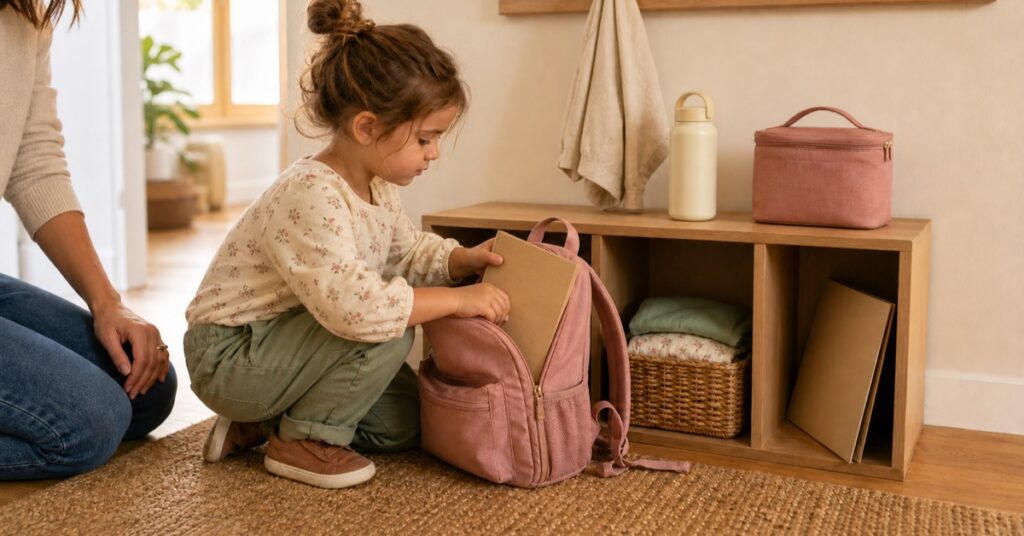
Short answer: Most preschoolers need a backpack only if the program asks for one, a labeled water bottle if the classroom requires it, lunch or a snack only when families provide food, and one complete change of clothes. Spare clothes usually belong in a cubby rather than traveling every day. Nap bedding, comfort items, sunscreen, diapers, medication, and weather gear are school-specific—not automatic backpack items.
Preschool packing sounds simple until the school email says “bring a backpack” and leaves the rest to your imagination. Then the back-to-school aisle suggests a miniature office, a three-piece lunch set, an extra pouch for every possible accident, and a nap mat you may never need.
Before opening a shopping tab, sort the school day: what has to travel, what can stay in the cubby, and what does the program already provide? Once those jobs are clear, the daily kit usually gets much smaller.
This guide separates the gear into four places: what travels every day, what stays at school, what comes home for a weekly reset, and what should wait for a written request. It also includes a one-minute independence test, because the best preschool container is not the one with the most features. It is the one your child can recognize, open, close, and put away without a rescue.
Before You Buy Anything, Ask the School These Six Questions
- Does the program provide lunch and snacks? If it does, an entire lunch system may disappear from your shopping list.
- Does the backpack need to hold a letter-size folder? Some programs send artwork and papers home flat; others use a tiny communication pouch or no daily bag at all.
- Do spare clothes stay in a cubby? If yes, they do not need to add weight and bulk to the backpack every morning.
- Is there a nap? Ask for the exact bedding dimensions, storage rule, and wash schedule before buying a mat, sheet, blanket, or pillow.
- What are the rules for bottles, sunscreen, comfort items, and food? Classrooms vary on straw cups, nuts, glass, outside sunscreen, stuffed animals, and cold storage.
- How are medication, allergies, and emergency plans handled? Ask for the forms and adult handoff procedure. Do not treat medication as an ordinary backpack item.
These questions are not administrative trivia. Each answer can delete a purchase, change the required size, or keep an important item from being rejected on the first morning.
The Preschool Daily Kit at a Glance
| Where it belongs | What usually goes there | When to remove it |
|---|---|---|
| Goes every day | School-required backpack or folder, labeled water bottle, and lunch/snack only when the family supplies food | Remove anything the school provides or does not want traveling daily |
| Stays at school | One complete change of clothes, including underwear and socks; clean spare bag; indoor shoes or toileting supplies if requested | Carry it daily only when there is no personal cubby or staff asks you to |
| Comes home weekly | Nap bedding, used outerwear, cubby clothing that needs washing or a size/season check | Skip bedding for half-day programs or when the school supplies it |
| Special-case only | Comfort item, sunscreen, diapers or pull-ups, rain gear, allergy plan, medication, or emergency supplies | Do not send these without the program’s written rule or direct request |
The easiest place to overpack is the cubby category. Spare clothes matter, but they rarely need a daily round trip. The easiest place to underpack is the “complete” part: a shirt and pants do not solve an underwear-and-socks accident.
Choose the Kit by Your Child’s School Day
Half day + food provided
- Backpack or folder only if requested
- Water bottle only if requested
- Complete spare outfit in the cubby
- No automatic lunch box, ice pack, or nap purchase
Half day + family snack
- Add one easy-open snack container
- Use cold storage only for food that requires it
- A shelf-stable snack does not need a full lunch system
- Confirm allergy and choking rules
Full day + packed lunch
- Backpack or parent-carried school bag
- Water bottle
- Lunch container matched to the food
- Insulated bag and two cold sources for perishables
- Nap gear only when requested
Potty training or frequent accidents
- Ask how many full changes the teacher wants
- Include underwear and socks
- Choose easy elastic-waist clothes
- Use an existing gallon bag or washable sealed bag for wet clothes
The Four Gear Decisions That Matter
1. A backpack that fits the program and the child
Measure the school’s folder, the cubby opening, and the lunch system before measuring a backpack against a product photo. Bigger is not automatically safer or more useful. The American Academy of Pediatrics’ backpack guidance favors a child-proportional bag with two broad adjustable straps, a close fit, and compartments that help distribute weight. A preschooler who leans forward or cannot manage the bag independently is carrying too much or wearing the wrong fit.
The one exact backpack that passed this article’s product screen is the Simple Modern Fletcher Kids’ Backpack, Medium 12L, Pink Ballerina. The brand lists it at 15 × 11.5 × 5.25 inches, with a chest strap, two expandable bottle sleeves, and room for folders and small books. That size can work for ages 3–5, but it is not a promise that every school folder, lunch bag, and cubby will match.
Its main caveat is durability variation. Current exact-color low-star feedback repeats zipper or seam failures alongside occasional arrived-dirty complaints. Inspect every seam and zipper as soon as it arrives, load it lightly during the return window, and use the brand warranty if construction fails. Also note that the bag is wipe-clean and air-dry, not machine washable.
Best for: a program that requires a full-size folder and a child who can manage a 15-inch bag.
Skip it if: the school does not require a daily backpack, the cubby is narrower, or the bag sits below the child’s lower back and causes forward leaning.
Measure first: folder, cubby, and the loaded lunch system—not just the child’s height.
Check the exact Fletcher Medium backpack on Amazon →
Need a different size or cleaning setup? Use the fit rules in our daycare backpack guide rather than assuming another color or size is identical.
2. A water bottle your child already knows how to use
A preschool bottle has four jobs: open easily, close completely, survive an upside-down bag test, and come apart far enough to clean. If the bottle already in your kitchen passes those jobs, keep it. Familiarity is an advantage on a busy first week.
I am deliberately not naming a new bottle here. Two popular current models were removed after deeper checks found repeated leaking, straw or button failures, and hard-to-clean parts. A broad brand reputation cannot make those day-to-day problems disappear.
Fill your existing bottle with water, close it the way your child normally would, place it upside down on a dry towel for ten minutes, then shake it inside a washable bag. Next, have your child open, drink, close, and repack it without a prompt. Finally, take apart every straw, valve, and gasket you will need to wash. If any step fails, use our toddler water-bottle cleaning guide to check the mechanism before choosing a replacement by character print.
3. A lunch system matched to the food
Lunch gear is where one purchase quietly turns into four. Slow down and match the pieces to the food: a bento box holds it, an insulated bag slows warming, ice packs create the cold source, and a vacuum jar handles a separate hot route.
For a perishable cold lunch, the USDA recommends a soft-sided insulated bag and at least two cold sources, placed above and below the food. Start with a lunch container your child already knows how to open. The selected outer system uses the Bentgo Kids Prints Lunch Bag and two Fit & Fresh Cool Coolers XL Slim ice packs, but it still has to pass the fit and temperature tests below.
Temperature is only half the lunch-safety check. Prepare each food to your child’s chewing skills and the classroom’s rules. The CDC’s choking guidance flags whole grapes or cherry tomatoes, hard raw fruit and vegetable pieces, nuts, popcorn, spoonfuls of nut butter, and round pieces of sausage or hot dog among the foods that need avoiding or safer preparation for young children. Preschoolers should eat seated and supervised, not while walking with the bag.
| Cold-lunch role | Exact product | Why it fits | Watch-out |
|---|---|---|---|
| Portion and seal | A container you already own | Familiar latches reduce first-week friction | Child must open it; avoid soup unless the container and school are set up for it; wash and dry every seal fully |
| Insulated outer layer | Bentgo Kids Prints Lunch Bag, Dinosaur 11 × 9.5 × 3.5 in |
Compact soft-sided bag with room for a small container and slim cold packs | Wipe-clean only; must be tested with the actual container, backpack, and cubby |
| Two cold sources | Fit & Fresh Cool Coolers XL Slim 4-Pack 7 × 4.75 × 0.5 in each |
Use two while the other two refreeze; each clears the USDA 5 × 3-inch example | Only a timed food-temperature test proves the setup works for your schedule |
The lunch bag is 3.5 inches deep on the outside, but exterior dimensions are not interior clearance. Put the real food container between two half-inch ice packs and close the bag without forcing it. If the zipper compresses the container seal, the combination fails the fit test.
Check the matching Bentgo Dinosaur lunch bag →
Check the exact Fit & Fresh XL Slim 4-pack →
For more cold-pack shapes, sizing tradeoffs, and real-lunchtime testing, see our guide to ice packs for kids’ lunch boxes.
For a hot lunch, use a vacuum jar only if the school accepts it, an adult can pack it safely, and the child can open the filled jar. The conditional pick here is the Thermos FUNtainer Food Jar 10 oz, Purple, model F3100PU6. Thermos lists “up to” five hours hot, but that is not a food-safety guarantee. Follow the USDA method: preheat the clean jar with boiling water, add thoroughly heated food, close it promptly, and test the food at your child’s real lunchtime with a clean thermometer. The target for hot holding is at least 140°F.
Have your child practice with an empty or cool jar only. If the warm filled jar becomes too tight to open, the route does not work. The 10-ounce capacity is also genuinely small; it suits preschool portions, not every appetite.
Check the exact 10 oz Purple FUNtainer food jar →
A 2026 CPSC recall covers Thermos Stainless King models SK3000 and SK3020 and Sportsman model SK3010. It does not list selected model F3100PU6. Check the model printed on the bottom of any Thermos product and review the official recall notice rather than relying on color or brand alone.
4. Labels that match the item’s cleaning cycle
Label the things that leave home or stay at school—not every object in the house. Start with the water bottle, lid, lunch box, lunch bag, backpack, jacket, and complete spare outfit. Use the phone number only if the school permits it; many programs prefer the child’s first and last name or initials.
For clothing with a care tag, a laundry marker may be the simplest answer. For tagless clothing, test one label through your normal wash and dry cycle before doing the entire wardrobe. For water bottles and lunch containers, the label or marker has to tolerate that item’s real dishwasher or hand-wash routine.
I am also leaving a popular no-iron label SKU out of the shopping list. Its current exact-model low-star feedback repeatedly described labels coming off in the first few washes, marker fading, and adhesive residue or discoloration. The useful lesson is bigger than the brand: never label thirty items before one test item survives the process.
For material-specific options, see our daycare labels guide.
The Non-Shopping Essentials
A complete cubby outfit
- One season-appropriate shirt
- One easy-on pair of pants or shorts
- Underwear or the toileting supplies requested by the school
- Socks
- A clean sealed bag for used clothing
Check this set after every accident and at least monthly. Preschool clothes can become too small between the day you stock the cubby and the day they are finally needed. Update for weather, and avoid complicated belts, tight buttons, or overalls when the child is still learning to toilet independently.
You do not need a special wet bag to start. A gallon zip bag or washable sealed bag you already own can do the job if the school accepts it. Write the child’s name on the clean bag and replace it when used.
Also confirm the school’s communication folder, emergency-contact card, and allergy or medical paperwork. A spare pair of socks and the right adult authorization form solve more real preschool problems than another organizing pouch.
Special-Case Items: Wait for the School to Ask
- Nap bedding: Buy only after receiving the required dimensions, storage rule, and weekly wash schedule.
- Comfort item: Send only an approved, replaceable item that can be labeled and washed.
- Sunscreen or insect repellent: Follow the program’s form, original-container, and application policy.
- Diapers, pull-ups, and wipes: Ask for the type, quantity, labeling, and refill system.
- Indoor shoes, rain gear, or snow gear: Let the local program define what stays and what travels.
- Medication: Do not put loose medicine, vitamins, or an unlabeled inhaler in a preschool backpack.
The AAP’s school medication guidance advises that medication be delivered by an adult, in the original labeled container, with the required written authorization. Food allergies likewise need a school-supported prevention and emergency plan, not only a note inside the lunch bag. The CDC’s school food-allergy resources are a useful starting point.
The 60-Second Independence Test
Run this in a calm moment before the first day. Pack the actual kit, then stop helping and observe.
Any step that needs precise alignment, a hard twist, or repeated verbal coaching is a first-week friction point. Practice it or change the setup. Do not assume the teacher will have a free hand every time twelve children get thirsty at once.
What Not to Put in a Preschool Backpack
- Unapproved toys, trading items, or a comfort object the family cannot afford to lose
- Loose medication, vitamins, sunscreen, or unlabeled personal-care products
- A full classroom-supply haul when the school did not request it
- Containers the child cannot open and close independently
- Perishable food without the school’s refrigerator or a tested insulated system
- A backpack so large or heavy that the child leans forward
- Special clothes or accessories that cannot tolerate paint, mud, water, or the lost-and-found
The Five-Minute After-School Reset
- Remove papers, food, wet clothing, and anything the teacher sent home.
- Take apart the water bottle, lunch box, and food-jar parts; wash and air-dry them completely.
- Wipe the lunch bag and backpack if needed, then leave every compartment open to dry.
- Refreeze both cold packs and replace any cracked, swollen, or leaking pack.
- Restock a used cubby outfit and place tomorrow’s approved items in one drop zone.
This reset is where a “minimal” kit proves itself. Fewer pieces mean fewer places for Friday’s yogurt cup to hide.
Preschool Packing FAQs
How many changes of clothes does a preschooler need?
Start with one complete change unless the school requests more. During potty training, outdoor water play, or a messy-weather season, the teacher may want two. “Complete” includes underwear and socks. Keep the set in the cubby when the program allows it.
What size backpack should a preschooler carry?
Choose the smallest bag that fits the program’s required folder or lunch system while remaining proportional to the child. It should sit close to the back, use both straps, and not make the child lean forward. Measure the cubby and folder before buying.
Does a preschooler need a backpack every day?
Not always. Some programs need a folder and water bottle; some send almost everything home in a tote; others keep personal items in a cubby all week. Follow the school’s actual traffic pattern instead of buying a bag by default.
Do preschoolers need their own crayons, scissors, and glue?
Only when the classroom list says so. Classroom communal supplies and a child’s daily operating kit are separate lists. Do not send loose school supplies in the backpack without a request.
Can medication go in the backpack?
Not as an ordinary child-carried item. Follow the program’s adult handoff, original-label, storage, and authorization procedure. Ask the pediatrician and school about rescue medication or an individual health plan.
Should every item be labeled?
Label anything that leaves home, can be separated into parts, or stays at school. That usually includes the backpack, water bottle and lid, lunch pieces, jacket, nap gear, and each spare garment. Match the label method to the item’s real wash cycle and test one first.
The Bottom Line
A preschooler does not need the whole back-to-school aisle. Most need a few clearly labeled things they can operate themselves, a complete spare outfit in the right place, and a family routine that removes yesterday’s food before tomorrow morning.
Start with the school’s list, sort each item into daily, cubby, weekly, or special-case, and test the working pieces with your child. If the bag opens easily, the spare clothes are where staff expect them, and lunch stays safe, the kit is doing its job. Everything else can wait.