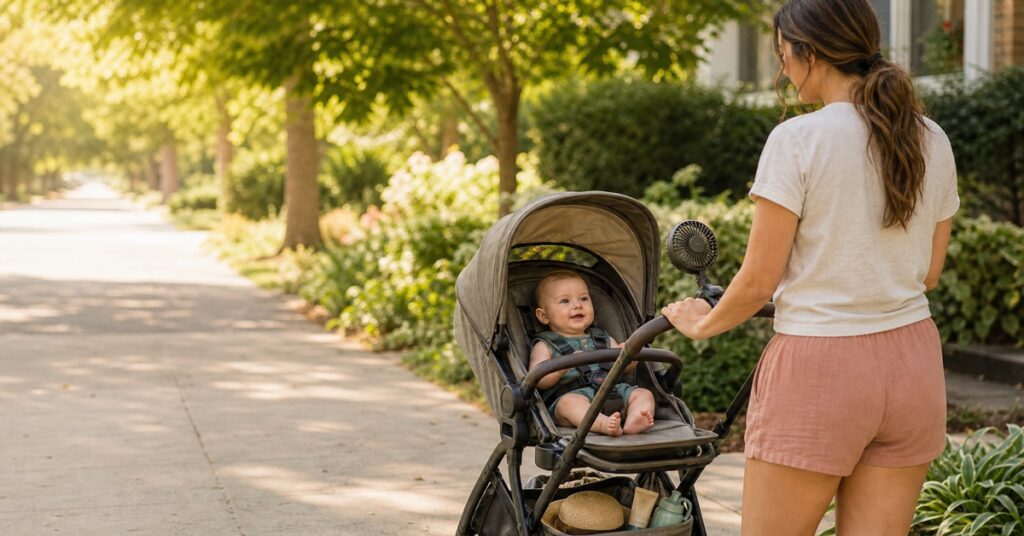
A hot-weather stroller walk does not need a bag full of cooling gadgets. It needs one decision before you leave, a few age-appropriate basics, and a route you can shorten the moment your baby stops looking comfortable.
I think of the kit in that order: weather first, baby’s age second, gear third. No fan, liner, or sunshade can turn an unsafe heat window into a safe one. But when local conditions are reasonable, a small, well-planned kit can make a short walk feel much less improvised.
This guide covers babies and toddlers from birth through age 3. Start with the quick go/shorten/skip check, then use the age table to pack only what fits your child’s current stage.
Save or screenshot this
The 30-Second Go, Shorten or Skip Check
Green: take a short loop
Local HeatRisk and air quality are acceptable, there is no heat alert, your route has shade, and your baby is feeding and acting normally.
Plan: choose a route with an easy turn-around point and an indoor place to cool down.
Amber: shorten or move indoors
Heat or humidity is rising, shade is unreliable, air quality is borderline, or your child has been sick, feeding poorly, or unusually tired.
Plan: make it one block, use an indoor walking option, or wait for a cooler window.
Red: skip this walk
There is a heat alert or high HeatRisk, air quality is unsuitable, the heat index is near the AAP’s 90°F danger flag, or your baby already seems unwell.
Plan: go inside. Do not use extra gear to talk yourself into going.
The American Academy of Pediatrics says a heat index at or above 90°F can be dangerous, especially for babies and young children. That is a warning line, not a personalized guarantee that every reading below it is safe. Direct sun, humidity, air quality, medical conditions, the route, and your child’s behavior still matter. The CDC recommends checking both local HeatRisk and air quality before planning time outside.
For a fuller explanation of heat index, symptoms, and when outside is too hot, read our guide to how hot is too hot for a baby. This article stays focused on what to pack once the weather check is green.
Pack by Age, Not by an Influencer Checklist
A bottle of water is sensible for a two-year-old and inappropriate for a two-month-old. Sunscreen belongs in a six-month-old’s kit but does not replace keeping a younger baby out of the sun. One universal summer list cannot handle those differences safely.
| Age | Feed or drink | Sun protection | Hat | Fan | Do not do this |
|---|---|---|---|---|---|
| 0–5 months | Breast milk or correctly prepared formula. Offer feeds more often if baby asks. | Keep baby out of direct and indirect sunlight. Use lightweight covering clothes and the stroller’s built-in canopy without blocking airflow. | A soft, well-fitting wide-brim hat only while baby is awake and supervised. | Usually unnecessary. A fan cannot make a risky heat window safe. | No extra water. Never dilute formula. Do not cover the stroller with a dry blanket. |
| 6–11 months | Breast milk or formula remains the main fluid. Small amounts of water can begin; the AAP’s general daily range is about 4–8 oz. | Use shade, clothing, and sunscreen on uncovered skin. Apply and reapply according to the label. | Choose a wide brim and a safety-release strap if a strap is needed. | Optional, only when out of reach and fully intact. | Do not treat 4–8 oz as a target for one walk; it is a general full-day range. |
| 12–17 months | Bring water in a cup your child already uses comfortably. Follow your family’s normal milk and meal routine. | Shade, lightweight coverage, and sunscreen work together. | Wide brim; safety-release strap rather than a continuous neck cord. | Optional, not essential. | Skip any generic insert that bunches, changes posture, interferes with the harness, or blocks ventilation. |
| 18 months–3 years | Bring a familiar, cleanable water bottle. The caregiver needs water too. | Use sunscreen, a hat, lightweight clothes, and shade. | Match the hat and strap to the activity; remove it for sleep and climbing. | Optional and mounted where curious hands cannot reach. | Routine short walks do not need sugary or electrolyte drinks unless a clinician has told you otherwise. |
The AAP advises that babies younger than 6 months should not receive extra water; breast milk or correctly mixed formula supplies their fluid. At around 6 months, babies can begin small amounts of water without replacing milk feeds. For children ages 1–3, the AAP gives a general reference of about four cups of total fluid per day, including water and milk, with individual needs changing in heat and humidity. These are whole-day guides, not instructions to make a baby finish a set amount during one stroller walk. See the AAP’s hydration guidance for the full age breakdown.
The Minimalist Hot-Weather Stroller Kit
This is the kit I would build from what most families already own. Buy only where a real gap remains.
Essential
Pack every time
- Baby’s age-appropriate feed or water
- Lightweight, loose sun-covering clothes
- Stroller’s built-in canopy, with airflow and a clear view of baby
- A well-fitting wide-brim hat
- Sunscreen for babies 6 months and older
- Water for the caregiver
- Phone access to weather, HeatRisk, and AQI
Useful
Add for a longer loop
- One small clean cloth for sweat or spit-up—not for covering the stroller
- Compact diaper-change supplies
- Refill water for a toddler and caregiver
- A planned indoor cool-down stop
- A backup route with more shade
Optional
Use only if it solves a problem
- A portable fan that passes the safety check below
- Baby sunglasses while awake and supervised, if your child tolerates them
- A manufacturer-approved liner that does not affect fit or airflow
If sunglasses make sense for your route, compare age and fit in our baby sunglasses guide.
If your stroller canopy is too small, poorly ventilated, or impossible to position without losing sight of your baby, address the stroller problem rather than layering a blanket over it. Our stroller comparison guide can help you compare canopy coverage, ventilation, recline, and everyday fit.
The Stroller-Fan Rule Most Shopping Lists Miss
A fan can move air. It cannot tell you whether your baby’s body is handling the heat, and it cannot lower a dangerous outdoor heat index. That makes it optional—not the center of the kit.
- Mount it beyond reach. Baby should not be able to touch the grille, controls, legs, clip, cable, or charging port from any recline position.
- Inspect the structure before every walk. Stop using it if the grille or faceplate moves, a clip or leg cracks, the head droops, or any fastener loosens.
- Inspect the battery. Do not charge or use a fan that is swollen, unusually hot, leaking, cracked, wet, or producing an odd smell or sound.
- Keep the fan and water separate. A mister, wet cloth, spilled bottle, or rain should not reach the motor, battery, or charging connection.
- Do not use airflow as permission to stay out longer. If your baby looks uncomfortable or the weather check turns amber, head inside.
You will not see a named stroller-fan pick in this version of the guide. During the current exact-model review, the two leading candidates showed unresolved structural or battery-related patterns in recent low-star reports. That does not prove every unit will fail. It does mean I do not have a model I am comfortable telling parents to place near a baby right now.
What to Skip, Even When It Looks Cooling
Green
Built-in canopy with open airflow
Use the stroller’s own canopy, keep baby visible, and open any manufacturer-designed ventilation panel. This is the default shade solution.
Green
Wide-brim safety-release hat
Look for face, ear, and neck coverage. Test the release before use, then remove the hat for sleep, climbing, or any situation where the strap can catch.
Green, 6m+
Mineral lotion or cream sunscreen
Follow the drug label for application and reapplication. Sunscreen supports clothing and shade; it does not replace them.
Amber
Portable fan
Use only when the weather itself is suitable, the fan is intact, the battery is normal, and every part stays out of reach.
Amber
Universal liner or cooling pad
Use only if the stroller maker permits it and it stays flat without changing harness position, baby’s posture, or the stroller’s airflow. This guide does not recommend a generic model.
Skip
Dry blanket or full stroller cover
Do not drape a dry muslin, blanket, or wrap over the stroller. It can restrict airflow and hide early signs that baby is getting too hot.
NSW Health warns that prams can become hot and says never to cover one with a dry wrap or blanket because restricted airflow can raise the internal temperature. It recommends the built-in canopy with airflow and frequent checks on the child.
The U.S. Consumer Product Safety Commission has previously recalled infant and toddler hats with a continuous one-piece chin strap because the strap could catch on equipment or other objects. That history is why this guide favors a safety-release design—and still removes any strapped hat for sleep and climbing.
The Two Researched Picks That Made the Cut
These are not items every family must buy. They are two precise options that cleared the current quantitative, exact-variation, manufacturer, safety-record, and low-star review screen. Use the “skip it if” line as seriously as the recommendation.
What about a toddler water bottle?
For children 18 months and older, bring the bottle they can already open, sip from, and close without turning the walk into a new drinking-skills lesson. I would prioritize a covered straw or spout, parts you can fully disassemble, an upright place in the stroller, and replacement straws or gaskets you can actually buy.
Do not assume “leak-resistant” means safe to toss sideways beside a phone or clean clothes. Test it over the sink, inspect it after drops, and replace damaged seals. Compare exact age ranges, cleaning paths, and real leak trade-offs in our toddler water bottle guide.
Turn Around at the First Warning Sign
The kit has done its job only if it helps you notice when the walk should end. Head inside if your baby has fewer wet diapers than usual, a dry mouth, no tears, unusual irritability, unusual sleepiness, poor feeding, or seems much hotter or less responsive than normal.
Do not wait this out on the sidewalk
Get urgent medical help for severe symptoms
Heat stroke is a medical emergency. Confusion, loss of coordination, limpness, being hard to wake, fainting, vomiting, abnormal fast or deep breathing, or a child who looks seriously unwell needs prompt medical attention. Move to a cooler place and contact emergency services or your child’s clinician as appropriate; do not delay care while trying more stroller gear.
Hot-Weather Stroller Walk FAQ
Can I cover a stroller with a muslin blanket in hot weather?
Do not cover a stroller with a dry muslin, blanket, or wrap. Even a lightweight cloth can restrict airflow and block your view of the baby. Use the built-in canopy, keep ventilation panels open as designed, choose a shaded route, and check your baby frequently.
Does a stroller fan keep a baby safe in the heat?
No. A fan moves air; it does not make a dangerous heat index safe or tell you whether your baby is overheating. If you use one in suitable weather, keep it out of reach, inspect the grille and mount before every walk, keep it dry, and stop at the first sign of battery or structural damage.
Can a baby under 6 months drink water on a hot walk?
Not unless your pediatrician has given specific instructions. Babies younger than 6 months should receive breast milk or correctly prepared formula rather than extra water. Offer feeds more often if your baby asks, and never add extra water to formula.
When can I use sunscreen on a baby?
The AAP’s current baby sunburn guidance says to keep babies under 6 months out of direct and indirect sunlight and rely on shade, lightweight covering clothes, and a wide-brim hat. For babies 6 months and older, use sunscreen on uncovered skin and follow the product label. The AAP prefers mineral creams, lotions, or sticks for babies over sprays.
What changes for a 20-minute walk versus a longer outing?
For a short neighborhood loop, the essential tier is enough: age-appropriate feed or water, shade, clothing, hat, sunscreen for 6m+, caregiver water, and a quick way home. For a longer outing, add diaper supplies, refill water, one clean cloth, and a planned indoor cool-down stop. Extra duration should add a cooling exit plan—not a pile of gadgets.
The smallest safe kit is the one you can use without negotiating with the weather. Check HeatRisk and air quality, pack for your baby’s age, and keep the route easy to abandon. If the check is red today, save this list for the next cooler window.