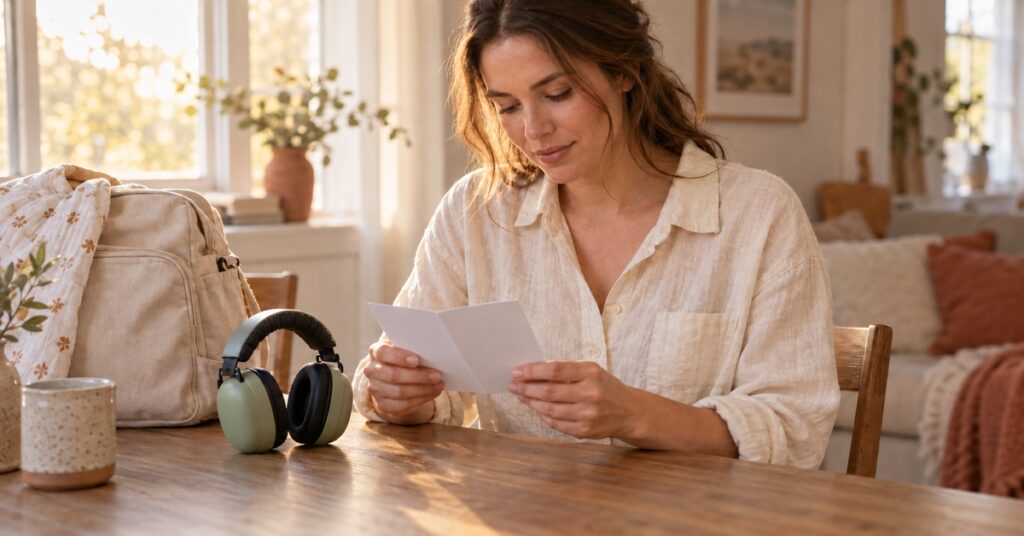
If you're packing the diaper bag for a wedding, you may be slipping a pair of tiny earmuffs beside the wipes. Before you zip it up, leave time to try them on in a quiet room. A cup that shifts when you pick your baby up is something you want to discover at home.
Baby ear protection can reduce sound reaching the ears when it is suitable and fitted correctly. It cannot promise that a loud outing is safe. I'd first ask whether you can choose a quieter plan, then check whether the particular earmuffs suit your child.
Reconsider the noisy outing
The American Academy of Pediatrics advises avoiding excessively noisy venues with young children. If children do attend, it recommends protective earmuffs, including for young infants. That advice makes room for infant hearing protection without giving every event, or every pair labeled “baby,” a pass. AAP noise guidance
Before buying, find out where the speakers will be, whether there is a quiet space, and how easily you can leave. At a family gathering, asking someone to lower the music may solve more than shopping for another accessory. If the main attraction is an extremely loud performance and there is no practical quiet alternative, I'd change the outing.
A “family friendly” description tells you who an event welcomes. It doesn't tell you the sound level beside your seat. ASHA includes family festivals, concerts and sporting events among settings that can become excessively loud for small children. ASHA guidance for infants and toddlers
Choose hearing protection for the task
When you search for baby headphones, several different products can appear together. Protective earmuffs cover the ears to reduce outside sound. Volume-limited headphones play audio and limit its output under specified conditions. Ordinary active noise-canceling headphones use electronics to reduce some background sound. An ANC feature alone is not a hearing-protection rating; NIOSH cautions against treating ANC headphones as hearing protection unless they carry an NRR. NIOSH hearing protection guidance
For a loud outing, look for hearing-protection earmuffs with the manufacturer's age, size, fitting and rating information. If you actually need headphones for music or tablet audio, that is a separate purchase: our guide to volume-limited kids' headphones. Turning on music to drown out a venue adds another sound source rather than solving the original problem.
Check the age limits on the actual model
There isn't one starting age you can apply to every baby earmuff. Infant-sized hearing protectors exist, but the word “baby” on a product page is not enough to choose a pair. Start with the instructions for the actual model and version you are buying. NIDCD guidance on children's hearing protection
Look for the minimum age and any size or fit requirements. Then compare the model information on the listing, packaging and instructions. A photo of a newborn, a parent's review, or an age range for another product from the same brand cannot settle that question. If the information conflicts, I would pause that purchase until the manufacturer provides instructions that clearly cover the product. Choosing another clearly documented option may be simpler.
Being within the stated age range is only the first check. You still need the cups and band to fit your particular child. Equally, a pair that appears to fit does not let you ignore its minimum age. For a newborn, or a child with a head or ear condition that affects fit, ask your pediatrician or pediatric audiologist for individual guidance.
Soft elastic bands can be worth considering if your child struggles with a traditional headband. CHOP notes that this style may work well for some infants and small children who do not tolerate traditional earmuffs. That is a possible fit advantage, not proof that every elastic-band design protects better. CHOP Hearing Conservation
A soft band still has to hold both cups in place. A padded arch still has to suit the child's head and the maker's age guidance. If one style slips whenever you lift your baby onto your shoulder, its material is not a reason to keep using it. Follow that model's headband-positioning instructions, especially around the soft spot; don't copy the position shown for a different design.
Check the fit before you leave home
Try the earmuffs in a quiet room before you need them. Keep the instructions beside you, and give yourself time to adjust the band without a speaker playing nearby. The aim is to learn whether the child can wear this pair comfortably and whether it stays correctly positioned.
Use this check with the manufacturer's instructions:
- Cover both ears. Each cup should fully surround the ear, with the cushion against the head around it.
- Look for gaps. Check for hair, hat fabric or glasses arms under the cushions. These can interfere with the seal. NIDCD fitting guidance
- Adjust as directed. Follow the instructions for the band and cup positions. Don't keep tightening a slipping pair until your child is uncomfortable.
- Recheck after movement. Let your child move naturally, then check again after you pick them up. A cup that lifts or slides needs attention.
- Inspect the condition. Check cushions and attachments for damage, and follow the manufacturer's care and replacement advice.
This is a fit inspection, not a measurement of protection. Don't clap beside your baby's head, turn music up, or judge the earmuffs by whether your baby startles. A visible reaction cannot tell you how much sound is reaching the ears. If you cannot establish a comfortable, stable fit, don't make a noisy outing depend on that pair.
Understand NRR and SNR
Two labels you may see are NRR, meaning Noise Reduction Rating, and SNR, meaning Single Number Rating. They describe attenuation using different testing and calculation systems. Comparing an NRR number with an SNR number does not produce a fair product ranking. Even within one system, the label describes laboratory performance rather than your child's measured protection. Research explaining NRR and SNR
Keep the rating beside the age and fit instructions when you compare products. A larger printed number cannot compensate for a cup that slides away. NIOSH's guidance for workers now recommends measuring individual attenuation through fit testing. A parent's visual check is useful, but it does not provide that measurement. NIOSH individual fit-testing guidance
I wouldn't subtract a label number from a venue's advertised sound level to decide how long a baby can stay. Neither tells you how much sound reaches your child's ears with the earmuffs on. The AAP also cautions that the adult workplace standard of 85 dBA averaged over eight hours should not be assumed safe for children. AAP on noise limits
Likewise, a manufacturer's maximum wear time is a limit for using that product. It does not establish how long a noisy event is safe. Follow the product's wear and break instructions, and take breaks in a quiet place.
Leave when you cannot maintain the fit
If your baby repeatedly pulls the earmuffs off, or a cup shifts during the outing, leave the noisy area and reach a quiet place before trying to fix the fit. Don't spend the next part of the performance repeatedly putting them back on beside the speakers. NIDCD warns that even brief removal of hearing protection in a very loud environment leaves the wearer exposed. NIDCD on consistent protection
You can leave before your child shows discomfort. Noise injury may not be immediately obvious, and you cannot judge protection by a baby staying calm or sleeping through the music. NIDCD on noise-induced hearing loss
Keep hearing protection separate from sleep plans
I wouldn't buy earmuffs to help a baby nap through loud events or sleep through household noise. For a noisy room at home, lower the sound where you can and choose a quieter sleeping space. ASHA advises keeping nursery sound machines at low volume and away from the crib. If you have a persistent noise problem you cannot change, discuss it with your child's clinician rather than improvising an overnight earmuff routine. ASHA infant noise guidance
Sleep safety still applies: place a baby on their back on a firm, flat mattress in an appropriate crib, bassinet or play yard. If a baby falls asleep in a stroller or carrier, the AAP recommends moving them to an appropriate sleep surface as soon as possible. Earmuffs do not change that advice. AAP safe sleep guidance
Before your next outing
If you are worried after a loud exposure, or notice a change in your child's response to sounds, contact your pediatrician or pediatric audiologist. An older toddler may also describe ear pain or muffled hearing. A home sound check cannot rule out injury; CHOP offers hearing evaluation and individualized hearing-conservation advice. CHOP hearing care
If you already own an intact pair with clear instructions that cover your child's age and size, start by checking that pair's fit. I wouldn't buy a second one simply for a bigger number on the box. Put the instructions beside the earmuffs tonight, try the fit in a quiet room, and decide whether the outing still makes sense.