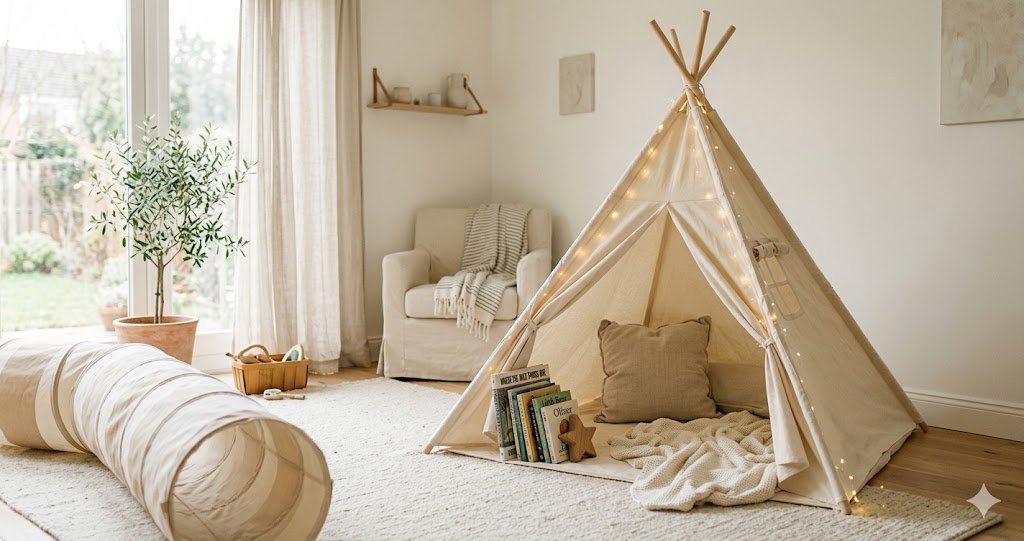
There was a stretch last winter when our living room was, functionally, a tent city. A teepee in one corner, a pop-up dome that my older son insisted was a spaceship, and a crawl tunnel snaking across the rug that everyone tripped over at least once a day. I kept threatening to fold it all up. I never did, because for about forty minutes at a time, all three kids were happily occupied and nobody was asking me for the iPad.
That is the real magic of a play tent. It is not just a cute thing for the nursery shelf. The American Academy of Pediatrics is blunt about it: in their report on the power of play, they describe giving kids “time and space to act out imaginary scenes, roles, and activities” as a genuine developmental need, not a nice-to-have. A tent is basically a container for exactly that kind of play.
So I went deep on this category. Below are eight play tents, teepees, and tunnels worth your money in 2026, sorted by what they actually do well and, just as important, where each one falls short. Because every single one of these has a downside, and you deserve to hear it before it shows up in your cart.
The quick list
- Best overall teepee: Tiny Land Cotton Teepee, the one that lasts
- Best budget teepee: Sumbababy Canvas Teepee
- Most popular play tent: JOYIN Rocket Ship
- Best pop-up: Mnagant Galaxy Dome
- Prettiest reading nook: Tiny Land Lace Tent
- Most fun / most unusual: W&O Inflatable Barn
- Best tunnel: Tiny Land Crawl Tunnel
- Best budget tunnel: Kiddey Play Tunnel
What actually matters when you buy one
After cycling through more of these than I’d like to admit, here is what I’d tell a friend to check before buying.
Match the structure to your kid’s age and energy. A delicate fabric pop-up that a calm 5-year-old treats gently will get demolished by a bulldozing toddler in a week. The cheaper pop-ups tend to have thin poles and lighter fabric; they’re fine, but go in with realistic expectations.
Think about the footprint. Tents and tunnels eat floor space, and the bigger inflatable kinds need a serious chunk of room plus a fan running. Measure before you fall in love with the giant barn.
Decide: classic or themed. A natural-canvas teepee blends into your decor and grows with the child for years. A rocket or undersea pop-up is louder, cheaper, and tends to peak in a kid’s affection somewhere around the second birthday party. Both are valid. They’re just different jobs.
Look at what’s included. Some “teepees” arrive with a padded mat and string lights; the bargain versions are often just fabric and poles. Neither is wrong, but it changes the value math, and it’s the number one source of “wait, where’s the mat?” disappointment.
The teepees
Tiny Land Cotton Teepee, best overall
If you only look at one tent on this list, make it this one. Tiny Land is a US-based brand that has been doing kids’ tents for years, and this teepee has one of the deepest, most consistently strong review histories in the entire category: we’re talking thousands upon thousands of ratings hovering near the top of the five-star scale. That kind of track record is rare for a toy this size.
It’s made of thick 100% cotton canvas on upgraded solid wood poles, and it actually comes with the good stuff: a half-inch padded non-slip mat, a string of fairy lights, four interior pockets, and a carry bag. A canvas teepee like this is the kind of thing an older preschooler or early-grade kid will quietly turn into a permanent reading corner: pillows in, lights on, a stack of books, door flap shut. It comfortably fits one to three kids, so it survives a sibling invasion too.
What I love: genuinely durable, comes complete, looks good enough to leave up in a real room.
The honest downside: it’s the priciest pick here, and a few buyers have reported the occasional stitching flaw or a missing part on arrival (Tiny Land’s customer service has a good reputation for sorting that out). Also, cotton canvas: air-dry only, no tumble dryer.
Check the current price on Amazon →
Sumbababy Canvas Teepee, best budget teepee
If you love the natural-teepee aesthetic but not the natural-teepee price tag, Sumbababy is the one to know. It’s a well-reviewed canvas tent on sanded, splinter-free pine poles, with a window for airflow and a tidy boho-stripe look that won’t fight your living room. At roughly half the cost of the premium option, it’s an easy yes for a first tent.
One thing to know going in: the base “Nature” color at the lowest price is mostly just the tent and poles. The versions with a mat and star lights cost a bit more, and Sumbababy sells a confusing number of color and bundle variations, so read the specific listing carefully before you click.
What I love: the classic canvas look for a fraction of the cost; roomy enough for a couple of kids.
The honest downside: a few owners mention the zipper door can stick, and like all A-frame teepees it’s a bit top-heavy, so an enthusiastic toddler yanking on a pole can tip it. Confirm whether your chosen version includes the mat and lights.
Check the current price on Amazon →
The pop-up play tents
JOYIN Rocket Ship Play Tent, most popular
This is the one everybody seems to own, and the sales numbers back that up: it’s a perennial top seller in the play-tent category. The appeal is obvious: a white spaceship tent with a fun graphic print, four poles, roof and floor anchors, and a carry bag, all for under thirty dollars and light enough to move room to room with one hand. For a kid deep in a space phase, a rocket they can “blast off” in is an easy win.
It assembles fast and packs down small. Just calibrate your expectations to the price.
What I love: cheap, cheerful, instantly appealing to a space-obsessed preschooler.
The honest downside: the poles don’t sit deep in the fabric, so a rowdy toddler can collapse it, and several parents report a pole connector cracking after a few weeks of hard play. The fabric is on the thin side. Treat it as a fun seasonal toy, not an heirloom.
Check the current price on Amazon →
Mnagant Space World Galaxy Dome, best pop-up
If the rocket’s flimsiness gives you pause, the Mnagant galaxy dome is the better-built pop-up at a similar price, and it carries an Amazon’s Choice badge with a near-top rating. It uses 210T polyester with a PU waterproof coating and two crossed fiberglass poles, sets up in about three minutes, and folds down to roughly the size of a folding umbrella, which makes it stupidly easy to stash or take to grandma’s. It also comes in a small army of themes: galaxy, astronaut, black hole, even a dino.
The dome shape feels surprisingly roomy inside for its compact footprint, and a couple of kids can pile in together.
What I love: better build than most pop-ups, folds tiny, tons of theme options.
The honest downside: the standard size is on the short side, so a taller kid can’t stand up in it, and there are no anchors or grippers on the corners, so it slides around on hard floors. Setup reviews are a little split: most find it quick, some find it fiddly.
Check the current price on Amazon →
Building a calm, screen-light playroom?
Grab our free Screen-Free Play Cheat Sheet: simple, low-setup activity ideas sorted by age, for the days when “just play in your tent” needs a little backup.
Tiny Land Lace Play Tent, prettiest reading nook
This is the tent for parents who want the play space to also look intentional in photos. Tiny Land’s lace tent is a free-standing, dotted-sheer design on a reinforced PVC frame, with a top window and a newer version that adds string lights. It’s tall and roomy, large enough to fit most cribs or toddler mattresses, and Tiny Land says it suits kids from three all the way to thirteen. Filled with a sheepskin rug and a few pillows, it makes a properly cozy reading nook: the kind of spot an older child will happily disappear into for a whole afternoon.
Worth noting: this style of polygon tent used to be notorious for thin, crack-prone poles, and Tiny Land specifically beefed up the PVC frame on this version to fix that.
What I love: genuinely beautiful, sturdy upgraded frame, doubles as decor.
The honest downside: the lace-and-boho styling leans feminine, so it’s a harder sell in a house of boys, and an adult needs about fifteen minutes and the instructions to assemble it the first time.
Check the current price on Amazon →
W&O Farmhouse Barn Inflatable Tent, most fun
This is the wildcard, and the one most kids would vote for. It’s an inflatable barn that you set up by attaching it to any standard 20-inch box fan: air pours in and the whole thing billows up in seconds into a huge 63-by-95-inch play space. This particular version adds LED lights with a remote and a button that plays six different farm-animal sounds. It is, frankly, a sensory party, and it’s the kind of thing that makes a playdate.
It’s a newer product without a long review history yet, so I’m leaning on what’s true of this whole inflatable-fort category, which is where the catch lives.
What I love: enormous, genuinely exciting, sets up in seconds, great for groups.
The honest downside: you must supply your own box fan, and the fan has to run the entire time: switch it off and the barn deflates. That means ongoing fan noise, a big footprint, and an open floor. Fun, but not a quiet bedroom hideaway.
Check the current price on Amazon →
The tunnels
Tiny Land Crawl Tunnel, best tunnel
Tunnels are deceptively great for the younger crowd. A one-year-old will happily crawl through a tunnel approximately four hundred times in a row, and all that crawling is quietly doing good things for their strength and coordination. This Tiny Land tunnel is the upgrade pick: soft peachskin fabric instead of crinkly nylon, see-through mesh sides for airflow and so anxious little ones don’t feel trapped, and ASTM safety certification. It comes in a calm beige-with-stars print and a couple of other colors, with a tote for storage.
What I love: soft, breathable, safety-certified, and actually pleasant to look at on the floor.
The honest downside: like all wire-sprung tunnels, the internal coil can eventually poke through the fabric if a wire breaks, and there’s no padding on the floor of the tunnel. It also needs a fair bit of open room to stretch out fully.
Check the current price on Amazon →
Kiddey Play Tunnel, best budget tunnel
If you just want to test whether your kid even likes a tunnel before spending real money, Kiddey is the low-risk entry. It’s a long-running, well-reviewed pop-up with see-through mesh sides, a fold-flat design, and a zip carry bag. It pops open instantly and stores behind the couch. Kids love taking turns being chased through it, which doubles as a remarkably effective way to wear them out before dinner.
What I love: the lowest price here, folds completely flat, easy to store.
The honest downside: the floor of the tunnel sits right on the support wires, so crawling on it can feel a little hard underneath, and the see-through fabric is thin enough that very rough play can tear it. It runs a touch short and narrow, so it’s best for smaller kids.
Check the current price on Amazon →
A few quick safety notes
Keep the basics in mind:
- Supervise younger kids, especially in zip-up or fully enclosed tents. A tent is a soft structure and won’t hold a child’s weight if they climb or lean on it.
- Skip the heavy stuff inside. Tents and tunnels collapse easily, so keep hard toys and climbing out of them.
- For wire-sprung pop-ups, check now and then that no support wire has popped through the fabric, and retire it if one does.
- For the inflatable kind, the box fan should be a child-safe distance away and never left running unsupervised with little ones around.
Frequently asked questions
What age is a play tent actually good for?
It depends on the type. Soft crawl tunnels work from the crawling stage, simple pop-ups suit toddlers and preschoolers, and a sturdy canvas teepee or a tall lace tent can genuinely last from toddlerhood into the early school years. If you want one purchase to stretch the longest, a quality canvas teepee is your best bet.
Are play tents worth it, or just clutter?
Used well, they earn their floor space. A defined little space supports exactly the kind of independent, imaginative play the AAP’s clinical report on play ties to language, problem-solving, and emotional regulation. The trick is rotating it in and out so it stays special instead of becoming background furniture. (If you want more low-effort ways to fill that play time, our guide to the best sensory toys for toddlers pairs nicely with a reading-nook tent.)
Teepee or pop-up tent, which should I get?
Get a teepee if you want something that looks good in a real room and lasts for years, and you don’t mind spending more and doing a little assembly. Get a pop-up if you want cheap, instant, themed fun and you’re okay treating it as a shorter-term toy.
Do I really need a fan for the inflatable ones?
Yes. Inflatable forts like the W&O barn stay up only while a standard box fan is blowing air into them, and the fan isn’t included. If constant fan noise or buying a separate fan is a dealbreaker, go with a pole-and-fabric tent instead.
Want the whole playroom dialed in?
Our free Screen-Free Play Cheat Sheet gives you a back-pocket list of easy, age-sorted activities, perfect for the moments when the tent’s up but the ideas have run dry.