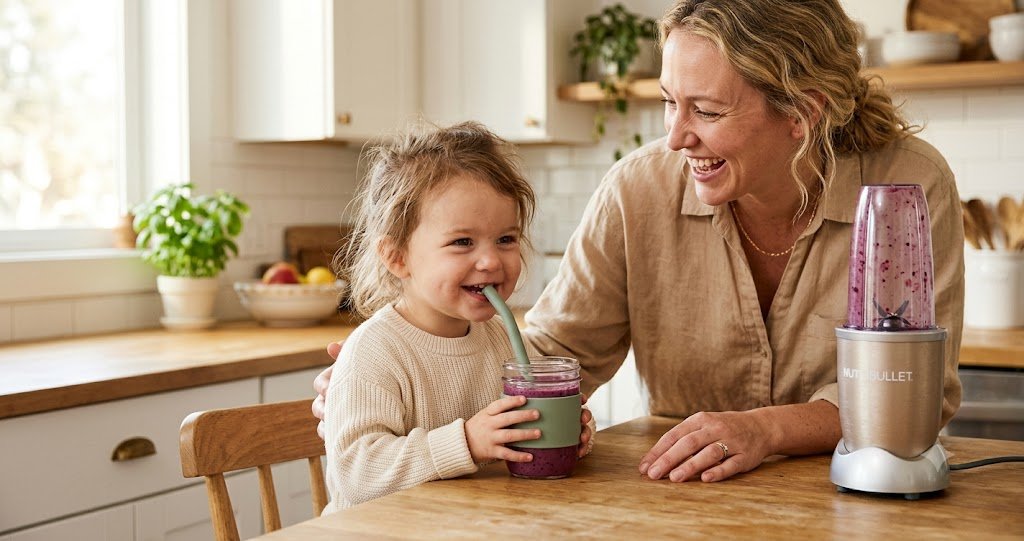
Last winter I finally cracked the code on veggie smoothies. The golden ratio, the color tricks, the whole system. My youngest son was actually drinking spinach. I felt unstoppable.
Then the straw clogged.
He pulled, got nothing, and treated it as a personal betrayal. Cup on the floor, purple smoothie on the grout, and me googling “why does my toddler’s straw not work with smoothies” at 7:40 in the morning. Turns out the recipe was never the whole game. The gear matters just as much, and most toddler cups and personal blenders were designed for water and protein shakes, not for a thick blueberry-spinach situation headed for a very opinionated 18-month-old.
So this is the equipment side of the smoothie project: the cups that can actually handle a thick blend, and the blenders that can turn frozen cauliflower into something with zero visible green flecks. Because as anyone who has served a picky eater knows, one fleck is all it takes.
Why Smoothie Gear Is Its Own Category
Before the picks, three things I wish someone had told me sooner:
1. Straw width decides everything. Regular sippy-cup straws are skinny because they’re built for water, and many have anti-spill valves inside. A thick smoothie will clog both. Every cup on this list uses a wide silicone straw with no valve. That’s a deliberate trade: these cups can drip if your kiddo shakes them upside down, but the smoothie actually reaches the mouth. Pick your battle. I picked the one where breakfast gets consumed.
2. Your child drinks with their eyes first. This is the whole point of the color psychology approach from my veggie smoothie guide. A hot-pink beet-and-strawberry blend only works its magic if your little one can see it. Clear cups (glass or translucent silicone) let the color do the selling. Stainless steel hides it, which is fine for the playground, but at the breakfast table I want that purple on full display.
3. The blender determines the flecks. A weak motor leaves specks of spinach, and specks get detected by toddler radar instantly. You need a blender that can genuinely pulverize greens and frozen fruit, ideally in the 60 seconds you have while also finding someone’s left shoe.
How I Chose These
Ten years and three kids into the sippy cup industrial complex, I have strong opinions about what survives real households. For this roundup I put every candidate through the same screen I use for all my gear guides: strong owner ratings over a meaningful number of reviews, consistent recent sales (products that quietly die on Amazon don’t get recalled or supported), specs verified against the manufacturer’s own product pages, and a dig through the critical reviews specifically looking for the failure that matters here, which is “the straw clogs with thick drinks.” Anything that flunked got cut. A few popular cups and one very famous portable blender didn’t make it for exactly that reason.
The Best Smoothie Cups for Toddlers
1. Elk and Friends 8oz Glass Mason Jar Cups — Best Overall
Elk and Friends 8oz Glass Mason Jar Cups with Silicone Sleeves & Straws (4-Pack)
Small glass mason jars wrapped in grippy silicone sleeves, with wide silicone straws that have a built-in stopper so they can’t be yanked out and flung. The brand states outright that the straws are wide enough for smoothies, and the critical reviews back it up. No valve, no clog.
Glass sounds insane for a toddler until you look at the design. The silicone sleeve absorbs the drops (owners report plenty of hardwood-floor survivals), and if a jar does eventually crack, it’s a standard mason size, so replacements are cheap and easy. Meanwhile you get the two things glass does best: nothing leaches into warm liquids, and the smoothie color shines straight through. Purple looks like a treat. That’s half the sell with a picky eater.
The same jars double as snack or leftover containers thanks to the solid storage lids. Two things worth knowing before you buy: the printed measurements only go partway up the jar (filled to the rim it holds the full 8 ounces), and the maker is upfront that these are not spill-proof. Tipped fully upside down, liquid can sneak out through the straw. In my house that trade is worth it every single time.
Ages: about 2 to 6 years · Price: typically $30–$40 for the set
Care: Microwave and dishwasher safe (sleeve can stay on); don’t move straight from fridge to microwave
Best for: Everyday home use, the color-psychology crowd, families who want cups that moonlight as storage containers.
Honest drawbacks: Not spill-proof by design. Glass is glass: supervised table drinking, not couch wandering. If you have a bigger kid in the mix, the same line comes in a 12oz size, and the lids are interchangeable across sizes, which is exactly the kind of small design decision that tells you parents were involved.
2. Olababy Silicone Training Cup with Straw Lid — Best for 12–18 Months
Olababy 100% Silicone Training Cup with Straw Lid, 5oz
This is the cup for the youngest smoothie drinkers, and it’s the one I’d hand my youngest son without hesitation. It’s 100% soft silicone with a weighted base that resists tipping, sized for hands that are still figuring out hands. The detail that earns it a spot here: Olababy designed the straw specifically to handle both thick and thin liquids. That’s the manufacturer saying, in plain words, “smoothies welcome.”
The cup is translucent, so your baby can see the liquid inside, which the pediatric feeding experts behind the design say reduces the anxiety of drinking from an unknown cup. It also means the pretty color trick still works. There are measuring dots on the side, the lid pops off so it converts to a mini open cup when your child is ready to practice, and the whole thing shrugs off the microwave, freezer, and dishwasher.
The real limitation is capacity: 5 ounces goes fast once a toddler decides smoothies are acceptable. Olababy makes a 9oz version of the same cup for older toddlers, which the brand pitches specifically at kids who love thicker drinks. Start with the 5, graduate to the 9.
Ages: 6 to 18 months · Price: typically $14–$18
Care: Microwave, freezer, and dishwasher safe; BPA, PVC, BPS, lead, latex, and phthalate free
Best for: First smoothies, the bottle-to-cup transition window, parents who want one cup that grows into open-cup practice.
Honest drawbacks: Small capacity by design. Residual liquid in the straw can drip if it tips over, which is true of every valve-free cup here.
3. Pandaloo Stainless Steel Smoothie Cups — Best for Daycare & On-the-Go
Pandaloo Stainless Steel Kids Cups with Straw & Storage Lids, 10oz (4-Pack)
Here’s where I break my own visibility rule, on purpose. Stainless steel hides the smoothie color, but it also doesn’t shatter, doesn’t stain, and doesn’t care what the daycare cubby does to it. If the smoothie is leaving the house, this is the format.
The Pandaloo set is 10oz cups in food-grade stainless steel with silicone sleeves, and the detail that separates it from the sea of lookalikes: the inner straw is stainless steel rather than plastic, which cuts plastic out of the drink path. One age note that comes with that: a firm metal straw is best for kids past the chew-everything stage, which is why I’d slot these in from around age two. Each cup ships with two lids, a straw lid for drinks and a flat lid that turns the cup into a snack container, which neatly solves the “one more container to pack” problem. Everything disassembles and goes in the dishwasher.
The maker is refreshingly honest that hard shaking upside down can produce minor drips, which is true of every valve-free straw cup ever made. My rule stays the same: valve-free is a feature, not a flaw, when smoothies are involved. For plain water duty at preschool, a different tool wins; my preschool water bottle picks cover that lane.
Ages: about 2 to 6 years · Price: typically $28–$35 for the set
Care: Fully disassembles; dishwasher safe; 18/8 food-grade stainless steel
Best for: Daycare bags, car cup holders, park mornings, families done with shattered and stained cups.
Honest drawbacks: You can’t see the smoothie color, so save the color-reveal moments for the glass cups at home. Firm metal straw suits kids past the biting phase.
4. teensy peepsy Honey Jar 3-in-1 — Best Multi-Stage
teensy peepsy Honey Jar 3-in-1 Silicone Training Cup, 8.5oz
This one is for parents who resent buying a new cup for every developmental stage, which is all of us. The Honey Jar is one silicone cup that runs three shifts: straw cup for the transition year, open cup around age two, and snack cup whenever you screw on the snack lid instead. Two little handles, a weighted bottom, and measuring lines inside.
For smoothie duty specifically, the soft wide silicone straw comes with a stopper so it can’t be pulled out mid-tantrum, and the inner straw is removable for actual cleaning. The mold-in-the-straw discovery is a rite of passage no parent needs twice; my guide to cleaning toddler bottles and straws exists precisely because of it. The box includes a second straw plus a brush. Silicone means it bounces instead of breaking, and it’s microwave, freezer, and dishwasher safe.
Ages: 6 months to 3 years · Price: typically $15–$20
Care: Microwave, freezer, dishwasher safe; BPA, PVC, phthalate, and lead free
Best for: One-cup-three-stages families, straw-to-open-cup practice, snack duty on the stroller.
Honest drawbacks: Like every cup in this article, residual liquid in the straw can drip if it’s knocked over. A soft silicone body means a determined big kid can squeeze it like a stress ball with predictable results. It’s a toddler cup. Keep it with the toddler.
Smoothie Cup Comparison
| Cup | Best For | Material | Size | Can You See the Color? |
|---|---|---|---|---|
| Elk and Friends Mason Jars | Everyday home use, ages 2+ | Glass + silicone sleeve | 8oz ×4 | Yes, fully |
| Olababy Training Cup | First smoothies, 6–18 months | 100% silicone | 5oz | Yes, translucent |
| Pandaloo Stainless Cups | Daycare, car, park | Stainless steel + silicone | 10oz ×4 | No |
| teensy peepsy Honey Jar | One cup, three stages | Food-grade silicone | 8.5oz | Partially |
The Best Blenders for Toddler Smoothies
A quick reality check before the picks. You do not need a $500 blender for toddler smoothies. You need three things: enough power to erase every fleck of spinach, a cup size that matches small servings, and a cleanup routine that takes less than a minute. That’s it. Here’s what clears the bar.
5. Ninja Fit Compact Personal Blender — Best Overall
Ninja Fit QB3001SS Compact Personal Blender, 700W
The Ninja Fit is the workhorse answer. Independent testing has shown it breaking down kale, spinach, and celery into a fine, consistent blend in about 20 seconds, which is precisely the “zero visible flecks” standard that decides whether a picky eater drinks or protests. It handles frozen fruit and ice without drama, which matters because frozen banana is the backbone of nearly every toddler smoothie.
The design is push-to-blend: you press the cup down and it runs, no buttons, no settings, nothing for a curious three-year-old to program. It comes with two 16oz cups and spout lids, so you can blend one for your kiddo and one for yourself without washing anything in between. All parts are BPA-free and top-rack dishwasher safe, though I’d hand-wash the blade assembly; dishwasher heat is the classic way to age out the rubber gasket early on any personal blender.
Price: typically $55–$70
Care: Cups and lids top-rack dishwasher safe; hand-wash the blade assembly to protect the gasket
Best for: The one-blender household, frozen-fruit-heavy recipes, blend-two-cups mornings.
Honest drawbacks: It’s loud. Not uniquely loud, just blender loud, so factor in the napping baby. And like most narrow-cup blenders, a very thick blend occasionally needs a pause-and-shake to loosen ingredients off the walls.
6. NutriBullet 600W Personal Blender — Simplest to Live With
NutriBullet 600W Personal Blender with 24oz Cup
The original NutriBullet has been the default kitchen-counter blender for over a decade for one reason: push, twist, blend, done. Sixty seconds from ingredients to smoothie, then the blade twists off, gets a rinse, and the cup rides the top rack of the dishwasher. If your tolerance for appliance fuss is zero, this is your machine.
The straight talk for smoothie parents: the 600W model has one speed and NutriBullet doesn’t market it as an ice-crusher. For the way most of us actually build toddler smoothies (frozen banana chunks, pre-steamed veggie cubes, milk or kefir base) it’s entirely up to the job. If your style is throwing in whole ice cubes and rock-hard mango straight from the freezer bag, skip ahead to the Pro+ below and save yourself the second purchase.
Price: typically $45–$60
Care: Blade rinses under the tap; cup is top-rack dishwasher safe; blade assembly is hand-wash only
Best for: Zero-fuss daily smoothies, small kitchens, anyone who wants exactly one moving part in their morning.
Honest drawbacks: Single speed, no pulse. Not built for whole ice cubes; keep the frozen load to fruit chunks and softened veggie cubes.
7. Ganiza 14-Piece Personal Blender — Best Budget
Ganiza 14-Piece Personal Blender for Shakes & Smoothies, 900 Peak Watts
Under thirty dollars, and the box includes a 24oz cup, two 17oz cups, two to-go lids, sealing lids, and a cleaning brush. For a family, that cup count is the actual selling point: blend once, cap the extras, and tomorrow’s smoothie is already in the fridge. It pairs beautifully with the Sunday batch-prep system from my veggie smoothie guide.
The stainless cross-blade handles frozen fruit fine with one caveat the manufacturer itself states: it wants liquid. Add your milk or kefir first, at least a generous splash, and don’t ask it to chew dry ice cubes. The safety interlock means it only runs when the cup is properly seated, and cups and lids are dishwasher safe.
Set expectations accordingly: this is a budget machine from a budget brand. It earns its spot on performance-per-dollar, not on decade-long durability, and the brand doesn’t have the support track record of Ninja or NutriBullet. At this price, many families are fine with that math.
Price: typically $28–$35
Care: Cups and lids dishwasher safe; safety interlock; built-in cooling fan
Best for: Tight budgets, batch-prep families, a first personal blender to test whether the smoothie habit sticks.
Honest drawbacks: Needs liquid to work well; not an ice-crusher. Budget-brand longevity and support are the trade for the price.
8. NutriBullet Pro+ 1200W — Upgrade Pick
NutriBullet Pro+ 1200W with Pulse Function & Auto Shut-Off
Double the power of the original, and it shows exactly where toddler smoothies get hard: frozen cauliflower, berry seeds, fibrous greens. NutriBullet says this one pulverizes things like wheatgrass and blackberry seeds, and reviewers have run it through ice tests that ended in snow-cone powder. If the double-blend method has ever left you with detectable specks, this is the fix.
My favorite feature has nothing to do with power: the hands-free cycle. Twist the cup on and it runs a full 60-second blend and shuts itself off, which means you can start the smoothie and go retrieve the shoe, the sock, or the child. There’s also a pulse button for chunkier jobs like fruit sauces or salsa, so it earns its counter space beyond the toddler years.
Price: typically $90–$110
Care: Cups top-rack dishwasher safe; blade assembly hand-wash; auto cycle isn’t meant to run back-to-back for minutes
Best for: Daily smoothie households, frozen-heavy recipes, parents who want to press one thing and walk away.
Honest drawbacks: Heavier on the counter, no small single-serve cup in the box (the 24oz is the smaller one), and roughly double the Ninja Fit’s price. If you make smoothies daily, it might be worth exactly that.
Blender Comparison
| Blender | Power | Cups Included | Best For | Watch Out For |
|---|---|---|---|---|
| Ninja Fit | 700W | Two 16oz | Best all-around value | Loud; occasional shake needed |
| NutriBullet 600W | 600W | One 24oz | Zero-fuss daily use | Single speed; not an ice-crusher |
| Ganiza 14-Piece | 900W peak | One 24oz, two 17oz | Budget + batch prep | Needs liquid; budget-brand durability |
| NutriBullet Pro+ | 1200W | 32oz + 24oz | Frozen-heavy blends, daily use | Price; no small cup included |
FAQ
Are glass cups really safe for toddlers?
With a silicone sleeve and table supervision, yes, and there’s a real upside: glass is inert, easy to sterilize, and never holds smoothie stains or smells. The sleeve absorbs everyday drops. What glass cups are not for is roaming the house or riding in the car seat; that’s what the stainless and silicone options are for. Match the cup to the location and you get the best of both.
When should my toddler move from a straw cup to an open cup?
Straw drinking can start around six months, and pediatric guidance from the American Academy of Pediatrics encourages moving away from bottles toward cups by around 12 to 18 months. Open-cup practice can happen alongside straw cups rather than after them. Several picks here are built for exactly that overlap: the Olababy works lidless as a mini open cup, and the Honey Jar converts outright.
What’s actually different about a “smoothie cup” versus a regular sippy cup?
Two things: a wider straw and no anti-spill valve. Valves are what make sippy cups leakproof with water, and they’re also exactly what a thick smoothie can’t get through. Every cup in this roundup made the list because it’s valve-free with a wide silicone straw. The trade-off is the same across the board: these cups resist spills, but none of them survive being shaken upside down by a scientist in footie pajamas. If leakproof water cups are the mission instead, my b.box vs Munchkin 360 vs Dr. Brown’s comparison settles that fight.
How long can a smoothie sit in the cup?
Treat it like milk: fine for the length of breakfast, not fine for discovery under the couch at nap time. Smoothies with dairy or kefir should be refrigerated if they’re not finished within an hour or two, the same as any perishable food. This is also why the storage lids on the Elk and Friends and Pandaloo sets are so handy: cap it, fridge it, offer it again at snack time. For portion guidance on what goes in the cup, MyPlate’s toddler recommendations are a solid anchor.
The recipe gets them to try it. The gear gets it into their mouth without a clog, a shatter, or a speck of visible spinach. Now if someone would invent a cup that also finds the missing shoe, we’d really be in business.