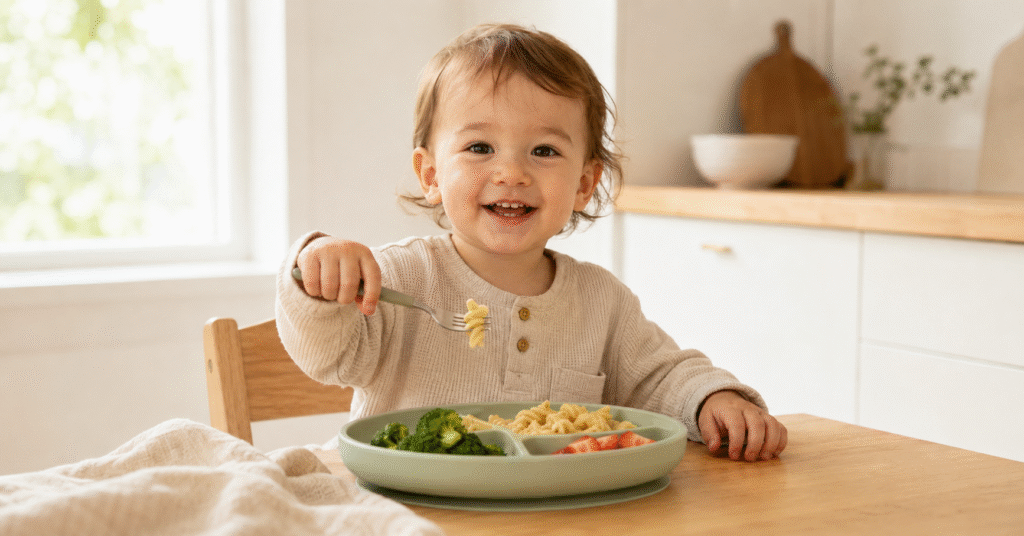
My older son is three, and his current food rule is very simple: nothing touches. If the sauce so much as glances at the rice, dinner is over. His little brother is eighteen months and has a different rule entirely: anything not bolted to the table gets launched. Same kitchen, same meal, two completely different plate problems.
That’s really the whole story of kids’ plates. Before age two, you’re fighting gravity, and a good suction plate is the difference between eating your own dinner warm and spending it on your hands and knees under the high chair. After age two (and well into the picky-eater years), the fight moves to the plate itself: foods need their own zones, portions need to look manageable, and the plate needs to survive being dropped, scraped, and occasionally used as a drum.
So this roundup covers both jobs. Five suction plates for the throwing phase, and two divided plates for kids who’ve graduated from suction but still want their peas nowhere near their pasta. I’ll also tell you exactly when to make the switch, because that’s the part nobody explains on the box.
The two plate phases (and how to know which one you’re in)
Phase one: the suction phase, roughly 6 months to 2 years. Babies learning to self-feed will tip, slide, and flip anything that moves. A plate that stays put lets them work on scooping and stabbing food instead of chasing the plate around the tray. This is the phase my youngest is in right now, and I can confirm suction is not a luxury.
Phase two: graduation. Somewhere around age two, most kids figure out how to defeat suction, and prying the plate loose becomes more entertaining than eating. That’s your signal. At that point a deep-walled divided plate does everything you actually need: it keeps foods separate for picky eaters, the walls give little utensils something to push against, and there’s no suction gimmick to turn into a game.
Divided sections matter more than you’d think for fussy eaters. Keeping foods separate lowers the stakes of putting something new on the plate, and pediatric feeding guidance consistently says the same thing: keep offering, keep the pressure low, and let kids warm up to new foods at their own speed. The American Academy of Pediatrics has a genuinely reassuring rundown on this in their picky eaters guide on HealthyChildren.org, and the short version is that picky phases are normal and food that isn’t touching is a battle you’re allowed to just… not fight.
How I picked these
Every roundup on this site goes through the same wringer: current listings and spec sheets, the brand’s own safety documentation, and a long, unglamorous read through critical reviews to find out how each product actually fails. Then I filter all of it through ten years of feeding three kids, which is its own kind of product testing. Anything with shaky safety credentials, chronic quality complaints, or a rating that’s coasting on old reviews gets cut before it reaches this page.
Best suction plates (roughly 6 months to 2 years)
1. ezpz Mini Mat — the one that’s genuinely hard to pry off
The ezpz Mini Mat isn’t a plate with suction cups. It’s a one-piece silicone placemat with three built-in compartments, and it seals itself to the surface across its entire footprint. That design detail matters: there’s no plate edge to grab and peel, so pulling up on the compartments does basically nothing. It was designed by a pediatric feeding specialist, and the three sections are sized to nudge you toward serving a little variety without turning dinner into a bento project.
What to know before you buy: the self-seal only works if air can’t get underneath, so it needs a genuinely smooth surface, and it’s on the larger side. Measure your tray before ordering, especially if you have a compact or space-saver high chair. It’s dishwasher, microwave, and oven safe, though a few parents report a white film after dishwasher cycles, which wipes off but is annoying.
2. Bumkins Silicone Grip Dish — the classic, for a reason
The Bumkins Grip Dish has been on American high chair trays for the better part of a decade, and it’s still the plate I’d hand a first-time parent. Three sections, a flat straight edge so your kiddo can scoot right up against it, and platinum-cured silicone that handles everything from the freezer to a 400°F oven. Bumkins is a small Arizona family business that’s been around since 1989, and their third-party safety testing is unusually transparent for this price range.
The honest fine print: the suction is good, not unbeatable. A determined toddler can work it loose eventually, and the grip softens a little with age. Silicone also loves to hold onto soap smells, so wash it with unscented detergent unless you want your kid’s scrambled eggs to taste faintly of lavender. Ask me how I know that trick matters.
3. PandaEar Toddler Plates, 3-pack — the budget workhorse
Three divided suction plates for less than the price of one premium plate. The PandaEar 3-pack is 100% food-grade silicone, stacks flat in a drawer, and goes in the microwave, dishwasher, and freezer without complaint. When you need a plate at home, a plate at grandma’s, and a plate that lives permanently in the daycare bag, this is the math that works.
The trade-off is right there in PandaEar’s own listing, which I respect them for: the suction is optimized for smooth, non-porous surfaces, and they suggest a few drops of water under the base for a better grip. Translation: on a glass table it holds fine, on a textured tray it’s more of a non-slip plate than a locked-down one. At this price, with three in the box, I think that’s a fair deal.
4. Elk and Friends Stainless Divided Plates with Suction Sleeves — the set that replaces your food containers too
This one solves a problem I didn’t know had a solution. The Elk and Friends set is four stainless steel divided plates, each sitting in a silicone suction sleeve, and each with its own snap-on lid. Prep tomorrow’s lunch on the plate, lid it, fridge it, and serve it on the same plate the next day. One big section for the main, two small ones for sides, and the whole thing goes in the dishwasher with the sleeve still on.
Two things to know. First, stainless steel means no microwave, full stop, so you’ll reheat in something else and transfer. Second, the suction is a four-point cup design under the sleeve, which is solid on smooth surfaces but not in the ezpz league, and the silicone sleeves are lint magnets between washes. If the lid system fits how your week actually runs, none of that will bother you.
5. Bakpoco Stainless Suction Plates, 2-pack — the plate that grows out of its own suction
Here’s a clever piece of design: the Bakpoco set is a 9-inch stainless divided plate sitting in a removable silicone suction sleeve. During the throwing phase, the sleeve locks it down. Once your kiddo graduates, pull the sleeve off and you’re left with a plain stainless divided plate that’ll serve for years. Stainless also sidesteps silicone’s two chronic complaints: it doesn’t hold odors, and spaghetti sauce wipes right off instead of tinting everything orange.
Check your tray width before ordering, because at nine inches this does not fit compact high chairs, and owners of IKEA-style trays report exactly that. A few parents also mention that clever little fingers can work the sleeve’s edge loose, so the removable design cuts both ways. And again: steel, so no microwave.
Best divided plates for suction graduates (2 years and up)
6. Re-Play Divided Plates, 3-pack — the picky eater standard
If you’ve eaten at a house with young kids in the last decade, you’ve probably seen Re-Play plates. Deep-walled, three compartments, made in the USA by a family company from recycled milk jugs, and nearly impossible to destroy. The deep walls are the underrated feature: they give a fork something to trap food against, which is the difference between a three-year-old eating independently and a three-year-old yelling for help every four bites. My older son is deep in this stage, and compartment walls have prevented more meltdowns in our house than I can count.
They’re microwave and dishwasher safe, they stack like poker chips, and there’s no printed decal to peel off because the color runs through the plastic. What they don’t do is stick to anything: there’s no suction here at all, which is precisely the point. Buy these when your child has stopped throwing plates, not before, or you’ll find out how well a lightweight plate flies.
7. Ahimsa Balanced Bites Plate — the buy-once, pediatrician-designed splurge
The Ahimsa divided plate was created by a pediatrician who’s also a mom of three, and it’s the plate for parents who’ve read the AAP’s concerns about certain chemicals in food-contact plastics and decided to just opt out of the question entirely. It’s recycled 304 stainless steel, MADE SAFE certified, tested in a CPSC-certified lab, and backed by a lifetime warranty. The three compartments are deep and generously sized, so it genuinely works from toddler portions through big-kid dinners; my daughter is six and a plate like this still maps onto how she eats.
Reality check before you fall in love: it costs as much as three budget plates, it can’t go in the microwave, and a steel plate hitting a tile floor announces itself to the whole neighborhood. But this is the only plate on this list I’d expect to hand down to a younger sibling looking exactly like it did on day one, and the colored versions use a bonded titanium finish rather than paint, so there’s nothing to chip.
Silicone vs. stainless vs. plastic: the 60-second version
Silicone is soft, quiet, and microwave-friendly, and it has the best suction options. Its sins are absorbing soap smells and slowly staining from tomato sauce. Stainless steel never stains, never smells, and lasts forever, but it’s banned from the microwave and it’s loud when dropped. Recycled plastic like Re-Play’s HDPE is light, cheap, microwave-safe, and durable; it just doesn’t offer suction and can eventually stain like any plastic. There’s no wrong answer, only a wrong phase: silicone shines before two, steel and plastic shine after.
FAQ
Do divided plates make picky eating worse by “giving in”?
The feeding-therapy consensus says no. Pressure is what entrenches picky eating; separation just lowers the temperature. A divided plate lets you keep offering a new food in its own compartment, meal after meal, without it contaminating the safe foods. Repeated no-pressure exposure is exactly what the AAP recommends for expanding a picky eater’s menu.
Nothing sticks to my textured high chair tray. Now what?
You have three options: wipe the tray with a damp cloth right before pressing the plate down (moisture improves the seal), put a smooth silicone placemat under the plate to create a stickable surface, or skip suction entirely and go straight to a deep-walled plate like the Re-Play and accept a little sliding. Honestly, once babies are past the deliberate-throwing stage, sliding is a much smaller problem than it looks.
When do kids move to regular plates?
There’s no deadline. My daughter drifted onto regular plates around kindergarten, mostly because she wanted to eat off the same dishes we did. A divided plate that also suits older kids, like the Ahimsa or the Re-Play, means you’re never forcing the transition; you just wait for them to stop caring whether foods touch. Some of us are still waiting on certain adults for that one.
How many plates do I actually need?
More than one, fewer than ten. Two or three in rotation covers the wash cycle. If your child eats at daycare or grandma’s regularly, a cheap multi-pack like the PandaEar for satellite locations plus one great plate at home is the setup I’d build.
Plates won’t cure picky eating; time, patience, and about four hundred low-pressure exposures to broccoli do that. But the right plate removes the fights you don’t need to have: the thrown plate, the touching foods, the tipped tray. Pick for the phase you’re in, and if you’re between phases, the Bakpoco’s removable sleeve is the cheapest way to hedge.
If you’re building out your feeding kit, we’ve also covered the best straw cups for babies and toddlers and daycare-ready water bottles for the drinking side of the table, plus toddler lunch and bento boxes for daycare and school lunches and kids thermoses and food jars for keeping food warm on the go.