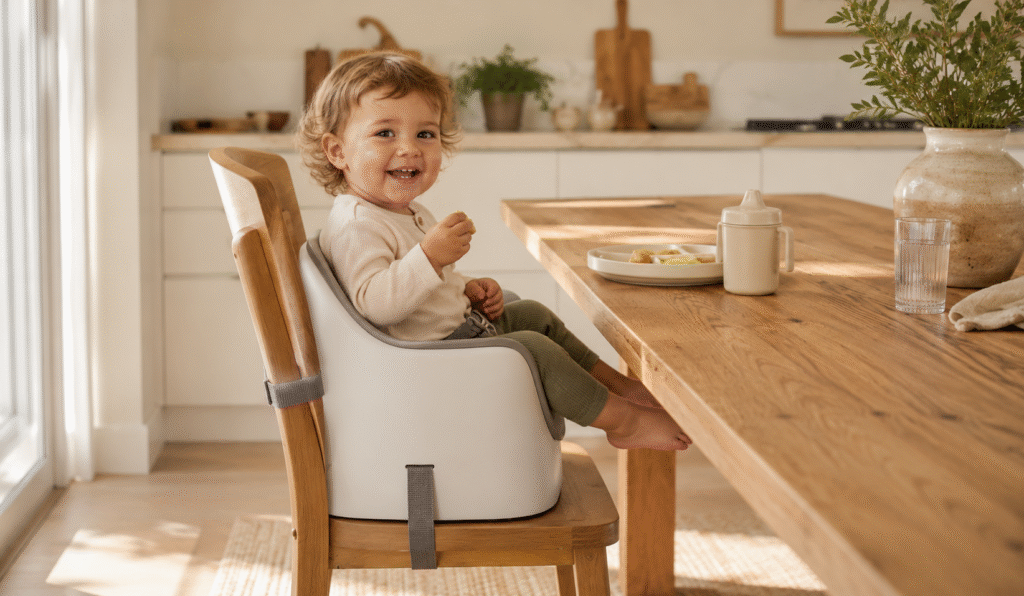
The week my youngest son outgrew his high chair tray was the same week he discovered he could climb out of anything with a buckle. That’s the chaos of toddler dining: the seat that worked yesterday is suddenly the wrong fit, and the booster that looked sleek online turns out not to clip onto your particular kitchen chairs.
After raising three kids through this exact transition (my daughter, who is now nearly six, and her two younger brothers), my husband and I have cycled through more booster setups than I care to admit, searching for the one that actually fits our routine. After spending the past few months cross-referencing parent reports, independent reviews from Consumer Reports and BabyGearLab, and the actual fine print on official manuals, I’ve narrowed the field to six booster seats that genuinely earn their place at the table.
None of these are perfect for every family. The honest truth is that booster seats are a “match the seat to your specific kitchen chair and child” problem, not a one-size-fits-all category. So I’ve organized this list by the question parents actually ask: which one is best for my situation?
How to Choose a Booster Seat for Your Dining Table
Before any product comparison, four factors will save you from a return shipment:
1. Measure your dining chair first
This is the step almost everyone skips. Strap-on boosters attach with a bottom strap (loops under the chair seat) and a back strap (loops behind the chair back). If your chair has a narrow back or unusual proportions, even a highly rated booster will slide around. Get a soft tape measure and note both the depth of the seat and the height and width of the chair back before you buy.
2. Tray or no tray?
Younger babies (6–15 months) usually need a tray because they’re not yet eating from the family table comfortably. Older toddlers (18 months and up) often do better at the actual table with no tray, since it builds family-meal habits and reduces the food-pushing-onto-the-floor reflex. Some seats let you remove the tray as your child grows, which is the most flexible setup.
3. Cleanability matters more than you think
A wipeable surface beats a machine-washable seat pad nine days out of ten (the same logic applies to choosing the right feeding bibs). Foam inserts trap crumbs in the seam between the insert and the base, which is a common pattern in parent reports. If you can find a seat with a one-piece wipeable design, that’s usually the lower-stress choice.
4. Match the harness to the kid
The American Academy of Pediatrics emphasizes that restraints are essential for any seat that elevates a child, regardless of how stable it looks. A three-point harness is the standard for boosters in this age range; some seats let you remove the harness when your child is older.
At a Glance: The 6 Picks
| Pick | Best for | Age | Weight limit | Price range |
|---|---|---|---|---|
| Bright Starts Pop ‘N Sit | Best overall, 3-in-1 with tray | 6m – 3y | 33 lbs | $20–$35 |
| Ingenuity Baby Base 2-in-1 | Best built-in tray with self-storage | 6 – 36m | 33 lbs | around $40 |
| Hiccapop OmniBoost | Best for travel and restaurants | 6m – 3y | 33–37 lbs | around $35 |
| Ingenuity SmartClean | Best lightweight, no-tray for older toddlers | 16 – 36m | 33 lbs | around $30 |
| Upseat Original | Best for posture and hip development | 4 – 24m | 30 lbs | around $120 |
| OXO Tot Nest | Best premium, longest age range | 9m+ | 50 lbs | around $56 |
The 6 Best Booster Seats for Dining, Reviewed
1. Bright Starts Pop ‘N Sit Portable Booster
$20–$35 • Check current price on Amazon
If you want one seat that does almost everything well for the price of a single dinner out, this is the workhorse. The three modes (floor seat, chair-top high chair with a removable tray, and toddler booster with the tray off) cover the full window from sitting-up baby to about three years old. Manufacturer Kids2 cites over two million sold worldwide, and the seat has a dedicated Consumer Reports review against the federal safety standard.
A few things make it the workhorse it is. The tray is dishwasher-safe, the seat folds to roughly five by fifteen inches with an included shoulder-strap carry bag, and the rear storage pocket actually holds bibs and wipes. It’s rated for children up to 33 pounds and ages six months to three years.
The honest limitations: The seat pad is machine-washable rather than wipe-clean, which means a single yogurt explosion is a laundry event, not a thirty-second cleanup. And in floor-seat mode, some toddlers will try to tip backward (a common pattern in parent reports), so positioning it against a wall or sofa during floor play is wise.
Best for: Families wanting one versatile seat from sitting-up through preschool, who don’t mind occasional laundry cycles.
2. Ingenuity Baby Base 2-in-1
Around $40 • Check current price on Amazon
This is the seat I would have wanted when my daughter was first making the leap from purees to finger foods. The hard-shell base feels noticeably more substantial than fabric-bodied alternatives, and the tray stores neatly underneath the seat instead of becoming a separate piece you eventually lose. It’s also the booster with the highest review count in this entire category, with tens of thousands of parents weighing in.
Rated for ages six to 36 months and up to 33 pounds, the Baby Base works as either a floor seat for sitting-up babies or as a chair-top booster strapped to a dining chair. The bottom strap measures 22 inches and the back strap 36 inches, with mounting points five inches up each side of the base. Those are numbers worth checking against your kitchen chairs before ordering. The tray itself accommodates plates up to 11 by 5 inches and is dishwasher-safe.
The honest limitations: The removable foam liner creates a gap where crumbs get trapped between the foam and the plastic base, which means cleanup takes longer than truly wipeable competitors. It’s also not the most travel-friendly option at about 4.5 pounds: fine for car trips, awkward for flying.
Best for: Families who want a sturdy, long-lasting kitchen booster and don’t mind a slightly more involved cleanup routine.
3. Hiccapop OmniBoost Travel Booster Seat
Around $35 • Check current price on Amazon
Anyone who has wrangled a one-year-old at a restaurant knows: their high chairs are universally terrible. Among the folding boosters that consistently rise to the top in parent reports and independent reviews, the OmniBoost is the one that strikes the best balance between portability and safety. It folds into a shoulder-strapped carry bag, weighs about four pounds, and unfolds into a structured chair with a tray, three-point harness, and “duck feet” attachments that stabilize it on uneven ground.
What sets it apart from cheaper folding boosters is the manufacturer’s lifetime guarantee. Hiccapop covers manufacturing defects and even accidental damage on items purchased through Amazon or their site. That kind of warranty signals confidence in the product, and the brand’s broader line of baby gear consistently earns high parent ratings as well. The seat is rated for ages six months to three years.
The honest limitations: The seat itself has no padding, so it’s a less comfortable spot for long sit-down meals than a cushioned home booster. Several parent reports also mention that the legs occasionally stick in the open position and require a firm push to collapse. (Worth noting: Hiccapop also sells the UberBoost, which is a separate inflatable car booster, so don’t confuse the two when comparison shopping.)
Best for: Restaurant outings, camping, beach days, grandma’s house, and any meal that happens somewhere other than your kitchen.
4. Ingenuity SmartClean Toddler Booster
Around $30 • Check current price on Amazon
When older toddlers are ready to graduate from the chair-and-tray setup to the actual family table, this is the kind of seat parents reach for. It’s a wipeable plastic shell with a soft foam insert, weighing in at about a pound and a half, the lightest seat in this roundup. The three-point harness is removable for kids who no longer need it, and the harness straps themselves are machine-washable.
Designed for 16 to 36 months and up to 33 pounds, it straps onto most adult dining chairs with bottom straps of 26 inches and back straps of 33 inches. The wipe-clean surface is genuinely fast to wipe down, which makes it a category favorite for high-mess eaters.
The honest limitations: Two recurring patterns in parent reports are worth flagging. First, the straps run long, so families with narrow-back kitchen chairs report the seat shifts when an active toddler wiggles. If your chairs have slim profiles, this may not be the right pick. Second, the foam insert is thin enough that some children mention discomfort after longer meals, with occasional reports of a red mark on the lower back. For shorter meals at a standard wide-backed dining chair, neither issue tends to surface.
Best for: Toddlers eating at the actual family table on standard wide-backed dining chairs, where lightweight portability and fast cleanup are the priorities.
5. Upseat Original Ergonomic Baby Floor & Booster Seat
Around $120 • Check current price on Amazon
This is the niche pick, and it’s an expensive one. The Upseat is the only seat in this roundup developed in collaboration with pediatric physical therapists, with a design that explicitly addresses two things parents rarely think about: anterior pelvic tilt (the slight forward rotation of the pelvis that supports upright posture) and hip splay angle. It cites the International Hip Dysplasia Institute’s guidance on healthy infant hip positioning, and the design has been independently recommended by practicing pediatric PTs writing outside the brand’s own marketing.
The seat is rated for four to 24 months and up to 30 pounds (a narrower age window than other picks) and converts between floor seat, booster (with included straps), and feeding seat (with included tray). It’s made of medical-grade polyurethane foam in North America and comes with a lifetime warranty on the seat itself (one year on the tray).
The honest limitations: The price is at least three times higher than most alternatives. The age range is also significantly shorter: you’ll need a different seat by age two. If your child’s posture or hip development isn’t a specific concern for your family, the value calculation is harder to justify.
Best for: Families where ergonomics, posture, or healthy hip development is a priority, particularly worth considering for younger babies still developing core strength.
6. OXO Tot Nest Booster Seat with Removable Cushion
Around $56 • Check current price on Amazon
The Nest is the seat I would point a friend toward if she wanted one booster that would last from baby-led weaning all the way through kindergarten lunches. The 50-pound weight limit is the highest in this entire roundup (nearly twice what most competitors offer), and the high back and side panels cradle smaller children securely while still working for bigger ones. It earned the runner-up spot in BabyGearLab’s most recent table booster review.
Rated for nine months and up, the Nest includes a removable cushion that’s BPA-, phthalate-, and PVC-free and wipes clean in seconds. Two side-release buckles secure even the most determined escape artist, the bottom and back chair straps adjust to a range of chair styles, and non-slip feet protect your dining chairs from scratches. (Make sure you’re looking at the “Nest” specifically: OXO Tot also sells a “Perch” model with different dimensions and a different age range.)
The honest limitations: The Nest is on the larger side, so kitchens with tight clearances may feel cramped with it strapped to a chair. The buckles take a firm push to lock fully, which is not a flaw but worth knowing. And depending on your table’s height, the lift might be slightly too tall or too short for an ideal eating position; it’s worth checking once it arrives.
Best for: Families wanting one premium seat that grows from nine months through the early school years, especially in homes that prioritize fast wipe-down cleanup over budget pricing.
Safety Notes Every Parent Should Read
Frequently Asked Questions
When is a baby ready for a booster seat at the table?
Most booster seats list six months as the minimum age, but the real readiness signal is whether your baby can sit up unassisted for several minutes at a time. If they still slump or tip when seated on the floor, they’re not ready for a chair-mounted seat regardless of what the box says.
Do I need a separate booster for travel?
Not necessarily. A folding option like the Hiccapop OmniBoost can serve as both your at-home and on-the-go seat. But families who eat out frequently or visit grandparents weekly often find it easier to keep a dedicated travel booster permanently in the car so it’s always ready.
How long do toddlers actually use booster seats?
The typical window is from around nine months (when most babies sit reliably) through about three to four years for tray-style seats, and through five or six years for tall-back boosters like the OXO Tot Nest. After that, most kids are ready for a regular dining chair, possibly with a cushion on top.
Can I use a car booster at the dinner table?
No. Car booster seats are engineered for crash forces and don’t have the right structural features for dining (no harness designed for spills, no compatible attachment for kitchen chairs). Use a dining-specific booster for meals.
The Bottom Line
If you want one seat that handles most situations from sitting-up baby through age three, the Bright Starts Pop ‘N Sit is the value pick. If your priority is fast cleanup and you want a seat that lasts into the early school years, go with the OXO Tot Nest. For families who eat out often, the Hiccapop OmniBoost is the travel staple, and for any family where posture or hip development is a specific concern, the Upseat Original is the one PT-developed option worth its premium.
Whichever you choose, measure your kitchen chair first, check the weight and age ratings against your child today, and remember the basic rule that applies regardless of the seat: never leave them unsupervised at the table.