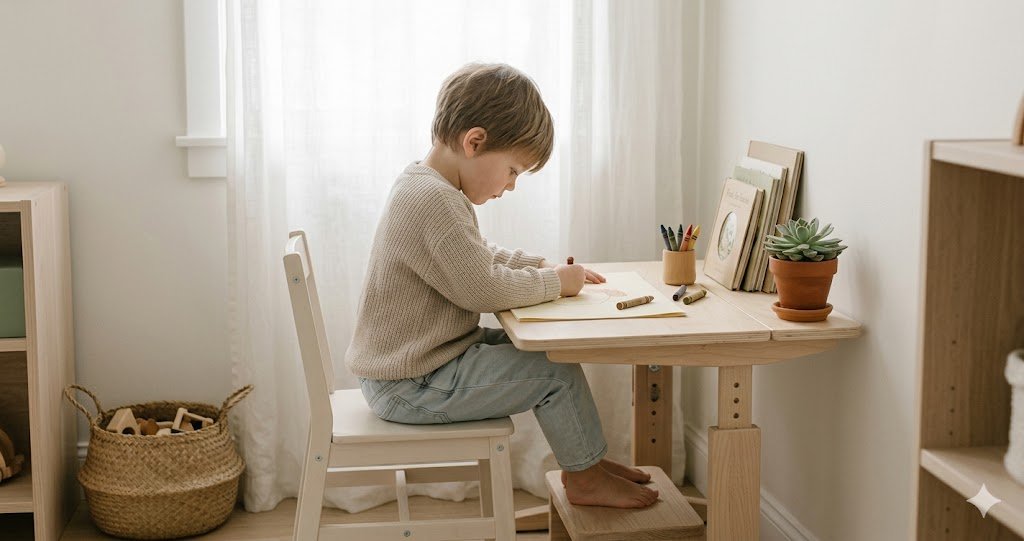
My daughter started writing her name somewhere around her fifth birthday, and for about a month the only place she wanted to do it was the kitchen table. Which sounds sweet until you picture the reality: chin practically resting on the placemat, legs swinging two feet above the floor, one elbow cocked up by her ear because the table hit her mid-chest. She’d last maybe four minutes before sliding off the chair to go do literally anything else.
My husband figured our daughter just wasn’t a sit-still kind of kid. It took me an embarrassingly long time to land on a less flattering explanation: nothing in our house actually fit her. A four-to-six-year-old at a grown-up table is in the same position you’d be in trying to write at a kitchen counter while standing on a stepstool. Of course they squirm.
So I went looking for a real desk, and immediately fell down a rabbit hole of “ergonomic kids’ desks” ranging from $60 plywood sets to $300 contraptions with more levers than my car. This guide is the version I wish I’d had at the start: what “ergonomic” actually means for a kid this age, the handful of features that matter, and five sets that get the fundamentals right at different budgets. (If your child is closer to 3 than 6, you may also want to look at simpler toddler table and chair sets, which I covered separately.)
Why “ergonomic” matters more at 4–6 than you’d think
It’s tempting to file “ergonomics” under grown-up-office-worker problems. But the preschool-to-kindergarten window is exactly when kids start spending real stretches of time seated and focused. Drawing, tracing letters, doing those first worksheets, all while their bodies are still figuring out how to hold themselves upright for it.
Pediatric occupational therapists describe the target posture as the 90-90-90 rule: hips, knees, and ankles each bent at roughly 90 degrees, with feet flat and supported. According to the guidance OTs use for setting up a child’s workspace, the desk surface should sit about two to three inches above the child’s bent elbow when they’re seated correctly, with shoulders relaxed. The NHS paediatric occupational therapy service makes the same point and adds a detail parents often miss: if a child’s feet don’t reach the floor, give them something to rest on, like a footrest or even an upturned box, so they have a stable base instead of dangling.
And that’s hard to pull off with regular furniture, because a child grows several inches across these two years, and a single fixed-height table fits them for maybe one of those years if you’re lucky. That’s the entire case for an “ergonomic” kids’ desk. Not the marketing buzzword, but a setup you can actually adjust to keep your kid in that supported 90-90-90 zone as they shoot up.
What actually makes a kids’ desk ergonomic (the 5 things I checked)
After wading through dozens of listings, the features that genuinely matter for this age sorted themselves into five buckets. Everything else (LED lamps, cup holders, cartoon decals) is a nice-to-have, not a need.
- Height adjustment that reaches low enough. The desk and chair both need to come down far enough for a small four-year-old, not just a tall first-grader. This is the single most important feature, because it’s what lets the set keep fitting as your child grows.
- A tilting desktop. A surface that angles up brings the work closer to the child’s eyeline so they stop hunching forward to see it. Pediatric OTs specifically list angled writing surfaces as a tool for better seated alignment. Great for reading and drawing; you’ll want it flat for things like building or gluing.
- A chair with real back support. Not a flat stool. A contoured or slightly reclined backrest gives the lower back something to lean into, which matters a lot for kids who still fatigue quickly when sitting.
- Safety and materials. Rounded corners, anti-pinch covers on any moving joints, a tip-resistant base, and a non-toxic finish. At this age the corners and the tip-over risk are the real concerns.
- A footrest or low chair. Because dangling feet wreck the whole posture. Either the chair sits low enough that feet reach the floor, or there’s a built-in footrest bar.
With that checklist in hand, here are the five sets I’d actually consider. I’ve grouped them so you can jump to the one that fits your space, budget, and how much “grow-with-them” engineering you want.
The 5 best ergonomic kids’ desks and chairs for ages 4–6
1. Rengue Height-Adjustable Desk & Chair Set — Best Overall Value
If you want the most ergonomic features for the least money, this is where I’d start. The Rengue set is the classic “study desk” silhouette (metal frame, MDF top) and it hits nearly every item on the checklist above without the premium price tag.
Both the desk and the chair adjust for height (the desk runs roughly 21 to 29 inches, the chair seat 12 to 17 inches), and the listing rates it for children from age 3 all the way to 12, so a four-year-old starts at the low end with plenty of room to grow. The desktop tilts continuously from flat to 55 degrees, which covers everything from gluing projects to upright reading, and there’s a small fold-up reading stand built into it. You also get a pull-out drawer, a side hook for a backpack, and a detachable LED lamp with a few brightness settings. The frame is steel with rubber floor pads, rated to 200 pounds.
Worth knowing before you buy: the top is MDF rather than solid wood, so it’s a “looks fine, isn’t an heirloom” piece. And the LED lamp is more of a bonus than a reason to buy; plenty of families just leave it off. But for a set that genuinely adjusts down to a 4-year-old and grows with them, the value here is hard to beat.
Best for: Parents who want full adjustability and a tilting top without spending three figures.
2. SMAGREHO Adjustable Desk & Chair Set — Best Track Record
The SMAGREHO set is the one that’s been around the longest. It’s been a steady fixture in this category for years, which means there’s a deep well of real-world feedback behind it rather than a listing that popped up last month.
Spec-wise it’s a close cousin of the Rengue: steel frame, both desk and chair height-adjustable, rated for ages 3 to 15, with a detachable LED lamp, a side hook, and a pull-out drawer. Its standout is the desktop, which tilts across an unusually wide range, flat all the way up to 75 degrees, plus a rotatable book stand that holds a book at a sensible eye distance. The build is MDF and PP plastic on a steel frame, with non-slip foot pads and a 200-pound capacity.
The trade-off is mostly aesthetic. Because it’s an older design, it looks a little more “functional classroom” and a little less “cute nursery” than some of the newer sets. If you care more about how well it works than how it photographs, that’s a feature, not a bug.
Best for: Parents who want a proven, long-selling option with the widest tilt range.
3. Xaperexi Height-Adjustable Desk & Chair Set — Best Simple Adjustable
Some kids don’t need a tilting top and a lamp and a hook. They need a clean, sturdy, height-right surface and nothing to fiddle with. The Xaperexi set is the pared-down version of the adjustable desk.
It skips the tilting mechanism in favor of a wide, flat desktop, which is actually the better choice if your child mostly builds, puzzles, and does open-ended play rather than upright reading. Both pieces adjust for height and it’s rated for ages 3 to 15, so the grow-with-them logic still applies. What stood out to me on the safety front: the listing specifically calls out rounded corners, curved edges, and an anti-pinch device on the adjustment mechanism, exactly the details that matter when little fingers are involved. There’s a built-in bookstand and a storage drawer, the frame is steel (rated to a hefty 400 pounds), and the materials carry forestry certification.
The thing to be clear-eyed about: no tilt means it’s not ideal if your main goal is upright reading posture. For writing, crafts, and play at the right height, though, the simplicity is the appeal.
Best for: Families who want a flat, fuss-free adjustable surface and skip the bells and whistles.
4. Treocho Wooden Desk & Chair Set with Hutch — Best Wooden Pick
If the metal-frame “study station” look isn’t for you, the Treocho is the set that leans warm and woody while still taking ergonomics seriously. It’s the one I’d put in a bedroom you actually want to look at.
It’s built around a generous 35-inch wooden top that tilts up to 105 degrees, the widest range of anything here, and it’s paired with a curved-back chair designed to encourage an upright sitting position. Above the desk sits a hutch with a cabinet and shelving, plus a built-in corkboard for taping up artwork and reminders. It’s rated for ages 3 to 8, which lands right in the 4-to-6 sweet spot.
Two honest caveats. First, unlike the metal sets above, the Treocho’s height isn’t adjustable. It’s sized for the 3-to-8 range as a fixed unit, so you’re trading grow-with-them flexibility for looks and a built-in hutch. Second, that hutch takes up real vertical and floor space, so measure your spot before you commit. But as a wooden, posture-minded desk that doubles as a tidy little command center, it’s lovely.
Best for: Parents prioritizing a warm wooden look and built-in storage over height adjustment.
5. UTEX Wooden Desk & Chair Set — Best Simple First Desk
And then there’s the case for keeping it dead simple. Not every 4-year-old needs cranks and tilt angles; sometimes you just want a solid little wooden desk that says “this is your spot.” The UTEX set is that, and it’s the budget-friendliest pick here.
It’s real wood (solid wood legs, not the wobbly metal you find on cheaper sets), and it’s certified to the ASTM, CPSIA, and CPC safety standards with a non-toxic finish, which is reassuring if you, like me, have a kid who still occasionally chews on furniture. Crucially for posture, the chair has a curved, slightly reclined backrest meant to support the spine, and the whole set is sized for ages 3 to 8 so a 4-to-6-year-old’s feet reach the floor. You get a stand-up tabletop organizer, an open cubby, and a pull-out drawer for supplies. The desk measures about 25 inches across.
The honest limitation is right there in the simplicity: the height is fixed. It fits the 3-to-8 range well, but there are no levers to extend it, so a tall six-year-old may start to outgrow it sooner than the adjustable sets. For a first desk that’s safe, sturdy, and genuinely affordable, though, it’s a smart entry point.
Best for: A first real desk on a budget, where simple and sturdy beats adjustable.
Quick comparison
| Set | Best for | Approx. price | Height adjustable? | Tilting top | Material |
|---|---|---|---|---|---|
| Rengue | Overall value | ~$75–80 | Yes (desk + chair) | 0–55° | MDF + steel |
| SMAGREHO | Track record | ~$100 | Yes (desk + chair) | 0–75° | MDF/PP + steel |
| Xaperexi | Simple adjustable | ~$90 | Yes (desk + chair) | No (flat) | Steel frame |
| Treocho | Wooden look | ~$130 | No (fixed) | 0–105° | Wood |
| UTEX | Simple first desk | ~$75 | No (fixed) | No (flat) | Solid wood legs |
Prices shift constantly on these, so treat the figures above as ballpark and check the live listing before you buy.
How to set it up so it actually helps their posture
Buying the desk is the easy part. Getting the fit right is what makes it ergonomic, and it takes about two minutes with your child sitting in it:
- Set the chair first. Adjust it (or pick the chair) so their feet rest flat, on the floor or a footrest, with knees bent at about 90 degrees. The Canadian Centre for Occupational Health and Safety frames this same “feet supported, joints near 90 degrees” principle for seated work.
- Then set the desk to elbow height. With your child sitting up and shoulders relaxed, the surface should land about two to three inches above their bent elbow, so their forearms rest without hunching or reaching up.
- Sort out the feet. If their feet dangle, which is common at four and five, add a footrest or a sturdy box. This one fix does more for posture than almost anything else.
- Recheck every few months. Kids grow in spurts, and a setup that was perfect in September can be too low by spring. A quick re-measure keeps the whole thing working.
One more thing that keeps the space usable: somewhere to put everything. A couple of bins or a low shelf nearby keep the desktop clear so it stays inviting rather than becoming a dumping ground. If you need ideas, our guide to storage bins and toy organizers covers options that work next to a desk.
Frequently asked questions
Adjustable or fixed-height, which should I get for a 4-year-old?
If budget allows, adjustable. A four-year-old is at the start of a fast growth stretch, and an adjustable set keeps fitting them through kindergarten instead of needing replacement in a year. A fixed wooden desk sized for ages 3–8 is a perfectly good call if you prefer the look or the price, just know you may be shopping again sooner.
Do I really need the tilting desktop?
It depends on what your kid does. Tilt genuinely helps for reading and drawing, because it brings the work up toward their eyeline instead of forcing them to bend over a flat surface. But if your child mostly builds, puzzles, and does crafts, a flat top is more practical, and you can always prop a book or slant board on a flat desk when you need an angle.
What about the LED lamps some of these include?
Treat them as a freebie, not a feature. A decent clip-on lamp or good room lighting does the same job. Don’t pick a desk for the lamp, and don’t pay extra for it.
My child’s feet don’t reach the floor, is that a problem?
Yes, and it’s an easy fix. Dangling feet pull a child forward and out of alignment. Add a footrest, a small stool, or even a firm box under their feet so their knees can sit at that 90-degree angle. Occupational therapists recommend exactly this when a chair can’t go low enough.
Metal frame or wood, which is better?
Neither is “better”; they solve different problems. Metal-frame sets are where the height adjustment and tilt live, so they win on grow-with-them ergonomics. Wooden sets win on looks, warmth, and how they fit into a bedroom you care about. Decide which of those matters more to you and the rest follows.
The bottom line
For most families with a 4-to-6-year-old, I’d reach for the Rengue first. It adjusts down low enough for a small child, tilts, and costs the least of the full-featured sets. If you want the most proven option, the SMAGREHO has the longest track record and the widest tilt. Prefer something that looks like furniture instead of a workstation? The Treocho wooden set with its hutch is the prettiest of the bunch. And if you just want a simple, sturdy, affordable first desk, the UTEX does that job without the fuss.
Whichever you choose, remember the part that actually matters: set the chair so their feet are supported, set the desk to their elbow, and re-check the fit as they grow. That’s the whole game. The desk just makes it possible.