I’ve done the “little kid in the sun” thing three separate times now, with three very different kids, and I can tell you the exact afternoon my priorities shifted. My daughter was still a baby and it was a brutally hot day at the park. I’d packed approximately four hundred items, and somehow not one of them made shade. We ended up huddled under a borrowed umbrella that flipped inside-out twice (my husband still brings it up), and I spent the whole afternoon as a human sun-blocker instead of, you know, sitting down.
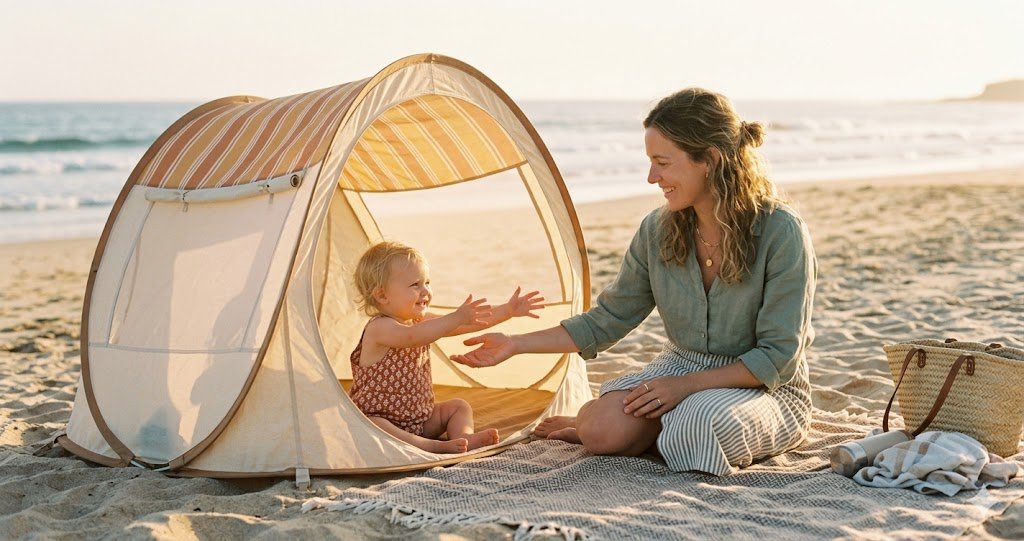
By the time my boys were old enough for real beach days, toddling around and eating fistfuls of sand, a proper pop-up sun shade was the first thing I packed, right next to the folding beach chairs. Little kids burn fast, overheat faster, and have zero interest in sitting still under an umbrella you’re holding by hand. A tent that pops open in seconds and gives them a shaded spot to roll, nap, or splash is one of those cheap purchases that quietly saves the whole day.
To put this list together I leaned on a lot of homework rather than personal testing of every single model: I cross-referenced hundreds of parent reviews, checked each product’s current Amazon status and rating, and ran every contender against safety-recall databases. I kept only options sitting at 4.4 stars or higher with a real review history and confirmed stock. I’ll be honest about what each one does not do, too, because no beach tent is perfect and a few of these have the same annoying quirk.
One thing I cut on purpose: the playpen-style “beach tents” (the tall mesh enclosures you set a baby down inside). Those are technically play yards, a regulated category that has seen a string of safety recalls for flammability and head-entrapment, including a popular beach-branded one. They deserve their own careful write-up. This guide sticks to soft pop-up sun shades, which are a different and lower-risk kind of product.
The shortlist, at a glance
| Pick | Best for | Approx. price | Standout feature |
|---|---|---|---|
| Monobeach Baby Beach Tent | Best overall | ~$26 | Built-in mini splash pool |
| Tiny Land Baby Beach Tent | Best design & build | ~$38 | U.S. brand, cooling fabric, 3 sand pockets |
| Wilhiker Baby Beach Tent | Best budget | ~$26 | Comes with a matching sun hat |
| Peradix 4-in-1 Pool Tent | Best for water play | ~$40 | Tent + paddling pool + ball pit + mosquito net |
| WEMOH Baby Beach Tent | Best for bug protection | ~$39 | Built-in mosquito net + rear vent window |
What actually matters in a baby beach tent
After three rounds of beach summers, here’s what I’d tell a friend to look for before anything else.
UPF 50+ fabric. This is the non-negotiable. UPF 50+ blocks the vast majority of UV rays, which matters enormously for thin baby skin. Every tent on this list claims it. Just remember shade is a layer, not a force field, more on that in the safety section.
Real ventilation. A sealed nylon dome on a hot beach turns into a tiny greenhouse. Look for mesh panels, a rear vent window, or a roll-up front so air actually moves through. A cranky, sweaty baby is the fastest way to end a beach trip early.
A plan for wind. Here’s the honest truth that the product photos won’t tell you: these lightweight pop-ups will tumble down the beach the second a real gust hits if you don’t anchor them. Sand pockets you fill with sand are more reliable than the flimsy stakes that come in the bag. None of these are built for genuinely windy or stormy days, full stop.
Pool or no pool. Several of these have a shallow dip in the floor you fill with a little water. Toddlers adore it; it also means you’re now supervising water, which changes the math (again, safety section).
The folding tax. Almost every pop-up tent on earth is a dream to open and a small wrestling match to fold back into its little round bag. It’s the single most common complaint across every brand. Watch the folding video once before your first trip and you’ll save yourself a beach meltdown (your own, not the baby’s).
The 5 best baby and toddler beach tents
1. Monobeach Baby Beach Tent — Best Overall
If you want the safe, popular, do-everything choice, this is it. The Monobeach has been the category best-seller for years, with thousands upon thousands of reviews, and it lands the basics: instant pop-up, UPF 50+ coverage, detachable sun-side panels, and a little built-in pool you can fill with roughly a gallon and a half of water so a baby can splash in the shade instead of getting near the surf. Two sand pockets help hold it down. At around twenty-five dollars, the value is hard to argue with.
Love: unbeatable price, the splash pool is a genuine toddler magnet, huge track record.
The catch: folding it back into the bag takes practice (the company literally made a tutorial video, which tells you something), a handful of reviewers report the frame wearing out after heavy use, and it’s so light you must weight it down.
Check the current price on Amazon →
2. Tiny Land Baby Beach Tent — Best Design & Build
Tiny Land is an actual U.S. brand with its own website and warranty, which already sets it apart from the wall of anonymous sellers in this category. The tent looks lovely (calm pastel tones rather than primary-color chaos), the fabric is designed to knock several degrees off the interior temperature, and it has three sand pockets instead of two for better stability. The small detail that stands out most: an oversized carry bag, which makes that dreaded refold noticeably less rage-inducing.
Love: reputable brand, genuinely nicer materials, the bigger bag is a quiet win, photographs beautifully if that matters to you.
The catch: the breezy mesh sides also let in more sand than fully enclosed designs, it’s a compact footprint best for one little one, and it’s newer so there’s less multi-season durability feedback.
Check the current price on Amazon →
3. Wilhiker Baby Beach Tent — Best Budget
For about the same money as the Monobeach, the Wilhiker throws in a matching wide-brim sun hat, which is a sweet little bonus when you’re trying to keep a baby fully shaded. It uses a silver-coated UPF 50+ fabric, has a handy double-zipper so you can reach in from either side, and includes a built-in storage pocket for bottles and the small stuff that always disappears into the sand.
Love: the bundled hat, dual-zip access, solid sun protection at a rock-bottom price.
The catch: the canopy doesn’t fully cover when the sun is low or harsh, color options are limited, and like the others it’s a battle to fold and only modestly wind-resistant. Important: the listing flags small parts and is not recommended for children under 3, so mind the hat and pegs around little ones.
Check the current price on Amazon →
4. Peradix 4-in-1 Pool Tent — Best for Water Play
This one is less “nap shelter” and more “backyard splash zone that also works at the beach.” It rolls four things into one: a sun shade, a shallow paddling pool, a ball pit, and a little tent, and the 2026 version adds a detachable mosquito net over the canopy. It’s roomy enough for two kids under five to share, pops up with no pump, and folds flat for travel. If your toddler’s idea of a good time is water plus chaos, this earns its spot.
Love: incredible versatility, works wet or dry and indoors or out, sold and shipped by Amazon directly.
The catch: the balls aren’t included (budget another few dollars), it’s a shallow pool only, and because it’s an open water feature it demands constant hands-on supervision (see safety below).
Check the current price on Amazon →
5. WEMOH Baby Beach Tent — Best for Bug Protection
If your “beach” is really a lakeshore, a marshy park, or anywhere mosquitoes show up at golden hour, this is the pick none of the others can match. The WEMOH builds a fine-mesh mosquito net right into the canopy, with two tie cords to hold it open and a rear vent window for cross-breeze, so your baby can nap bug-free without baking. It comes with three sand pockets and four longer-than-usual stakes, and the brand notes it uses at least 50% recycled fabric.
Love: real bug protection, smart front-and-back airflow, eco-conscious materials, a roomier interior than most.
The catch: it’s a brand-new 2026 model, so the independent review history is still thin, and the maker openly says it’s not made for strong winds. No splash pool here, but that’s rather the point.
Check the current price on Amazon →
Beach sun and water safety for babies and toddlers
A tent is a tool, not a guarantee. Here’s how the pediatric guidance actually shakes out, and how I think about it in practice.
Babies under 6 months belong out of direct sun. The American Academy of Pediatrics recommends keeping infants under six months out of direct sunlight altogether, relying on shade and lightweight clothing that covers arms and legs. A pop-up tent is a perfect way to create that shade when there’s none around. You can read the AAP’s full guidance on infant and child sun safety here.
Shade reduces UV, it doesn’t erase it. Sand and water bounce sunlight right back up under a canopy, so a shaded baby can still pick up rays. Keep the sun hat and UPF clothing on, and for babies under six months, the AAP says you can apply a small amount of baby sunscreen to exposed areas like the face and backs of the hands when shade and clothing aren’t enough. After six months, sunscreen can be used more freely.
Never leave a baby alone in a tent, and watch the heat. A zipped-up tent in full sun can get warm quickly. Check on your little one often, keep airflow moving through the mesh, and never treat the tent as a place to step away from. These shelters explicitly do not protect against overheating.
The water rule that matters most: even an inch of water in a built-in pool is a drowning risk for a baby or toddler. Drowning is silent and fast. The AAP calls for “touch supervision”, an adult within arm’s reach, any time a young child is in or near water. If you use a pool-style tent, empty it the moment play is done.
Mind the small parts. A couple of these come with extras like stakes or a sun hat that include small pieces. Keep loose hardware away from babies who put everything in their mouths, and follow each product’s stated age guidance.
Frequently asked questions
Do baby beach tents really block UV rays?
Yes, the ones rated UPF 50+ block roughly 98% of UV radiation that hits the fabric. The catch is reflected light from sand and water, which sneaks in from the sides and below, so pair the tent with a hat, UPF clothing, and (age-appropriately) sunscreen.
What age is a beach tent good for?
Most of these are sized for infants up to about age three: a baby can nap in the shade and a toddler can sit up and play. For the youngest babies, though, lean on these for shade in the backyard or a shaded park rather than open beach sun, and keep the under-six-month guidance above in mind. Older preschoolers usually outgrow the small dome-style tents and do better with a larger pop-up beach shelter.
Should I get one with a built-in pool?
A splash pool is a wonderful toddler distraction on a hot day, but only if you’re committed to hands-on water supervision every second. If you mostly want a shady nap and play spot, a no-pool option like the WEMOH is simpler and safer.
How do I keep a beach tent from blowing away?
Fill the sand pockets completely, then drive the stakes in at an angle. Sand pockets do more than the included pegs alone. Honestly, on a properly windy day, I’d skip the pop-up tent and set up behind a windbreak instead.
Why is it so hard to fold these back up?
The flexible spring frame that makes them pop open in a second is the same thing that fights you on the way down. It’s a twist-and-fold motion, not a push. Watch the brand’s 30-second video once and it clicks, literally.
Whichever you choose, the win is the same: a shaded, contained little spot where your kid can be a kid and you can actually sit down for five minutes. After three beach-baby summers, that five minutes is worth its weight in gold.