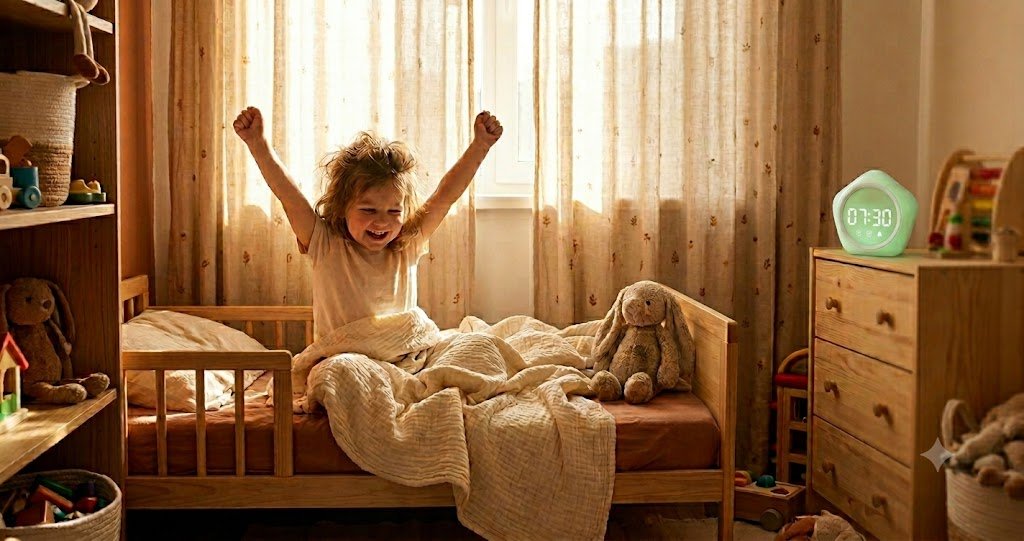
If you’re shopping for an OK-to-wake clock, I’m going to guess your toddler’s mornings are starting earlier than you’d like. Mine certainly were.
A few years back, when my daughter was three, she decided that 5:15 a.m. was the perfect time to start the day. Not 5:15 exactly — some mornings she’d go with 4:50 instead, just to keep us on our toes. She’d pad into our room, peel one of my eyelids open with a tiny finger, and announce, “Mama. It’s morning.”
It was not morning. By week three, my husband and I were communicating exclusively in hand signals before 6 a.m.
If you’re reading this with one eye open and a coffee that’s gone cold twice, you already know why OK-to-wake clocks exist. The pitch is simple: toddlers can’t tell time, but they can absolutely tell red from green. The clock glows one color for “stay in bed” and another for “okay, come destroy the kitchen.” You set the wake time. The clock holds the line so you don’t have to negotiate with a three-year-old at dawn.
Do they work? Honestly: yes, with an asterisk. Sleep experts like the team at Taking Cara Babies are clear that an OK-to-wake clock is a tool, not a magic fix. It gives your kiddo a visual boundary, but you still have to enforce that boundary consistently for a week or two before it clicks. The clock doesn’t do the parenting. It just makes the parenting visible at 5 a.m.
It’s also just one piece of the morning puzzle. Once your early riser is waiting for the green light, the next battles are clothes, shoes, and the front door — we rounded up the gear for that whole sequence in our morning routine tools guide.
How I picked these OK-to-wake clocks (the boring-but-important part)
I didn’t just sort Amazon by “best seller” and call it a day. Every clock here had to clear the same bar I use for everything I recommend: a strong rating backed by a meaningful number of reviews, consistent real-world sales (a clock nobody buys can hide its flaws), and a clean run through safety checks. That last one matters more than people think. I checked every brand on this list against the CPSC recall database, dug through one-to-three-star reviews looking for repeated failure patterns, and cross-checked manufacturer claims against their own product pages.
Two of the most famous names in this category didn’t survive that process. I’ll tell you exactly why at the end, because if you’ve been googling “toddler clock,” you’ve definitely seen them, and you deserve the full picture before you spend $50 to $75.
The 5 Best OK-to-Wake Clocks in 2026 (at a glance)
| Pick | Best For | Wake Cue | Price |
|---|---|---|---|
| Windflyer “Little Teddi” | Best overall | Face expressions + green light | low $30s |
| ANNNGUL Sleep Trainer | Best budget | Classic red/green light | ~$20 |
| Yoto Mini (2024 Edition) | Best splurge / all-in-one | Day & night display + audio | ~$80 |
| ANALOI Cat Clock | Cutest design | Sun/moon icons + color light | low $30s |
| FiveHome Emoji Clock | Best for nap training | Red/green light + emoji faces | under $30 |
Prices bounce around — check the live listing before you commit.
1. Windflyer “Little Teddi” — Best Overall OK-to-Wake Clock
Windflyer OK-to-Wake Clock for Kids
This clock has been around since 2020, which in this category makes it a grizzled veteran, and it’s collected thousands of reviews while holding an excellent rating. That longevity matters: plenty of toddler clocks launch, sell hard for six months, and vanish before the one-star reviews catch up.
What sets it apart is the face. Instead of just switching colors, Little Teddi runs a three-stage cycle with actual expressions: closed eyes for sleep, a winky face with pale green light for an optional “quiet play” window, and a full smile with green light when it’s truly time to get up. That middle stage is clever for kids who wake early no matter what you do. You can set it for anywhere up to 90 minutes before wake time, and it signals “you can look at books in your room, but it’s not morning yet.” If you’ve built any kind of quiet independent play routine, this slots right into it.
It also covers the practical stuff: a child lock so curious fingers can’t reprogram it, settings that survive a power outage thanks to a small built-in memory battery, five night light colors, and a handful of sleep sounds.
Power: Plug-in with built-in settings-memory battery
Best for: Young toddlers who read faces better than colors, early risers who need a “quiet play” middle stage, families who want one OK-to-wake clock that lasts into the school years.
Honest drawbacks: A few parents report the white noise occasionally shutting off early. Display brightness is adjusted manually, separate from sleep mode. And the pale-green “play” light can look an awful lot like the real green light to a determined toddler — some families just turn that stage off.
2. ANNNGUL Sleep Training Clock — Best Budget
ANNNGUL OK-to-Wake Clock for Kids
If you want the red-light-green-light concept with zero frills and zero learning curve, this is the one. It carries an Amazon’s Choice badge and outsells almost every dedicated OK-to-wake clock on the platform, which tells you something about how many parents just want the basics done well.
Red light means stay in bed, and it stays on all night, dimming automatically so it won’t light up the room like a brake light. Green means go. The buttons sit right on the clock face instead of hiding underneath, so setup takes about three minutes. There’s one quietly brilliant feature buried in here: if you set the wake alarm with the volume at zero, you get a silent, light-only wake-up. No sound to jolt a kid who might have otherwise slept another 20 minutes. If you’ve ever woken a sleeping toddler by accident, you understand why I’m calling this brilliant.
The trade-offs are exactly what you’d expect at this price. It has to stay plugged in, and there’s no white noise or sound machine function. If you already run a separate sound machine in your kiddo’s room, that’s irrelevant. If you wanted one gadget to do both jobs, look at the Windflyer above.
Power: Plug-in only (adapter included)
Best for: Budget shoppers, families who already own a sound machine, parents who want the simplest possible setup.
Honest drawbacks: Must stay plugged in — no battery mode. No sound machine function. Function over beauty; this won’t win any nursery-decor awards.
3. Yoto Mini (2024 Edition) — Best Splurge / All-in-One
Yoto Mini Kids Bluetooth Speaker & Audio Player, 2024 Edition
The Yoto Mini is not really a toddler clock. It’s a screen-free audio player that happens to include an excellent OK-to-wake clock function, and that distinction is exactly why some families should buy it and others shouldn’t.
Here’s the case for it: kids pop physical cards into the speaker to play audiobooks, music, and podcasts — no screen, no ads, no camera, no microphone. The little pixel display doubles as the OK-to-wake cue, switching between a night-time and a morning face. It runs about 14 hours on a charge, works as a Bluetooth speaker, plays white noise at bedtime, and travels well. For a three-or-four-year-old, it can be the bedtime storyteller, the sleep trainer, and eventually the thing they listen to chapter books on at age eight. Almost nothing else in the kids’ gear world has that kind of lifespan, and its rating reflects it: this is one of the most loved kids’ products on Amazon, full stop.
The case against it: if all you need is “stop waking me at 5 a.m.,” this is overkill. The wake cue is a small icon rather than a room-filling colored glow, so very young toddlers may find a dedicated light clock easier to read. And the cards are an ongoing cost. The starter card is included, but the library is the whole point, and the library isn’t free.
Ongoing cost: Audio cards sold separately (1,000+ card library)
Best for: Families who want one device for stories, white noise, and wake training; kids 3+ who will grow into the audio library; screen-free households.
Honest drawbacks: Three to four times the price of a basic OK-to-wake clock. Audio cards are an ongoing expense. Wake cue is subtler than a dedicated light clock — better for 3+ than for young 2s.
4. ANALOI Cat Alarm Clock — Cutest Design
ANALOI Cat OK-to-Wake Clock for Kids
Sometimes the deciding factor is simply whether your kid will love the thing enough to obey it. ANALOI’s cat-shaped OK-to-wake clock is highly rated and leans hard into charm: green light plus a flashing sun icon for “time to get up,” red light plus a flashing moon for “back to sleep, beloved.”
Beyond the cuteness, the spec sheet is surprisingly grown-up. It uses an eye-friendly light source, offers ten night light colors and seven soothing sounds, and includes dual alarms so you can run different wake times for school days and weekends without reprogramming anything. The brand also backs it with a two-year free replacement policy, which is rare in a category where most products are covered by a shrug.
Warranty: 2-year free replacement
Best for: Kids motivated by cute things, families juggling different weekday and weekend schedules, parents who care about gentle lighting.
Honest drawbacks: Fewer total reviews than the veterans on this list. Cat styling may not land with every kid.
5. FiveHome Sleep Training Clock — Best for Nap Training
FiveHome Toddler Sleep Training Clock with Nap Timer
Naps are where a lot of toddler clocks quietly fail. Plenty of models technically support naps, but make you dig through the same settings you use for overnight. The FiveHome clock builds the nap timer in as a headline feature alongside the red/green system, which makes it the pick for families whose biggest battle is the 1 p.m. standoff rather than the 5 a.m. wake-up.
It uses the familiar red/green system with little emoji expressions as a secondary cue, and it consistently sits on Amazon’s best-seller chart for kids’ room clocks. If your toddler fights afternoon quiet time harder than bedtime, this is the OK-to-wake clock built for that exact job.
Power: Plug-in
Best for: Nap-resistant toddlers, families who want a visual cue for afternoon quiet time, mid-range budgets.
Honest drawbacks: Smaller feature set overall than the Windflyer. Less established than the veterans here.
Two famous OK-to-wake clocks that didn’t make my cut
If you’ve researched toddler clocks for more than five minutes, you’ve met these two. I want to be straight with you about why they’re not on my list, because they’re both fine products that a lot of families love — they just didn’t clear the bar I hold everything else to.
LittleHippo Mella
The Mella is the best-selling kids’ room clock on Amazon, a Kickstarter success story from a US-based small business, and honestly one of the prettiest objects in the category. It’s built from child-safe materials, meets a long list of safety standards, and the face-plus-color system works beautifully when it works.
The problem is consistency. Across its enormous review base, there’s a persistent thread of units that develop glitches, frozen screens, or button failures, enough to drag its overall rating just below the cutoff I use for every roundup on this site. At around $50, I think you’re paying a design premium over the clocks above without getting better reliability. If you fall in love with the look, buy it through a retailer with easy returns and test it hard in the first month. Plenty of families never have an issue. Enough do that I can’t put it in my top five.
Hatch Rest / Rest+
Hatch is probably the most recommended brand in mom group threads, and the hardware is genuinely lovely. But the Rest has become the poster child for a trend I really dislike in kids’ products: subscription creep. A meaningful chunk of the sound and content library now sits behind the Hatch+ membership, the device leans heavily on Wi-Fi and a phone app that reviewers frequently describe as laggy, and the brand’s first-generation power adapter was the subject of a CPSC recall a few years back.
Paying a premium up front and then being nudged toward a yearly fee to unlock the full product is not a deal I’d recommend to a friend, and “would I tell my best friend to buy this” is the final filter for everything on this site. If you already live happily in the Hatch ecosystem, carry on — the core red/green function works without paying. But as a new purchase in 2026, the clocks above give you more honesty per dollar.
How to actually make an OK-to-wake clock work
I promised honesty, so here it is: the clock is maybe 30% of the solution. The other 70% is what you do for the two weeks after it arrives. A few things that make the difference, pulled from sleep consultant guidance and a great deal of personal trial and error:
- Introduce it during the day, not at bedtime. Let your little one push the buttons, watch the colors change, and practice the rule while everyone’s in a good mood. Expect a solid afternoon of them making the light turn green and yelling “WAKE UP TIME” at the cat. That play is the training.
- Start with a realistic wake time. If your kid currently wakes at 5:15, setting the green light for 7:00 on day one is a recipe for mutiny. Set it for 5:30, win, then push it later by 10 to 15 minutes every few days.
- Be boring about the red light. The first mornings, your child will absolutely test it. Walk them back to bed with minimal chat: “The light is red, it’s still sleep time.” Every exciting negotiation teaches them that waking you up is a fun game. If bedtime itself is the bigger war zone in your house, our bedtime battles guide tackles that end of the night.
- Pair it with a consistent bedtime. Toddlers ages 1–2 need around 11 to 14 hours of sleep per day and preschoolers 10 to 13, according to guidance endorsed by the American Academy of Pediatrics. A chronically overtired kid wakes earlier, not later, so a too-late bedtime can quietly sabotage the whole project.
- Know when it’s not the clock. If early waking persists for weeks despite consistent routines, or comes with snoring, gasping, or daytime exhaustion, that’s a conversation for your pediatrician rather than a gadget.
What age should you start an OK-to-wake clock?
Most kids start connecting the colored light to the rule somewhere between 2 and 2.5 years old. My youngest son is 19 months, and right now a glowing red light is just an interesting thing to point at — the cause-and-effect wiring isn’t there yet, and that’s completely normal. My daughter, on the other hand, was the 5:15 a.m. alarm I told you about at the start: the concept clicked within a week of her third birthday, and that era ended much faster than I expected once the light did the arguing for me.
If your toddler is under two, you can absolutely set the clock up early as part of the room, but keep your expectations at “decorative” until their second birthday rolls around. And if you’re also navigating the crib-to-bed move around the same age, our toddler bedding guide covers that transition.
Quick answers
Red light or total darkness at night?
Dim red light is the least disruptive color for sleep, which is why nearly every OK-to-wake clock uses it for the “stay in bed” signal. Keep whatever night light you use as dim as your child will accept.
Do I need an OK-to-wake clock if my toddler sleeps fine?
No. This is a problem-solving purchase, not a milestone purchase. If nobody in your house is awake at 5 a.m. against their will, save the money.
Will an OK-to-wake clock stop night wakings too?
It helps with the “is it morning yet” wakings near dawn. It won’t fix true middle-of-the-night wakings, which usually trace back to schedule, sleep associations, or a developmental phase. The clock teaches “when,” not “how,” to sleep.