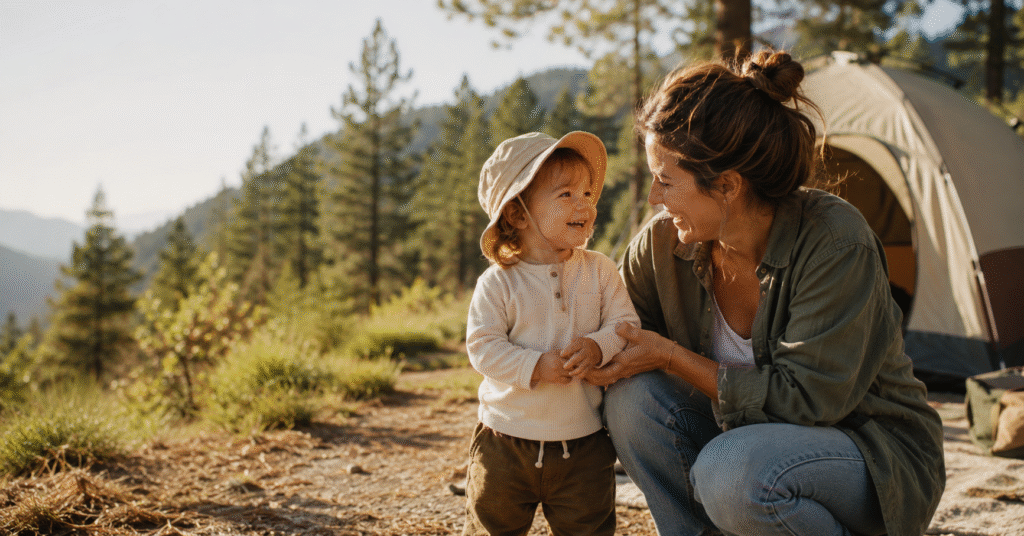
Camping with a baby or toddler sounds either magical or completely unhinged, depending on the day you ask. The first time you load up the car, there’s a specific kind of panic that sets in somewhere around the third bag. Where is this tiny person going to sleep? What happens when the sun is blazing at the campsite by 9 a.m.? What about the mosquitoes? And the part nobody warns you about: it gets cold at night, even in summer, and little bodies don’t hold their heat the way ours do.
Here’s the reassuring part. You do not need to recreate your entire nursery in a tent. After digging through what experienced camping parents rely on (and what they quietly return), the kit comes down to a handful of pieces that solve the four problems that make or break a trip: sleep, carrying, sun, and bugs. Get those right and everything else is just snacks and wipes.
This is a gear-first guide, but every pick below is filtered through current pediatric safety guidance, because “popular on Amazon” and “actually safe for a baby” are not always the same list.
What camping with a baby or toddler really takes
Camping with a 5-month-old and camping with a busy 2.5-year-old are two completely different sports. A young baby is portable but fragile about sun, heat, and sleep environment. A toddler is sturdier but will sprint toward the fire pit, the lake, and the one patch of poison ivy within ninety seconds of arrival. Plan for the kid you actually have.
For a first trip, car camping (where you park near your site and your whole setup is steps from the car) is dramatically easier than backcountry anything. A cabin or “glamping” tent with walls is easier still. The gear below is built around car camping, which is where most families with little ones start. If you’re weighing how to even get there, our road trip with a baby or toddler guide covers the drive itself.
The sleep system (this is the whole ballgame)
If your child sleeps, the trip works. If they don’t, no view is worth it. Anyone who’s watched a toddler treat an unfamiliar room as a personal invitation to abandon bedtime entirely (my husband and I have lost a few evenings to exactly this) knows what’s at stake. A workable outdoor sleep setup has three jobs: a safe, familiar sleep surface; darkness (campsites get bright early); and a way to manage temperature.
A travel crib for the safe surface
Pamo Babe Compact Pack and Play (budget-friendly)
A packable play yard gives your little one the one thing pediatric safe-sleep guidance actually asks for: a firm, flat, bare surface with breathable mesh sides. This one folds into a carry bag, fits in a car trunk, and won’t make you cry when it gets a little campsite dirt on it. Reviewers consistently call out the quick setup and how sturdy it feels for the price.
A blackout canopy for the darkness
SlumberPod Blackout Sleep Canopy (the worth-it splurge)
This is the splurge that earns its keep on a sunlit campsite. The SlumberPod is a bottomless blackout canopy that fits over your play yard or mini crib, creating a dark cave so a 6 a.m. sunrise through tent fabric doesn’t end everyone’s night. Crucially, it is not a sleep surface itself, which is what separates it from the soft “crib tents” that have been recalled over entrapment and strangulation risks (and a related tent-style travel bed, the PeaPod, was pulled after reported incidents that included a death). It is age-graded for 4 months and up and is designed to go over a separately safe, flat sleep space.
White noise and the right warmth layer
Campgrounds are loud in unfamiliar ways: other sites, wind, wildlife, that one group that did not get the quiet-hours memo. A portable sound machine smooths it over. The Hatch Go is the rechargeable, clip-anywhere standard; if you want to spend a third as much, the battery-life-focused jaroco portable sound machine runs many hours on a charge, which matters when there’s no outlet in sight.
For warmth, skip loose blankets (still a no-go in a sleep space) and use a wearable sleep sack sized to the night’s low temperature. A 1.0-TOG option like the BubblePanda bamboo sleep sack suits the cool nights of typical camping season; for warm summer nights a lighter 0.5 TOG is plenty, and for genuinely cold nights you’ll want warmer pajamas underneath rather than reaching for a blanket. Not sure what weight to use at what temperature? That’s exactly what our TOG dressing chart is for.
Getting them down the trail: a carrier that fits the job
A stroller and a hiking trail are not friends. For any walking beyond the parking lot, you’ll want your child on you. Which carrier depends on age: a younger baby with good head and neck control does fine in a soft structured carrier, while a sturdy toddler who can sit unassisted is better off in a framed hiking carrier that distributes the weight to your hips.
Luvdbaby Hiking Carrier Backpack (the do-everything pick)
This framed carrier is built for exactly this use case: it includes a sun-and-rain hood, an insulated pocket for bottles, and a built-in changing pad, so a lot of your other bags stay in the car. Parents who hike regularly tend to land on a full-frame carrier like this one because the hip belt saves your shoulders on longer walks.
besrey Toddler Hiking Backpack (strong value)
A lighter-on-the-wallet framed carrier with an adjustable multi-height seat and a foldable frame. A good fit if you want a real hip-supported hiking carrier without the top-tier price, and a popular choice for occasional-trip families.
If you’re a serious hiker and budget is no object, the Osprey Poco is the premium benchmark. Worth knowing: an older 2012–2014 generation of the Poco was recalled, but the current model is a different design.
Sun protection: shade first, sunscreen second
This is the section where popular gear and pediatric guidance really diverge, so it’s worth getting right. The order of operations from the American Academy of Pediatrics and the FDA is: shade and clothing come first; sunscreen is a backup, not the plan. (For more on heat itself, see our guide on how hot is too hot for a baby.)
For babies under 6 months, the guidance is to keep them out of direct sun (especially 10 a.m. to 4 p.m.) and rely on shade plus lightweight long sleeves, long pants, and a brimmed hat that shades the neck. Sunscreen is reserved for small areas only when shade and clothing aren’t enough.
Monobeach Pop-Up Baby Sun Tent (budget hero)
A pop-up sun shelter is the single most useful sun-protection purchase for a campsite, because it creates the shade the guidance keeps pointing to: a cool, out-of-the-sun spot for a baby to nap, play, or eat. It folds flat and weighs almost nothing.
For babies 6 months and older, sunscreen joins the lineup, and for little ones the pediatric preference is a mineral (zinc oxide) formula, broad-spectrum, SPF 30–50. Mineral sunscreens sit on top of the skin and start working immediately, rather than needing to absorb. Two consistently well-regarded options: the much-loved Thinkbaby SPF 50+ and the Blue Lizard Baby Mineral, whose cap changes color in UV light as a built-in “time to reapply” nudge. Apply generously, reapply every two hours, and one note: pediatric guidance steers away from spray sunscreens for young children because of the inhalation risk, so lotions and sticks are the safer call.
Bug protection: barriers, then the right repellent
Mosquitoes and ticks are the real downside of a beautiful campsite, and they carry genuine disease risk, so this isn’t optional. Your approach depends on age.
Under 2 months: no chemical repellent at all, per the CDC. Lean entirely on physical barriers: lightweight long clothing and a fine-mesh mosquito net draped over the carrier, stroller, or play yard.
2 months and older: the AAP and CDC both endorse picaridin or DEET (at 30% or less). Picaridin is a popular pick for families because it’s effective, low-odor, and doesn’t damage gear and plastics the way DEET can.
OFF! Family Care Picaridin Lotion
A lotion (rather than an aerosol) gives you far more control over where it goes, which matters a lot on a wriggling toddler, and there’s no spray cloud to breathe in. Picaridin’s protection scales with concentration: a 5% formula covers a few hours, while 20% can stretch to most of a day, so match the strength to how long you’ll be out.
One habit worth building no matter your child’s age: do a full-body tick check at the end of every day outdoors. Run your fingers behind the ears and knees, around the neck and waistband, in the belly button, and through the hairline. Ticks like warm, hidden folds, and prompt removal is the single best defense against tick-borne illness like Lyme disease, so this two-minute ritual matters more than almost anything else on this list.
The pared-down packing list
If you remember nothing else, this is the short version of the kit that actually moves the needle:
- Sleep: packable play yard (with its own firm pad), blackout canopy for early sunrises, portable sound machine, temperature-matched sleep sack
- Carry: a framed hiking carrier (toddlers) or soft structured carrier (babies), harness always buckled
- Sun: pop-up sun tent, UPF long sleeves and pants, brimmed hat, and mineral sunscreen for the 6-months-plus crowd
- Bugs: mosquito net for the under-2-months set, picaridin lotion for everyone older, and a nightly tick check for the whole family
- Don’t forget: way more diapers and wipes than feels reasonable, a wet bag for the dirty ones, layers for the temperature swing, and a basic first-aid kit
Camping with a baby or toddler is gloriously imperfect and completely worth it. Pack the four systems that matter, keep the safety basics non-negotiable, and let the rest be a little messy.