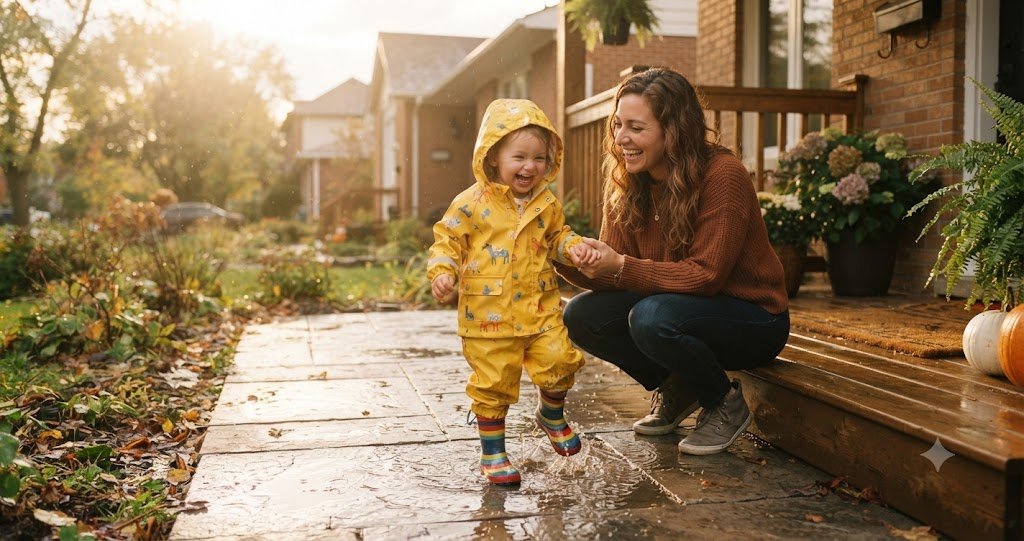
There is no force in nature quite as committed to a puddle as a toddler. My youngest son spots one from half a block away and changes course like a tiny heat-seeking missile. My older son’s whole strategy is volume: the bigger the splash, the better the day. I gave up fighting it a long time ago. Now I just make sure they’re dressed for it.
That’s really what toddler rain gear is for — not keeping kids out of the wet, but letting them stomp through it and come home dry from the skin out. And here’s the thing nobody tells you before you have a one- or two-year-old: rain gear for toddlers is its own little category. It isn’t just smaller versions of big-kid coats.
Little kids are short, so when their legs are inside something, basically their whole body is inside it, which changes what “coverage” even means. They can’t reliably dress themselves yet, so anything you choose has to be easy for you to wrangle onto a wiggly body at 8:02 a.m. If you’re somewhere in the potty-training trenches, every extra zipper between your kid and the toilet is a small gamble. And plenty of daycares and outdoor preschools now require waterproof outerwear, so this is real gear, not a cute afterthought.
The 8 best toddler rain gear picks (at a glance)
| Pick | Type | Best for | Price |
|---|---|---|---|
| JAN & JUL Puddle-Dry | Rain suit | Best premium suit | ~$60–67 |
| Tuffo Muddy Buddy | Rain suit | Best budget suit | ~$30–40 |
| Columbia Glennaker | Rain jacket | Best everyday jacket | ~$30–35 |
| Columbia Rain-Zilla II | Rain jacket | Best for chilly, wet days | ~$37–45 |
| Crocs Handle It | Rain boot | Easiest to put on | ~$30–36 |
| Kamik Stomp | Rain boot | Best value | ~$28–35 |
| Hatley Rain Boots | Rain boot | Cutest (the one they’ll wear) | ~$38–53 |
| BOGS Grasp | Rain boot | Warmest | ~$55–65 |
Prices bounce around — check the live listing before you commit.
The one decision that shapes everything: suit or separates?
Before you compare a single product, answer this: do you want a one-piece rain suit, or a separate coat and pants? It sounds small. It’s the whole game. The trade-off comes down to coverage versus bathroom independence, and your kiddo’s age tips the answer.
| One-piece rain suit | Coat + pants (separates) | |
|---|---|---|
| Coverage | Sealed head-to-ankle. Best for short-legged little ones who sit, crawl, and plop straight into puddles. | A gap at the waist can let water sneak in during serious puddle-sitting. |
| Bathroom breaks | The catch. Getting a whole suit off for a potty emergency is slow, and “fun” has a way of making toddlers forget to go until it’s urgent. | Easy. A potty-trained kid can usually drop the pants themselves. |
| Flexibility | One garment, one decision. | Rain pants over leggings for a wet-but-not-pouring day; just the jacket as a windbreaker when it’s only breezy. |
| Best age | Babies through about 3, especially before potty training. | Most kids graduate here around 3–4, once they want bathroom independence. |
My rough rule: if your child is under three or not yet potty-trained, a one-piece suit will save your sanity on the truly wet days. Once they’re reliably using the toilet and want to do things “by self,” separates start to win. (If you’re racing a preschool deadline, our guide to potty training before preschool can help you time the switch.) Plenty of families end up owning both and grabbing whichever matches the forecast and the kid’s mood. For more on gearing up little ones for time outside, our camping with a baby or toddler guide goes deeper on outdoor layering.
Best toddler rain suits
If you only buy one thing for a puddle-jumping toddler, make it a suit. Two stand out for very different budgets.
JAN & JUL Puddle-Dry Rain Suit — Best Premium Suit
This is the suit forest-school parents keep recommending, and it’s easy to see why. It pairs a 10,000 mm waterproof rating with fully taped seams and an inner membrane, so it genuinely holds up to sitting in puddles rather than just shrugging off drizzle. The thin liner keeps it usable nearly year-round, and the “grow-with-me” waist toggles plus generous sizing mean you can cinch it now and let it out (or layer under it) later — which is how you get more than one season out of a pricier piece. The brimmed hood keeps rain off little faces, and there’s reflective piping for dark mornings.
Waterproofing: 10,000 mm rating, taped seams, inner membrane; PVC-, fluorine- & PFAS-free
Features: Thin liner (year-round), grow-with-me waist toggles, brimmed hood, reflective piping
Good to know: Reviewers with the youngest walkers note the front zipper doesn’t open quite far enough, so dressing a 12-month-old is a lay-them-down-and-wrestle job. No stirrup strap to lock the ankles over boots.
Best for: Forest school, serious puddle days, and milder wet climates. If you live somewhere genuinely cold and wet, JAN & JUL makes a fleece-lined “Cozy-Dry” version of the same suit that doubles as light snow gear.
Tuffo Muddy Buddy Coverall — Best Budget Suit
The Muddy Buddy has been a parent staple for years, and it earns it by getting the basics right at roughly half the price of the premium suits. The standout feature for toddler life is the dual front zippers that run the length of the suit, which makes both quick changes and bathroom breaks far less of an ordeal. It’s nylon with sealed seams to keep water out, and the seat and knees are reinforced in heavier fabric for the kids who slide, kneel, and generally treat the ground as furniture. The elasticized hood has a stiff brim, the cuffs cinch over mitts and boots, and it all packs into an included waterproof bag for the car or daycare cubby.
Material: 70-denier nylon with PU coating (200-denier reinforced seat & knees); sealed seams
Included: Waterproof carrying/storage bag
Care: Machine wash cold, hang to dry
Good to know: Runs large (handy for layering), the elastic ankles make solo on/off over shoes tricky, and the lighter fabric is built for everyday play rather than years of hard abuse.
Best for: Budget shoppers, everyday puddle play, and the walk-to-daycare-in-the-rain routine.
Best toddler rain coats
A rain jacket is the piece that lives in the backpack and the car for the “it might rain” days. For toddlers, the honest question is whether you need a true puddle-grade waterproof or just a reliable light-rain layer — because most kids’ jackets are built for the latter.
Columbia Glennaker Rain Jacket — Best Everyday Jacket
If your toddler needs one grab-and-go raincoat, this is the safe pick, and it happens to be one of the most popular kids’ rain jackets going. It’s a lightweight waterproof nylon shell with a hood and elastic cuffs that scrunches down small enough to forget it’s in the diaper bag until you need it. Perfect for drizzle, the walk into daycare, and “the playground equipment is wet” afternoons.
Material: Lightweight waterproof nylon shell, unlined; hood, elastic cuffs; packable
Good to know: This is light-rain protection, not a sit-in-the-puddle suit. There’s no taped seam or membrane, so a long downpour or extended puddle session will eventually find its way through.
Best for: The one raincoat that lives in the bag — drizzle, daycare drop-off, and unexpected showers.
Columbia Rain-Zilla II Jacket — Best for Chilly, Wet Days
When the rain comes with a cold snap (hello, spring and fall), the Rain-Zilla adds a soft fleece lining to a waterproof shell, so it works as that one layer your kiddo can wear over a tee on raw, drizzly mornings. It keeps the parent-friendly touches — adjustable hood, elastic cuffs, full zip, reflective accents, a couple of pockets — and skews a little warmer than the ultra-light Glennaker.
Material: Waterproof nylon shell + soft fleece lining; adjustable hood, elastic cuffs, reflective details, two pockets
Good to know: The fleece means warmth you don’t always want — it can feel stuffy on mild, wet days. For a warm spring shower, the lighter Glennaker is the better call.
Best for: Cold, wet mornings. Think of these two Columbias as a pair: one for “wet,” one for “wet and cold.”
Best toddler rain boots
If suits are the splurge, boots are the workhorse. Toddlers outgrow them fast and wear them out faster, so I think about boots by the job they need to do: easiest to put on, best value, cute enough that the kid will actually wear them, and warmest for a wet winter. Here’s a pick for each.
Crocs Handle It Rain Boot — Easiest to Put On
The oversized handles on these are the whole point, and they’re genuinely a gift for the “I do it myself” stage: a toddler can grab and yank them on without a parent on the floor. They’re feather-light molded Croslite (so very easy to rinse clean), with a reflective heel logo for low light. A roomy fit is part of the design, and Crocs recommends sizing down to the next whole size — worth doing, because too roomy plus too light means they can slip off mid-stomp.
Material: Molded Croslite (EVA), waterproof, unlined; oversized pull handles; reflective heel logo
Good to know: Unlined, so it’s a warm-and-mild-weather boot rather than a cold-winter one.
Best for: The independent dresser who wants to get their own boots on.
Kamik Stomp Rain Boot — Best Value
A do-everything rubber boot at a friendly price. The Stomp is 100% waterproof phthalate-free rubber with a slip-resistant, non-marking sole — the kind of detail that matters more than parents expect once you’ve watched a toddler take a wet-sidewalk tumble. A removable felt footbed adds a touch of warmth, and the lightweight rubber is easy for little legs to walk in.
Material: 100% waterproof phthalate-free rubber; removable felt footbed; slip-resistant non-marking sole; made in Canada
Good to know: It’s a pull-on with no side handles, and there’s no real insulation, so deep winter isn’t its lane.
Best for: Everyday rain, recess, and garden-stomping without spending much — plus a non-toxic materials story.
Hatley Rain Boots — Cutest (the One They’ll Wear)
Never underestimate a toddler’s willingness to wear something just because it has dinosaurs on it. Hatley’s boots come in in-house illustrated prints you won’t see everywhere, and the construction backs up the looks: handmade vulcanized rubber that’s 100% waterproof and PVC-free, with a slip-resistant tread and a removable insole. Easy pull-up handles help with self-dressing.
Material: Handmade vulcanized rubber, 100% waterproof, PVC-free; cotton lining; removable insole; pull-up handles
Good to know: Not insulated — Hatley sells a separate boot liner if your winters call for it. Sits at the higher end of the price range.
Best for: The kid who’ll only wear the fun ones, and parents who want prints they won’t see on every other pair at daycare.
BOGS Grasp Insulated Rain Boot — Warmest
For the genuinely cold-and-wet climates, BOGS is the name families pass down. The Grasp pairs a waterproof build with Neo-Tech neoprene insulation, so it covers rain, slush, mud, and light snow without cold toes, and the pull-on handles make it manageable on a squirmy toddler.
Material: Waterproof build + Neo-Tech neoprene insulation; slip-resistant sole; pull-on handles
Good to know: The priciest boot here and the heaviest, and a common note is that if you size up much past a half size, the heel can slip.
Best for: Places where “rainy” also means “freezing” — and for crossover into slush and light snow.
How to choose toddler rain gear (and a few safety notes)
Once you’ve sorted suit-versus-separates and picked your boots, a handful of details separate gear that works from gear that disappoints by the second rainy week.
Size up, but not too up
For suits and coats, sizing up a little buys you layering room and a second season of wear — exactly what you want from a one-piece. Boots are the exception: more than about a half size too big invites trips, blisters, and boots that fall off in the mud, so keep those close to true size (remembering many brands already run large). Check current sneaker size for boots rather than going by age.
Waterproof vs. water-resistant
This is the single most useful thing to read on a label. Waterproof gear with taped or sealed seams is what stands up to puddle-sitting and a real downpour. Water-resistant handles light rain but soaks through if your kid stays out long enough — which toddlers absolutely will. For a primary rain layer, choose waterproof; a water-resistant jacket is a fine backup, not the main event.
Reflective details and grippy soles
Rainy days are dark days, and a lot of drop-offs happen in gray half-light. Reflective piping or logos help drivers see a small person near the curb. On boots, a defined, slip-resistant tread is one of the most overlooked safety features there is, because wet sidewalks, slick playground equipment, and tracked-in school floors are exactly where new walkers lose their footing.
Warmth and layering
Wet plus cold chills a small body fast, and toddlers can’t always tell you they’re cold until they’re miserable. In cooler weather, layer a warm base under a waterproof shell rather than relying on the shell alone, and choose insulated boots (or boot liners) when temperatures drop. The American Academy of Pediatrics has good general guidance on dressing little ones for cold, wet weather.
A quick word on materials
If “forever chemicals” are something you think about, you’re not alone — and the good news is that several brands now use non-PFC water-repellent finishes and PVC-free construction. It’s worth a glance at the label, but don’t let it paralyze you. A kid who’s dry and warm and outside is the goal.
Caring for rain gear so it lasts
Rain gear quietly stops working when it’s loved to death in the wash. A few habits keep it doing its job:
- Don’t over-wash. Frequent hot washes strip the water-repellent finish. Spot-clean mud when you can, and wash only when it’s truly needed.
- Follow the brand on taped-seam suits. Many premium rain suits last longest with a gentle cold wash (or hand wash) and air drying rather than a hot tumble. Turn fleece-lined pieces inside out to help the lining dry — it’s the part that stays damp longest.
- Store rubber boots out of the heat. A hot car, a sunny windowsill, or a heating vent dries rubber out and cracks it early. A rinse after muddy play and a spot in a cool, dry place buys you a lot more puddle-jumping seasons — and a boot that’s easy to pass down to the next kid.
Toddler rain gear FAQ
Should I get my toddler a rain suit or a rain coat?
For the under-three crowd, or any toddler who treats puddles as a full-body sport, a one-piece suit gives the best coverage. A coat (ideally with rain pants) makes more sense once your child is potty-trained and wants to manage bathroom trips on their own. Many families keep both.
Do toddlers really need rain pants?
If you go the separates route, yes — pants are what make it work. A jacket alone leaves the legs and bottom soaked the moment a toddler sits in a puddle or slides down a wet slide. Rain pants slip over any outfit and pop off easily for the bathroom.
What size rain gear should I buy?
Size up a little on suits and coats for layering room and longer wear. Keep boots close to true size (no more than about a half size big) so they don’t trip your kiddo or slip off, and remember that many rain boots already run large.
Are rain suits a problem for potty training?
They can be the trickiest part. A full suit takes time to get off, and a deeply engrossed toddler may not flag a bathroom break until it’s an emergency. If you’re mid-training, look for suits with full-length dual zippers (much faster off) or switch to separates for a while.
When do kids switch from one-piece suits to separates?
Most kids make the move around age three or four, when they’re more independent, more active, and ready to handle bathroom trips without a full costume change.
How do I keep boots from coming off or letting water in?
Get the size right (close to true), and for puddle-sitting, a rain suit or rain pants with elasticized ankle cuffs that sit over the boot top does the most to keep water from running in. Boots with pull handles also help a child keep them on by re-seating them themselves.
Can rain gear double as snow gear?
Sometimes. A fleece-lined rain suit can work as light snow gear with warm layers underneath, and insulated rubber-and-neoprene boots cross over to slush and light snow. For deep cold or real snow, dedicated snow gear is still the better tool.