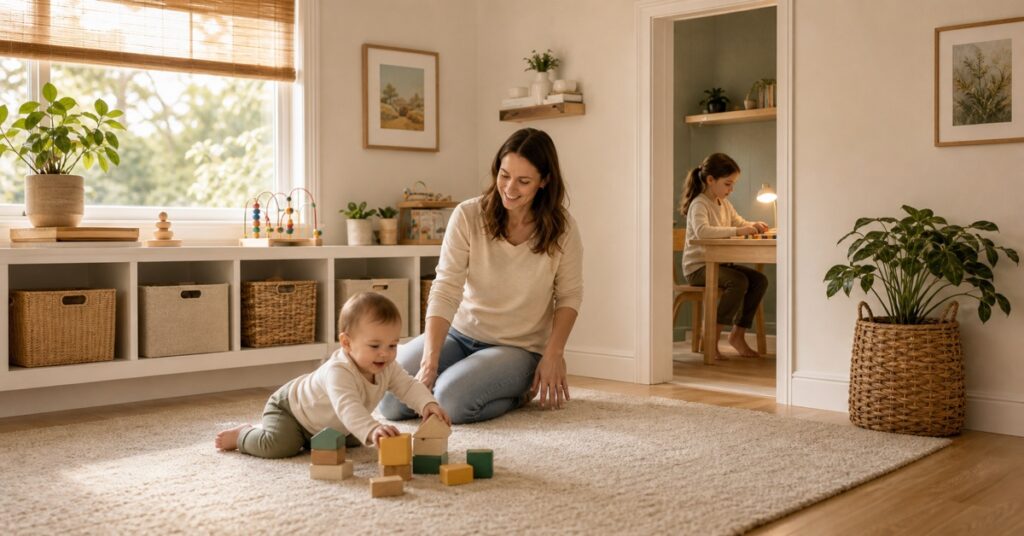
The first warning that a playroom has outgrown its one-age setup is usually tiny. Literally. It is the puzzle peg under the bookcase, the doll shoe beside the rug, or the single building piece your baby finds after everyone else has declared the floor clean.
In a three-kid house, the toy that is finally interesting enough for an older child is often exactly the toy the youngest wants to taste. Neither child is doing anything wrong. The older one is ready for more detailed play. The baby is exploring the way babies do. The room simply needs a new set of rules.
You do not have to ban every big-kid toy or turn the whole house into a padded baby pen. The workable goal is simpler: make the shared floor safe for the youngest child, then contain the toys that are not.
The short version: Create a green shared zone, a yellow big-kid zone that can actually close, and a red storage zone that only an adult can open. Then use the same five-minute reset every time small-part play ends.
The Three-Zone Mixed-Age Playroom
These colors are family shorthand, not safety certifications. A green rug does not make toys safer, and a yellow label will not stop a crawling baby. What matters is who can reach the space, what is allowed inside it, and what happens when the adult leaves.
| Zone | Who uses it | What belongs there | What makes it work |
|---|---|---|---|
| Green: Shared play | All children | Toys chosen for the youngest child, board books, large blocks and simple floor play | An open sight line, a clear path and adult supervision |
| Yellow: Big-kid work | Older children, with the baby kept out | Small building pieces, detailed puzzles, tiny figures and supervised craft materials | A door, securely installed gate, stable work surface or another boundary that can close |
| Red: Adult-controlled | Adult access only | Loose batteries, high-powered magnets, damaged toys and other high-consequence items | Locked storage—or removal from the playroom entirely |
The three zones do not need equal floor space. The shared floor gets the strictest rules because the youngest child can reach it. The yellow zone gives an older child room to grow. The red zone is not a play area at all.
Start With the Youngest Child’s Safety Baseline
Treat the age label as a boundary
The U.S. Consumer Product Safety Commission’s small-parts rules are designed to protect children under age 3. In a mixed-age room, that means a toy marked for older children may be perfectly appropriate for the child using it and still be wrong for the shared floor.
Use the youngest child’s actual behavior, too. A birthday does not switch off mouthing, climbing or opening drawers. If your child still explores objects with their mouth or needs additional safeguards for their developmental stage, keep the stricter boundary longer.
Make a “never on the shared floor” list
Every family’s toy collection is different, but these categories deserve clear rules:
- Small balls, marbles, tiny figures and pieces that can break off.
- Uninflated balloons and broken balloon pieces. CPSC advises keeping them away from children younger than 8.
- Loose button or coin batteries, plus electronics with damaged or easy-to-open battery compartments.
- Loose high-powered magnets and any magnetic toy that is cracked, split or missing a piece.
- Water beads. These are not a yellow-zone compromise: CPSC urges families to remove them from environments where children live or play.
- Anything broken, loose, sharp or no longer complete.
This is not a reason to panic over every older-child activity. It is a reason to stop treating all small objects as if they carry the same consequence. A missing puzzle piece is annoying. A missing magnet or button battery needs immediate adult attention.
Audit the room, not just the bins
A baby experiences a playroom from the floor up. Get low enough to see the sofa gap, rug edge, baseboard and shadow under the storage unit. Those are the places a bright bead or tiny wheel disappears from adult view while remaining perfectly visible to a crawler.
Then look higher. Are tempting toys stored on top of a bookcase, inviting a child to climb? Are the shelves and cabinets anchored? Are there blind cords behind the reading nook? The CPSC recommends anchoring furniture and TVs, and says cordless window coverings are the safest option when young children are present.
If you need a whole-house pass rather than a playroom-only check, use our room-by-room baby-proofing checklist. For the anchoring details, see the furniture-anchor guide.
Green Zone: Make the Shared Floor Boringly Predictable
The green zone is not necessarily the baby’s private corner. It is the part of the room where every child can play, but only toys safe for the youngest are allowed.
Keep the selection easy to scan: a few board books, large blocks, sturdy pretend-play pieces and toys that match the youngest child’s age and abilities. Open one basket at a time when possible. A floor covered by six dumped bins is harder to inspect and harder for any child to use well.
Leave a clear path through the room. A crawling baby, a preschooler carrying a block tower and a school-age child stepping backward to admire a project should not all be competing for the same narrow strip of floor. Keep riding toys, active movement and tall builds away from the baby’s main play spot.
A useful test: If you would rush to move an item before answering the door, it does not belong on the shared floor. This is a test for the room—not permission to leave the baby unattended.
Low storage can make safe toys easier for children to choose and return. It does not mean every low bin should be open to every child. Our toy-storage guide by age and play style can help with the broader storage decision; this article’s rule is simply that anything the baby can open must be safe for the baby to reach.
Yellow Zone: Give Big-Kid Toys a Boundary That Can Close
The yellow zone protects two things at once: the baby’s body and the older child’s right to play at their own level. A preschooler or early elementary child should not have to give up every detailed project while a younger sibling is in the mouthing-and-crawling stage. They do need a place where those projects cannot quietly migrate across the whole room.
Choose a real boundary
A closed door is a boundary. A securely installed gate or divider used according to its instructions may be a boundary. A stable tabletop with adult-controlled storage can be a boundary when the baby cannot reach or climb to it.
A rug is only a visual cue. So is painter’s tape. A freestanding decorative screen that can tip is not a child-safety barrier. Use color to help the older child remember the rule, but use a physical setup to manage access.
In many homes, it makes more sense to contain the small-part activity than to contain the baby all day. A play yard can be useful for a short, supervised stretch when the baby needs a protected spot. But when the only hazard is one tray of tiny pieces, closing that activity often gives both children more usable space.
Use six simple yellow-zone rules
- Bring out one small-part activity at a time.
- Keep it on a tray or defined work surface.
- Small pieces stay inside the yellow zone.
- Pause if the baby crosses the boundary.
- Close the activity before the supervising adult leaves.
- Reset the floor before the room becomes green again.
The wording matters. “You cannot play with this because of the baby” makes the baby sound like the thief of everything fun. “These are big-kid toys, so they stay at the big-kid table” gives the older child status and a clear job.
It also helps to protect some ownership. An older child does not need to share every project with a baby who wants to dismantle it. These “mine zone” ideas for siblings handle that emotional boundary; here, the safety boundary comes first.
Do not make the older child the safety monitor. They can help return pieces and feel proud of caring for the room. An adult still performs the final check.
Red Zone: Lock Up the High-Consequence Items
The red zone should be smaller than most parents expect. It is not every marker and puzzle. It is the group of items where one missing piece changes the situation quickly.
Button and coin batteries: Keep loose cells locked away. Check toys and household electronics for secure battery compartments, and remove anything with a damaged compartment from children’s reach. The CPSC button-battery guidance explains why suspected ingestion requires immediate medical help.
High-powered magnets: These are not ordinary refrigerator magnets. If more than one is swallowed, they can attract to each other inside the body and cause severe injury. Keep loose sets out of children’s free-access storage, inspect magnetic toys for cracks, and seek immediate medical attention if ingestion is suspected. See the CPSC magnet safety guidance.
Water beads: Keep them out of the mixed-age playroom. Their small dry size makes spills hard to find, which defeats the entire idea of a baby-safe shared floor.
Balloons and fragments: Enjoy balloons where an adult can manage them, then remove the broken pieces and uninflated balloons immediately. They should not live in an open playroom bin.
A high shelf by itself is not a red zone. Children climb toward interesting things, and an open shelf can drop what it holds. Use closed, adult-controlled storage and anchor the furniture that supports it.
No Separate Playroom? Use Time Zones
You can build this system without a dedicated playroom. A mixed-age safety zone can be a place, a time, or both.
In a living room, the shared floor stays green while small-part play happens at a table. The activity returns to a closed cabinet before the baby comes back to the floor. In a shared bedroom, the floor remains safe for the youngest child and detailed projects move to the kitchen table. In a very small apartment, the older child may use a yellow-zone activity while the baby naps or plays elsewhere under another adult’s direct care.
The important step is the handoff. “The baby is awake” does not automatically turn the room green. First the activity closes. Then an adult checks the floor. Only then does the space switch back.
If your bigger challenge is fitting different activities into one small footprint, our small-space playroom layout covers that side. Use its structure with the youngest-child safety rule from this article.
The Five-Minute Reset That Makes the Zones Work
A safety plan that depends on everyone remembering everything will fail on the tiredest day of the week. A short closing routine is much more dependable.
- Close: Put the big-kid activity back into its adult-controlled storage.
- Sweep: Clear the shared floor and the path through the room.
- Get low: Check beneath furniture, along baseboards and under rug edges from the baby’s height.
- Check damage: Look for cracked magnetic toys, loose battery covers and newly broken parts.
- Reopen: An adult confirms that the room is ready before the baby returns.
This is not a deep clean. It is a risk reset. Crayon marks can wait. The small wheel under the cabinet cannot.
Older children can help with steps one and two. Turning the low scan and final reopening into the adult’s job keeps the responsibility in the right place.
Five Common Setups That Are Not Enough
“The small toys are on a high shelf.”
High shelves invite climbing and open shelves can shed their contents. Fix it with anchored furniture and closed storage that an adult controls.
“My older child promised to pick up every piece.”
Let them participate, but plan for an imperfect cleanup. Children get distracted, pieces bounce, and a baby’s eye level is different from ours. The final floor check belongs to an adult.
“The baby has a soft mat.”
A soft mat may make floor play more comfortable. It does nothing about choking hazards, batteries, magnets, window cords or an unanchored shelf.
“There is a gate, so the space is safe.”
A gate lowers access only when it is appropriate for the opening, installed correctly, closed and not being climbed. It does not replace supervision or the cleanup routine.
“We will relax the rules when the baby turns 3.”
Age labels matter, but so do behavior and the type of hazard. A child who still mouths objects, opens latches or moves furniture needs a setup that matches those abilities. Batteries and high-powered magnets do not become casual floor toys after a birthday.
Update the Room Before Each New Milestone
A non-mobile baby needs protection from dropped pieces, rough movement and an older child’s project landing on the play mat. A crawler turns the entire floor—and every space beneath the furniture—into the inspection zone.
Once the baby pulls to stand, revisit low shelves, gate hardware and anything that can be used as a handhold. Once walking begins, assume chairs can be pushed toward tables and that an older sibling’s room can be followed into. The setup that worked last month may still look the same while functioning very differently.
Do not wait for a near miss to make the next change. When a new skill appears, do another floor-to-ceiling scan.
Mixed-Age Playroom FAQ
Should the baby or the big kid go behind the gate?
Contain the source of the risk when you can. If the risk is one small-part project, a closable big-kid area is often more useful than restricting the baby’s entire day. A play yard can still provide a short-term protected space for the baby when used according to its instructions and with supervision.
Is a high shelf enough for LEGO and other small toys?
Usually not. Pieces can fall, and visible toys can tempt a child to climb. Closed storage that the baby cannot open is a better boundary, paired with anchored furniture and a defined place to play.
Can magnetic tiles stay in the shared zone?
Follow the product’s age label and inspect every piece regularly. Stop using a magnetic toy if the shell is cracked, seams are separating or a piece is missing. Magnetic tiles with enclosed magnets are not the same product as loose high-powered magnet sets, but damage still deserves immediate attention.
What if we only have one play corner?
Keep the floor green, use a table as the yellow work area, and store small-part activities in a closed cabinet. If the baby can reach or climb to the table, switch to time zoning and do the activity elsewhere.
When can we relax the zones?
Gradually, based on the youngest child’s behavior, the toy’s age guidance and the child’s ability to open storage or climb. Do not drop every boundary at one arbitrary birthday.
What if the baby falls asleep in the play area?
A play mat, floor cushion or ordinary gated corner is not automatically a safe sleep surface. For babies under 1, the American Academy of Pediatrics recommends a firm, flat, non-inclined sleep surface that meets current safety standards, with toys and soft objects removed. Move a sleeping baby to an appropriate crib, bassinet, portable crib or play yard.
Protect Both Children’s Right to Play
The baby needs a floor where exploring does not depend on everyone else remembering every tiny piece. The older child needs toys that match a growing attention span and imagination. And you need a system that still works when dinner is late and nobody feels like sorting a bin.
That is what the three zones provide. Green tells everyone what can be shared. Yellow protects detailed play. Red takes the highest-consequence items out of children’s hands. The reset is what makes those colors mean something tomorrow morning.