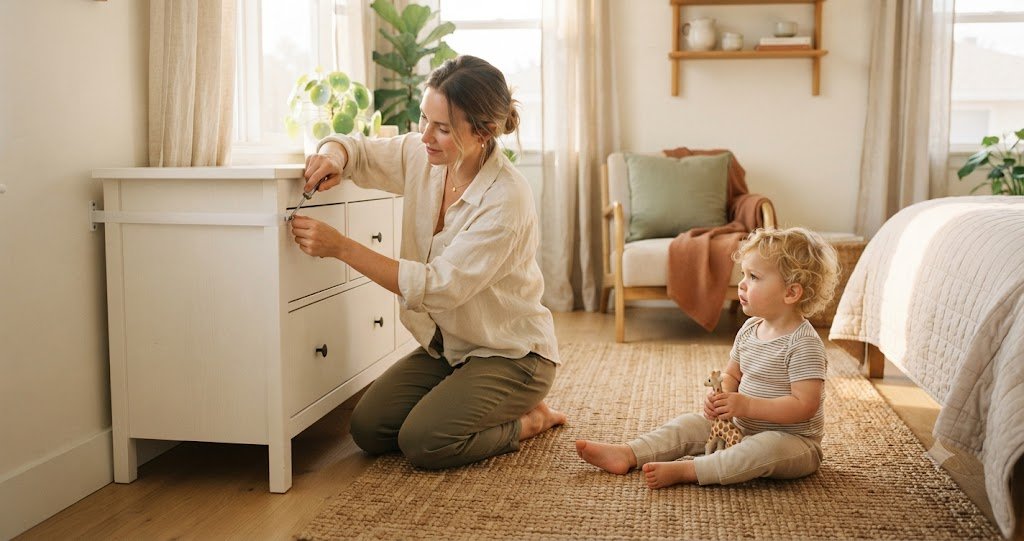
My youngest son is nineteen months old, and as far as he’s concerned, every dresser in our house is a rock-climbing wall. Open the bottom drawer, step in, reach for the next one up. He figured this out before he could say “drawer.” Toddlers always do.
That climbing instinct is exactly why furniture tip-overs remain one of the most heartbreaking — and most preventable — hazards in American homes. According to CPSC’s 2023 tip-over report, roughly 17,800 people land in the emergency room every year from furniture, TV, and appliance tip-overs, and a child is treated for a tip-over injury about every 53 minutes. Children make up the large majority of the fatalities. Many of these incidents happen with an adult nearby; the CPSC notes that parents often assume it simply can’t happen while they’re home.
The fix costs less than a pizza and takes about twenty minutes per piece of furniture. This guide walks you through why anchoring is non-negotiable (even if you bought your dresser last year), which anti-tip straps are actually worth buying in 2026, which popular kits we deliberately left off this list (including one that was federally recalled), and how to install everything so it holds when it matters.
Why “It Won’t Happen to Us” Doesn’t Hold Up
I’ll be honest: when my daughter was a baby six years ago, we anchored exactly one piece of furniture, her nursery dresser, and called it a day. The bookshelf in the living room? The TV console? “She’s never in there alone.” It took me embarrassingly long to understand how fast a toddler moves in the eleven seconds it takes to grab a coffee refill.
Two things have changed since then, and both of them matter for your home.
First, the good news. In 2023, a federal safety standard under the STURDY Act took effect: clothing storage furniture (dressers, chests, armoires) manufactured on or after September 1, 2023 must pass real-world stability testing, including tests that simulate a climbing child. Combined with a decade of the CPSC’s Anchor It! campaign, tip-over injuries and deaths have dropped by nearly half since 2015. Progress is real.
Now the part that surprised me. The STURDY Act has two enormous blind spots:
- It’s not retroactive. Every dresser manufactured before September 2023 (which is nearly every dresser currently standing in an American bedroom) was never required to meet the standard. That hand-me-down chest from your in-laws, the one you bought in college, the nursery dresser from 2021: none of them are covered.
- It only covers clothing storage. Bookshelves, TV stands, entertainment centers, cabinets, and the TV itself are all outside the law entirely. And when you look at the CPSC’s fatality data, furniture and TVs falling together is a recurring, devastating pattern.
The CPSC’s own position is blunt: anchor everything tall or heavy, regardless of when it was made. A new STURDY-compliant dresser is more stable than an old one, but “more stable” and “anchored to a wall stud” are not the same thing, especially once a determined little climber enters the picture.
Quick audit for tonight: walk through your home and count every piece of furniture taller than your child that isn’t attached to a wall. Dressers, bookcases, TV consoles, wardrobes, changing tables, that leaning mirror. Most families count five to eight pieces. That number is your shopping list.
What Actually Makes a Good Furniture Anchor (It’s Not the Weight Rating)
This is where the guide gets opinionated, because the anchor market changed dramatically over the last two years. Most roundups haven’t caught up.
Between 2024 and early 2026, the CPSC took action against multiple anti-tip kit brands sold on Amazon. Plastic tip restraint kits from 4our Kiddies were recalled, and the agency issued stop-use warnings for plastic kits from Cranach Hardware and KareKlub after consumers reported the plastic brackets and zip ties breaking — in some cases while children were climbing the furniture the straps were supposed to protect. All of them failed ASTM F3096-23, the industry strength standard for tip restraints. The CPSC called it a hidden defect: the straps look installed, the parents feel safe, and the plastic quietly degrades behind the dresser.
Independent lab testing points the same direction. Consumer Reports tested a wide range of anchor kits in 2024 and found that metal components consistently outperformed plastic ones, and that peel-and-stick adhesive kits were the weakest of all. Of the products claiming to work in hollow drywall without a stud, only a third could hold back even 60 pounds of force — roughly the push of one climbing child.
So when I built this list, the filters were strict, and they knocked out some very popular products:
- All-metal load path. The brackets, the cable or buckle, and the connection points should be metal. No plastic brackets, no plastic zip ties: that’s the exact failure mode behind the recent recalls.
- Screw-in installation. Adhesive-only anchors didn’t make the cut, full stop. More on that in the renters section.
- Strong, established track record. Every pick below is a highly rated kit with a large base of parent reviews and consistent real-world sales, not a listing that appeared last month.
- Complete hardware in the box. Screws, brackets, and cables included, so the project actually happens this weekend instead of after a hardware store trip.
One more thing worth knowing when you shop beyond this list: the standard that recalled kits failed, ASTM F3096-23, is the benchmark to look for. If a product page explicitly states compliance with it, that’s a meaningful signal — and its absence from most budget listings tells you how loosely regulated this corner of Amazon still is.
The Anti-Tip Straps Worth Buying in 2026
These four cover essentially every situation: a whole-house kit, a slightly different whole-house kit with more flexible mounting, a heavy-duty strap that also secures flat-screen TVs, and a budget option for finishing the last few pieces.
1. Booda Brand Furniture Anchors, 10-Pack — Best Overall
Top Pick
This is the kit I’d hand to a friend who says “just tell me what to buy.” It’s a cable-style, all-metal design: one bracket screws to the back of the furniture, one screws into the wall, and a steel cable ties the two together. The screw-closure release is the underrated feature: when you need to pull the dresser out to vacuum (or retrieve the sippy cup that rolled behind it), you unscrew the cable instead of unbolting the whole thing from the wall.
It’s a longtime category leader with an Amazon’s Choice badge and one of the largest review bases of any anchor kit, which counts for a lot in a product where quiet failure is the thing you’re paying to avoid. Ten anchors is the right number: at the recommended two anchors per piece, mounted wide apart at the top corners, one box secures five pieces of furniture.
Typically under $10 for a 10-pack · all mounting hardware included
2. Ougourim Furniture Anchors, 10-Pack — Best Mounting Flexibility
Runner-Up
Functionally a close sibling of the Booda kit — steel cable, metal brackets, quick-release design — with two differences that matter in certain homes. The wall plates can be installed vertically or horizontally, which is genuinely useful when your stud position doesn’t line up neatly with the back of the furniture. And it comes in white, black, or silver, so the hardware disappears against dark furniture instead of announcing itself.
It’s also one of the highest-rated kits in the entire category right now. If the Booda kit is out of stock, or your furniture is dark-toned, buy this and don’t think twice.
Typically under $10 for a 10-pack · vertical or horizontal wall-plate mounting
3. BOOTWO Heavy Duty Metal Anti-Tip Straps, 2-Pack — Best for TVs & Heavy Pieces
Best for TVs
Cable kits are perfect for dressers and bookcases, but a flat-screen TV needs a strap that bolts into the VESA mounting holes on the back of the set. This is the rare kit built around that job with no plastic in the load path. The end plates and the cam buckle are metal, connected by triple-stitched nylon webbing, and VESA-standard screws come in the box. The cam buckle also makes the length properly adjustable, which helps with awkward gaps between furniture and wall.
Given that the recent CPSC crackdown centered on plastic brackets and zip ties breaking, “no plastic parts” isn’t a marketing flourish here — it’s the whole reason this kit is on the list. Use it for the TV, the bunk bed, or that one massive wardrobe you side-eye every time your kiddo walks past it.
Typically around $10 for a 2-pack · includes VESA screws for flat-screen TVs
4. Guirnd Furniture Anchors, 6-Pack — Best Budget Pick
Budget Pick
Same fundamental design as our top two picks (steel cable, metal brackets, vertical or horizontal mounting, full hardware in the box) at roughly half the price. It’s a newer listing than the others, but it has built a solid, highly rated track record with parents, and the construction follows the all-metal playbook we’re insisting on.
This is the kit for finishing the job: you anchored the nursery and the living room with a 10-pack, and now there are three pieces left in the guest room and the office. At around five dollars, there is genuinely no excuse left.
Typically around $5 for a 6-pack · lowest cost per anchor of our picks
What We Didn’t Pick — and Why It Matters
Normally I keep roundups positive. This category is the exception, because the products we cut are still bestsellers, and some are still sitting behind dressers in millions of homes.
- Anything with plastic brackets or plastic zip ties. This is the design the CPSC recalled and warned against, after more than a hundred consumer reports of breakage across brands. Plastic degrades over years of tension, sunlight, and dry indoor air. An anchor that fails silently is worse than no anchor, because it buys false confidence. If the straps currently behind your furniture are plastic, tonight is a good night to check them against the CPSC recall list and plan an upgrade.
- Adhesive-only, no-drill anchors. I really wanted these to work; the renter appeal is obvious. But in Consumer Reports’ 2024 lab tests, peel-and-stick kits were the weakest category tested, and several couldn’t withstand the force of a single climbing child. We researched several popular no-drill kits for this guide and decided not to recommend any of them.
- Nylon-strap kits with light-duty ratings. Several inexpensive strap kits state right on their own listings that they’re only suitable for light furniture. A product that disqualifies itself from the dresser-and-bookcase job is not a tip-over solution; it’s a drawer tidy with ambitions.
How to Install Furniture Anchors So They Actually Hold
My husband handled our install marathon one Saturday, and his verdict was that finding the studs took longer than every actual installation combined. The steps that actually matter:
- Find a stud. This is the entire game. Drywall alone cannot reliably resist the straight-out pull of tipping furniture, which is precisely why federal researchers found that anchor kits are built around wood screws rather than drywall plugs. Use a stud finder (or the knock test, or find an outlet and measure 16 inches), and put the wall-side screw into solid wood.
- Skip the included drywall plugs. Many kits toss expansion anchors in the bag. Ignore them. If you absolutely cannot reach a stud for a particular piece, use a metal toggle bolt rated for the job; Consumer Reports’ experts specifically recommend metal toggles over plastic for hollow-wall situations.
- Two anchors per piece, high and wide. Mount the furniture-side brackets in the top third of the piece, at opposite corners, screwed into the solid frame, not the thin cardboard-ish back panel.
- Tension the cable or strap snug. A slack strap lets the furniture build tipping momentum before the anchor engages. Snug it so the piece can’t lean at all.
- Test it like a toddler would. Open the top drawer, load it, and pull. Grab the top of the bookcase and tug forward, hard. If anything shifts, re-tension.
- Re-check every six months. Screws loosen, walls settle, kids get heavier. I do ours when the smoke-alarm batteries get checked. One calendar reminder, two chores.
Multi-kid reality check: anchoring the nursery is not enough. My older son’s favorite climbing target at two was the living room bookcase, because that’s where we kept the “big kid” puzzles — deliberately out of reach, which to a three-year-old reads as an invitation. Anchor the rooms your children actually play in, which is all of them.
Renting? Here’s the Honest Answer
The uncomfortable truth: there is no adhesive shortcut that we can responsibly recommend for securing a tall dresser. If you rent, you have three real options, in order of preference:
- Just ask — and ask in writing. A pair of small screw holes is standard wall wear, patchable in five minutes with spackle, and many landlords say yes immediately when the words “child safety” and “CPSC recommendation” appear in the same email. Many leases already permit picture-hanging-scale holes, and this is the same scale.
- Offer to patch at move-out. If your landlord hesitates, the promise to fill and touch up two 3/16-inch holes usually settles it. This costs you a few dollars and ten minutes someday, versus living with unanchored furniture now.
- If the answer is still no, change the furniture, not the physics. Move tall pieces out of kids’ rooms, choose low and wide storage, put the TV on a low, deep console pushed back against the wall, and empty the top drawers so pieces are bottom-heavy. It’s not as good as anchoring. It’s much better than hoping.
What Anchors Can’t Do: The Other Half of Tip-Over Safety
The Anchor It! campaign pairs anchoring with behavior changes for a reason: the anchor stops the furniture, but you can also make the furniture boring to climb:
- Heavy things live in bottom drawers. A bottom-heavy dresser resists tipping even before the anchor engages.
- Nothing tempting on top. Remotes, tablets, snacks, and favorite stuffed animals on top of furniture are climbing bait. My youngest son once attempted a dresser ascent for a single goldfish cracker. One.
- TVs sit low, deep, and pushed back on furniture designed to hold a TV; older tube TVs shouldn’t be resting on dressers at all.
- Keep cords out of reach. A dangling TV cord is a pull-rope attached to forty pounds of glass.
- Grandma’s house counts too. Holiday visits put your climber in a home full of decades-old, never-anchored furniture. A budget 6-pack and twenty minutes on your next visit is one of the kindest gifts you can give your parents, and yourself.
- Supervision still matters. Anchors are a backstop for the eleven seconds you’re pouring coffee, not a replacement for eyes on your climber.
If you’re doing a bigger babyproofing sweep this season, it’s also worth pairing this project with a well-stocked family first-aid kit and a look at how your little one’s room is set up for safe, independent play — the same climbing energy that worries us near a dresser is wonderful when it’s aimed at the right things.
FAQ: Furniture Anchors & Anti-Tip Straps
When should I anchor furniture — what age?
Before your baby can pull to standing, so realistically by six to eight months. In practice, the best time is before the baby comes home, when you still have free hands and uninterrupted naps of your own. And there’s no upper age limit: the CPSC’s fatality data includes older children and seniors, which is why the agency frames anchoring as a whole-household habit, not just a nursery task. The American Academy of Pediatrics offers the same advice in its guidance on preventing furniture and TV tip-overs.
My dresser came with an anti-tip kit. Isn’t that enough?
Sometimes. Since the STURDY Act, new dressers ship with restraint kits, but included kits vary wildly in quality, and several furniture-brand kits have themselves been recalled for breakable plastic parts. Check what’s in the bag: metal brackets and a robust strap or cable, use it; plastic brackets and a zip tie, spend ten dollars on one of the kits above instead.
Do furniture anchors damage the wall?
Each anchor leaves one or two small screw holes in the wall, the same scale of hole as hanging a heavy picture frame. Spackle, sand, dab of paint, invisible. It’s the cheapest repair in home ownership, purchased against the most expensive thing imaginable.
What about earthquakes — are these the same straps?
The picks above are marketed for both child safety and seismic use, and the mechanics overlap: solid connection to a stud, high mounting, snug tension. If you’re in a high-seismic area like the West Coast, the stud-mounted, all-metal approach in this guide is the right starting point, and it’s worth also following your local emergency-management guidance for securing water heaters and large appliances.
How many anchors does my house actually need?
Count your tall furniture and multiply by two. For most families with young kids, that lands between ten and sixteen anchors: one 10-pack plus one budget 6-pack, or about fifteen dollars total. Compare that to what we spend on baby gear we use for four months, and this is the best safety money you’ll ever spend.
One evening. One screwdriver. Done for a decade.
Anchoring is the rare babyproofing project you do once and never think about again. No batteries, no lost parts, no toddler outsmarting it by Tuesday. If this guide helped, our newsletter shares one practical, research-backed home safety and parenting deep-dive like this each week. No fluff, ever.